World War I Resources: Causes and Timeline from Indiana Department of Education
Document from Indiana Department of Education about World War I Resources. The Pdf explores the causes of World War I, such as mutual defense alliances and imperialism, and provides a detailed timeline of key events from 1914 to 1918, useful for high school History students.
See more31 Pages


Unlock the full PDF for free
Sign up to get full access to the document and start transforming it with AI.
Preview
Indiana Department of Education
Dr. Jennifer McCormick Superintendent of Public Instruction Working Together for Student Success
WW1 100 YEARS
Causes of World War I
World War I occurred between July 1914 and November 11, 1918. By the end of the war, over 17 million people would be killed including over 100,000 American troops. The reason why war erupted is actually much more complicated than a simple list of causes. While there was a chain of events that directly led to the fighting, the actual root causes are much deeper and part of continued debate and discussion. This list is an overview of the most popular reasons that are cited as the root causes of World War 1.
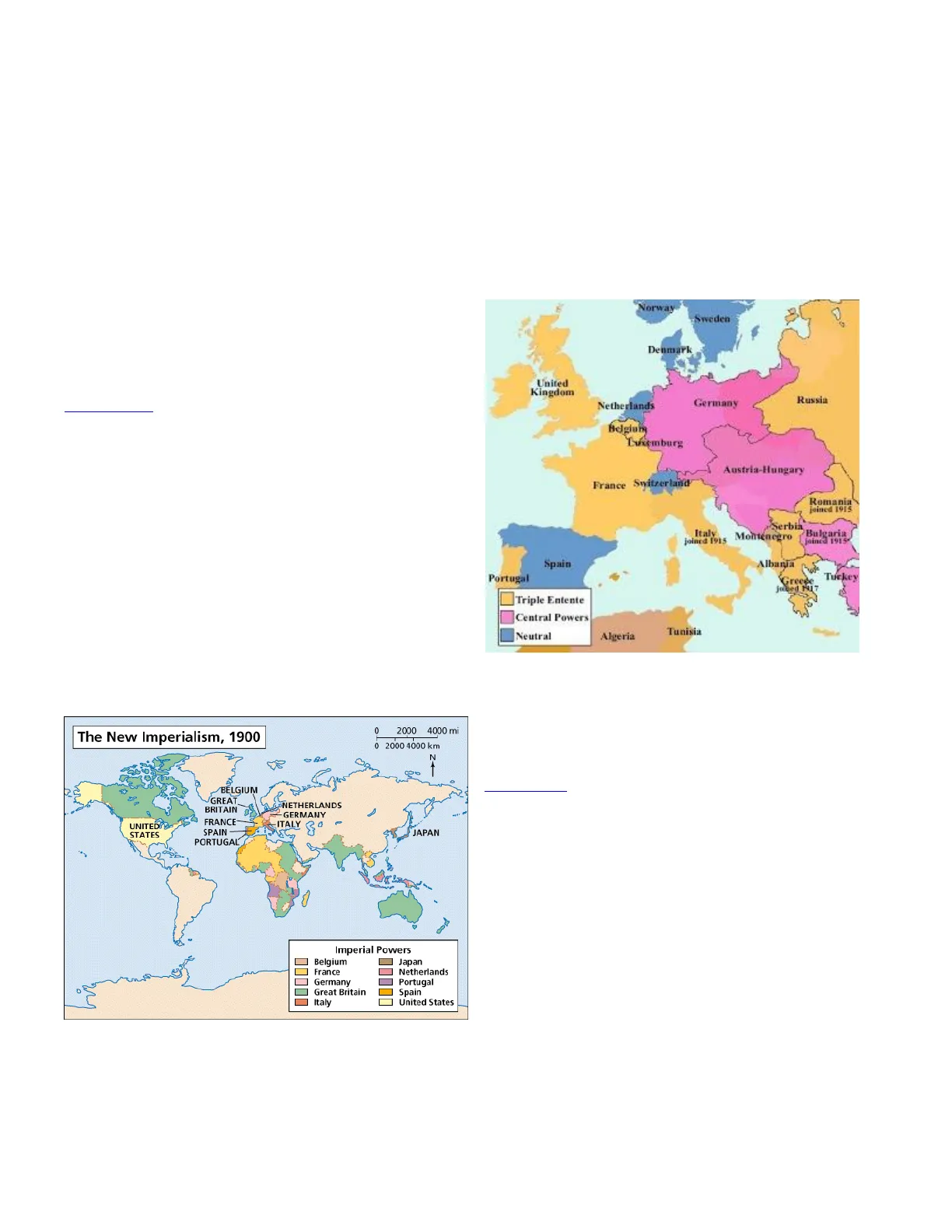
Mutual Defense Alliances
- Mutual Defense Alliances
Over time, countries throughout Europe made mutual
defense agreements that would pull them into battle.
These treaties meant that if one country was attacked,
allied countries were bound to defend them. Before
World War 1, the following alliances existed:
- Russia and Serbia
- Germany and Austria-Hungary
- France and Russia
- Britain and France and Belgium
- Japan and Britain
Norway Sweden Denmark United Kingdom Russin Netherlands Germany Belgium Luxemburg Austria-Hungary France Switzerland Romania joined 1915 Italy joined 1915 Bulgaria joined 1915 Spain Albania Turkey Portugal Greede jodued 1917 Triple Entente Central Powers Neutral Algeria
The New Imperialism, 1900 0 2000 4000 km N BELGIUM GREAT BRITAIN NETHERLANDS -GERMANY FRANCE- ITALY 30 UNITED STATES SPAIN PORTUGAL JAPAN Imperial Powers Belgium Japan France Netherlands Germany Portugal Great Britain Spain Italy United States
Imperialism as a Cause
- Imperialism Imperialism is when a country increases their power and wealth by bringing additional territories under their control. Before World War I, Africa and parts of Asia were points of contention among the European countries. This was especially true because of the raw materials these areas could provide. The increasing competition and desire for greater empires led to an increase in confrontation that helped push the world into WW I.
Tunisia 0 2000 4000 mi Serbia Montenegro
Militarism and Arms Race
- Militarism As the world entered the 20th century, an arms race had begun. By 1914, Germany had the greatest increase in military buildup. Great Britain and Germany both greatly increased their navies in this time period. Further, in Germany and Russia particularly, the military establishment began to have a greater influence on public policy. This increase in militarism helped push the countries involved into war.
FRANCE The Allies-"Onward to Victory"
Nationalism and Dominance
- Nationalism Much of the origin of the war was based on the desire of the Slavic peoples in Bosnia and Herzegovina to no longer be part of Austria Hungary but instead be part of Serbia. In this way, nationalism led directly to the War. But in a more general way, the nationalism of the various countries throughout Europe contributed not only to the beginning but the extension of the war in Europe. Each country tried to prove their dominance and power
Assassination of Archduke Franz Ferdinand
- Immediate Cause: Assassination of Archduke Franz Ferdinand The immediate cause of World War I that made the aforementioned items come into play (alliances, imperialism, militarism, nationalism) was the assassination of Archduke Franz Ferdinand of Austria-Hungary. In June 1914, a Serbian-nationalist terrorist group called the Black Hand sent groups to assassinate the Archduke. Their first attempt failed when a driver avoided a grenade thrown at their car. However, later that day a Serbian nationalist named Gavrilo Princip assassinated him and his wife while they were in Sarajevo, Bosnia which was part of Austria- Hungary. This was in protest to Austria-Hungary having control of this region. Serbia wanted to take over Bosnia and Herzegovina. This assassination led to Austria-Hungary declaring war on Serbia. When Russia began to mobilize due to its alliance with Serbia, Germany declared war on Russia. Thus began the expansion of the war to include all those involved in the mutual defense alliances.
Taken from About Education: The Top 5 causes That Led to World War !
World War I - Summary of Events
The Start of the War
The New York Times. HEIR TO AUSTRIA'S THRONE IS SLAIN WITH HIS WIFE BY A BOSNIAN YOUTH TO AVENGE SEIZURE OF HIS COUNTRY Francis Ferdinand Shot During State Visit to Sarajevo. THO ATTACKS IN A DAY A 0 Time by Knocking Andr & SLAIN IN SECOND ATTEMPT LIO 1D A SENVIAN PLOT NOCO EMPEROR IN STRICKEN ----- Slain by Assassin's Bullets.
The assassination of Austrian Archduke Franz Ferdinand (June 28, 1914) was the main catalyst for the start of the Great War (World War I). After the assassination, the following series of events took place:
- July 28 - Austria declared war on Serbia.
- August 1 - As Austria's ally, Germany declares war on Russia, an ally of Serbia
- August 3 - Germany declares war on France, an ally of Russia and immediately begins an invasion of neutral Belgium
- August 4 - Great Britain, an ally of France, declares war against Germany
- The United States (President Wilson) declares that the United States will remain neutral
The Western and Eastern Fronts
The first month of combat consisted of bold attacks and rapid troop movements on both fronts. In the west, Germany attacked first Belgium and then France. In the east, Russia attacked both Germany and Austria-Hungary. In the south, Austria-Hungary attacked Serbia. Following the Battle of the Marne (September 5-9, 1914), the western front became entrenched in central France and remained that way for the rest of the war. The fronts in the east also gradually locked into place.
NORHAY SWEDEN BALTIC SEA NORTH SEA DEN RUSSIAN EMPIRE J.K. 10 YPRES ATLANTIC OCEAN GERMANY FRANCE 1 ŚWITZ AUSTRIA - HUNGARY CASPIAN SEA PORTUGAL ROMANIA BLACK SEA SPAIN ITALY ADRIATIC SEA SERBIA BULGARIA GREECE OTTOMAN EMPIRE ........ PERSIA ..... A FRENCH NORTH AFRICA MEDITERRANEAN SEA Cyp339 (TK) EUROPE & THE NEAR EAST, OCTOBER 12-31, 1914
The Ottoman Empire's Entry
......THE OTTOMAN EMPIRE Late in 1914, the Ottoman Empire was brought into the fray as well, after Germany tricked Russia into thinking that Turkey had attacked it. As a result, much of 1915 was dominated by Allied actions against the Ottomans in the Mediterranean. First, Britain and France launched a failed attack on the Dardanelles. This campaign was followed by the British invasion of the Gallipoli Peninsula. Britain also launched a separate campaign against the Turks in Mesopotamia. Although the British had some successes in Mesopotamia, the Gallipoli campaign and the attacks on the Dardanelles resulted in British defeats.
Trench Warfare
The middle part of the war, 1916 and 1917, was dominated by continued trench warfare in the east. Both sides had built a series of trenches that went from the North Sea and through Belgium and France. Soldiers fought from dug-in positions, striking at each other with machine guns, heavy artillery, and chemical weapons. The land between the two enemy trench lines was called "No Man's Land." This land was sometimes covered with barbed wire and land mines. The enemy trenches were generally around 50 to 250 yards apart. Though soldiers died by the millions in brutal conditions, neither side had any substantive success or gained any advantage.
Trench Warfare A Front line trench Support treach C Reserve trench Artillery fire "softened up" resistance before an infantry attack. Enemy trench Communication trenches connected the three kinds of trenches. x2 Barbed wire entanglements C B "No Man's Land" (from 25 yards to a mile wide) A Dugout Sops were shallower trenches in "no man's land," allowing access to machine gun nests, grenade-throwing positions, and observation posts. D
United States' Entrance and Russia's Exit
THE UNITED STATES' ENTRANCE AND RUSSIA'S EXIT Despite the stalemate on both fronts in Europe, two important developments in the war occurred in 1917. In early April, the United States, angered by attacks upon its ships in the Atlantic, declared war on Germany. Then, in November, the Bolshevik Revolution prompted Russia to pull out of the war.
WAKE UP, AMERICA ! I WANT YOU FOR U.S. ARMY NEAREST RECRUITING STATION CIVILIZATION CALLS EVERY MAN WOMAN AND CHILD ! MAYOR'S COMMITTEE SO EAST 42" ST
The End of the War and Armistice
THE END OF THE WAR AND ARMISTICE Although both sides launched renewed offensives in 1918 in an all-or-nothing effort to win the war, both efforts failed. The fighting between exhausted, demoralized troops continued to plod along. In August - September, an Allied offensive along the Meuse River and through the Argonne Forest succeeded in driving an exhausted German army backward toward the German border. A deadly outbreak of influenza, meanwhile, took heavy tolls on soldiers of both sides. Eventually, the governments of both Germany and Austria-Hungary began to lose control as both countries experienced multiple mutinies from within their military structures. On November 11, 1918, the Germans signed an armistice in which they agreed to surrender their arms, give up much of their navy, and evacuate occupied territory.
Regular Edition! 3:45 p. m. Third Edition! THE BRAINERD DAILY DISPATCH BRAINERD, MINNESOTA MONDAY, NOVEMBER ER, ERIR ARMISTICE IS SIGNED GERMANY SURRENDERS Washington, Nov. 11, 2:30 a. m .--- Government at Washington officially announced the signing of the armistice by Germany, which occurred at 5:00 a.m. Paris time. Hostilities ceased at 11 a. m. News from Washington flashed to St. Paul 30 seconds after announcement was made. American Boys Delighed Laughed and Sang President Reads Armistice Terms "America Gains All She Fought For." PRESIDENT WOODROW WILSON Washington -. President Wilson to-day issued the following procla- mation: My fellow countrymen the armistice was signed this morning. Everything for which America fought has been accemodel wen accomplished. It will now be car fortunate So quist by example. . .... ..... example, by sober friendly counsel and by material sid in the establish of Just democracy throughout the world, Signed, WOODROW WILSON, Proddent.
Can’t find what you’re looking for?
Explore more topics in the Algor library or create your own materials with AI.