Changing Perspective in the Environment: Environmental Economics
Document from University about Changing Perspective in the Environment. The Pdf explores environmental economics, covering historical events, key principles like externalities, and sustainability. It is suitable for university students studying Economics.
See more35 Pages


Unlock the full PDF for free
Sign up to get full access to the document and start transforming it with AI.
Preview
Overview of Environmental Issues
Over the past five decades, we have become increasingly aware of environmental problems at the local, national, and global levels. Attention to environmental issues has a long history, but in the modern period perceptions of an environmental crisis began in the 1960s. In 1970, the Environmental Protection Agency was created in the United States to respond to what was at that time a relatively new public concern with air and water pollution. In 1972, the first international conference on the environment, the United Nations Conference on the Human Environment, met in Stockholm. Since then, growing worldwide attention has been devoted to environmental issues.
Important Events in Modern Environmental History
1962: The publication of Rachel Carson's Silent Spring, widely recognized as the catalyst of the modern environmental movement, details the dangers posed by excessive pesticide use. 1970: The creation of the Environmental Protection Agency by President Richard Nixon. Also, over 20 million participate in the first Earth Day on April 22. 1972: The creation of the United Nations Environment Programme (UNEP), headquartered in Nairobi. 1992: The Rio Declaration on Environment and Development recognizes "the integral and independent nature of the Earth, our home" and lists 27 principles of sustainable development including reducing global inequities, international cooperation, and the promotion of an economic system that addresses environmental problems. 1997: The Kyoto Protocol is negotiated, the first international treaty that commits ratifying nations to reduce their greenhouse gas emissions. Although rejected by the United States, the treaty was ratified by 191 nations and entered into force in 2005. 2015: The Paris Agreement on climate change, approved by 195 countries, calls for a "global peaking of greenhouse gas emissions as soon as possible" with a goal of "holding the increase in global average temperature to well below 2℃ above pre-industrial levels." Over 150 countries submit plans to limit their greenhouse gas emissions. 2021: The global economic slowdown because of the COVID-19 pandemic leads to a significant reduction in air pollution and carbon emissions. The International Energy Agency announces that, for the first time, solar energy is the world' s cheapest energy source. In 2021, however, global fossil fuel use and emissions rise again with economic recovery.
Economic Approaches to the Environment
Environmental economists apply mainstream economic principles to environmental and natural resource issues. Starting around 1980, ecological economics emerged as a field which brings together viewpoints from different academic disciplines to study the interactions between economic and ecological systems. Eco-logical economics is defined by the analysis of economic activity in the context of the biological and physical systems that support life, including all human activities.
Main Principles of Environmental Economics
Environmental economics is based on the application of several mainstream economic theories and principles to environmental issues. We can identify four concepts:
- The theory of environmental externalities.
- The optimal management of common property and public goods.
- The optimal management of natural resources over time.
- The economic valuation of environmental goods and services.
Core Concepts of Ecological Economics
The core concepts in ecological economics are three:
- The economic system is a subset of the broader ecological system.
- Sustainability should be defined according to ecological, rather than economic, criteria.
- It is essential to rely upon a range of academic disciplines and perspectives, in addition to economics, to provide insight into environmental issues.
These core concepts have implications both for how economic analysis is con-ducted and for policy recommendations.
Principles of Ecological Economics
The Economic System in an Environmental Context
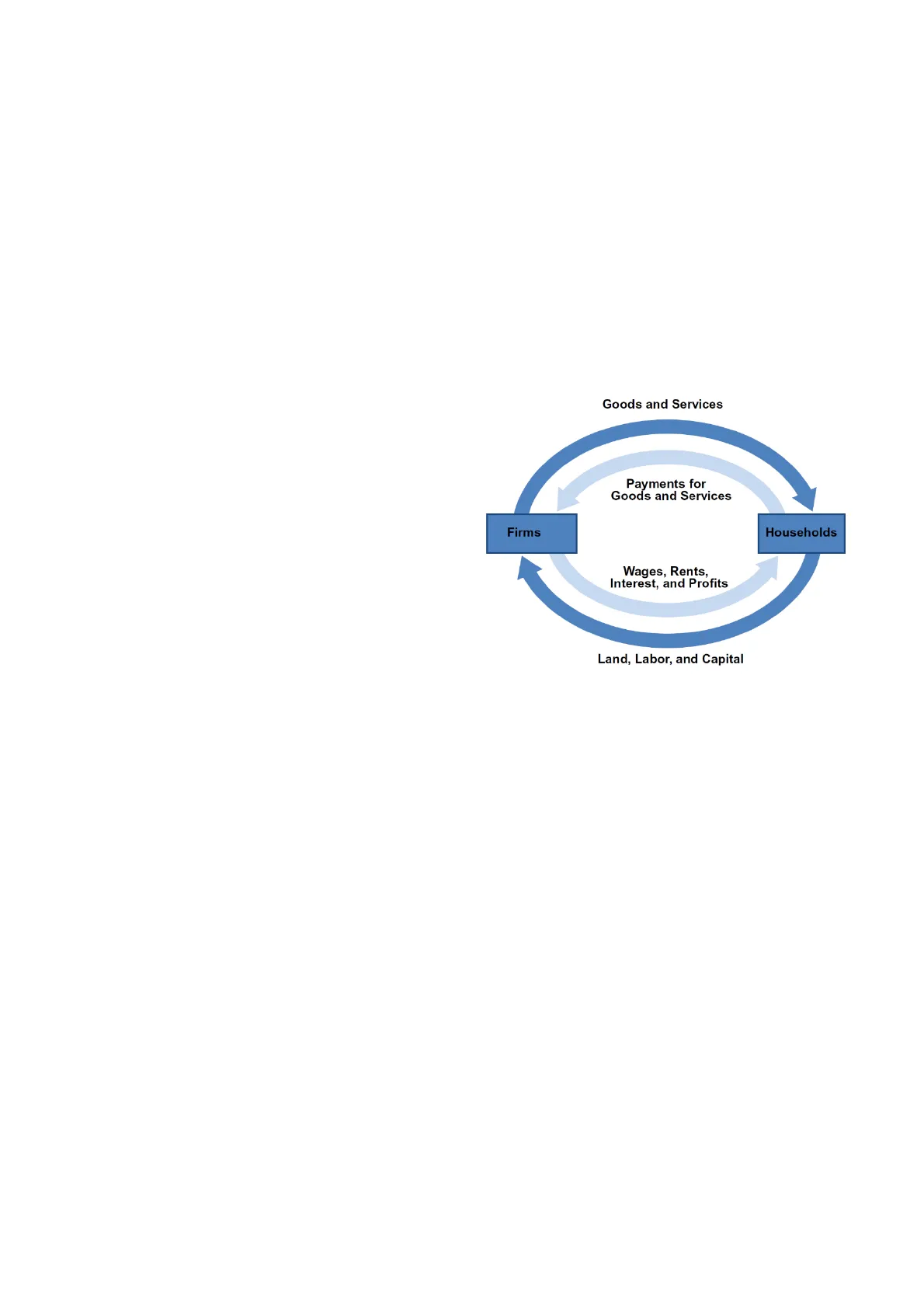
Ecological economics involves an effort to broaden perspectives beyond standard economics. A basic building block of mainstream economic theory is the standard circular flow model of an economic system. As illustrated in Figure 1.1, the model depicts the relationships between households and business firms in two markets: the market for goods Goods and Services and services and the market for factors of production. Factors of production are generally defined as land, labour, and capital. The services Payments for Goods and Services that these factors provide are "inputs" into the production of goods and services, which in turn Firms Households provide for households' consumption needs. Wages, Rents, Interest, and Profits Natural resources fall under the inclusive category of "land." The two other major factors of production, labour and capital, continually regenerate through Land, Labor, and Capital the economic circular flow process. Ecological economists place particular emphasis on a broader circular flow model that considers ecosystem processes as well as economic activity.
Natural resources include:
- renewable resources: resources that are regenerated over time through ecological processes, such as forests and fisheries, but can be depleted through exploitation.
- Non-renewable resources: resources that do not regenerate through ecological processes, at least on a human time scale, such as oil, coal.
Defining Sustainability
Sustainable development was first defined in 1987 by the United Nations' Brundtland Commission. The Commission published Our Common Future, a report on the environment and economic development. The report is generally recognized as coining the term sustainable development and defining it as "development that meets the needs of the present without compromising the ability of future generations to meet their own needs."
The Commission defines sustainability based on the criterion of meeting human needs across time. An alternative, more ecologically oriented approach would define sustainability on the basis on maintaining appropriate levels of natural resources and ecological functions. In fact, some ecological economists believe that sustainability should be defined solely based on ecological, rather than human, factors.
Other Differences between Environmental and Ecological Economics
Environmental economists often attempt to place monetary values on environmental goods and services.Ecological economists are more likely to acknowledge the inherent value of nature. Inherent value derives from ethics, rights, and justice, rather than human willingness to pay. When market failures occur, environmental economists tend to advocate policies that create economic incentives for behavioural changes, such as taxes and subsidies.
Resources, Environment and Economic Development
Overview of Economic Growth
The advent of market economies and rapid technological progress, centred in Western Europe, altered this pattern dramatically. Population in Europe entered a period of rapid growth that led the British classical economist Malthus to theorize that population would out-grow food supplies, keeping the mass of people perpetually at a subsistence standard of living. History has proved the simple Malthusian hypothesis wrong.
Measuring Growth Rates
GDP is defined as the market value of final goods and services produced within a country's borders over a specified time period, usually a year. A country's GDP can grow over time due to changes in two factors: population and per capita (or per- person) GDP:
GDP = (population) x (per capita GDP)
We can then define in terms of growth rates the relationship among the GDP growth rate, the population growth rate, and the per capita GDP growth rate:
GDP growth rate = (population growth rate) + (per capita GDP growth rate)
To correct for the effects of inflation, we should use real GDP rather than nominal GDP in this equation.
Factors Essential to Economic Growth
The ecological economics perspective focuses on three other factors as essential to economic growth:
- energy supply: Europe's economic growth in the 18 and 19 centuries depended heavily on coal as an energy source, and some writers at the time expressed concern that coal supplies might run out.
- Supplies of land and natural resources: ecological economists prefer the term natural capital to refer more broadly to the natural endowment of land and resources, including air, water, soil, forests, minerals. All economic activities require some natural capital to provide raw materials.
- Absorptive capacity of the environment to assimilate wastes and pollution: this issue is not so critical when the scale of economic activity is small relative to the environment. But as national and global economic activity accelerates, the flow of waste products increases and may threaten to overwhelm environmental systems. Flows of solid wastes, sewage and liquid wastes, toxic wastes, all pose specific environmental problems that require local, regional, and global solutions.
Economic Growth in Recent Decades
Figure 2.1 tracks the history of several key variables since the 1960s. All variables are indexed to 1961, meaning that the value of each variable is scaled to equal 1.0 in 1961, and then the value for future years is expressed relative to the 1961 value. The trends tell a clear story that significant economic progress has been made over the last 60 years. The growth rates for food production, economic production, and energy use have all been greater than the rate of population growth. 8 7 6 Index (1961=1) 5 4 3 2 1 0 1960 1965 1970 1975 1980 1985 1990 1995 2000 2005 2010 2015 2020 -Population -- Food Production - - Gross World Product -- Energy Figure 2.1 Growth in Population, Food Production, Economic Production, and Energy Use, 1961-2019Thus, relative to 1961, the average person has access to more food, more economic production, and more energy. Other measures of human well- being over this period also indicate positive global trends. For example, life expectancy increased from 53 to 72 years over this period. Figure 2.1 presents average results for the entire world. But economic and social conditions can vary tremendously across countries.
The data in Figure 2.2 demonstrate the extent of global economic inequality. But the results also suggest that we may need to consider the relationship 50,000 between economic development and the 45,000 environment differently in developed versus 40,000 developing countries. Economic growth has 35,000 30,000 been substantial in high and middle income 25,000 countries. GDP per Capita, 2010 US Dollars 20,000 Can such growth continue without depleting 15,000 important categories of natural capital or 10,000 overloading the absorptive capacity of the 5,000 environment? For low- income countries, is there 0 2020 1960 1970 1980 1990 2000 2010 a relationship between their very low average Low -- Middle -High growth rates and the environment? Figure 2.2 Economic Growth, 1961-2019, by Country Income Category In the last few decades, economists have explored the resource curse hypothesis (countries or regions with abundant natural resources grow more slowly than those where natural resources are scarcer). Numerous explanations have been proposed for this effect, including the high volatility of natural resource prices, the possibility for corruption, and violence from competition for access to resources. But the resource curse hypothesis is not universally accepted, as subsequent analyses both supported and refuted the hypothesis.
Environmental Trends in Recent Decades
Every several years UNEP publishes Global Environmental Outlook (GEO) reports that assess global environmental conditions and document trends. The GEO-6 report of 2019 includes separate chapters on five main categories of environ-mental impacts:
- Air: trends in emissions into the atmosphere can be broadly classified into two categories: greenhouse gases and air pollutants. The primary greenhouse gas is carbon dioxide (CO2). Figure 2.3 shows the global emissions of CO2 since the 1960s, with emissions steadily rising through 2018. But looking at the data in Figure 2.3 by income group 40 tells a more informative story: - the carbon emissions of the world's poorest countries are negligible. - Most global emissions were attributed to the high income countries. Before 2000, more than half of global emissions were from high- income countries. Since then, emissions from high- income countries have decreased, by over 5%. 35 Million Tons of Carbon Dioxide 30 25 20 15 10 5 0 1960 1970 1980 1990 2000 2010 2020 Low -- Lower Middle Upper Middle -- High -World - The rapid increase in emissions is from middle Figure 2.3 Global Carbon Dioxide Emissions, 1960-2018, by Country Income Category income countries. The trends for other air pollutants offer a mix of policy successes and ongoing challenges. Data on major outdoor air pollutants, including sulphur dioxide (SO2), nitrogen oxides (NOx), and volatile organic compounds (VOC), find that global emissions increased significantly from 1940 to 1980. But from 1980 to 2010, emissions of SO2 declined by about 20%. The trends differ between developing and developed countries.
Can’t find what you’re looking for?
Explore more topics in the Algor library or create your own materials with AI.
