Inhalation Therapy: Drug Delivery, Barriers, and Pulmonary Defense Systems
Slides from University of Portsmouth about Inhalation Therapy (Lecture 1). The Pdf explores therapeutic inhalation, highlighting benefits of inhaled drug administration and barriers to efficacy. The Pdf describes bronchioles and alveoli anatomy, gas exchange, and pulmonary defense systems.
See more36 Pages


Unlock the full PDF for free
Sign up to get full access to the document and start transforming it with AI.
Preview
Inhalation Therapy Overview
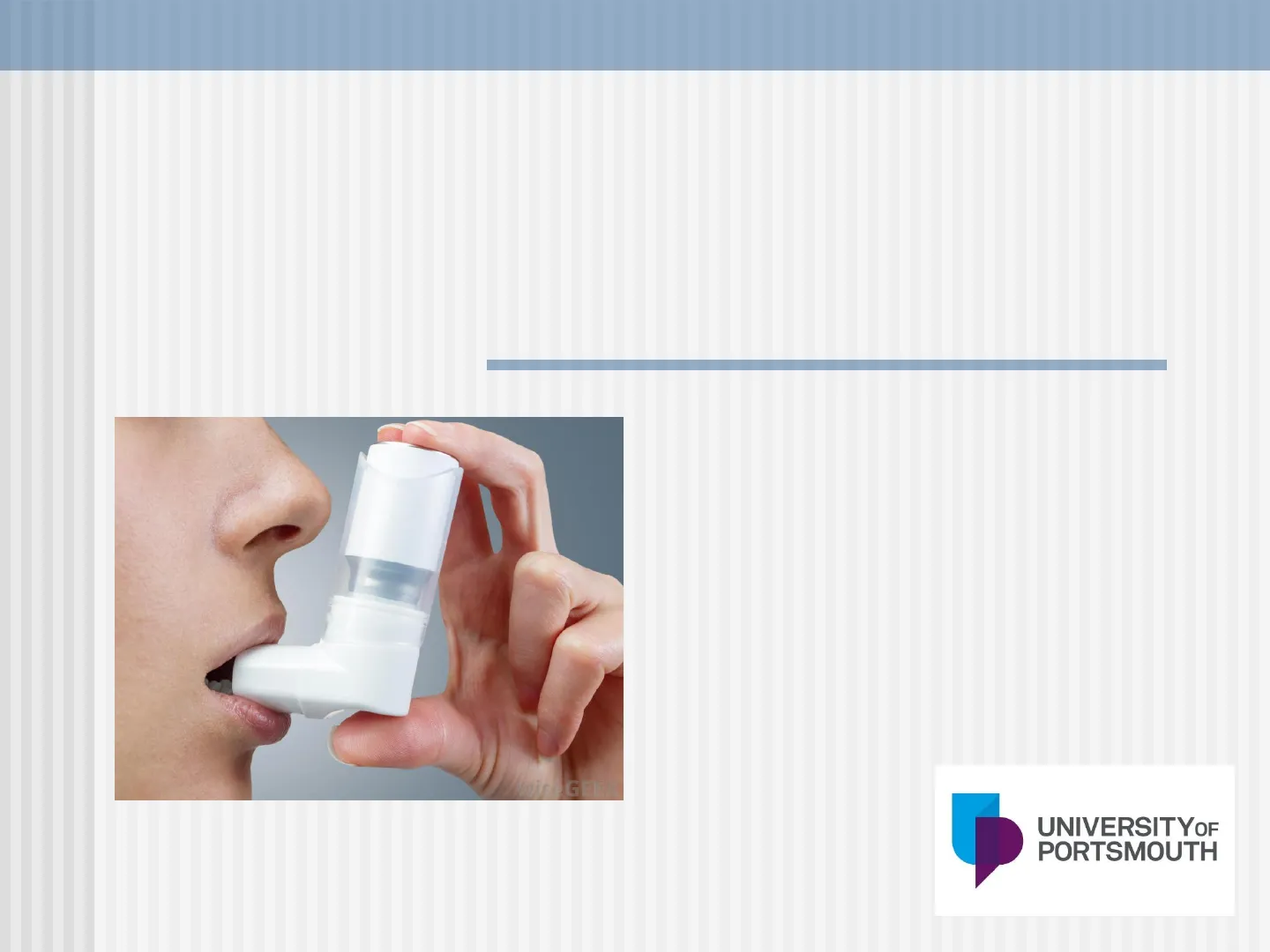
Inhalation Therapy (Lecture 1) wiseGEEK Professor Paul Cox School of Pharmacy & Biomedical Sciences UNIVERSITYOF PORTSMOUTHInhaled Drug Delivery
Benefits of Inhaled Drug Delivery
- Rapid onset of Activity
Smaller doses (fewer side effects) " Good where a drug is poorly absorbed orally Avoidance of first-pass metabolism (hepatic)Human Respiratory System
Human Respiratory System Anatomy
Nasal cavity Pharynx Larynx Bronchioles Trachea Lungs Bronchi Alveoli DiaphragmThe Respiratory System
Inhaled air passes through the nasal cavity and the pharynx, past the epiglottis to the trachea. Key role of the nasal cavity is to act as a filter to prevent the entry of large particles. Also warms and humidifies the airstream. F ST SS T SR A IT ET F ST E- 0 SM T MM S MBronchi & Bronchioles
On passing through the trachea, air enters the lungs via the bronchi, bronchioles and alveoli. Bronchi walls contain rings of cartilage, interspersed throughout smooth muscle. Inner surface lined with cilia. These assist in the upward and outward movement of unwanted particles. Right lung Left lungBronchioles & Alveoli
Bronchioles are narrow versions of bronchi, usually less than 1mm in diameter. Bronchioles repeatedly branch to form terminal bronchioles. The terminal bronchi divide into respiratory bronchioles, which possess outgrowths, the alveoli. These are the sites of gaseous exchange. Alveolar Sacs Pulmonary Artery Alveoli Bronchiole Pulmonary VeinALVEOLAR EPITHELIUM (TYPE | CELLS) ALVEOLAR LUMEN Capillar CO2 2 ENDOTHELIUM FUSED BASAL LAMINA 2 ERYTHROCYTE PULMONAR CAPILLARY LUMEN ALVEOLAR/CAPILLARY BARRIER
Desired site of of action is bronchioles & alveoli.Defence Systems & Difficulties
Barriers to Drug Delivery
Defence Systems and Particle Kinetics
Defence Systems . mucociliary clearance system Particle kinetics
Compromised Airways & Lungs
-
Compromised Airways & Lungs · alteration of angles in airways · constriction & narrowing · obstruction
-
inflammation . loss of elasticityParticle Kinetics
Particle deposition in respiratory tract. Governed by three mechanisms Inertial impaction · particles greater than 5 micrometres diameter · Sedimentation · particles greater than ~1 - 5 micrometres diameter · Diffusion · particles less 0.5 - 1 micrometre diameter Smaller particles than this are usually exhaled.Particle Deposition In Respiratory Tract
Three mechanisms of aerosol kinetics govern the majority of particle deposition within the respiratory tract. Inertial impaction 3 Diffusion 9% 90% 1% Trachea Bronchi Direction of flow IMPACT Bronchioles IMPACT IMPACT Canday Medical LimitedParticle Kinetics - significance
Significance of Particle Kinetics
Significance Manipulate particle size to control site of deposition Importance of particle size for maximum deposition of drug "Particles > 5 microns unlikely to reach lungs - no use systemic delivery Particles less than 0.5 microns are likely to be exhaledFactors Affecting Deposition
Factors Affecting Particle Deposition
-
Mode of inhalation ◼ inhaled volume (deep breathing) · flow rate breath holding pause maintained at end of inspiration
-
Compromised system (COPD etc) Aerosol properties " aerodynamic diameter Humidity of respiratory tract affects particle size
-
(hygroscopic) ◼ Aerosol formulationAerosol Deposition at varying Particle Size
I cron size Deposition 10 Nasal Cavities Pharynx Pharynx, larynx & Upper respiratory tract Larynx Trachea Bronchus 5 Optimal tracheobronchial deposition lung 2 Optimal alveolar deposition 0.5 Particles exhaled if <0.5 micron 0Methods of Delivery
Methods of Drug Delivery
An aerosol is a colloidal dispersion of liquid or solid in a gas. This is the primary method of delivery to the lungs.VICKS
Inhalations
-
Inhalations · Solutions or suspensions of one or more active ingredients that when vaporised are intended to be brought into contact with the lining of the respiratory tract.
-
Used to relieve congestion and inflammation of the respiratory tract.
-
Some are volatile at room temperature and may be inhaled from a handkerchief an inhaler device or a fabric face mask.
-
Others are added to hot but not boiling, water (About 64 ºC is suitable) and the vapour is inhaled for about 10 minutes. Examples include propylhexedrine (a decongestant) or Eucalyptus oil (relief or catarrh / decongestant)Vitrellae
Vitrellae
AMYL NITRITE INHALANT IDHALANT BAYL NITRITE · Thin walled glass capsules containing a volatile medicament. . They are protected by a suitable wrapping. . They are intended for use by crushing the glass and inhaling the vapour. · Example: amyl nitrite used to treat angina.Inhalation Aerosols
Inhalation Aerosols Categories
Three main categories: "Metered Dose Inhalers Dry Powder Inhalers NebulizersMetered Dose Inhalers (MDI)
Metered Dose Inhalers (MDI)
MDI Device Characteristics
MDI Inhaler ◼ Used for over 60 years ◼ Most commonly used device ◼ Pressurised inactive gas used to propel medicine in each puff. Also, a surfactant is usually included. ◼ Sometimes referred to as a Pressured Metered Dose Inhaler (PMDI)MDIS
MDI Container and Propellant
Generally aluminium containers used. ◼ (alternatives: tin plated steel, plastic coated glass) ◼ Propellant formerly CFC-based. ◼ Now HFAs used (hydrofluoroalkanes) ◼ 200 doses. Usually no indication how many does left (or if dose has been taken). 196MDI
MDI Schematic Diagram
Schematic Diagram Canister Drug Suspension Actuator Oral Tube Metering Valve Actuator Seat Actuator OrificeMDI
MDI Mode of Operation
- Mode of Operation ◼ Drug is dissolved or suspended in propellant (and other excipients) ◼ Contents are in a pressurized canister fitted with metering valve. ◼ Dose is released as a spray on actuation, ◼ Formulation expands as mixture of gas and liquid. High speed gas helps to break liquid into fine spray.Metering Valve
MDI Metering Valve
Blind End Metering Chamber Opening for emptying of metering chamber Valve Stem Opening to Actuator SeatMetering Valve
Reproducible delivery of 25-100 uL Depression of valve stem activates discharge through opening. After actuation, metering chamber re-fills from bulk. Must be primed for use. Slight modifications needed for HFAS.Formulation of MDIS
MDI Formulation
Solution (two phase) or suspension. Propellants are poor solvents even with cosolvents (e.g. ethanol) Practical formulations are usually suspensions. Evaporation rate of propellant affects droplet size. E.g. Smaller droplets for HFA vs CFC.Advantages of MDIS
Advantages of MDIs
Low cost Portability Disposibility Reproducible dose delivery Inert conditions provide protection from oxidation/microbiological contamination.Disadvantages of MDIS
Disadvantages of MDIs
Inefficient drug delivery method. 10-15% reaches the lungs. ~ High velocity droplets hit back of throat. (80% without spacer device). Droplet size too large for deep lung deposition (40 uL). Poor patient compliance.MDI
Correct MDI Usage
Correct usage 1 Sit straight or stand up. Lift up chin (open airways) 2. Remove cap and shake vigorously (Drug/propellant usually suspension) 3. Spray into air first if new or not used for a while (Priming/filling valve)MDI
Correct Usage 4. Breathe deeply - breathe out - place mouthpiece over lips and seal around mouthpiece. 5. Breathe in slowly and simultaneously press on the canister to release. Only press once. Timing important. 6. Continue to breathe deeply (to ensure medicine gets in lungs) 7. Hold your breath for 10 seconds, or as long as possibleMDI
Correct Usage 8. If you need to take another puff, wait for 30 seconds, shake inhaler again, repeat steps (4-7) 9. Replace the cap on the mouthpiece. 10. Rinse mouth (80% of drug goes to oropharynx) MDIs are much more effective and easier to use with a spacer device.Tail Off - MDI inhalers
MDI Dose Reliability
Many users try to squeeze the last drops from their inhaler. Dose reliability `tails off' as the inhaler reaches its empty stage. Should not be used beyond labelled doses, even if some medication remains.Spacer Devices
Spacer Devices
Spacer Device Components
Canister Mouthpiece Mask Actuator One way valve Some spacers have a built-in 'whistle'. This is to help prevent the patient breathing in too fast through their spacer device.Advantages of Spacer Devices
Advantages of Spacer Devices
Better deposition of drug in lungs (~20%) - droplet velocity reduced, propellant evaporation increased. Actuation/inhalation coordination not necessary. Less drug in throat (~15% instead of 80%)Disadvantages of spacers
Disadvantages of Spacer Devices
Cumbersome to carry around. Patient compliance Spacer should be rinsed with water/detergent once a month and left to drain. Replaced every 6-12 months. Wait 30 seconds between puffs. Droplets stick together and to sides of spacer - leads to smaller dose.Breath Activated MDIs
Breath Activated MDIs
e.g. Easi-Breathe inhaler. .Releases a dose of medication when the patient inhales. .Opening the cap compresses a spring inside the device which pushes down on the canister. When the user breathes in, this releases the mechanism so the spring operates the can. .Significant aid for those who have difficulties with co- ordination (young/old). 3M's Autohaler is another example of a BOISummary (Lecture 1
Summary of Lecture 1
Pulmonary Drug Delivery and Particle Size
-
The pulmonary route is very attractive for drug delivery - particularly for conditions associated with the lungs.
-
Particle size is extremely important in influencing how far down the respiratory tract a particle will travel.
-
In order to exert a therapeutic effect, particles must deposit on the respiratory tract. There are three key deposition mechanisms :-
- Inertial Impaction
- Gravitational Sedimentation
- Diffusion
-
Aerosols are usually used to deliver drugs to the respiratory tract.
- Metered Dose Inhalers are a popular choice of drug delivery device, however they are inefficient.Summary (Lecture 1)
MDI Effectiveness and Spacer Devices
-
Understanding the formulation and deposition mechanisms for particles help us to understand how to use MDI inhalers most effectively
-
Spacer Devices considerably reduce the amount of drug that hits the back of the throat.
- Breath Activated MDIs are particularly useful for patients how have difficulty coordinating their breathing with actuating their inhaler.
Can’t find what you’re looking for?
Explore more topics in the Algor library or create your own materials with AI.
