Problematizing Bilingual Education: Principles, Types, and Measurement
Slides from Universidad Santo Tomas about Problematizing Bilingual Education: Principles, Types, and Measurement. The Pdf explores bilingual education, discussing the implications of ideologies in language testing and their consequences. This university-level material in Languages provides an academic overview of linguistic evaluation.
See more62 Pages


Unlock the full PDF for free
Sign up to get full access to the document and start transforming it with AI.
Preview
Problematizing Bilingual Education
25/10/21 18:48 PROBLEMATIZING BILINGUAL EDUCATION UNIVERSIDAD SANTO TOMAS PRIMER CLAUSTRO UNIVERSITARIO DE COLOMBIA VIGILADA MINEDUCACIÓN - SNIES 1704
Tensions and Trends in Bilingual Education
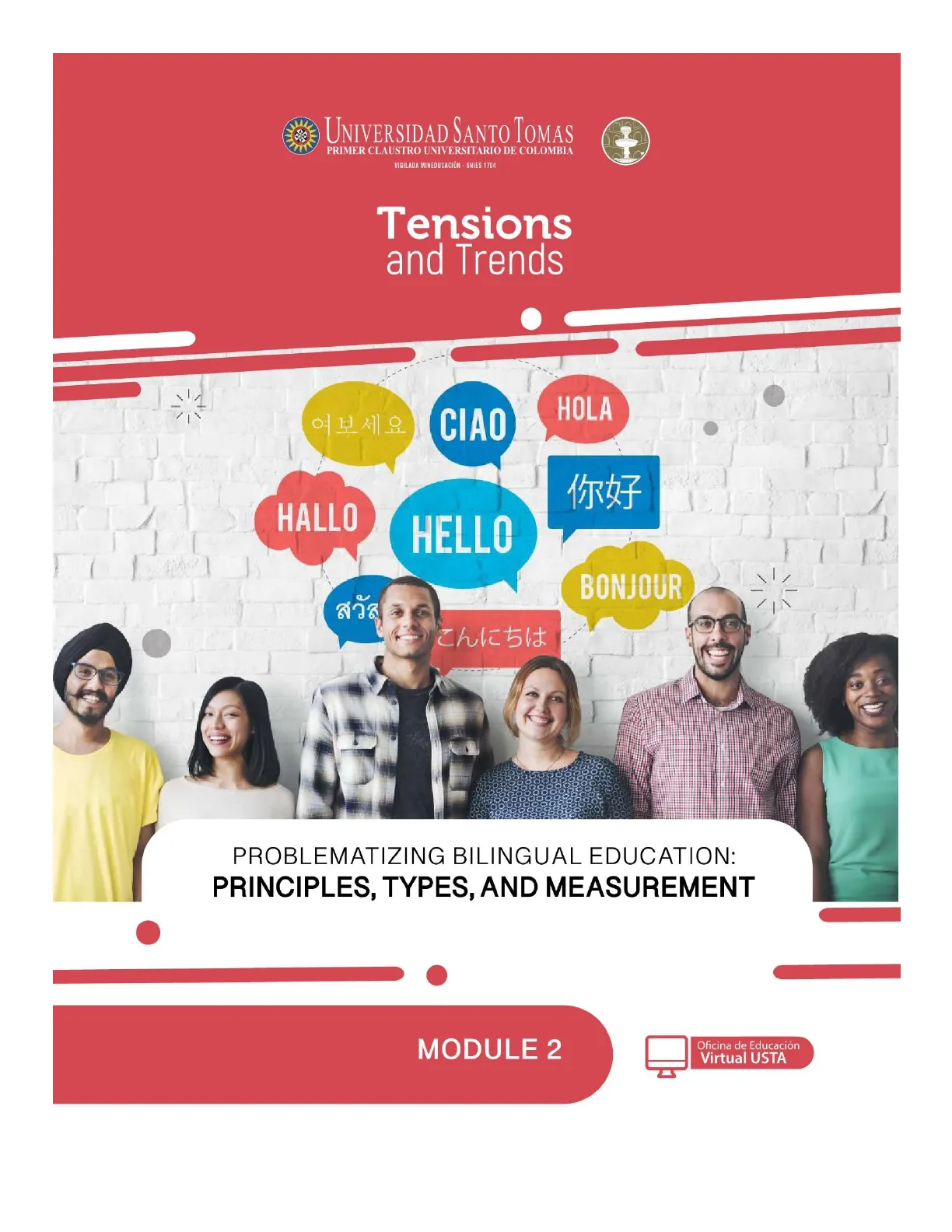
HOLA 여 보 세 요 CIAO 你 好 HALLO HELLO BONJOUR สวัส こ ん に ち は
PROBLEMATIZING BILINGUAL EDUCATION: PRINCIPLES, TYPES, AND MEASUREMENT MODULE 2 Oficina de Educación Virtual USTA https://online.fliphtml5.com/qxsv/ailg/#p=1 1/6225/10/21 18:48 PROBLEMATIZING BILINGUAL EDUCATION https://online.fliphtml5.com/qxsv/ailg/#p=1 2/6225/10/21 18:48 PROBLEMATIZING BILINGUAL EDUCATION UNIVERSIDAD SANTO TOMAS PRIMER CLAUSTRO UNIVERSITARIO DE COLOMBIA VIGILADA MINEDUCACIÓN - SNIES 1704
Module 2: Tensions and Trends in Bilingual Education
MODULE 2 PROBLEMATIZING BILINGUAL EDUCATION: PRINCIPLES, TYPES, AND MEASUREMENT AUTHOR M.A. LEIDY YISEL GÓMEZ VÁSQUEZ Oficina de Educación Virtual USTA https://online.fliphtml5.com/qxsv/ailg/#p=1 3/6225/10/21 18:48 PROBLEMATIZING BILINGUAL EDUCATION
Universidad Santo Tomás Leadership
DIRECTIVOS UNIVERSIDAD SANTO TOMÁS Fr. José Gabriel MESA ANGULO, O.P Rector Fr. Eduardo GONZÁLEZ GIL, O. P. Vicerrector Académico General Fr. Wilson Fernando MENDOZA RIVERA, OP. Vicerrector Administrativo y Financiero General Fr. Javier Antonio CASTELLANOS, O. P. Decano de División de Educación Abierta y a Distancia Pedro Antonio Vela González Decano de Facultad de Educación
Author and Production Team
AUTOR DISCIPLINAR Maestría en Ambientes Bilingües de Aprendizaje - MABA Departamento de Humanidades y Formación Integral 30 de septiembre de 2020 Tensions and Trends Part 3: Envisioning bilingualism and bilingual education: society, culture and identity Autor: Leidy Yisel Gómez Vásquez ASESORÍA Y PRODUCCIÓN Mg. Carlos Eduardo Alvarez Martínez Coordinador Oficina de Educación Virtual Mg. Wilson Arley Sánchez Pinzón Asesor tecnopedagógico, corrector de estilo y diseñodor instruccional Prof. Diego Fernando Jaramillo Herrera Diseñador gráfico Oficina de Educación Virtual Universidad Santo Tomás Sede Principal - Bogotá https://online.fliphtml5.com/qxsv/ailg/#p=1 4/6225/10/21 18:48 PROBLEMATIZING BILINGUAL EDUCATION Universidad Santo Tomás
Instructional Analysis - Module 2
PROBLEMATIZING BILINGUAL EDUCATION: PRINCIPLES, TYPES, AND MEASUREMENT https://online.fliphtml5.com/qxsv/ailg/#p=1 5/6225/10/21 18:48 PROBLEMATIZING BILINGUAL EDUCATION Universidad Santo Tomás INSTRUCTIONAL ANALYSIS (Content synthesis) - Module 2
Welcome 2 Themes map 3 learning objectives 4 Core problem 5 Problematic questions 5 1. Bilingual education definitions and categories (Introduction) 6 Defining bilingual education and its purposes 7 A classification of bilingual education 9 Challenges for bilingual education 13 Conclusions 14 2. How bilingualism is assessed in educational contexts(Introduction) 16 Language tests objectives and types 17 Language testing constrains 19 Socio-political views of language tests 21 Critical language testing in the educational context 23 The power of tests 25 The consequences of imposed ideologies on language testing 26 Conclusions 27 Pages Module 2 https://online.fliphtml5.com/qxsv/ailg/#p=1 6/6225/10/21 18:48 PROBLEMATIZING BILINGUAL EDUCATION Universidad Santo Tomás
3. Bilingual education standards and practice (Introduction) 29 Language policies description 30 Language policies: what research establishesprofessional growth 32 The effects of language policies on daily life 35 Conclusion 37 4, Bilingual education standards and practice (Introduction) 39 The role of bilingual education for employability 40 Tourism as a challenge for bilingual education 41 Technology and media for bilingual education 43 The relation between economy and bilingual education 45 Conclusions 46 Learning activity 47 Conclusions 48 Glossary 49 Bibliography 50 Pages Module 2 https://online.fliphtml5.com/qxsv/ailg/#p=1 7/6225/10/21 18:48 PROBLEMATIZING BILINGUAL EDUCATION Universidad Santo Tomás
1. F Module 2 https://online.fliphtml5.com/qxsv/ailg/#p=1 8/6225/10/21 18:48 PROBLEMATIZING BILINGUAL EDUCATION Universidad Santo Tomás
Welcome to Module 2
D WELCOME Dear student in the present unit you will get to know some purposes of bilingual education in an effort to define it. You will also understand models of bilingual education, as well as, challenges it entails. Later on, you will get familiar with purposes, types and limitations of language testing. Additionally, a critical socio-political view of language examination, reasons for the power of language testing and consequences of hidden agendas will be explained. To continue, the role of policies formulation and application will be introduced by explaining some definitions, dimensions, objectives and effects. Finally, you will get familiar with contexts that are linked to the practice of bilingualism such as employability, tourism, mass media and economy. As each topic is covered you are expected to develop a learning activity to assess your progress and understanding. Be ready to learn and participate actively. Module 2 2. https://online.fliphtml5.com/qxsv/ailg/#p=1 9/6225/10/21 18:48 PROBLEMATIZING BILINGUAL EDUCATION Universidad Santo Tomás
Themes Map for Bilingual Education
ITHEMES MAP
- Bilingual education definitions and categories.
- How bilingualism is assessed in educational contexts.
Problematizing Bilingual education: principles, types, and measurement.
- Bilingual education standards and practice.
- Linking bilingual education with society: the applicability of what is learnt.
3. Module 2 https://online.fliphtml5.com/qxsv/ailg/#p=1 10/6225/10/21 18:48 PROBLEMATIZING BILINGUAL EDUCATION Universidad Santo Tomás
Learning Objectives for Bilingual Education
LEARNING OBJECTIVES
- Identify the types of bilingual education and their implications.
- Determine critically through the evaluation of some tests the tensions that emerge in bilingual education from the standardization of bilingualism assessment.
- Approach an initial understanding of the tensions derived from policies creation in bilingual education.
Module 2 4. https://online.fliphtml5.com/qxsv/ailg/#p=1 11/6225/10/21 18:48 PROBLEMATIZING BILINGUAL EDUCATION Universidad Santo Tomás
Core Problem and Questions
CORE PROBLEM Taking into account that bilingual education is ambiguous and gives special relevance to monolingual environments , it is necessary to study concepts and types of bilingual education, critically inspect and compare some bilingual tests, make an initial contact with educational policy creation and execution and think of the practical application of bilingual education. ? PROBLEMATIC QUESTIONS
- How to comprehend the types of bilingual education and its implications?
- How is bilingualism measured around the globe and how can students critically analyze some instruments to do so?
- How do the tensions derived from policies creation influence bilingual education?
Module 2 5. https://online.fliphtml5.com/qxsv/ailg/#p=1 12/6225/10/21 18:48 PROBLEMATIZING BILINGUAL EDUCATION Universidad Santo Tomás
Bilingual Education Definitions and Categories
BILINGUAL EDUCATION DEFINITIONS AND CATEGORIES INTRODUCTION In the following section you will learn about some characteristics of bilingual education. You will take a look at its definition, which has not been clearly established yet; some of its purposes, which are not always the ideal ones in terms of language enrichment; and, some models and programs for bilingual education will be explained. By the end, the problems and challenges posed by bilingual education will be presented and let to analysis. Module 2 6. https://online.fliphtml5.com/qxsv/ailg/#p=1 13/6225/10/21 18:48 PROBLEMATIZING BILINGUAL EDUCATION Universidad Santo Tomás
Defining Bilingual Education and its Purposes
DEFINING BILINGUAL EDUCATION AND ITS PURPOSES Bilingual education is, as Wright and Baker (2017) explain, an "ambiguous term", in fact, for many people bilingual education is understood as the monolingual use of a second language in the classroom or any educational setting. For example, many schools which claim to be bilingual deliver their classes in the target language only, and students and teachers are often penalized for using their native language. This vision of bilingual educational is in fact non-bilingual but has been imposed by policies and colonial practices, Guerrero (2008). But then, what is bilingual education? It is not easy to define it, yet Andersson and Boyer (1970) approximated a definition by saying that it is "instruction in two languages and the use of those two languages as mediums of instruction for any part, or all, of the school curriculum" (p.12). With this in mind, conflict emerges between what has been widely believed and practiced in some wrongly called "bilingual schools". To contribute in such definition of bilingual education one could focus on the purposes it has. Ferguson et al. (1997) delivered a list of ten purposes. Notice how these objectives can be negative or positive in terms of maintaining and enriching languages. The objectives proposed are:
- To assimilate people into the mainstream of society. This means that people need to learn another language so they can have a complete participation in the society they are immersed in. Usually, this society is not their own, like in the case of immigrants.
- To unify a multilingual society. This happens when there is a multiplicity of ethnics or languages, the purpose will be then to make them one, with the corresponding negative effect of losing multiculturalism.
- To allow people to communicate with the other cultures. A country might promote bilingual education with the objective of communicating with other countries, also, indigenous communities will want to learn another language so they can interact with other indigenous communities.
- To give people skills that will allow them better employability and status. Frequently, mainstream languages as English.
7. Module 2 Universidad Santo Tomás https://online.fliphtml5.com/qxsv/ailg/#p=1 14/6225/10/21 18:48 PROBLEMATIZING BILINGUAL EDUCATION Universidad Santo Tomás
- To conserve ethnic and religious identity. Generally, minority languages need to be preserved for the big cultural background they hold, this is the case of many indigenous languages.
- When there are different political and linguistic communities bilingual education allows to reconcile and mediate between them. This is common case in societies where urban, rural and indigenous communities share their geographical space.
- Colonialism is reflected on bilingual education. Societies are bilingually educated in terms to acquire and socialize practices of a dominant culture. For instance, in Latin America and many other countries many customs and traditions have been imposed and normalized by the teaching of English.
- To enforced the domination and privileged position of elite groups. In Colombia, education was first taught in French, which eliminated many indigenous languages and at the same time strengthened the elite position of the groups who could access that education, Guerrero (2009).
- To provide a similar status by means of language policies to languages that in real life are not equal. It is the case of societies that want to preserve their languages and use bilingual educational policies in other to legitimize them.
- To expand the understanding of languages and cultures. Bilingual education is a unity among the formal (words, grammar, etc.) and cultural aspects of a language. Therefore, learning in a bilingual environment fosters the knowledge of sociocultural traits of the communities that use the language.
As can be seen, not all the purposes of bilingual education tend for the conservation or enrichment of languages. In order to understand this objectives better, it is necessary to see in detail some of the models and programs for bilingual education. Module 2 8. https://online.fliphtml5.com/qxsv/ailg/#p=1 15/62
Can’t find what you’re looking for?
Explore more topics in the Algor library or create your own materials with AI.
