Myp2 Individuals & Societies Unit 5: The River Civilizations Mesopotamia & Egypt
Document from Sek International School El Castillo about Myp2 Individuals & Societies Unit 5: The River Civilizations Mesopotamia & Egypt. The Pdf explores the evolution from prehistory to history and the emergence of early empires, detailing social, economic, and cultural structures, religion, art, and the environment of these ancient civilizations for Middle school History.
See more8 Pages


Unlock the full PDF for free
Sign up to get full access to the document and start transforming it with AI.
Preview
SEK International School El Castillo Middle Years Programme
MYP2 Individuals & Societies Unit 5: The River Civilisations: Mesopotamia & Egypt
Table of contents
5.1. Why did prehistory evolve into history? 2 5.2. How did the first empires emerge? 3 5.3. What was society like in the first civilisations? 4 5.4. What was culture like in Mesopotamia? 5 5.5. Ancient Egypt: environment and history 6 5.6 Ancient Egypt: society and economy 6 5.7. Ancient Egypt: culture, religion and art 7
SEK International School El Castillo Middle Years Programme
5.1. Why did prehistory evolve into history?
a. The appearance of writing
Writing appeared in Mesopotamia over 5,000 years ago. When cities grew, it became necessary to create a system to keep the data which were of interest of interest to the king and his government: taxes, trade, transactions, etc. The invention of writing was so important that it is from this event that historians set the birth of history.
b. The first civilisations
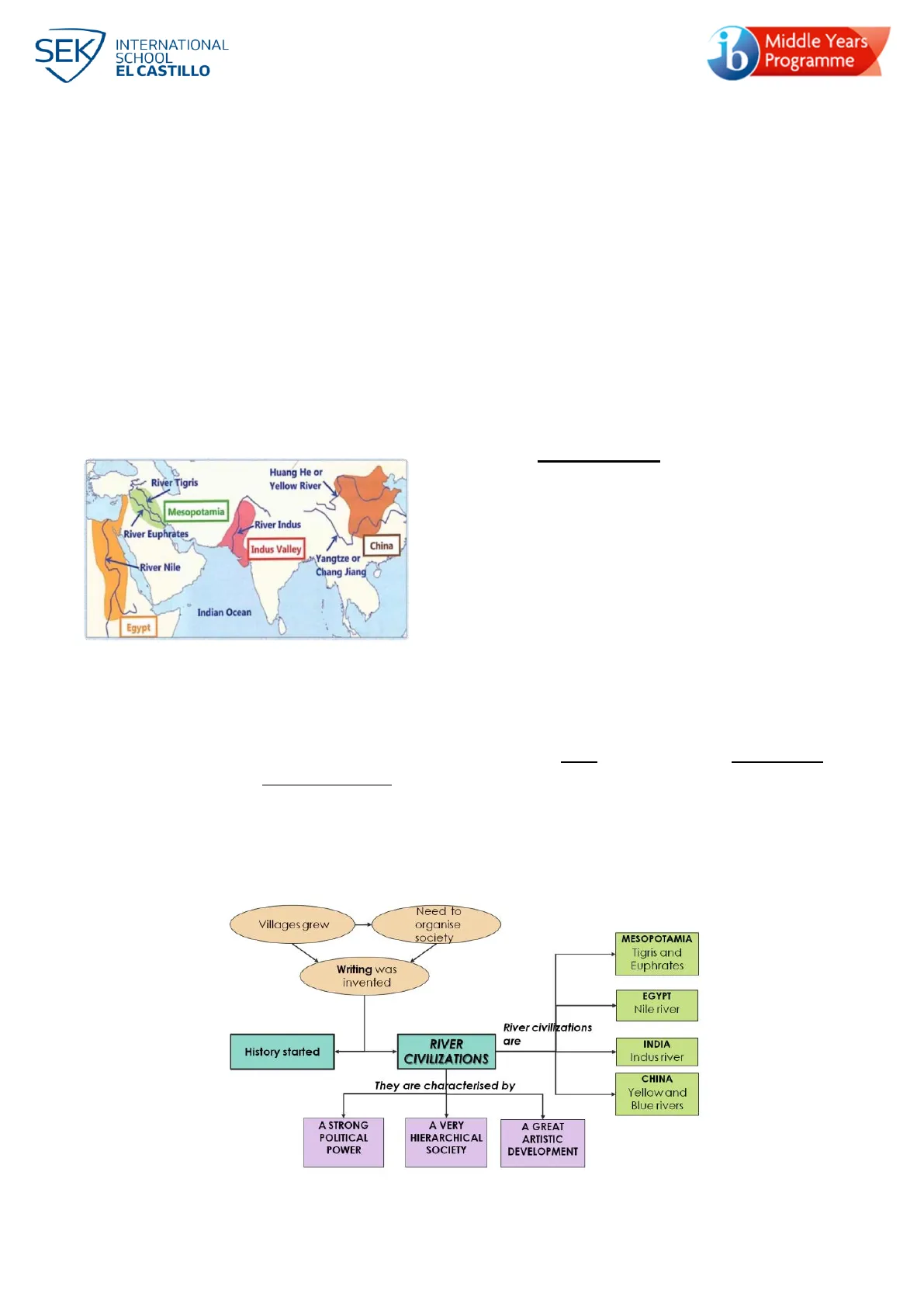
The first civilizations emerged in Mesopotamia, Egypt, India and China about 5,000 years ago. During the Metal Age, there were small cities governed by a king. As time went by, cities enlarged by treaties or by war.
River Tigris Mesopotamia River Indus River Euphrates Indus Valley China River Nile Yangtze or Chang Jiang Indian Ocean Egypt
River civilizations were characterised by:
- A strong political power. Power was centred on a king. In order to manage and protect their possessions, kings created a body of civil servants and formed large armies.
- A very hierarchical society. Society was divided into groups: - A minority of privileged people, who owned most of the lands and held the main public offices. - A majority of subjugated people.
- A great artistic development. Kings used art to enhance their power.
Villages grew Need to organise society MESOPOTAMIA Tigris and Euphrates Writing was invented EGYPT Nile river River civilizations are History started RIVER CIVILIZATIONS INDIA Indus river They are characterised by CHINA Yellowand Blue rivers A STRONG POLITICAL POWER A VERY HIERARCHICAL SOCIETY A GREAT ARTISTIC DEVELOPMENT They are called river civilizations because they developed along the banks of large rivers:
- Tigris and Euphrates rivers, in Mesopotamia.
- Nile River, in Egypt.
- Indus River, in India.
- Yellow and Blue rivers in China.
Huang He or Yellow River
SEK International School El Castillo Middle Years Programme
5.2. How did the first empires emerge?
a. From cities to empires
During the Metal Age, there were small cities governed by a king. As time went by, these kings enlarged their possessions by agreements or by war and they managed to form large empires. The enlargement of territories brought the need to create a state structure to assure the king's dominance:
- Governors (provinces).
- Civil servants, who could write, read and count, and took charge of collecting taxes.
. Codes of laws to regulate the relations between inhabitants. The oldest code of laws that has been found is the Code of Hammurabi.
b. An example: state formation in Mesopotamia
Mesopotamia means 'between rivers'. It was called this way because this civilisation developed between the rivers Tigris and Euphrates. The construction of irrigation canals and its geographic situation, which favoured trade between Asia Minor, the Mediterranean Sea and Syria, developed its economy. Many people lived in Mesopotamia in independent city states. The political history of Mesopotamia was defined by the alternating power between these people or empires:
MESOPOTAMIA THE HEARTLANDS HURRIANS OCARCHEMISH ONINEVEH SUBARTU DASHURS 3 OMARI ASSYRIA AKKAD TEPE GIYAN ELAM SIPPARO BABY BABYLON. LONIA SUSA NOMADIC ISIHO URUR PLARSA UR SEMITES 0 100 200 500 800 km @ LOOKLEX 2006
- Sumer: From 3500BC, hegemony passed to the Sumerians, who organized themselves into independents cities such as Ur and Lagash.
- Akkad: Around the year 2300BC, king Sargon I conquered the Sumerian cities and founded the Akkadian Empire.
- Babylon: Around the year 1800 BC, the rulers of the city state of Babylon conquered other cities and created the Babylonian empire.
- Assyria: after 1350BC the Assyrians created a great empire that stretched across to the Mediterranean coast and Egypt. In the 6th century BC, the Persians conquered Mesopotamia.
Standard of Ur (Sumer) NIPPURO SUMERS
SEK International School El Castillo Middle Years Programme
5.3. What was society like in the first civilisations?
From the 3rd millennium BC, cities grew a lot. Cities experienced a clear division of work. Each person was devoted to a particular job.
a. The case of Mesopotamia: cities
The cities of Mesopotamia were surrounded by walls of sun- dried bricks. Two buildings stood out within them:
- The temple, where people worshipped gods.
- The palace, which was the king's residence.
10 3 4 7 5 6 2 8 2
b. The case of Mesopotamia: population and work
The city states of Sumer were ruled by high priests. When empires were created, their kings held political and religious authority, it was a theocracy. Beneath the kings, there was a hierarchical society divided into privileged and non-privileged groups.
PRIVILEGE GROUPS All the rights Groups Most of the rich people 1 . Aristocracy . Priests . Civil servants NON-PRIVILEGE GROUPS Free people Slaves Have rights I Groups Had no rights and were treated as objects 1 .Craftsmen .Peasants
PRIVILEGE GROUPS: The aristocracy consisted of the king, his family and the nobility. They owned most part of the land. They held the highest positions in the army and government. The priests were in charge of the religious rituals. Also:
- They owned part of the land and craft workshops.
- They cooperated with the government.
The scribes stood out among the civil servants. They were trained to read and write cuneiform. NON-PRIVILEGE GROUPS: Craftsmen worked in workshops to make manufactured products. They produced wool for cloth, pottery, metal work and jewellery. Peasants rented the lands that surrounded the city and belonged to the king or temple. In exchange, they had to give them part of the harvest. Rivers were essential for agriculture. Crops were irrigated with water from canals and dikes were built to prevent the rivers from flooding. Women were the property of men, and when they worked, their wage was half of that of an adult man. Slaves were the lowest group. They did not have rights and were treated as objects.
SEK International School El Castillo Middle Years Programme
5.4. What was culture like in Mesopotamia?
a. Religion in Mesopotamia
Mesopotamian people did not believe in life after death, but they were polytheistic, they believed in many gods, such as Marduk, god of creation, and Ishtar, goddess of love and war. Each god was revealed by dreams, natural phenomena or the art of divination. Gods were human-shaped and had the same passions as human beings, but they were immortal. Temples were the gods' residence on Earth. In some cases, they were great fortresses, and in others, they were built on a tower of several stages, called ziggurat.
b. The first schools
The first schools in the history of humanity were found in Mesopotamia. At the beginning, schools were specialised in scribe training. Afterwards they became the centre of Mesopotamian culture and it trained scholars, scientists, theologians, linguistics, etc. Only children who came from the richest families went to school and only men could attend.
c. Mesopotamian art
In architecture, the materials used for construction were adobe bricks. Important innovations were the arch, the vault and the dome. The great Mesopotamian buildings were decorated with coloured clay strips and beautiful reliefs and frescos. For sculpture, they used stone. They represented kings and gods, figures of bulls and reliefs with hunting and war scenes.
Ishtar gate Relief of Ashurbanipal palace
SEK International School El Castillo Middle Years Programme
5.5. Ancient Egypt: environment and history
a. Environment
Ancient Egyptian civilization developed after 4,000BC along the Nile River. There were two regions:
- Upper Egypt (south): mainly dry region, with settlements along the Nile.
- Lower Egypt (north): flat, fertile area around the Nile Delta.
The Nile flooded the valley each summer and fertilised its land with mud, favouring the development of agriculture. Neolithic populations settled here learned to control the river's annual flooding and, thanks to this, towns grew into cities. The river was so important that the Egyptians worshipped it like a god. Boats could navigate through it, so it was also a trade and communications route.
b. The history of Egypt
Independent kingdoms developed in Upper Egypt and Lower Egypt until they were united by King Menes around 3,100 BC. There were four main periods:
- Old Kingdom (2700 - 2200 BC): The kings - or pharaohs - ruled all Egypt from their capital in Memphis. The great pyramids of Giza were built.
- Middle Kingdom (2050 - 1650 BC): Egypt expanded to the south and the capital moved to Thebes. Egypt was invaded by people from Mesopotamia. The treasures of Tutankhamun found in his tomb is a great example of the power and wealth pharaohs had.
- New Kingdom (1550 - 1070 BC): Expansion continued towards Syria and Libya. Famous pharaohs reigned, such as Amenophis IV (Akhenaten), Tutankhamun and Ramses II.
- Later Period (700 - 30 BC): Egypt broke up into small independent states and it was conquered several times. In 4th century BC it was conquered by Alexander the Great and finally in 30 BC it became part of the Roman Empire.
5.6 Ancient Egypt: society and economy
a) Society
As in Mesopotamia, they were a hierarchical society with different levels.
- The king or pharaoh was at the top. He was considered the earthly incarnation of Horus, god of the sky, for which he was worshiped as a god. He concentrated all the powers: he had the political power; he led the army and he was the religious authority.
Pharaoh EGYPTIAN SOCIAL PYRAMID Government officials Vizier Priest Noble This diagram shows how Egyptian society was shaped. Which groups formed the top two levels of the social pyramid? The bottom two levels! Soldiers Scribes Merchants Craftsmen Peasants Slaves
Can’t find what you’re looking for?
Explore more topics in the Algor library or create your own materials with AI.