Great Britain in the 18th Century: Socioeconomic Development and Political Articulation
Document from University about Great Britain in the 18th Century: Socioeconomic Development and Political Articulation. The Pdf explores the socio-economic and political development of Great Britain in the 18th century, including cultural and technical activities, and major novelists like Daniel Defoe and Jonathan Swift, for University Literature students.
See more10 Pages


Unlock the full PDF for free
Sign up to get full access to the document and start transforming it with AI.
Preview
Introduction to 18th Century Great Britain
A series of events took place in Great Britain by the 18th century, giving rise to certain changes that affected the whole country socially and culturally.
One of these factors was the pursuit of wealth; that is, the nobility and the middle classes had accrued considerable wealth by trade and exercised considerable power through the English Parliament.
Besides, a new technology implied that a reorganization of the agricultural system, by enclosing commonly held land, could give financial benefits to the rich. It also involved producing more food for a growing population as well as the dispossession of the rural poor and therefore created a new proletariat to labour for the Industrial Revolution.
There was also an increase of literate people due to the rise of the middle class. Thus, the novel developed as a literary genre and a handful of important authors appeared.
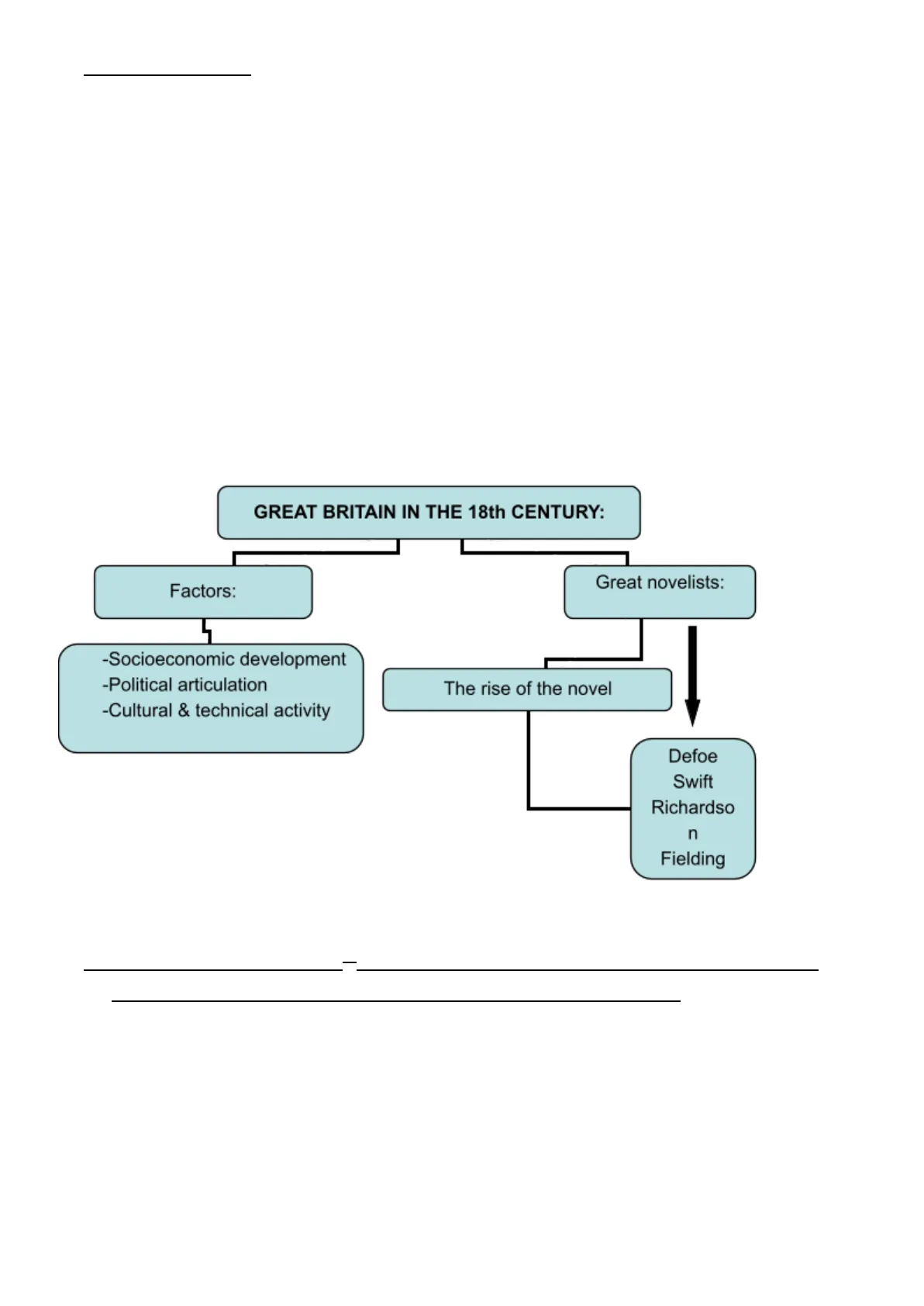
Next we present the following diagram intended to offer a general view of the content that is going to be developed in this unit: GREAT BRITAIN IN THE 18th CENTURY: Factors: Great novelists: -Socioeconomic development -Political articulation The rise of the novel -Cultural & technical activity Defoe Swift Richardso n Fielding
18th Century British Socioeconomic Development
There are some factors that explain the situation of Great Britain in the 18th century. They are the following:
Rural Transformation and Urbanization
England was mainly rural in 1700, although in the second half of the century, enclosure and agricultural change transformed the appearance of the rural environment. As the fields were enclosed, woodlands and wastes disappeared and a new pattern of hedges, walls, fences and roads took shape. Nevertheless, working conditions were not easy, since hours were long, including for children, in conditions similar to slavery. Besides, enclosure threatened the independence of a number of people who had previously felt themselves to be independent (when farmers become gentlemen, their labourers become slaves).
Thus, by 1750, large towns began to appear. But the population in those towns had no representation in Parliament, and their conditions in the new urban areas were awful (streets were used as sewers, no drains could be found and there was rubbish everywhere). As a consequence of these focuses for disease, only 25% of the population reached adulthood.
Even so, the eighteenth century brought in significant improvements, such as the placement of streetlights in London (1739) or Acts of Parliament (1760) allowing many towns to raise local taxes to be able to illuminate and clean the streets. So, social conditions in England were amongst the best in Europe by the end of the century.
Social Stratification and Gender Roles
However, there was an immense difference between high and low classes. There appeared growing groups of professional people and large numbers of "milding folk", who were involved in a wide variety of occupations; they had more opportunities of making money and of spending it. The word "gentlemen" was very used at that time, including people as lawyers, physicians, army officers, clergymen, "men of letters", artists and musicians, independent or servile. There was also an "underground" constituted by vagrants, sharpers, cheats, thieves, and so on.
In the case of women, it is important to mention that they did not get the vote in parity with men until 1928. Many times they were associated with pleasure; married women were associated with poverty; respectable unmarried women (described in 1719 as "spinsters") were associated with charity, etc.
As for the children, they began to be treated no longer as small adults but as a group with special needs. At the end of the century, child labour began to be seen as shameful and in the nineteenth century, it became a main area of social reform.
Political Articulation in 18th Century Britain
The Two-Party System: Whigs and Tories
The emergence of the two-party system that arose in the late seventeenth century was prominent in English politics, as well as another important factor in the social and cultural development of the country. Those two clearly political parties were the Whigs and the Tories, and both of them had developed opposed attitudes.
On the one hand, the Whigs who were the king's opponents (they were afraid of an absolute monarchy), evolved into the Liberal Party. They were a less homogeneous group: many powerful nobles, jealous of the power of the Crown, the merchants and financers of London, a number of bishops and Low Church clergymen, and the Dissenters; these varied groups were united by their policies of toleration and support the commerce.
On the other, the Tories were Royalist, that is, they were the party of the court, which supported the king. They drew their strength largely from the landed gentry and the country clergy. They became the Conservative Party of the period: strong supporters of the Crown and the Established Church as the two great sources of political and social stability, they opposed toleration of Dissenters. Tories were also hostile to the new moneyed interests, whether among the newer nobility or the increasingly well-to-do middle class, for they held that landed wealth is the only responsible wealth.
Monarchy and Ministerial Rule
At the same time, the English monarchy also suffered some relevant changes along the eighteenth century. For instance, it has to be commented the Act of Settlement (1701), that set the line of succession for the English crown and kept it from going to any Catholics. First, it went to James II's youngest daughter, Anne, and then to Sophia, the Duchess of Hanover (in Germany), Anne's closest Protestant relative. In 1702, Queen Anne was crowned (becoming the last monarch from the Stuart family).
From 1702 to 1713, the War of Spanish Succession (supported by Whigs) was led by Captain-General John Churchill, the Duke of Marlborough, who dominates Anne until 1710. In that year, the Whigs wanted to dissolve the Test Act, but Anne, loyal to the Established Church, dismissed her Whig ministers and appointed Tories: Robert Horley (later the Earl of Oxford) as Lord Treasurer, and Henry St. John (later Viscount Bolingbroke) as Secretary of State.
Anne died in 1714 and George I (son of Sophia, who had died) came to the throne and with him, the Whigs came back into power. George I's reign lasted from 1714 to 1727. He and his son George II (who ruled 1727-60) spent much of their time in their native Germany and left the task of governing to ministers. As a result, the ministers became much more powerful.
Thus, Sir Robert Walpole, a Whig, became Prime Minister (from 1721 to 1742) and began to develop what would become the modern British system of ministerial rule. Under him, the importance of the House of Commons increased, and industrialism began. He brought peace and prosperity, but also corruption.
Later on, during George III's reign (1760-1820), Britain began to emerge as a colonial power, giving rise to a period of expansionism.
Cultural and Technical Activity in 18th Century Britain
Architectural Styles and Political Expression
It is important to clarify that beauty did not lie solely in demonstrations of the grand style, in further refinements of classical precedent, or in an observation of nature according to Newtonian precepts.
In English architecture, the principles derived from the study of ancient precedent and from the writings of the Roman theorist Vitruvius. It was with the gradual triumph in the 1720s of the severer styles imitated from the works of Palladio, that influential aristocratic patrons and the designers they employed, found a common aesthetic language equally expressive of political and economic power and of the leisure and comfort to enjoy it.
The linkage between what became an essentially Whig style and dominance of Whig politics is perhaps best evidenced in the dismissal of Sir Christopher Wren, that marks the end of the idiosyncratic English flirtation with the international baroque style.
English Palladianism, with its emphasis on subdued good taste, balance, and a strict adherence to classical proportion as opposed to exuberance, ebullience, and innovation, became the national style of the mid-century. It became associated with the government of a liberal-minded oligarchy, as opposed to royal autocracy. The baroque style suggested the spiritual restlessness of earlier generations and, the suspect encroachments of continental tyranny in both Church and State.
Technological Innovations and Industrial Revolution
Besides, technological changes were essential to the improvement of industry (for instance, the use of steam power; the invention of the flying shuttle; also, the creation of a crucial puddling and rolling process that made possible a huge increase in the production of wrought iron). Some of the inventors worked in solitude behind the scenes; others were publicity-minded, and their skills turned to marketing and the exploitation of fashion.
So, it was as much the adoption of technological innovation as the innovation itself that constituted the social history of the industrial revolution.
Great Novelists of the Period
As far as literary production is concerned, several trends can be seen along the eighteenth century, such as the growth of journalism and magazines; a noticeable increase in literary criticism; a decline in the reputation of contemporary drama; a reaction to Augustan neoclassicism in poetry; an attraction for the fantastic, the exotic and the primitive; and the most significant one at that time: the rise of the novel.
So, before going deeply into the great novelists of the period, let us explain this popular if critically unprestigious genre.
The Rise of the Novel as a Literary Genre
A novel is a work of narrative fiction, usually written in prose. It developed as a literary genre in the eighteenth century by different reasons: the rise of the middle class and the development of a class consciousness; a set of values shared by the same social group; English fiction dealing with alteration of social relationship: change of status (i.e. rich/poor, single-married ... ); importance of social and financial status; emergence of a new reading public: women and servants.
The literary influences of the novel are: journalism; parallel art forms; letter writing; travel literature; the Restoration Comedies of Manners; the Picaresque convention; the mock romance of knight errantry.
The main characteristics of the novel are:
- an original plot that was not taken from tradition or previous literature;
- focus on the particular: characters, places, time ... are specifically defined; they do not represent universals;
- a philosophical realism in opposition to Neo-classicism in literature;
- the characters were given Christian names and surnames: they were representing individuals;
- the new role of time: taking into account both present action and past experience; present time is frequently used;
- emphasis on realism and authenticity required concrete environmental definition.
Can’t find what you’re looking for?
Explore more topics in the Algor library or create your own materials with AI.
