Molecules, C 1.1 SL Enzymes: Biological Catalysts and Metabolism
Document from High school about Molecules, C 1.1 SL Enzymes. The Pdf explores the role of enzymes as biological catalysts, their interaction with other molecules in metabolism, and key concepts like anabolic and catabolic reactions. It also analyzes the effects of temperature, pH, and substrate concentration on enzyme activity and denaturation.
See more10 Pages


Unlock the full PDF for free
Sign up to get full access to the document and start transforming it with AI.
Preview
Guiding Question
"In what ways do enzymes interact with other molecules? "What are the interdependent components of metabolism?"
Syllabus Objectives
C1.1.1 Enzymes as Catalysts
Students should understand the benefit of increasing rates of reaction in cells.
C1.1.2 Role of Enzymes in Metabolism
Students should understand that metabolism is the complex network of interdependent and interacting chemical reactions occurring in living organisms. Because of enzyme specificity, many different enzymes are required by living organisms, and control over metabolism can be exerted through these enzymes.
C1.1.3 Anabolic and Catabolic Reactions
Examples of anabolism should include the formation of macromolecules from monomers by condensation reactions including protein synthesis, glycogen formation and photosynthesis. Examples of catabolismshould include hydrolysis of macromolecules into monomers in digestion and oxidation of substrates in respiration.
C1.1.4 Enzymes as Globular Proteins with an Active Site for Catalysis
Include that the active site is composed of a few amino acids only, but interactions between amino acids within the overall three-dimensional structure of the enzyme ensure that the active site has the necessary properties for catalysis.
C1.1.5 Interactions Between Substrate and Active Site to Allow Induced-Fit Binding
Students should recognize that both substrate and enzymes change shape when binding occurs.
C1.1.6 Role of Molecular Motion and Substrate-Active Site Collisions in Enzyme Catalysis
Movement is needed for a substrate molecule and an active site to come together. Sometimes large substrate molecules are immobilized while sometimes enzymes can be immobilized by being embedded in membranes.
C1.1.7 Relationships Between the Structure of the Active Site, Enzyme-Substrate Specificity and Denaturation
Students should be able to explain these relationships.
C1.1.8 Effects of Temperature, pH and Substrate Concentration on the Rate of Enzyme Activity
The effects should be explained with reference to collision theory and denaturation.
C1.1.9 Measurements in Enzyme-Catalysed Reactions
Students should determine reaction rates through experimentation and using secondary data.
C1.1.10 Effect of Enzymes on Activation Energy
Students should appreciate that energy is required to break bonds within the substrate & that there is an energy yield when bonds are made to form the products of an enzyme catalysed reaction. Students should be able to interpret graphs showing this effect.
Enzymes and Reaction Rates
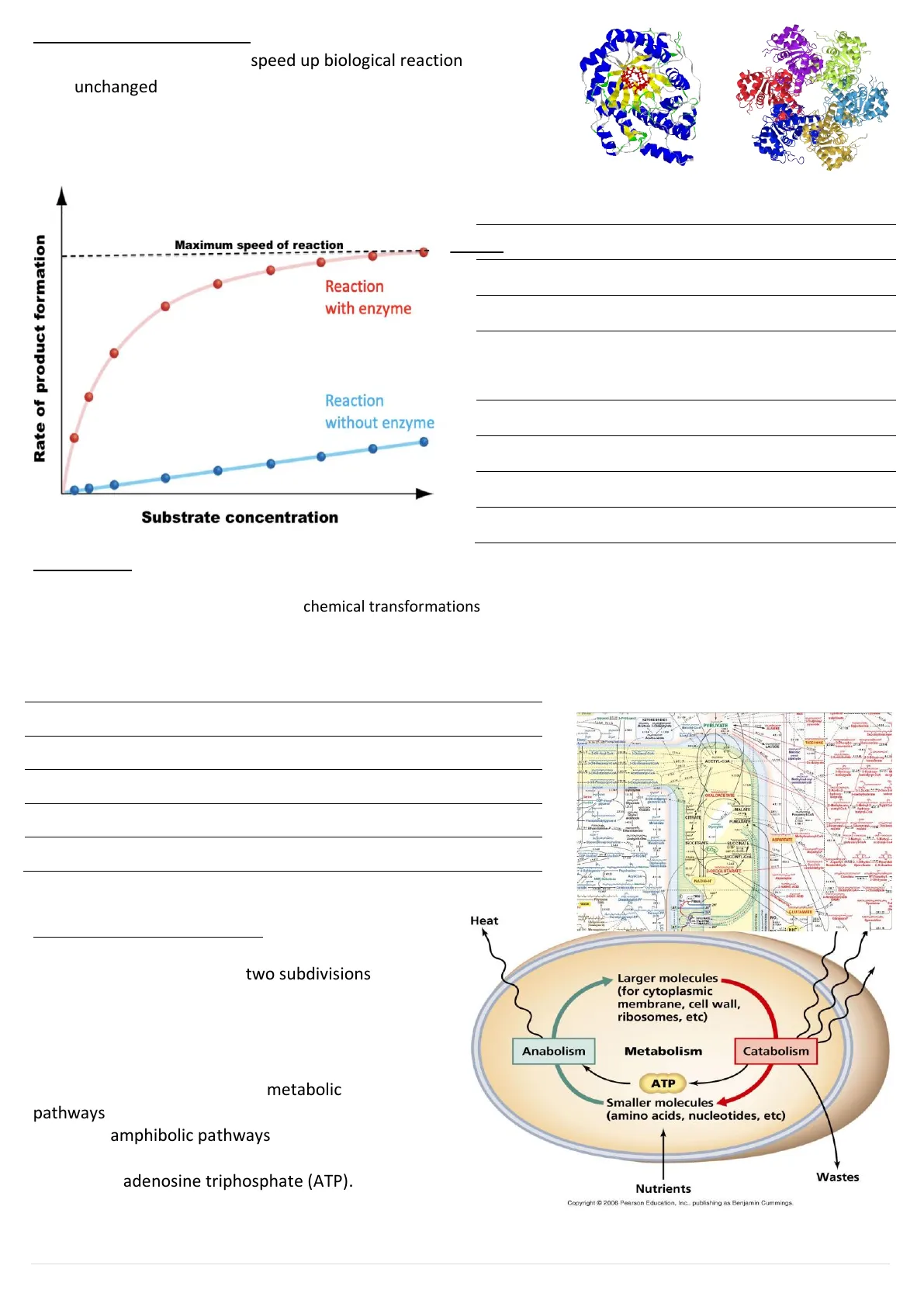
Enzymes are catalysts which speed up biological reaction but are itself unchanged by the reaction. Enzymes are globular proteins composed of one or more polypeptides, and their 3D structure is affected by changes in temperature and pH
Enzyme Examples
The enzyme amylase The enzyme helicase
Define the Term "Rate of Reaction"
Rate of product formation Maximum speed of reaction
Rate of reaction is the amount of a product produced per unit time (eg. amount of gas produced per second)
Describe How a Rate of Reaction is Affected When Using an Enzyme
A reaction with an enzyme occurs much faster and more efficiently than a reaction without enzyme.
Metabolism
Metabolism is the complex network of interdependent and interacting chemical reactions occuring in living organisms. Metabolism is the set of life sustaining chemical transformations within the cells of living organisms. These enzyme- catalyzed reactions allow organisms to grow and reproduce, maintain their structures, and respond to their environments. The word metabolism can also refer to all chemical reactions that occur in living organisms.
Examples of Metabolic Reactions in Cells
- Carbohydrate metabolism
- Lipid metabolism
- Amino acid metabolism
- Nucleotide metabolism
- Metabolism of cofactors and vitamins
- ATP production
Anabolism Versus Catabolism
Metabolism is composed of two subdivisions:
- Anabolism and
- Catabolism
Both types of reactions occur through a series of enzyme-mediated steps called metabolic pathways. Linked anabolic and catabolic processes are called amphibolic pathways. The primary molecule used to store and deliver energy for all cell functions is adenosine triphosphate (ATP).
Copyright 2006 Pearson Education, Inc., publishing as Benjamin Cummings.
Complete the Table Below
Anabolism
Building up larger molecules from smaller units by joining them together Requires energy input to occur Condensation reactions (releasing water molecules when joining molecules together)
Catabolism
Breaking down larger molecules into smaller ones (into its smaller units/ subunits) Releases energy ias they occur Hydrolysis reactions (need water molecules to split molecules apart)
Anabolic: Small molecules are assembled into large ones. Energy is required.
Catabolic: Large molecules are broken down into small ones. Energy is released.
Examples
- Photosynthesis
- DNA replication
- Protein synthesis
- Building up cell wall components
- Building up of storage products, eg: glycogen formation
- Digestion of food
- Oxidation of substrates in cellular respiration
- Decomposition of organic compounds
Enzymes and Their Active Sites
Once a substrate has been locked into the active site, the reaction is catalyzed. Shortly after the products are released and the enzyme is used again
What is a Substrate?
A substrate is a reactant in a biochemical reaction.
What is an Enzyme?
An enzyme is a globular protein which acts as a catalyst for biochemical reactions.
What is the Active Site?
The active site is a region on the surface of an enzyme to which substrates bind and which catalyses the reaction. The polar regions of the amino acid of the active site attract the substrate.
Enzyme Substrate Specificity
The active site of an enzyme binds to a specific substrate - the shape of the active site and substrate fit in two ways. Describe each of them:
Structurally
The 3D structure of the active site is specific to the substrate (shape).
Chemically
The chemical properties of substrate and enzyme attract through opposite charges.
Figure 8.9 Biochemistry, Seventh Edition 2012 W. H. Freeman and Company
What is Meant by the "Induced Fit" Model or Mechanism?
The active site the substrate binds to has a very intricate and precise shape. It also has a distinctive chemical properties. Active sites match the shape and chemical properties of their substrates. The induced fit causes an enzyme to change shape when binding occurs. Other molecules either do not fit or are not chemically attracted.
Stages of an Enzymatic Reaction
Enzyme activity is the catalysis of a reaction by an enzyme. There are three stages:
- The substrate(s) binds to the active site of the enzyme because of its structural and chemical similarity.
- While the substrates are bound to the active site, bonds in the substrate are stressed or weakened causing it to change into different chemical substances (products of the reaction).
- The products separate from the active site, leaving it vacant for substrates to bind again.
Molecular Arrangements Affecting the Formation of Enzyme-Substrate Complexes
Try This Out!
The formation of an enzyme-substrate complex depends on ...
- The molecular motion of both, enzyme and substrate which causes collision between molecules. All metabolic reactions occur in an aqueous solution which enables dissolved molecules continual motion. The direction of movement is random and changes repeatedly.
water molecules substrate active site enzymes
- The correct alignment and angle between substrate and enzyme affect the success of the collision.
No reaction occurs: orientation is incorrect.
- The speed of movement is affected by the molecule's size - substrates are usually smaller than enzymes, so their movement is faster.
Denaturation of Enzymes
Since enzymes are proteins, their structure can be altered by changes in pH or temperature. If the shape of the active site is changed considerably, they will not function.
Which Two Factors Cause Denaturation in a Protein? Explain
High temperature causes denaturation as the extra energy leads to increased vibration with the molecule, breaking intra-molecular bonds within the protein. Changes in pH lead to a higher or lower concentration of hydrogen ions in the solution - as a consequence, hydrogen bonds within the enzyme are broken.
1. The Effect of Temperature on the Rate
A thermophile, such as bacteria at deep-sea vents, is an organism that is able to withstand much higher temperatures before its enzymes denature.
Describe How the Rate of Reaction Changes With Temperature
As temperature increases, the rate of reaction increases as molecules have more kinetic energy. Enzyme and substrate molecules move faster, increasing the chances of colliding with the active site of the enzyme. Enzyme activity therefore increases. When enzymes are heated above the optimum temperature, the chance of bonds breaking within the molecule increases. The structure changes, denaturing the enzyme - change the shape of the active site.
Can’t find what you’re looking for?
Explore more topics in the Algor library or create your own materials with AI.
