Economic and Business History: A Timeline from 1929 to 1970
Slides about Economic and Business History. The Pdf, a presentation for university-level Economics, covers key events and theories from 1929 to 1970, including wars, depressions, and post-war economics, structured as a detailed timeline.
See more50 Pages

Unlock the full PDF for free
Sign up to get full access to the document and start transforming it with AI.
Preview
Economic and Business History Overview
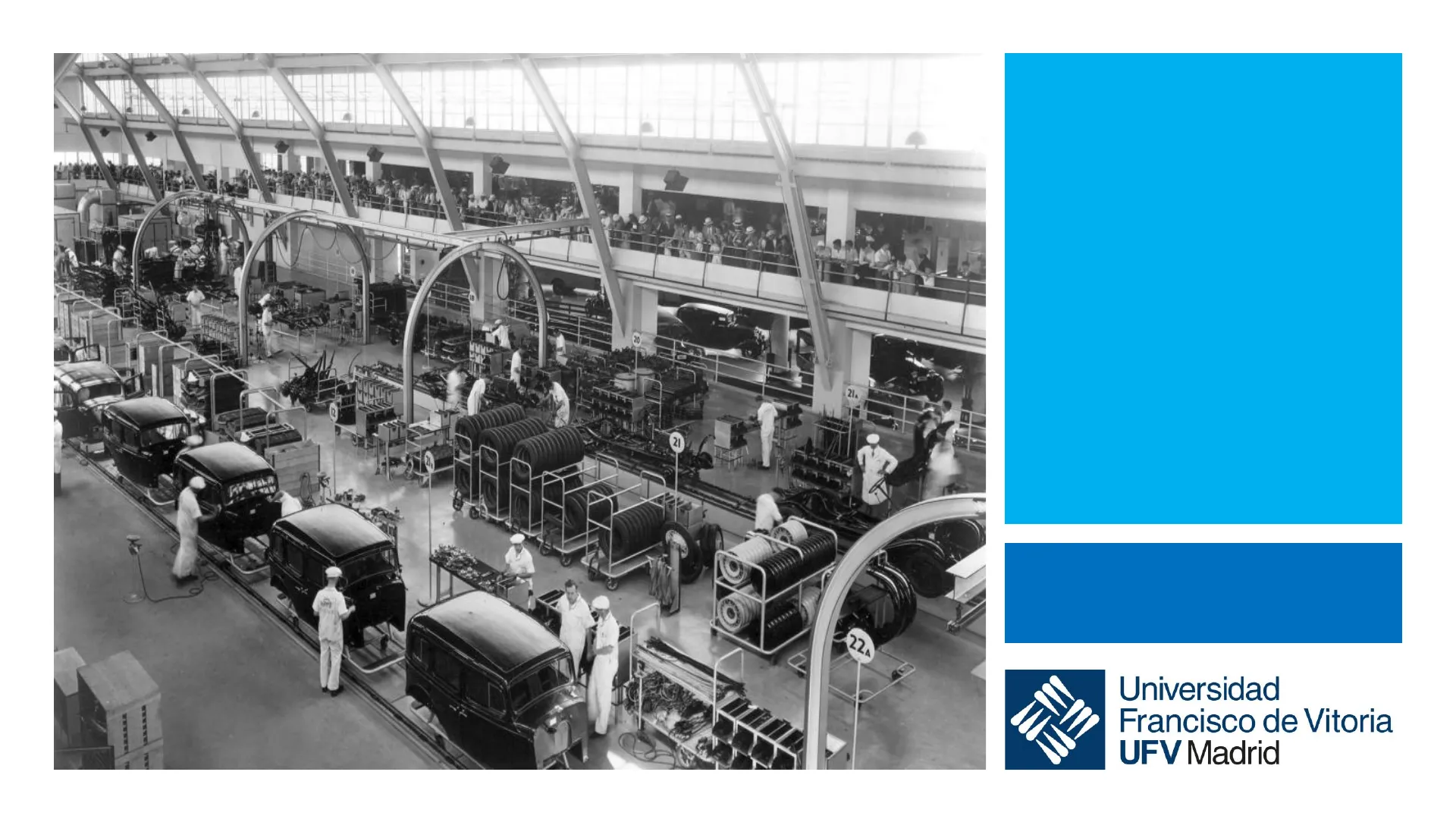
20 21 12 21 22A Economic and Business History UFV Year: 1 Subject code: 7111 Prof. Damián Rubianes Universidad Francisco de Vitoria UFV MadridUnit 1: Introduction to Economic and Business History ECONOMIC AND BUSINESS HISTORY | UFV | PROF. DAMIÁN RUBIANES | PG. 2UNIT 1 ANCIENT AND MIDDLE AGES Introduction to Economic and Business History
- 1.1 Concept, objectives and method of Economic and Business History.
- 1.2 The long term perspective.
- 1.3 Basic concepts and economic indicators.
- 1.4 Schools of economic thought.
A CONCISE ECONOMIC HISTORY OF THE WORLD FROM PALEOLITHIC TIMES TO THE PRESENT [ Pdh Edelen Larry Neal | Rondo Cameron OXFORD Source: Teaching guide. Universidad Francisco de Vitoria UFV Madrid ECONOMIC AND BUSINESS HISTORY | UFV | PROF. DAMIÁN RUBIANES | PG. 3UNIT 1 ANCIENT AND MIDDLE AGES Introduction to Economic and Business History
- 1.1 Concept, objectives and method of Economic and Business History.
- 1.2 The long term perspective.
- 1.3 Basic concepts and economic indicators.
- 1.4 Schools of economic thought.
A CONCISE ECONOMIC HISTORY OF THE WORLD FROM PALEOLITHIC TIMES TO THE PRESENT [ Pdh Edelen Larry Neal | Rondo Cameron OXFORD Source: Teaching guide. Universidad Francisco de Vitoria UFV Madrid ECONOMIC AND BUSINESS HISTORY | UFV | PROF. DAMIÁN RUBIANES | PG. 4CONCEPT, OBJECTIVE
Economic and Business History: Concepts and Objectives
Economic and business history studies economic development. Economics is the study of how societies use their resources - the land, coal, people and machines that are involved in making useful services and goods. It tries to answer the following question:
- Why isn't the whole world developed?
The Great Divergence: over the past three centuries, when the economic performance of Europe became uncoupled from that of the rest of the world. Economic history tries to understand why. Business history studies economic development through one of its most important actors, the business firm, the primary social organization in the capitalist system. Source: Neal, Larry; Cameron, Rondo. "A concise economic history of the World". Universidad Francisco de Vitoria UFV Madrid <2
Economic Historians and Development
Nobel Prize-winning economic historian Douglass North suggested that what is of particular concern to the economic historian is explaining the institutional structures that underlie (and account for) the performance of an economic system and how these institutions change over time. For the economic historian Rondo Cameron, the most pressing concern was to explain the origins of unequal levels of development in the world. David Landes, a professor of history at Harvard wanted economic historians to trace and understand the main streams of economic advances and modernization, that is, how mankind came to where-and what-we are, in the sense of making, getting, and spending.
Institutions, Property Rights, and Economic Growth
Institutions, Property Rights, and Economic Growth The Legacy of Douglass North EDITED BY SEBASTIAN GALIANI AND ITAI SENED Source: "An economic history of the World since 1400", Donald J. Harreld. Universidad Francisco de Vitoria UFV Madrid ECONOMIC AND BUSINESS HISTORY | UFV | PROF. DAMIÁN RUBIANES | PG. 5CONCEPT, OBJECTIVE
Economic Growth Theories
Economic theorists as well have attempted to construct a unified theory of economic growth. Initially, the dominant idea in economic theory was to increase the capital stock of an economy, especially in the manufacturing sector.
- Economists noted that machinery increased labour productivity ever since the adoption of the steam engine in eighteenth-century Britain.
- The key factors for maintaining economic growth in per capita terms, it was thought, were an increasing level of capital per worker and an increasing number of workers in an economy.
AIR CANADA C ... Source: Neal, Larry; Cameron, Rondo. "A concise economic history of the World". Universidad Francisco de Vitoria UFV Madrid ECONOMIC AND BUSINESS HISTORY | UFV | PROF. DAMIÁN RUBIANES | PG. 6CONCEPT, OBJECTIVE
Technology and Economic Growth
The flaw of the previous view is that economists saw technology as something given, increasing over time but lacking a clear idea of its origin. Eventually, economists understood that technology is the outcome of economic inputs, especially: education of the workforce and scientific research. By 1990, some economists could even summarize the models for economic growth in four simple rules: (i) increase investment in manufacturing, (ii) raise the education level of the labour force, (iii) reduce the birth rate so that more of the population is in the labour force, (iv) and increase exports. Source: Neal, Larry; Cameron, Rondo. "A concise economic history of the World". Universidad Francisco de Vitoria UFV Madrid ECONOMIC AND BUSINESS HISTORY | UFV | PROF. DAMIÁN RUBIANES | PG. 7CONCEPT, OBJECTIVE
Institutional Elements in Economic Growth Models
The four factors had worked well for the Asian tiger economies coming out of the oil shocks of the 1970s and were starting to work in some Latin American countries. However, Russia's economy, following all four rules for economic growth to excess, collapsed, along with the political structure that had sustained it through most of the twentieth century. As a consequence, economic theorists have integrated institutional elements into their models of economic growth. Source: Neal, Larry; Cameron, Rondo. "A concise economic history of the World". Universidad Francisco de Vitoria UFV Madrid ECONOMIC AND BUSINESS HISTORY | UFV | PROF. DAMIÁN RUBIANES | PG. 8MINI CASE 1
Industrial Revolutions and Technological Paradigms
DEBATE NOW IT'S YOUR TURN Industrial Revolutions: Sharp transitions in technological paradigms that were determined by aspects such as technical skills, scientific knowledge, forms of energy, and capital intensity. Technical progress is cumulative, but there are also substantial discontinuities.
Stages of Industrial Revolution
INDUSTRIAL REVOLUTION
- 1.0 Mechanization, steam power, weaving loom.
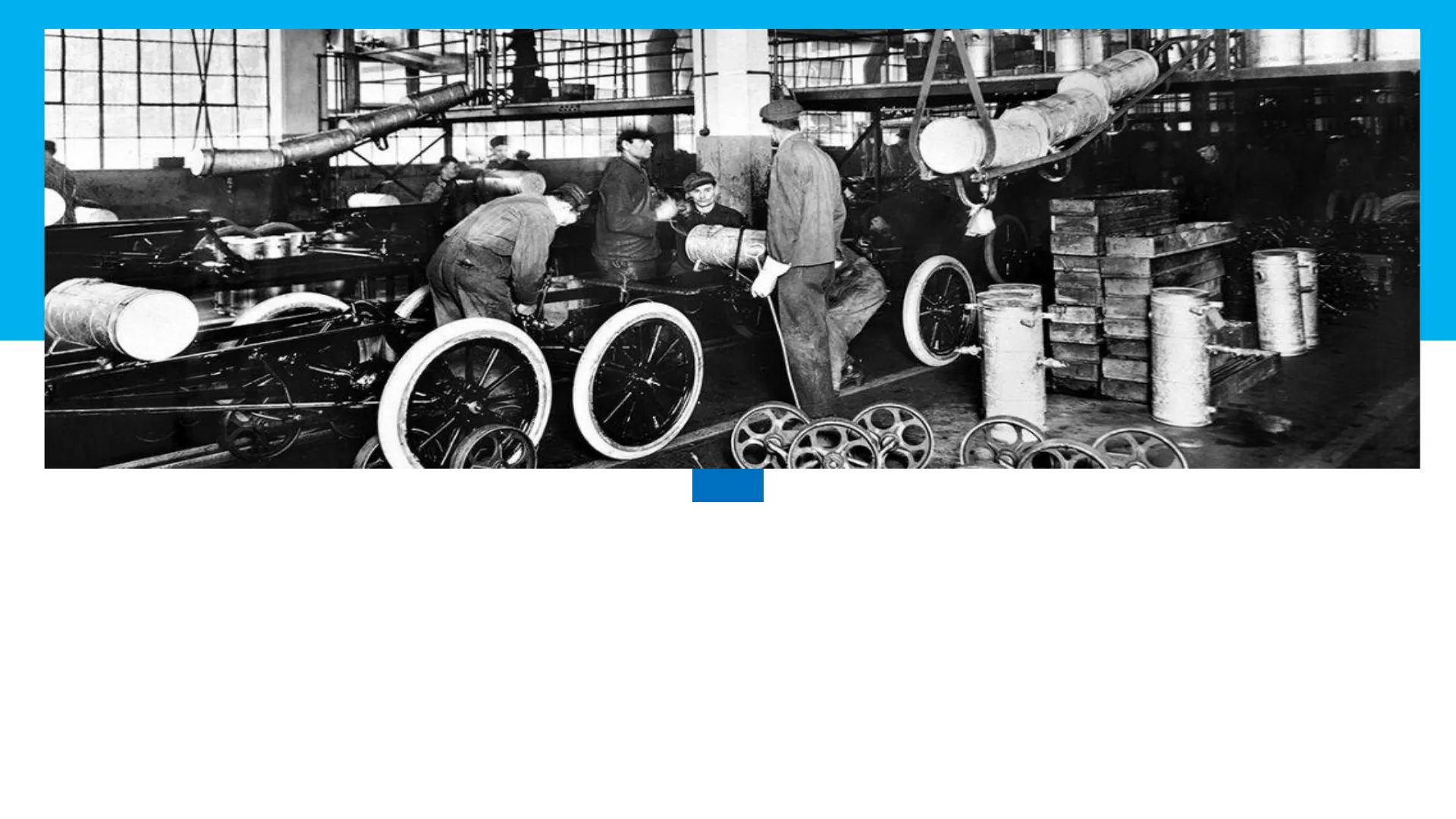
- 2.0 Mass production, assembly line, electrical energy.
- 3.0 Automation, computers and electronics.
- 4.0 Cyber Physical Systems, internet of things, network.
Source: Amatori, Franco; Colli, Andrea. "Business History". Universidad Francisco de Vitoria UFV Madrid ECONOMIC AND BUSINESS HISTORY | UFV | PROF. DAMIÁN RUBIANES | PG. 9MINI CASE 1
Four Industrial Revolutions: Impact on Economic Development
NOW IT'S YOUR TURN DEBATE " Justify which of the four industrial revolutions has been more important in the economic development of Western societies. Four Industrial Revolutions . 1765 1870 1969 Today 4th revolution 1 st revolution 2nd revolution 3rd revolution MECHANIZATION led by the steam engine MASS PRODUCTION AUTOMATED PRODUCTION NEW TECHNOLOGIES driven by electricity and oil-based power supported by electronics and information technologies Internet of Things (loT), Artificial Intelligence (AI); Big Data, Cloud, Cyber-Physical Systems ... Universidad Francisco de Vitoria UFV Madrid ECONOMIC AND BUSINESS HISTORY | UFV | PROF. DAMIAN RUBIANES | PG. 11MINI CASE 1
Industrial Revolutions Throughout History
DEBATE IR 1: Steam was harnessed for mechanical production. Transition from an agricultural economy to an industrial one. The most revolutionary economic, technological and social transformation the world had ever seen. IR 2: In 1870, mass production powered by electricity was first introduced. The assembly line was invented and the industrial sector speeded up exponentially. IR 3: In 1969, advances in computing led to machine programming, which opened the door to progressive automation. IR 4? Read: https://www.iberdrola.com/innovation/fourth- industrial-revolution Source: Deloitte. Universidad Francisco de Vitoria UFV Madrid Industrial revolutions throughout history NOW IT'S YOUR TURN LELET 1784 1870 INDUSTRY 1.0 INDUSTRY 2.0 First mechanical loom. Steam-based mechanical production. First assembly line. Electricity-based mass production. .. 2014 1969 INDUSTRY 4.0 INDUSTRY 3.0 First online mass production in a smart factory. Ubiquitous production and control. First programmable controller. Controller-based automation. ECONOMIC AND BUSINESS HISTORY | UFV | PROF. DAMIAN RUBIANES | PG. 12MINI CASE 2
The Economics of the Rio Grande: Nogales Case Study
3 PG. READING + DISCUSSION 1. 3-pg. document available in the virtual campus (Canvas). Read + debate. NOW IT'S YOUR TURN SO CLOSE AND YET SO DIFFERENT THE ECONOMICS OF THE RIO GRANDE THE CITY OF NOGALES is cut in half by a fence. If you stand by it and look north, you'll see Nogales, Arizona, located in Santa Cruz County. The income of the average household there is about $30,000 a year. Most teenagers are in school, and the majority of the adults are high school graduates. Despite all the arguments people make about how deficient the U.S. health care system is, the population is relatively healthy, with high life expectancy by global standards. Many of the residents are above age sixty-five and have access to Medicare. It's just one of the many services the government provides that most take for granted, such as electricity, telephones, a sewage system, public health, a road network linking them to other cities in the area and to the rest of the United States, and, last but not least, law and order. The people of Nogales, Arizona, can go about their daily activities without fear for life or safety and not constantly afraid of theft, expropriation, or other things that might jeopardize their investments in their businesses and houses. Equally important, the residents of Nogales, Arizona, take it for granted that, with all its inefficiency and occasional corruption, the government is their agent. They can vote to replace their mayor, congressmen, and senators; they vote in the presidential elections that determine who will lead their country. Democracy is second nature to them. Life south of the fence, just a few feet away, is rather different. While the residents of Nogales, Sonora, live in a relatively prosperous part of Mexico, the income of the average household there is about one-third that in Nogales, Arizona. Most adults in Nogales, Sonora, do not have a high school degree, and many teenagers are not in school. Mothers have THE ORIGINS OF POWER, PROSPERITY, AND POVERTY WHY NATIONS FAIL DARON ACEMOGLU JAMES A. ROBINSON Universidad Francisco de Vitoria UFV Madrid ECONOMIC AND BUSINESS HISTORY | UFV | PROF. DAMIÁN RUBIANES | PG. 13
Can’t find what you’re looking for?
Explore more topics in the Algor library or create your own materials with AI.