The Interwar Years: Economic Recovery and Rise of Totalitarianism
Slides about The Interwar Years. The Pdf explores the period between the two world wars, analyzing the economic recovery of the 1920s and the rise of fascism and Nazism. The Pdf, suitable for High school History students, covers key topics like the Roaring Twenties, Fascist Italy, and Hitler's rise to power.
See more19 Pages


Unlock the full PDF for free
Sign up to get full access to the document and start transforming it with AI.
Preview
Recovery in the Twenties
Unequal Economic Growth
The interwar years Unit 61. Recovery in the twenties 1.1. Unequal economic growth. Global economic dominance shifted from Britain to the USA, with the international financial center moving from London to New York. Economic recovery in Europe, especially in Germany, was difficult due to war reparations, leading to hyperinflation (1$ went from 493 marks to 4.3 billion marks). From 1924, production and employment rose in Europe, though not as much as in the USA, thanks to British and, especially, American investment.
The Roaring Twenties in the United States
1.2. The Roaring Twenties in the United States 1922-1929: The USA saw massive industrial growth due to the production line method, standardized production, and the rise of large corporations. The standard of living rose, with the middle class able to afford automobiles, refrigerators, radios, etc., often bought on payment plans. This new American way of life spread worldwide. New forms of entertainment emerged: cinema, spectator sports, popular music (like jazz), and dances. Additionally, the press and radio grew in importance, providing both information and entertainment.
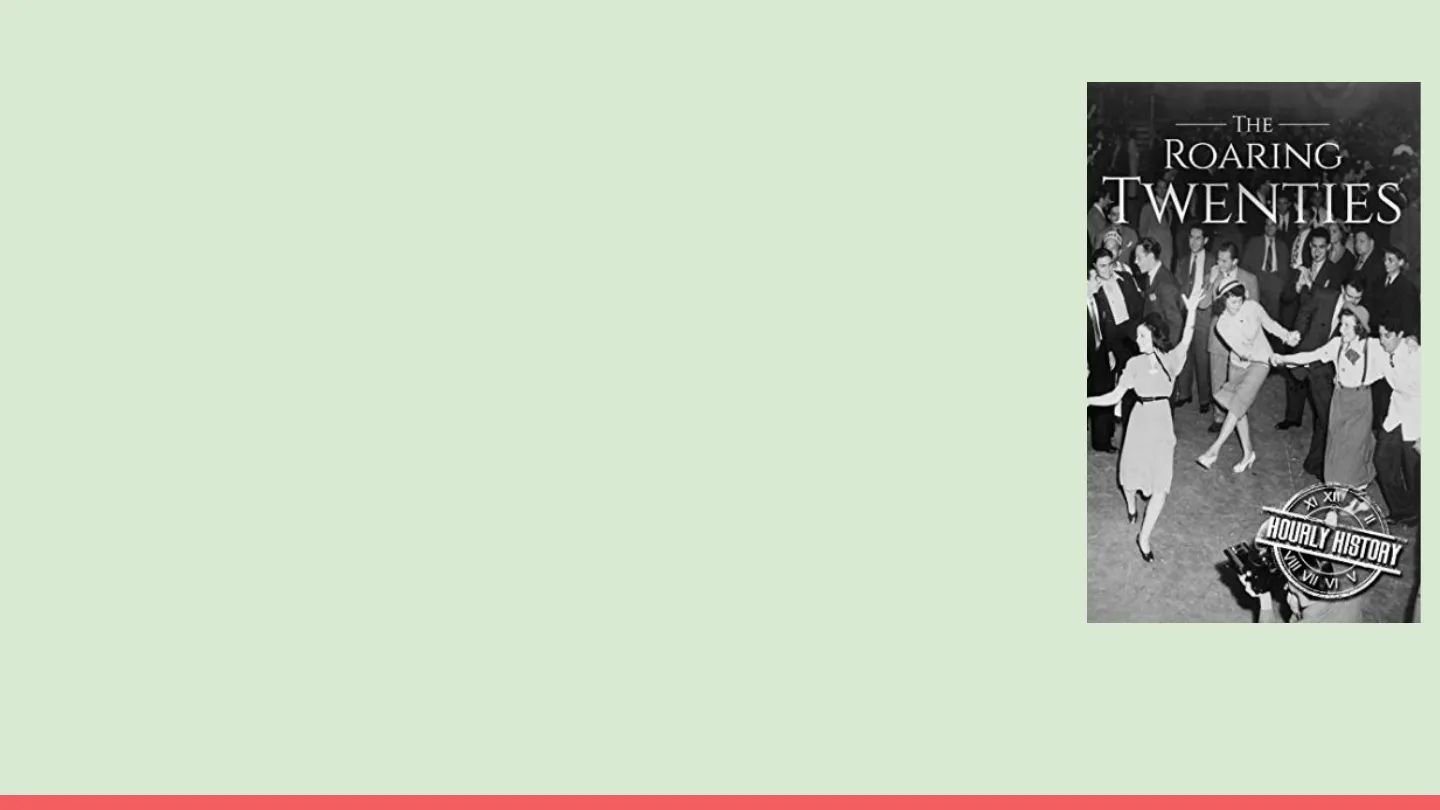
- THE ROARING TWENTIES HOURLY HISTORY1. Recovery in the twenties
International Politics
1.3. International politics Early 1920s tensions: France and Germany faced growing tensions due to Germany's inability to pay reparations and France's struggle to repay debts to the USA. 1923 - Ruhr Occupation: France occupied the Ruhr to extract profits from German mines, and Germany's resistance (strikes and passive resistance) worsened its economic crisis. 1924 - Dawes Plan: The USA lent money to Germany to help it pay reparations, enabling Germany to repay its debts to the Allies, including France. 1925 - Treaty of Locarno: France and Germany improved relations, signing the Treaty of Locarno, a series of peace treaties, leading to the "spirit of Locarno" (pacifism). Germany recognized its borders with France and Belgium as per the Treaty of Versailles. 1926 - League of Nations: Germany was admitted to the League of Nations. 1928 - Kellogg-Briand Pact: Countries signed the Kellogg-Briand Pact, renouncing war as a means of resolving conflicts. A cartoon by David Low showing Aristide Briand, Austin Chamberlain and Gustav Stresemann signing the Locarno Treaty (1925).
The Great Depression
Causes of the Crash
2. The Great Depression 2.1. Causes of the crash Overproduction: During WWI, countries focused on wartime production, while others (like Japan and Argentina) produced consumer goods. After the war, nations could produce all types of goods on their own, resulting in excess supplies. Speculation: Many people invested in stocks, even as struggling companies continued to sell them. When companies needed funds, they sold more stocks, leading to mass selling. This culminated in the Stock Market Crash of 1929, known as Black Thursday (October 24th).
Impact of the Great Depression
2.2. The Great Depression Banks failed: customers withdrew their money and did not pay many of their loans. Demand for industry and farm products fell, many companies closed, farmers went bankrupt and Unemployment rose. The US reduced its imports, which harmed countries, especially in latin America, that supplied the US with raw materials. US banks withdrew their investments in Europe, harming especially Germany and Austria. WHY CAN'T YOU GIVE MY DAD A JOB?
The New Deal
2. The Great Depression 2.3. The New Deal Measure launched by the president Franklin D. Roosevelt (1933), with greater state intervention in economy:
- Public works: goal = create employment and stimulate investment by large companies.
- Farming subsidies: farmers were paid to produce less to rise prices.
- Improved working conditions: shorter work day, minimum wage and unemployment insurance.
- Restructuring of the financial system.
The goal was to increase consumption to stimulate USA economy. London Economic Conference in 1933: to adopt international recovery measures, but failed because each country defended their own interests. HOOVER 1932 NEW DEAL 1940 BREAD LINES HIGHER WAGES HOMELESS LOW RENT HOMES BANKS CLOSED Reelect SOCIAL SECURITY ROOSEVELT Vote AMERICAN LABOR C.
The Rise of Totalitarianism
The First Dictatorships
3. The rise of totalitarism 3.1. The first dictatorships After WWI, the authoritarian empires disappeared and democratic regimes were formed in many new countries. However, economic crisis led to social tensions and there were peasant uprisings and the middle and upper class feared a communist revolution. In this context, dictatorial regimes emerged in several countries:
- In Italy: Mussolini rose to power as leader of the Fascist Party in 1922.
- Also in Hungary (1921), Spain (1923), Poland (1926), Portugal (1926), Yugoslavia (1929) ...
Political Extremism in the 1930s
3. The rise of totalitarism 3.2. Political extremism in the 1930s The crash of 1929 caused people in Europe to lose confidence in democracy and traditional political parties. Extremist parties gained followers and became more radical:
- On the left: many workers and peasants supported communist parties. *Only the USSR was a communist regime.
- On the right: extremist parties (including new fascists parties) received great support. *The most important regimes were Fascism in Italy and Nazism in Germany.
In this tense atmosphere, there was a new wave of dictatorships in the 1930s:
- In Germany, the rise of Hitler's Nazi regime to power in 1933 was followed by coups d' état in Austria (1933), Greece (1936) and Spain (1939).
In totalitarian regimes:
- A single party controlled all the powers of state.
- Rules of behavior were imposed.
- Human rights were violated and liberties were eliminated.
Fascist Italy
Italy After World War I
4. Fascist Italy 4.1. Italy after World war I Lost of 600.000 men in WWI, disappointment because of receiving little territory in the Paris peace treaties, debts and inflation led to growing unemployment. The economic crisis generated social tensions: peasants occupied estates, industrial workers held strikes ... In this context, the middle and lower classes began to fear a communist revolution. Growing support to Communist Party and Benito Mussolini's fascists (Blackshirts).
What Was Fascism?
4.2. What was fascism? In Italy, Benito Mussolini founded the National Fascist Party in 1921:
- Opposition to democracy and communism.
- Totalitarian state without individual rights, runned by the "Il Duce".
- A single political party: The National Fascist Party.
- Violence against opposition.
- Monopoly of the media and propaganda.
- The state controlled the economy: they wanted to make an autarchy (self-sufficient state).
- Nationalism and inequality: Italy glorified, some nations/peoples were considered superior.
- Militarism: war was glorified (they wanted to create a "new Roman Empire".
The Fascist Dictatorship
4. Fascist Italy 4.3. The fascist dictatorship The fascist responded social disorders with violence. As they lost the elections of 1919 and 1921, they decided to take the power by force, taking over several towns and advancing to Rome. Following the March on Rome (October 1922), the king Vittorio Emmanuele II ceded the government to Mussolini. Mussolini was given full power during a year, after that, he won an absolute majority in the elections after a campaign of terror against the opposition. His supporters were: industrial and financial bourgeoisie, land owners and some middle class members. He established a dictatorship with almost absolute power and took these actions:
- Put his opponents in prison, banned political parties, unions and liberties.
- He created a secret police: Organisation for Vigilance and Repression of Antifascism (OVRA).
- Efforts to increase production and to become an autarchy.
- Expansionist foreign policy: Italy occupied Abyssinia (Ethiopia) and Albania and sent armed forces to support Franco in the Spanish Civil War.
P N A F A
The Origins of Nazism
The Weak Weimar Republic
5. The origins of Nazism 5.1. The weak Weimar Republic After WWI the provisional government repressed the Spartacist Revolt (attempt to establish a communist regime in Germany in 1919). In 1919, in Germany, they passed a constitution in the city of Weimar and became a democratic republic and (this regime was unofficially known as the Weimar Republic). The Social-Democratic Party had a majority in the parliament and controlled the government, but they faced opposition from extremist groups: - Extreme left: they thought they were too moderate. - Extreme right: they said they had betrayed Germany accepting the Treaty of Versailles.
Hitler and the Nazi Party
5.2. Hitler and the Nazi Party 1919 A. Hitler joined the National Socialist German Workers' Party, the Nazi Party. He reformed the party and created a paramilitary group, the Assault Division, to maintain order at party events. Hitler led a failed coup, the Beerhall Putsch (1923) and he was imprisoned. During his prison time he wrote Mein Kampf (My Struggle), which reflected the principles of Nazism, with many fascists characteristics (rejection of democracy, devotion to the leader (führer) and glorification of violence), but with some identifying characteristics: Nazism identifying characteristics - Racism, especially against the Jews (anti-Semitism), blamed for all their problems. - Superiority of the Aryan race. - Living space: Aryans should conquer new territory to live in.
Hitler's Rise to Power
5. The origins of Nazism 5.3. Hitler's rise to power 1920s: the difficult economic situation increased social tensions in Germany. To pay reparations they printed large amounts of money, causing hyperinflation and a sharp decline in the living standards of the middle class. 1924: a government formed by Social-Democrats and centrists managed to improve the economy. Field Marshal Hindenburg was elected president and the tensions decreased. However, Germany was deeply affected by the crash of 1929. The unemployment increased and the measures taken only made things worse for the working class, leading to a rise in social tensions again. In this context, the working class began to support the Communist Party and the National-Socialist Party. In fear of revolution, the industrialists and financiers supported the Nazi Party, which they believed was the only one capable of restoring order and protecting their interests. In the 1932 elections, the 2 most voted parties were the socialists and the Nazis but they didn't have a majority, however, the businessmen and Germany's more conservative groups pressured Hindenburg, who named Hitler Chancellor in January 1933.
Can’t find what you’re looking for?
Explore more topics in the Algor library or create your own materials with AI.
