Class Week 1-2 Math June: Arithmetic Polynomials and Rational Numbers
Slides about Class Week 1-2 Math June. The Pdf introduces mathematical concepts for 9th-grade students, including arithmetic polynomials with grouping signs, rational numbers, and the use of the Vernier scale. This material is designed to support learning and problem-solving in Mathematics for middle school.
See more30 Pages

Unlock the full PDF for free
Sign up to get full access to the document and start transforming it with AI.
Preview
CLASS WEEK 1-2
MATH JUNE
9th grade
C r2TT e=2,79 y= chx x=b +00 1× C P = 4× AZ h i=0) y S .= 3 X 10011 X y =- X Q + dy 10 1 +42 12 9 5-d P= sing= 6 t=2 y=127x2-1 =)stadt y=12/x2-1 . 10 w Su x=b +00 è _ é x 19 2 Slimx X n=Q Dfx)= y × m W k=Q m Q ( w) = e-ex 2 19 Slimx x y=Shx= 1× Q12 Cl12 A=1 3 2 Q22 Urw) = k 10 101
INVENTIONS AND NUMBERS THAT HAVE CHANGED HUMANITY THROUGHOUT HISTORY
Technology is the combination of techniques and instruments created by humans in a scientific and systematic manner that allows them to transform, solve needs, and create better tools to facilitate adaptation to their environment. It also allows them to save time and effort to achieve certain benefits.
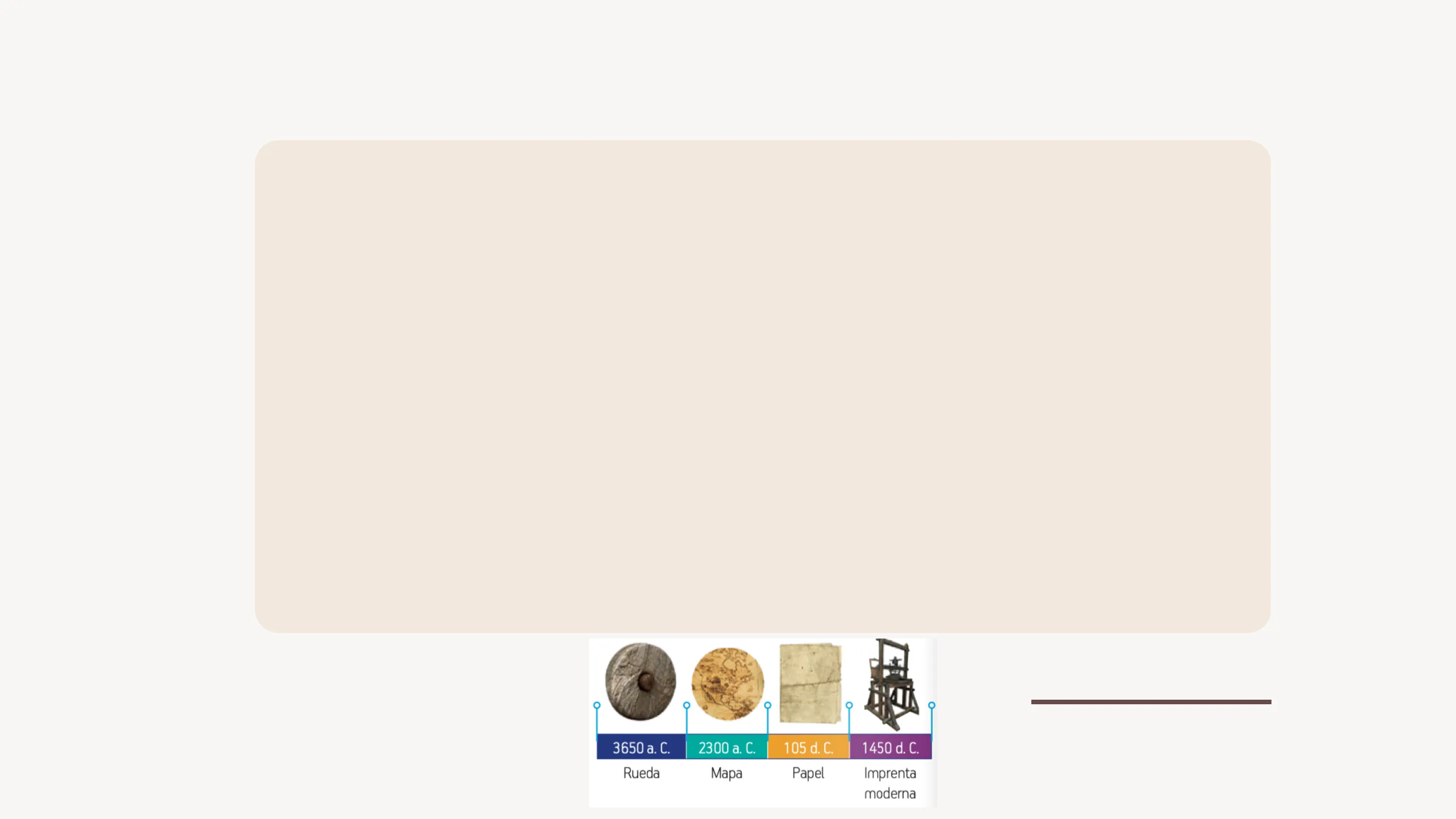
The image shows some of the technological inventions that have been a great contribution to the development of humanity.
This timeline is based on the Gregorian calendar, in which dates are indicated by B.C. (before Christ) and A.D. (after Christ). By comparing two events that occurred after Christ, you can determine the number of years separating them and, furthermore, identify which event happened before and which after. However, in the case of events that occurred before Christ, it is necessary to introduce a new set of numbers known as "the set of integers."
Class video O O O
3650 a. C. 2300 a. C. 105 d. C. 1450 d. C. Rueda Mapa Papel Imprenta moderna
THE SET OF INTEGERS
The set of integers (Z) consists of the positive integers (Z+), the number 0, and the negative integers (Z-). That is, Z = Z- U {0} ≤ Z+. It is determined by extension as follows:
Z={ ... - 3, -2, - 1, 0, 1, 2, 3 ... }.
NUMBER LINE REPRESENTATION OF INTEGERS
Integers can be represented graphically on a number line as follows: · First, a point is located on the number line corresponding to zero. · Second, from this point, marks are drawn, separated from each other by equal spaces, both to the right and left. · Finally, each mark is assigned an integer; positive integers are placed to the right of zero; and negative integers are placed to the left, as shown below.
Enteros negativos Enteros positivos 1 + + -10 -9 -8 -7 -6 -5 -4 -3 -2 -1 0 1 2 3 4 5 6 7 8 9 10
Distance Between Numbers
Thanks to the representation on the number line, it is possible to identify the concept of distance between numbers, which refers to the amount of space that separates two numbers.
2 unidades -3 -2 -1 0 1 2 3 1 unidad
For example, the number 1 and the number -1 are separated by a distance of two units. At the same time, both are separated by one unit from the number zero. The distance is always a positive number or equal to zero; this distance is known as the absolute value. If a is an integer, its absolute value is expressed with the symbol | a |.
ADDITION OF INTEGERS
· To study the addition of integers, two cases are considered: addition of numbers with the same sign and addition of integers with opposite signs.
Addition of Two Integers with the Same Sign
To add two integers with the same sign, add the absolute values of the numbers, and the common sign of the addends is added to the result.
For example, (-6) + (-9) = - 15 (5) + (4) = 9
Addition of Two Integers with Different Signs
To add two integers with opposite signs, obtain their absolute values and subtract the smaller from the larger. The sign of the number with the greater absolute value is added to the result.
For example, (-15) + (10) = - 5 (-8) + (12) = 4
EXAMPLE 1
Observar la información de la tabla que presenta los lugares del planeta que tienen las alturas más extremas, registradas con instrumentos de alta tecnología. Los números negativos indican alturas por debajo del nivel del mar.
¿Cuál es la diferencia en metros entre las profundidades del océano Pacífico y del océano Índico?
Para hallar la diferencia en metros entre las profundidades del océano Pacífico y del océano Índico se realiza una sustracción.
Lugar Altura o profundidad Everest 8 848 m K2 8 611 m Kanchenjunga 8 586 m Océano Pacífico -10 924 m Océano Atlántico -9 219 m Océano Índico -7 455 m
-10 924 - (-7 455) Se plantea la sustracción con las medidas. = - 10 924 + 7 455 Se suma el minuendo con el opuesto del sustraendo. =- 3 469 Se realiza la suma de números enteros. Por tanto, hay una diferencia de -3 469 metros entre las alturas.
Subtraction of Whole Numbers
Subtraction between two whole numbers corresponds to the addition of the minuend and the opposite of the subtrahend. That is, if a, b, and z, then a - b = a + (-b). If the result is a negative number, it indicates that the minuend is less than the subtrahend.
For example, (-14) - (-9) = (-14) + (9) = - 5 12 - (-8) = 12 + (8) = 20
Multiplication of Integers
The multiplication of two integers a and b is called the product, symbolized as a x b = c or a*b = c. The terms a and b are called factors.
When multiplying two integers, two cases arise.
- If the numbers have the same sign, the absolute values of each number are multiplied, and the respective product is positive. For example, (-15)*(-3) = 45.
- If the numbers have different signs, their absolute values are multiplied, and the product is negative. For example, (-25) · 5 = - 125.
Division of Integers
When the product and a factor of a multiplication are known, division is the operation that allows you to find the unknown factor.
If a, b E Z with b = 0, the number c E Z such that b*c = a is called the "exact quotient of a and b." The quotient of a and b is indicated by the notation a/b. Division does not satisfy the closure property, since the quotient of two integers is not always an integer.
To divide nonzero integers, two cases are considered.
- The quotient of two integers with the same sign is positive.
- For example, (-78) + (-26) = 3.
- The quotient of two integers with different signs is negative.
- For example, (-105) + 15 = - 7.
EXAMPLE 1
Un motor de combustión interna está a una temperatura de 20 ℃ cuando esta apagado, y al encenderse alcanza en 15 minutos su temperatura maxima, que es de 95 °C. ¿ Cuanto cambio la temperatura del motor en cada minuto?
Primero, se debe calcular cuál fue el cambio de la temperatura del motor. Para esto se realiza una sustracción entre la temperatura final y la temperatura inicial: 95 - 20 = 75. Segundo, se divide el cambio de temperatura entre la cantidad de minutos que duró el cambio, es decir, 15, 75 + 15 = 5. Por tanto, la temperatura del motor subió 5 ℃ por minuto.
ARITHMETIC POLYNOMIALS WITH INTEGERS
An arithmetic polynomial is a mathematical expression in which several operations are indicated. To solve an arithmetic polynomial, the following cases must be considered:
(-3) . 5 + (-2) 4 Polynomial without grouping signs 2 - {[(2-5) . (4+(-9))] - 10} Polynomial with grouping signs
ARITHMETIC POLYNOMIALS WITHOUT GROUPING SIGNS
To solve an expression without grouping signs, first calculate the powers and roots; then, multiply and divide from left to right; finally, add and subtract from left to right.
Ejemplo Solucionar el polinomio (-3) . 5 + (-2)4.
(-3). 5+(-2)4 Polinomio dado. =(-3) . 5 + 16 Se resuelve la potencia. = (-15) + 16 Se resuelve la multiplicación. =1 Se resuelve la suma.
ARITHMETIC POLYNOMIALS WITH GROUPING SIGNS
The same rules apply to developing an expression with grouping signs, but it is also important to note that grouping signs are eliminated from the inside out. To do this, the operations indicated within each of them are performed following the order suggested in the previous point.
Solucionar el polinomio 2- {[(2-5) . (4 + (-9))] - 10}.
Grouping symbols are: ( ) Parentheses [ ] Brackets {} Braces
2-{[(2-5).(4+(-9))] - 10} Polinomio dado. =2-{[(-3).(-5)] -10} Se resuelven las operaciones de los paréntesis. =2-{15-10} Se resuelve la multiplicación de los corchetes. =2-5 Se resuelve la resta de las llaves. =- 3 Se resuelve la resta.
Solve exercises on book page 19
THE VERNIER SCALE AND RATIONAL NUMBERS
Measuring instruments such as rulers and tape measures have a precision in millimeters, which is sufficient for making drawings with given measurements or measuring a person's height.
However, for situations related to measuring watch parts, or those where greater precision is required, an auxiliary scale known as the vernier or vernier is used.
This second scale, in the case of the meter, divides the millimeter into equal parts, allowing readings to be taken down to hundredths of a millimeter.
Solve exercises on book page 20-21
RATIONAL NUMBERS
The set of rational numbers consists of numbers of the form a/b , a and b are integers, and b # 0.
The set of rational numbers is symbolized as Q and is determined by: Q={%,aybeZyb#0}
a is called the numerator and b is the denominator.
Each rational number is represented by a single point on the number line, where positive rational numbers are located to the right of zero and negative rational numbers are located to the left of zero.
ORDER IN THE SET OF RATIONAL NUMBERS
Given the rational numbers and with a/b and c/d, b y d # 0, one and only one of the following relationships can be established:
흠 < 음 음 > 등 , 흠 = 등
To determine the order relationship between two rational numbers, the numbers are transformed into equivalent fractions with the same denominator. Then, the relationship between the numerators of the equivalent fractions is determined.
Furthermore, if b > 0 and d > 0, it is true that if a/b < c/b, then a*d < b*c
Solve exercises on book page 19
EXAMPLE
Representar en una recta numérica el número - 9 4 .
Para representar en la recta numérica - 9 , primero se determina el par de enteros consecutivos entre los cuales está la fracción. Como - 4 está entre - 3 y - 2, se divide la unidad en cuatro partes y se cuenta a a partir de - 2 una parte a la izquierda, como se muestra en la figura.
9 4 -3 -2 -1 0
Solve exercises on book page 19
OPERATIONS WITH RATIONAL NUMBERS
- Addition and Subtraction: The sum or subtraction of two or more rational numbers with the same denominator is a rational number that corresponds to the sum or subtraction of the numerators with the same denominator.
- Meanwhile, the sum or subtraction of two rational numbers with different denominators is equivalent to the sum or subtraction of equivalent rational numbers with the same denominator.
- Multiplication: The product of two or more rational numbers is another rational number, whose numerator is the product of the numerators and whose denominator is the product of the denominators.
- Division: The quotient of two rational numbers is the product of the first rational number and the reciprocal of the second.
Solve exercises on book page 19
Can’t find what you’re looking for?
Explore more topics in the Algor library or create your own materials with AI.
