Unit 08: Human sexuality and reproduction, a biology presentation
Slides about Human Sexuality and Reproduction. The Pdf, suitable for high school biology students, covers sexual reproduction, the human reproductive cycle, placentation, the stages of pregnancy, and the birth process.
See more31 Pages

Unlock the full PDF for free
Sign up to get full access to the document and start transforming it with AI.
Preview
Human Sexuality and Reproduction
Reproduction or Sexuality?
· Humans reproduce sexually: two different gametes, sperm and egg, need to combine and form a
zygote
· Gametes (sperm and eggs) are produced by men and women respectively.
· Men and women
are sexually
dismorphic: their
external anatomy is
different
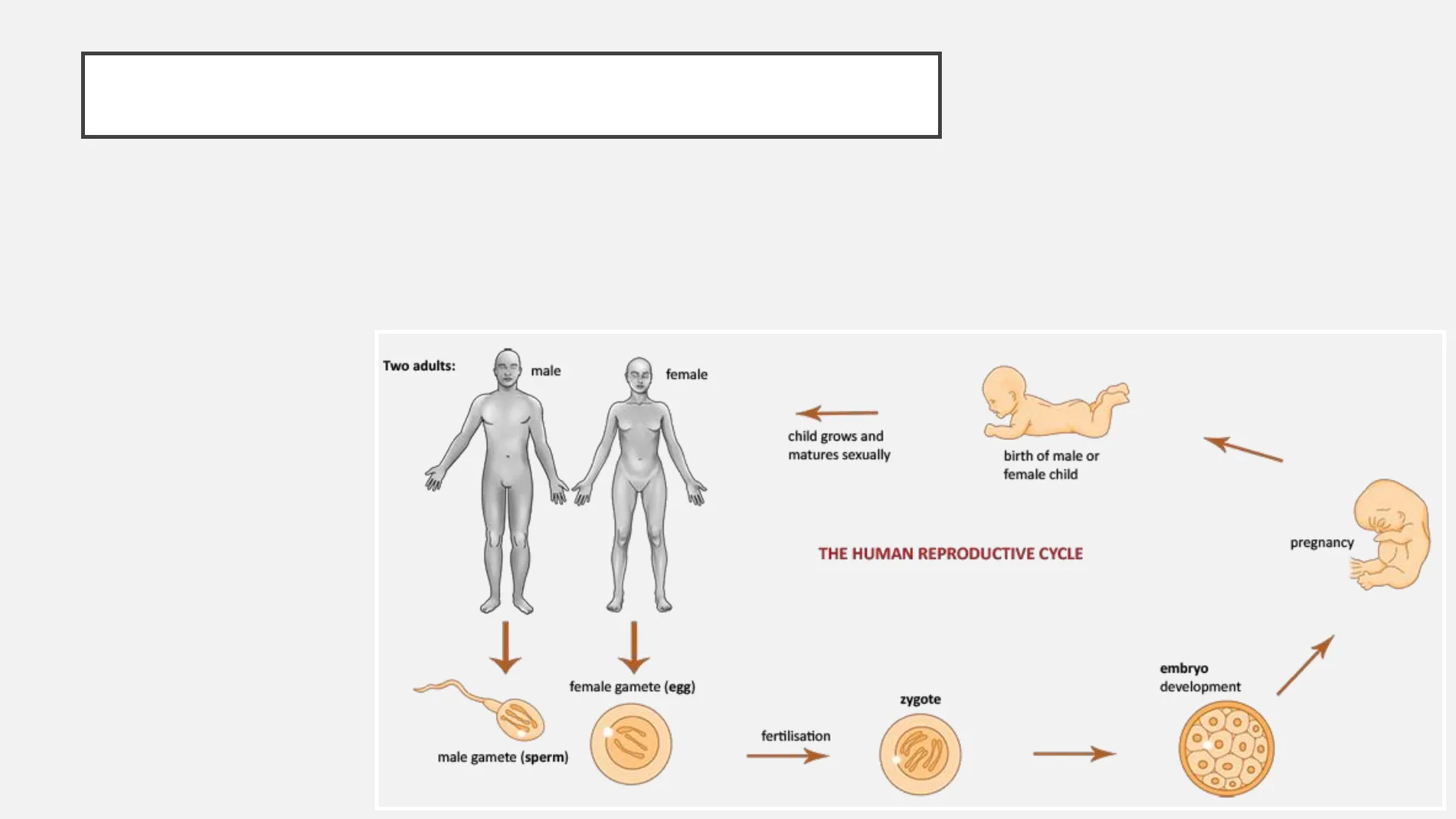
The Human Reproductive Cycle
Two adults:
male
female
child grows and
matures sexually
birth of male or
female child
pregnancy
female gamete (egg)
embryo
development
zygote
fertilisation
male gamete (sperm)
The Male Reproductive System
Penis
· Formed of erectile tissue, a connective tissue with
large spaces that fill with blood when is erect.
· The erectile tissue is found in the three regions that
form penis:
· Two corpora cavernosa
· Corpus spongiosum
· Corpus spongiosum surrounds urethra, keeping it
open at all times. It widens at the end to form:
· Glans: very sensitive area, protected by foreskin.
corpus spongiosum
urethra
corpora cavernosa
Testicles
· Two oval shaped organs inside a sack of skin (scrotum)
and outside the abdominal cavity.
. Each testicle is formed of millions of seminiferous
tubules.
. Walls of seminiferous tubules contain the sperm
precursor cells.
· Temperature of testicles is about 3℃ lower than body
temperature, this is essential for spermatogenesis.
. There are other endocrine cells between seminiferous
tubules which produce androgens (testosterone).
Epididymis
N
Seminiferous
tubules
Genital Tract
bladder
seminal vesicle
vas deferens
Cowper'sgland
prostate
gland
urethra
penis
epididymis
scrotum
testicle
glans
foreskin
Consists of ducts that take sperm to outside:
· Epididymis
· Long, coiled tube attached to the top of each testicle.
· Sperm is stored here while it matures.
· Vas deferens:
· Part of epididymis, passes through prostate and empties
into urethra.
. Secretions from accessory glands empty into vas deferens.
· Urethra:
. Duct shared by reproductive and excretory system.
· Expells semen and urine from body
Accessory Glands
bladder
seminal vesicle
vas deferens
Cowper'sgland
prostate
gland
urethra
penis
epididymis
scrotum
testicle
glans
foreskin
Secrete substances that mix with sperm to form semen:
- Seminal vesicles
. Located behind urinary bladder.
· Empty into final part of vas deferens.
· Produce seminal fluid rich in fructose = energy for sperm. - Prostate gland
· Located underneath bladder, surrounding urethra.
· Produces prostatic fluid.
. Activates sperm and neutralises acidity of female mucous
secretions. - Cowper's glands
· Located at base of penis.
· Secrete lubricating fluid that neutralises acidity of urethra.
The Female Reproductive System
External Genitalia
· Called vulva, formed of:
· Labia majora, two folds of skin that cover
the
· Labia minora, two thinner folds
· Clitoris, a very sensitive organ near the
top junction of the labia minora: it is the
female equivalent of the male glans.
infundibulum
Fallopian
tube
1
ovary
myometrium
endometrium
uterus
cervix
vagina
hymen
vulva
Genital Tract Ducts
Formed of the ducts that take the eggs to outside:
· Fallopian tubes
. Two ducts that empty into uterus.
. Connected to ovaries by infundibulum.
· Uterus
· Hollow, muscular organ, shape of an upside-down pear.
. Narrow section at bottom is cervix, connected to vagina.
. Wall of uterus is formed of myometrium, thick layer of
smooth muscle.
· Inside is covered with endometrium, epitelial cells with
many blood vessels.
· Vagina
. Elastic duct formed of walls of muscle.
· Connects cervix to outside.
. Glands on vaginal wall secrete lubricants.
· External opening is partially covered by a membrane
(hymen).
infundibulum
Fallopian
tube
1
ovary
myometrium
endometrium
uterus
cervix
vagina
hymen
vulva
Ovaries
corpus luteum
medula
cortex
oocyt
follicles
mature egg
. Size and shape of an almond.
· Suspended in abdominal cavity by small ligaments.
· Produce eggs and female hormones (oestrogens and
progesterone).
· Made up of medulla (inside part) and cortex (outside part).
. Cortex contains numerous spherical cavities called follicles.
· Follicles contain immature eggs (oocytes).
· Oestrogens and progesterones are synthesised in follicles at
different times during menstrual cycle.
. When mature follicle releases egg it converts to a corpus
luteum
Formation of Gametes
Sperm Structure
· Sperm consist of three parts:
· Head
. Contains nucleus with 23 chromosomes.
. A human has 46, so half of them come from the
egg.
· Contains acrosome, an organelle containing
enzymes to dissolve outer layer of ovum.
· Midpiece
· Contains numerous mitochondria.
head
acrosome
nucleus
midpiece
tail
· Tail
. Moves thanks to energy provided by mitochondria.
Oogenesis
· Egg formation (oogenesis) occurs inside the ovarian follicles.
. Process begins before birth and stops at oocyte stage.
· Restarts in puberty.
. Oocytes mature to become eggs in a cyclical process: the
ovarian cycle.
. The ovarian cycle occurs every 28 days approx. alternating
between two ovaries.
· Cycle starts with menarche (first period) during adolescence
and continues until menopause.
zona pellucida
nucleus
vitelline
membrane
cytoplasm
corona
radiata
Egg Structure
THE OVARIAN AND MENSTRUAL CYCLES
. They are regulated by pituitary gland and ovarian hormones.
. They occur approximately every 28 days if no fertilisation has occurred.
· The ovarian cycle: changes that occur in the ovary so that an egg can be produced, mature
and be released. It also produces female sex hormones. It occurs during oogenesis,
alternating between the two ovaries.
. The menstrual cycle: changes that occur in the endometrium of the uterus to prepare it for
implantation of the embryo. It occurs periodically
The Ovarian Cycle: Follicular Phase
1 st Follicular phase:
· Starts on the first day of a
period and lasts about 14 days.
· The pituitary gland
produces FSH , which
stimulates the ovaries,
maturating of a follicle and the
oocyte it contains.
· As the follicle grows, it starts to
produce oestrogens.
ovarian
cycle
hormones
menstrual
cycle
0
2 4 6
8
10
12
14
16
18
20
22
24
26
28
FSH
LH
oestrogens
progesterone
The Ovarian Cycle: Ovulation
2nd Ovulation:
· Occurs approximately on day
14, when the levels of FSH
and oestrogens are at their
highest.
. The pituitary gland starts to
release LH, causing the mature
follicle to rupture and release
an egg into the Fallopian
tubes.
· During and just after this
period, the woman is fertile.
ovarian
cycle
hormones
menstrual
cycle
0
2 4 6
8
10
12
14
16
18
20
22
24
26
28
FSH
LH
oestrogens
progesterone
The Ovarian Cycle: Luteal Phase
3rd Luteal phase:
. Lasts approximately between
day 15 and day 28.
· If fertilisation has not taken
place, on day 28 the woman
starts her period.
· The broken follicle transforms
to become the corpus luteum.
. LH stimulates the corpus
luteum to
ovarian
cycle
hormones
menstrual
cycle
0
2 4 6
8
10
12
14
16
18
20
22
24
26
28
secrete progesterone.
FSH
LH
oestrogens
progesterone
The Menstrual Cycle: Proliferative Phase
1 st Proliferative phase:
· Begins when menstruation
ends and lasts until
ovulation.
· The oestrogens produced
by the ovarian follicle
stimulate the endometrium
in the uterus, causing it
to thicken.
ovarian
cycle
hormones
menstrual
cycle
0
2 4 6
8
10
12
14
16
18
20
22
24
26
28
FSH
LH
oestrogens
progesterone
The Menstrual Cycle: Secretory Phase
2nd Secretory phase:
· Starts after ovulation and
continues until the start of
the next period.
· Progesterone secreted by
the corpus luteum causes
maximum thickening of
the endometrium,
preparing it for possible
implantation of a fertilised
ovum.
ovarian
cycle
hormones
menstrual
cycle
0
2 4 6
8
10
12
14
16
18
20
22
24
26
28
FSH
LH
oestrogens
progesterone
The Menstrual Cycle: Menstruation
3rd Menstruation:
· Starts on the first day of the
cycle and lasts between five
and seven days.
· If fertilisation has not taken
place during the previous
cycle, the corpus luteum
breaks down in the ovary and
stops producing
progesterone. This causes the
endometrium to break away.
ovarian
cycle
hormones
menstrual
cycle
0
2
4
6
8
10
12
14
16
18
20
22
24
26
28
FSH
LH
oestrogens
progesterone
Hormonal Regulation of Cycles
Pituitary
gland
LH/FSH
Estrogen and
progesterone
Ovary
Uterus
Ovulation Cycle Diagram
28
1
27
2
26
3
25
4
24
5
PERIOD
23
6
22
LUTEAL
PHASE
7
FOLLICULAR
PHASE
8
20
9
19
FERTILE
WINDOW
11
17
12
16
13
15
14
21
10
18
Woman's Menstrual Cycle Calendars
September
1
2
3
4
5
6
7
8
9
10
11
12
13
14
15
16
17
18
19
20
21
22
23
24
25
26
27
28
29
30
CALENDARS of a
woman's menstrual
cycles
November
1
2
3
4
5
6
7
8
9
10
11
12
13
14
15
16
17
18
19
20
21
22
23
24
25
26
27
28
29
30
October
1
2
3
4
5
6
7
8
9
10
11
12
13
14
15
16
17
18
19
20
21
22
23
24
25
26
27
38
29
30
31
December
1
2
3
4
5
6
7
8
9
10
11
12
13
14
15
16
17
18
19
20
21
22
23
24
25
26
27
28
29
30
31
- Longer and shorter cycle duration
- Ovulation day of each cycle
- Fertile period of each cycle
- The days of September when the egg develops in, matures and leaves the ovary (days after
menstruation and before ovulation) - The days of September when the egg reaches the uterus (days after ovulation and before
menstruation)
From Fertilisation to Birth
- FERTILISATION and IMPLANTATION
- PLACENTACION
- PREGNANCY
- BIRTH
Fertilisation Process
Fusion of a sperm (23 chromosomes) and an egg (23 chromosomes)
to form a zygote (46 chromosomes)
Occurs inside female reproductive system, generally in Fallopian
•
tubes.
· Occurs during ovulation (wandering of egg to uterus).
· Egg can survive for 24-48 h, sperm survive for ~72 h (or longer!).
. After fertilisation, the zygote starts dividing very quickly to form a
mass of cells called the morula.
. Morula travelles through Fallopian tubes to uterus.
. Morula develops to form embryo.
· Embryo adheres to endometrium of uterus (implantation).
Fertilisation and Implantation Steps
1.FERTILISATION AND IMPLANTATION
1
300 000 000 sperm are deposited in the vagina, but only one will fuse the egg.
2
Sperm releases enzymes from its acrosome to break down egg membranes so that the sperm's head
can penetrate the egg. Egg secretes the fertilisation membrane, which prevents more sperm from
penetrating. The fusion forms the zygote.
3
formation of the embryo
3
Zigote divides to morulla and to
embryo. During its first days embryo
receives nutrients from ovum's
vitellus.
4
Embryo penetrates the endometrium,
which contains many blood vessels.
2 fusion of gametes
embryo
morula
zygote
..
4
implantation
sperm
egg
1
approximation
of gametes
Can’t find what you’re looking for?
Explore more topics in the Algor library or create your own materials with AI.
