Topic 1: Madrid Primary Education English, Magister Notes
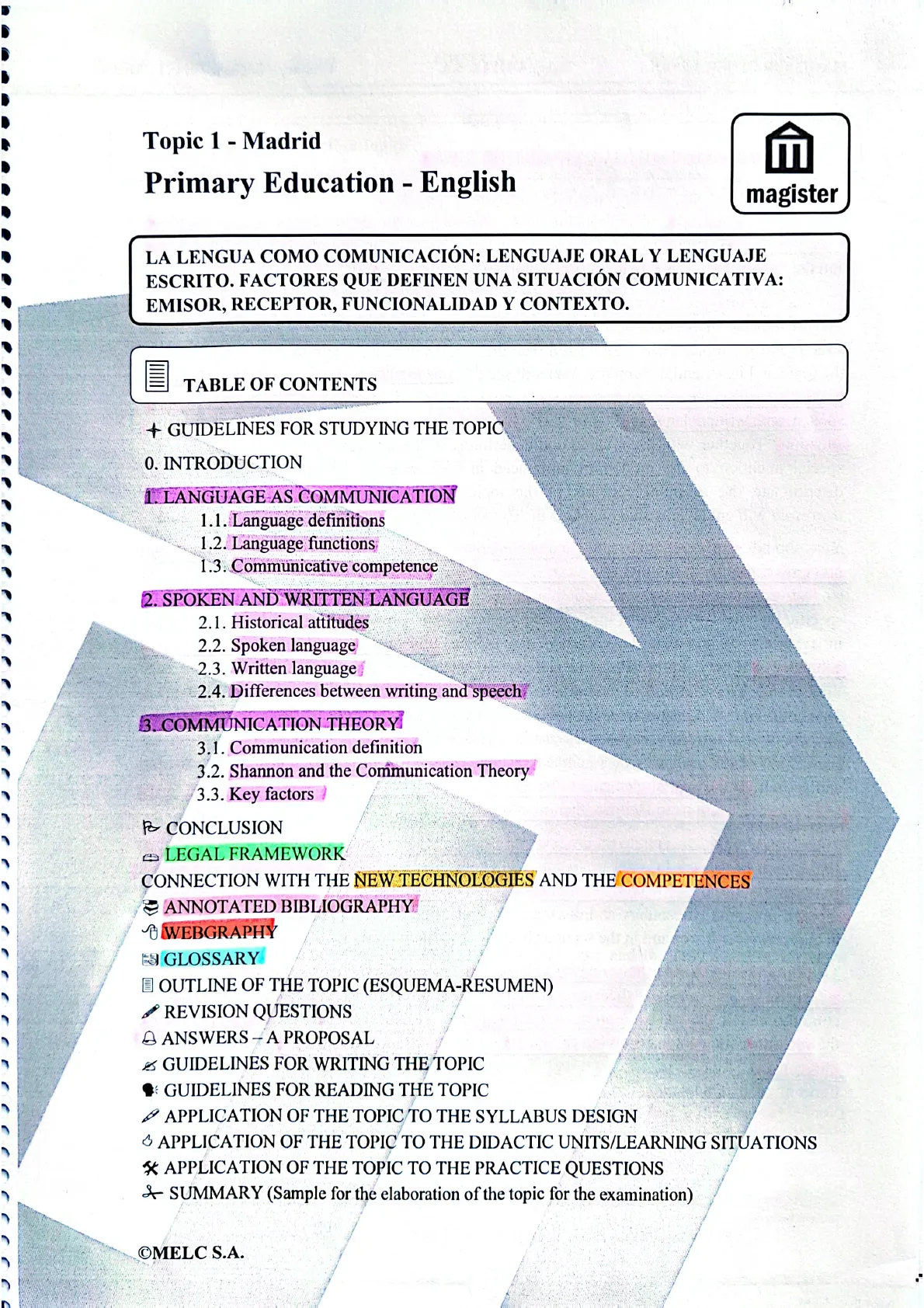
Document from Magister about Topic 1 - Madrid Primary Education - English. The Pdf provides guidelines for studying communication, covering oral and written language, communication theory, and legal frameworks. This material is designed for Civil service exams in Languages.
See more33 Pages

Unlock the full PDF for free
Sign up to get full access to the document and start transforming it with AI.
Preview
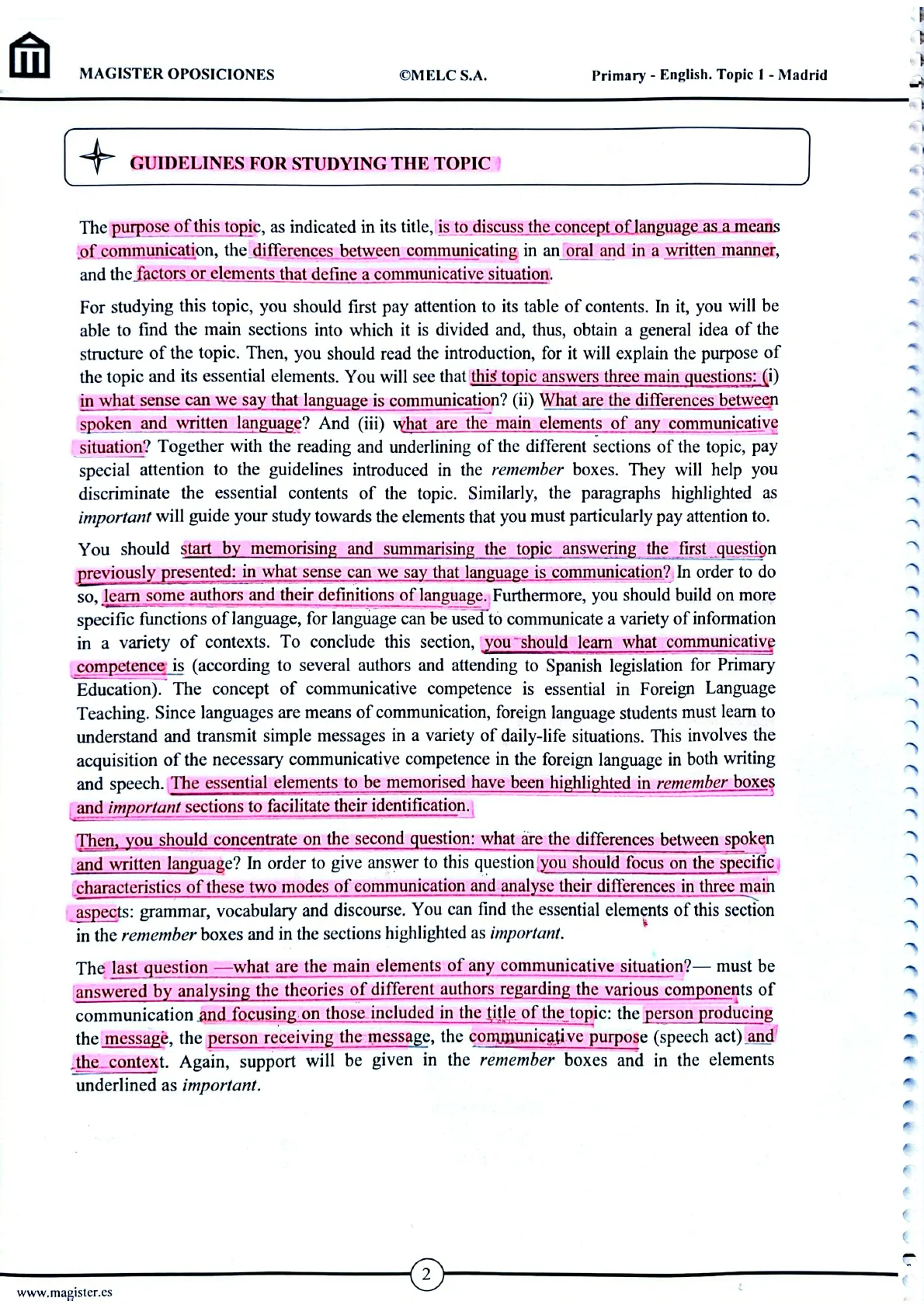
GUIDELINES FOR STUDYING THE TOPIC
The purpose of this topic, as indicated in its title, is to discuss the concept of language as a means of communication, the differences between communicating in an oral and in a written manner, and the factors or elements that define a communicative situation.
For studying this topic, you should first pay attention to its table of contents. In it, you will be able to find the main sections into which it is divided and, thus, obtain a general idea of the structure of the topic. Then, you should read the introduction, for it will explain the purpose of the topic and its essential elements. You will see that this topic answers three main questions: (i) in what sense can we say that language is communication? (ii) What are the differences between spoken and written language? And (iii) what are the main elements of any communicative situation? Together with the reading and underlining of the different sections of the topic, pay special attention to the guidelines introduced in the remember boxes. They will help you discriminate the essential contents of the topic. Similarly, the paragraphs highlighted as important will guide your study towards the elements that you must particularly pay attention to.
You should start by memorising and summarising the topic answering the first question previously presented: in what sense can we say that language is communication? In order to do so, learn some authors and their definitions of language. Furthermore, you should build on more specific functions of language, for language can be used to communicate a variety of information in a variety of contexts. To conclude this section, you should learn what communicative competence is (according to several authors and attending to Spanish legislation for Primary Education). The concept of communicative competence is essential in Foreign Language Teaching. Since languages are means of communication, foreign language students must learn to understand and transmit simple messages in a variety of daily-life situations. This involves the acquisition of the necessary communicative competence in the foreign language in both writing and speech. The essential elements to be memorised have been highlighted in remember boxes and important sections to facilitate their identification.
Then, you should concentrate on the second question: what are the differences between spoken and written language? In order to give answer to this question you should focus on the specific characteristics of these two modes of communication and analyse their differences in three main aspects: grammar, vocabulary and discourse. You can find the essential elements of this section in the remember boxes and in the sections highlighted as important.
The last question -what are the main elements of any communicative situation ?- must be answered by analysing the theories of different authors regarding the various components of communication and focusing on those included in the title of the topic: the person producing the message, the person receiving the message, the communicative purpose (speech act) and the context. Again, support will be given in the remember boxes and in the elements underlined as important.
Connection with other topics
This topic is very much related with other topics analysing the nature of language and communication, particularly topics 2 and 3, which deal with verbal and non-verbal communication, and spoken and written communication respectively. Topics 7 and 8 also deal with communication and the language skills: topic 7 with the oral skills (listening and speaking) and topic 8 with written skills (reading and writing). The concept of communicative competence (1.3.) is also developed in topics 2, 3, 13 (didactics of Foreign Language Teaching) and 14 (methods and techniques of FLT related to the acquisition of communicative competence), However, the concept of communicative competence could be developed in any topic since, according to Spanish legislation; it is the ultimate goal of FLT.
INTRODUCTION
Traditional Foreign Language Teaching concentrated on getting students consciously to learn items of language in isolation. These bits of information would be mainly used to read texts and only occasionally for oral communication. The focus was not on communication, but on a piece of language. Following Krashen's distinction between acquisitions and learning" we can say that people got to know about the language (learning) but could not use it in a real context (acquisition).
The British applied linguist Allwright tried to bridge this dichotomy when he theorised that if the language teacher's management activities were directed exclusively at involving the learners in solving communication problems in the target language, then language learning would take care of itself. We may or may not agree with this extreme rendering of the Communicative Approach2, but we all agree nowadays on the importance of letting our pupils use English for real communication during, at least, the production stage".
In this unit we are going to study language and its functions to see that communication is one of these functions. We will then posit that learning a language is not only a grammatical and lexical process, but also a social process. We will also analyze the differences between writing and speech; and finally we will discuss the most important communication theory models, defining their key factors.
It is important to establish the connection between our topic and the law. The Organic Law (3/2020, of 29th December which modifies the Organic Law 2/2006 of 3rd May of Education (LOE-LOMLOE), the Royal Decree 157/2022, 1st March, which establishes the organization and Stephen Krashen identifies two types of linguistic knowledge in Second Language Teaching: acquisition and learning. Acquisition occurs automatically when the learner engages in natural communication where the focus is on meaning and where there is comprehensible input. Acquisition is, therefore, unconscious and consists of subconscious second- language rules which the learner can call upon automatically. Learning, on the other hand, occurs as a result of formal study where the learner is focused on the formal properties of the second language. Learning is a conscious process and consists in metalinguistic knowledge which can only be used to monitor output generated by means of acquired knowledge. 2 See topic number 13 for further information. m The production stage is mainly used to give pupils the opportunity to experiment on their own and allow them to see how much they have really understood and learnt of the language that has been practised under controlled conditions so far. This stage also provides both teachers and pupils with feedback about the learning/teaching process.
minimum teachings of Primary Education, and DECREE 61/2022, of July 13, of the Governing Council, which establishes for the Community of Madrid the organization and curriculum of the stage of Primary education indicate that, among the general objectives of Primary Education, is the acquisition of a basic communicative competence in a foreign language. Students will thus have to be able to understand and convey messages in a variety of daily-life communicative situations (in both writing and speech).
LANGUAGE AS COMMUNICATION
Language definitions
CONNECTION: We will start by providing different definitions of language to defend the idea that languages are means of communication as the title of the topic affirms.
The word language has prompted innumerable definitions. Some focus on the general concept of language (what we call "lengua" or "lenguaje") and some focus on the more specific notion of a language (what we call "lengua" or "idioma").
Sapir (1921) said that: "Language is a purely human and non-instinctive method of communicating ideas, emotions and desires by means of voluntarily produced symbols".
Trager (1949) said that: "A language is a system of arbitrary vocal symbols by means of which the members of a society interact in terms of their total culture".
Hall (1964) defined language as: "The institution whereby humans communicate and interact with each other by means of habitually used oral-auditory arbitrary symbols."
As we can see in these definitions it is difficult to make a precise and comprehensive statement about formal and functional universal properties of language so some linguists have tried to identify the various properties that are thought to be its essential defining characteristics.
The physical aspects of human teeth, larynx and so on are not shared by other creatures and may explain why only the human creature has the capacity for speech. However, we did not suggest that the human was the only creature which was capable of communicating. All creatures, from apes, bees, dolphins, through to zebras, are capable of communicating with other members of their species. The most widely acknowledged comparative approach has been proposed by Charles Hockett, who used a zoological mode of enquiry to identify the main points of connection between language and other systems of communication, especially those found in animals. The range and complexity of animal communication systems are staggering and we could not hope even to summarise their diverse properties here. What we can do, as part of an investigation of language, is concentrate on those properties which differentiate human language from all other forms of signalling and which make it a unique type of communication system (Yule, 1985).
Can’t find what you’re looking for?
Explore more topics in the Algor library or create your own materials with AI.
