Module IV: Expression of the Genetic Information, Transcription
Slides from University about Module IV. Expression of the genetic information Unit 11: Transcription. The Pdf, a presentation for University students in Biology, explores the molecular mechanisms of DNA transcription into RNA and the factors regulating this process in eukaryotes, with detailed diagrams and concise text.
See more34 Pages


Unlock the full PDF for free
Sign up to get full access to the document and start transforming it with AI.
Preview
Module IV. Expression of the genetic information
Unit 11: Transcription
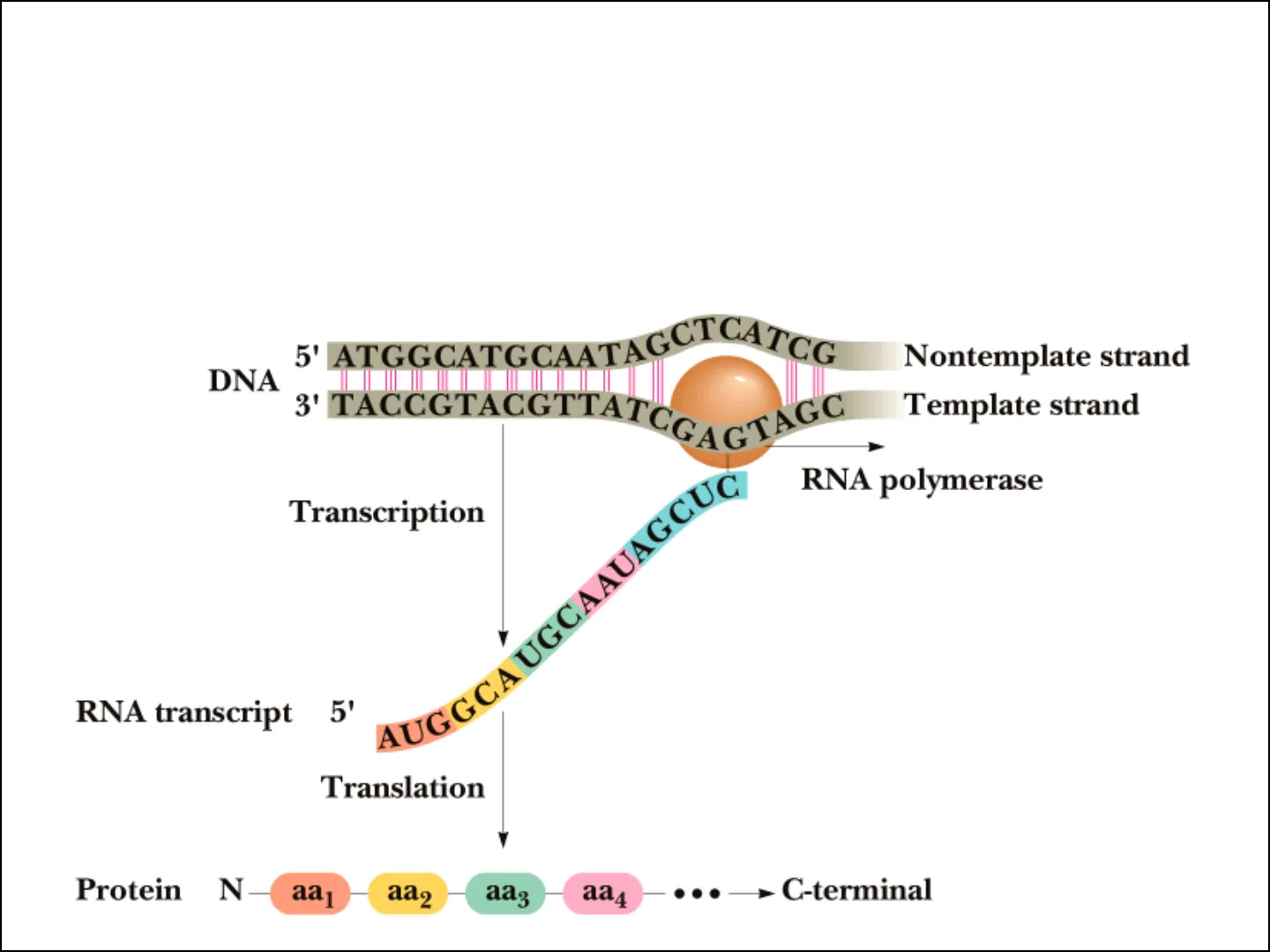
Transcription is the process by which RNA is synthesized using DNA as a template. Thus, the genetic information stored in the DNA is transferred to the RNA and, in structural genes, it becomes available for the synthesis of proteins in the ribosomes. It is a selective process, only the necessary genetic messages are transcribed at the same time according to the energy needs of the cell.
CAATAGCT ATCG Nontemplate strand DNA 5' ATGGCATGCAAT 3' TACCGTACGTTATC GTAGC Template strand RNA polymerase Transcription CA UGCAAUAGCU RNA transcript 5' Translation Protein N aa1 aa2 aa3 aa4 .... - C-terminal
Differences between gene expression of Prokaryotes and Eukaryotes
- Chromatin structure of eukaryotic DNA.
- The primary transcription product of the eukaryotic structural genes must be matured.
- Monocistronic eukaryotic mRNA vs polycistronic prokaryotic mRNA.
- Transcription and translation coupled in prokaryotes vs compartmentalization (transcribed / matured / exported / translated) in eukaryotes.
- Single prokaryotic RNA polymerase vs three eukaryotic RNA polymerases.
1 w 6 7 DNA monocatenario desplazado DNA bicatenario del intrón (a) DNA monocatenario desplazado 12 79 8 Hibrido de DNA-RNA pro eu Hibrido de DNA-RNA DNA monocatenario desplazado
Messenger RNA
Prokaryotes
A B One RNA Polymerase 5' 3' C - mRNA Translation D Exit to citoplasm AAAn Translation Polycistronic mRNA
Eukaryotes
Three RNA Polymerases 3' 5' pre mRNA Processing 5' Cap C AAAn E Monocistronic mRNA
Coding and template strands
+1 DNA strands: Coding-+ 5' - TG GA ATT GT GAG CG GATA ACA AT TT CA CACAGGA AACAGCTATGACCATG-3' Template-+ 3' - AC CT: TA ACA CT CG CC TATTGT TAAAGTGTGTCCTTTGTCGATACTGGTAC-5' RNA transcript 5' ........... p AU UGUGAGCGGAUA ACAAUUUCACACAGGAAACAGCUAUGACCAUG 3' Upstream Downstream Sense (coding) strand 5' 5' RNA 3' 5' Antisense (noncoding) strand
Transcriptional units: Promoter, coding región and terminator
Gene A Gene B Gene C Gene D 5' 3' 3' 5' Template strands 3' T
Where the transcription begins and ends
(A) start site gene stop site 5' 3' 3 5' DNA promoter terminator template strand RNA polymerase RNA SYNTHESIS BEGINS 5' 31 31 5' sigma factor 5' growing RNA strand 5' 31 3' 5' TERMINATION AND RELEASE OF POLYMERASE AND COMPLETED RNA CHAIN 31 5' sigma factor rebinds 5' 3' 3' 5' @1998 GARLAND PUBLISHING
Prokaryotic promoter
Transcription start site 40-50 bp Promoter Transcribed region of gene Coding strand 5' Template strand 3' TGTTGACA TATAAT 3' DNA 5' - -35 region -10 region +1 Conserved distance: 17 (+/- 1) pb 5' 3' RNA product -35: Frequency of transcription (No. of copies per RNA Pol complex entry) -10: Transcription fidelity (copies always start at +1) TATA- or Pribnow-box. Closed complex Open complex
Transcription in Prokaryotes
RNA transcript 5' P-P-P B' RNAP complex 3' 5' Transcription 350-380 KDa Core + 70 KDa o Template read 3'-5' RNA synthesis 5'-3' σ 5' 3' RNAP complex
E. coli RNA polymerase subunits
Subunidad Gen Amino- ácidos Tamaño (kDa) Función rpoB 1.342 150 rpoC 1.407 155 a rpoA 329 36 0 70 rpoD 613 70 Centro catalítico Unión inespecífica al DNA Asociación entre B y B' Reconocimiento del promotor
Transcription in Prokaryotes: Closed-Open complex
DNA +1 -35 -10 Closed promoter complex RNA polymerase Transcription bubble Nontemplate strand RNA polymerase Open promoter complex Rewinding 5' DNA 3 3 Template strand RNA RNA 5' RNA-DNA hybrid, 8 bp Active site Direction of transcription n L 18 pb 48-50 pb o subunit Unwinding Open RNAPol complex protects DNA from -40 to +3 (+/-3)
Transcription start site
1 Promoter Transcribed region of gene Coding strand 5' Template strand 3' TGTTGACA TATAAT 3 DNA 5 -35 region -10 region -> +1 RNA transcript 5' P-P-P B 3 Transcription 5 2 5' 3ª RNAP complex RNA polymerase holoenzyme P - P Sigma factors Core polymerase 1. Template binding + ATP + XTP 2. RNA chain initiation pppApX pppA 3. RNA chain elongation pppA pppA XTP P P XTPA XTP XTP Sigma factor release Coding strand 5' Template strand 3' AGCCCGC TCGGGCG GCGGGCT CGCCCGA 3' DNA AAAAAAAA 5 TT TTTT 3 DNA AAAAAAAA UUUUUUU-3' 5' U A U G C C G C G CG G C 5' C G RNA transcript Negative control factors: repressors Positive control factors: activators t Helicases and Topoisomerases Iniciation, elongation and termination 4. RNA chain termination and enzyme release DOC Termination factors Antitermination factors Direction of transcription Coding strand 5' Template strand 3' 5 RNA 3 product O
Prokaryotic terminator
rho-independent and rho-dependent. Conserved distance (40 pb) A and B: inverted repeats Direction of transcription A B Coding strand 5' AGCCCGC TCGGGCG GCGGGCT CGCCCGA TTTTTTTT AAAAAAAA 3' DNA Template strand 3' 5' TTTTTTTT Coding strand 5' DNA Template strand 3' AAAAAAAA UUUUUUU-3' U A U G C CG C G CG G C C G RNA transcript 5' 1 1 ATP 1 + H20 RNA polymerase Rho (p) protein ADP + Pi ppp 5' rho: homohexamer with ATP-dependent helicase activity that interacts with the DNA-RNA hybrid, pulling apart DNA and RNA and thus releasing the transcript. 3' 5' rho-dependent termination
Transcription control in prokaryotes
Francois Jacob Jacques Monod
Transcription control in prokaryotes: RNA polymerases
Secuencias promotoras de E. coli para RNA polimerasas Genes Factor o de la RNA polimerasa Secuencias del promotor 5' + 3' La mayoría de los genes Choque térmico @70 TTGACA N16-18 TATAAT ₲32 TNNCNCNCTTGAA N13-15 CCCCATNT Metabolismo del nitrógeno 54 TGGYAYA NNNN YYGC N: Cualquier nucleotido. Y: Nucleótido de pirimidina. Dirección de la transcripción - Gen regulador Centros de control Genes estructurales 1 N DNA RNA polimerasa mRNA para el represor 1 mRNA poligénico Ribosomas Ribosomas H OH H OH Lactose (B-D-Galactopyranosyl-(1->4)-a-D-glucose Proteína represora (activa) + ß-galactosidasa Permeasa Proteína A Lac Operon CH2OH CH2OH O H HO H H B >1 0 4 OH H OH H H OH H Proteínas codificadas Inductor Complejo inductor-represor (inactivo) z codes for ß-galactosidase: it catalyzes the hydrolysis of lactose into glucose and galactose. y codes for galactoside permease: transports b-galactosides into the bacterial cell. a codes for thiogalactoside transacetylase: catalyzes the transfer of the acetyl group from acetyl Coenzyme-A to 6-OH from a thiogalatoside acceptor. It is not essential for the metabolism of lactose, but it is necessary to detoxify other products that enter by permease. -0 H 8 Alternative o factors
Lactose Operon
De- repressor Regulator gene Control elements Structural genes Lactose I P O Z Y A Repressor protein Promoter ß-galactosidase Transacetylase Operator Permease Gene arrangement on bacterial chromosome Regulator gene Control elements Structural genes DNA I P O Z Y A
Lactose Operon: W/O de-repressor
RNA polymerase DNA I P O Z Y A Transcription Repressor binds operator mRNA Translation Active repressor protein No transcription There is no gene transcription because repressor is blocking RNA polymerase accces to promoter
Lactose Operon: W/ de-repressor
RNA polymerase DNA I P 0 Z Y A Transcription Transcription mRNA Translation Lactose mRNA Translation Protein folding Active repressor protein C ß-galactosidase Permease Transacetylase
Transcription control in prokaryotes: lac Operon
Promotor Gen i Centro de unión del complejo CAP-AMP-cíclico Centro de entrada de la RNA polimerasa Operador Señal de iniciación Gen z Centro del represor + fMet - Thr - Met GAAAGCGGGCAGTGAGCGCAACGCAATTAATGTGAGTTAGCTCACTCATTAGGCACCCCAGGCTTTACACTTTATGCTTCCGGCTCGTATGTTGTGTGGAATTGTGAGCGGATAACAATTTCACACAGGAAACAGCTATGACCATG 3' CTTTCGCCCGTCACTCGCGTTGCGTTAATTACACTCAATCGAGTGAGTAATCCGTGGGGTCCGAAATGTGAAATACGAAGGCCGAGCATACAACACACCTTAACACTCGCCTATTGTTAAAGTGTGTCCTTTGTCGATACTGGTAC 5' 1 10 20 30 40 50 60 70 80 90 100 110 120 Promotor Operador (a) Señal de iniciación i CAP 0 Z y a 1 Centro de entrada para la RNA polimerasa (b) Promotor Operador i Z y a Dirección de la transcripción -> CAMP RNA polimerasa I Complejo represor- inductor (c) Promotor Operador i Z y a Represor RNA polimerasa Secuencia del DNA - Glu -- Gly - Gln - Ser - Stop
Tryptophan Operon
Co-repressor Regulator gene Control elements Structural genes Tryptophan I P O E D C B A I 1 1 1 1 1 Repressor protein Promoter trpE trpD trpC trpB trpA Operator Gene arrangement on bacterial chromosome Regulator gene Control elements Structural genes DNA R P O E D C B A Active when there is need to synthesize tryptophan. Negative control mediated by corepressor (tryptophan).
Tryptophan Operon: W/O co-repressor
RNA polymerase DNA R P O E D C B A Transcription Active repressor protein Transcription mRNA Translation Translation mRNA Protein folding Active repressor protein trpE trpD trpC trpB trpA Repressor without co-repressor could not join the operating region.
Tryptophan Operon: With co-repressor
RNA polymerase DNA R P E D C B A Transcription Repressor binds operator mRNA Active repressor protein Translation Active repressor protein Tryptophan No transcription There is no gene transcription because co-repressor bind to repressor protein allows this to enter the operator, blocking RNA polymerase accces to promoter
Repression/Activation: Ara Operon (E. coli)
= araO2 araO. CRP site ara Promoter araB araA araD AraC/arabinose + CRP/CAMP AraC AraC araBAD mRNA araB araA araD AraC AraA AraB AraD Arabinose L-Ribulose L-Ribulose- 5-P D-Xylulose- 5-P Arabinose (a) ara operon araC arao -Binding of AraC to araO2 and aral inhibits transcription of araBAD AraC aral araB araA araD Binding of AraC to araO, inhibits transcription of araC Arac araO. CRP site (b) Negative regulation at low arabinose levels 2 .- Induction at high concentration of arabinose CAMP araO. 2 araO, CRP site aral Promoter araB araA araD CRP AraC araBAD mRNA (c) Positive regulation at high arabinose levels CAMP CRP araC araC promoter + AraC mRNA AraC 2 1 .- Repression at low concentration of arabinose Binding of cAMP- CRP plus AraC-arabinose promotes transcription of araBAD
Regulation of gene expression in eukaryotes
1 .- Reversible: Similar to bacterial; Genes that are regulated according to metabolic needs. Escherichia coli 2 .- Non-reversible: differentiation genes; in development processes there is growth but also differentiation, where the cell is no longer able to "go back" in its genetic program. Mus musculus
Can’t find what you’re looking for?
Explore more topics in the Algor library or create your own materials with AI.
