GCSE History Edexcel: Nazi Dictatorship, 1933-1939
Document from Gcse History Edexcel about GCSE History Edexcel Nazi Dictatorship, 1933-1939. The Pdf covers the Nazi dictatorship in Germany between 1933 and 1939, including Hitler's rise to power, propaganda, and cultural changes, suitable for High school History students.
See more34 Pages

Unlock the full PDF for free
Sign up to get full access to the document and start transforming it with AI.
Preview
Nazi Dictatorship, 1933-1939
Contents
- How Did Hitler Create A Dictatorship by 1934?
- The Nazi Police State
- Religion in Nazi Germany
- Nazi Propaganda
- Culture Changes in Nazi Germany
- Support & Opposition to the Nazi Party
How Did Hitler Create A Dictatorship by 1934?
Your notes
Summary of Hitler's Rise to Power
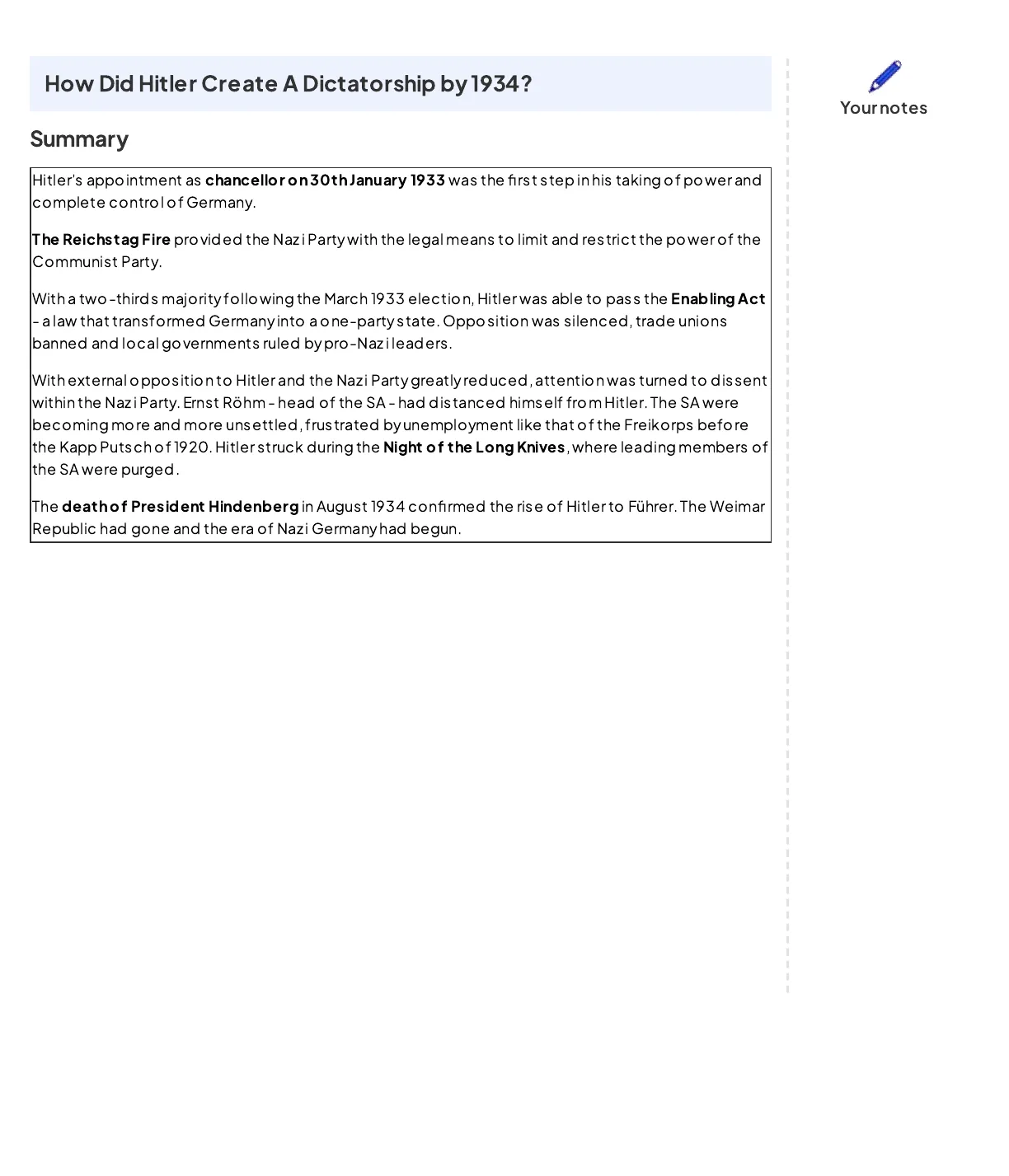
Hitler's appointment as chancellor on 30th January 1933 was the first step in his taking of power and complete control of Germany.
The Reichstag Fire provided the Nazi Party with the legal means to limit and restrict the power of the Communist Party.
With a two-thirds majority following the March 1933 election, Hitler was able to pass the Enabling Act - a law that transformed Germany into a one-party state. Opposition was silenced, trade unions banned and local governments ruled by pro-Nazi leaders.
With external opposition to Hitler and the Nazi Party greatly reduced, attention was turned to dissent within the Nazi Party. Ernst Rohm - head of the SA - had distanced himself from Hitler. The SA were becoming more and more unsettled, frustrated by unemployment like that of the Freikorps before the Kapp Putsch of 1920. Hitler struck during the Night of the Long Knives, where leading members of the SA were purged.
The death of President Hindenberg in August 1934 confirmed the rise of Hitler to Führer. The Weimar Republic had gone and the era of Nazi Germany had begun.
The Reichstag Fire
Your notes
Hitler became Chancellor of Germany on 30th January 1933, but still did not have complete control of Germany:
- The Nazi Party only controlled one-third of the Reichstag
- Hindenburg was President of Germany
- The Weimar Constitution limited the power of the chancellor
A fire destroyed the Reichstag building on 27th February 1933:
- A Dutch communist named Marinus van der Lubbe was arrested at the scene and later executed
- The fire resulted in the arrests of around 4,000 communists
Hitler persuaded Hindenburg to pass the Reichstag Fire Decree:
- The Reichstag Fire gave Hitler the opportunity to scapegoat the Communist Party (KPD)
- Political opponents were imprisoned legally and communist newspapers were shut down
- The SA was able to justify using violence and intimidation towards political opponents
The Nazi Party increased their seats to 288 in the March 1933 election, giving them a two-thirds majority in the Reichstag
Your notes
Worked Example: Reichstag Fire Inference
Give two things you can infer from Source A about how the Nazis reacted to the Reichstag Fire (4 marks)
Source A: From a description of the Reichstag Fire written by Rudolf Diels. At the time of the Reichstag Fire, Diels was a senior policeman in Berlin
The Reichstag was still burning when arrived. Hitler stood on a balcony staring into the flames. He shouted uncontrollably: 'There will be no mercy. Even Communist official must be shout wherever he is found'
Iordered a radio message to be sent out, putting the police on a state of alert. The police already had lists of people to arrest, which had been prepared for such an emergency.
When I returned to police headquarters later that night it was buzzing with activity. Some suspects were already being brought in under arrest.
Answers:
(i) What Icaninfer: The Nazi Party was organised in advance (1) Details in the source that tell me this : "The police already had lists of people to arrest"(1)
(ii) What Icaninfer: Hitler reacted aggressively to the fire (1) Details in the source that tell me this : "There will be no mercy" (1)
This answer would receive full marks because it contains two relevant inferences, supported by details from the source.
The student's inferences are targeted at the focus of the question - how the Nazis reacted to the Reichstag Fire.
Exam Tip for Inferences
Answers such as 'Hitler ordered communist officials to be shot' would not be awarded with a mark. Remember, anything stated in the source is not considered an inference.
Your notes
The Enabling Act
- The Enabling Act became law on 24th March 1933 by 444 votes to 94:
- All 81 members of the Communist Party were absent
- Only the SPD opposed the vote
- Other members of the Reichstag were intimidated by the SA before the vote took place
The Act gave the Nazi Party a number of powers:
- As chancellor, Hitler could propose new laws
- Hitler's cabinet could pass these laws
- These laws could overrule the Weimar Constitution
The Enabling Act was only valid for four years, but it was renewed again in 1937
- Parties in the Reichstag could no longer oppose new laws, marking an end to democratic rule in Germany
Exam Tip: Reichstag Fire Decree and Enabling Act
Consider the significance of the Reichstag Fire Decree and its links to the Enabling Act: Hitler, byreducing the power of the Communist Party and branding them enemies of Germany, could weaken opposition while also strengthening his own position. Many members of the public mistakenly believed the Enabling Act to have been created to protect their security and livelihoods. However, it was used as a tool by Hitler to set up the foundations for a police state.
Removing Public Opposition
The Enabling Act provided Hitler and the Nazi Party the power to pass laws without the consent of the Reichstag
Hitlerused the powers of the Enabling Act to remove forms of public opposition:
The Night of the Long Knives
Your notes
The Enabling Act allowed Hitler to remove external opposition to the Nazi Party
- Hitler was concerned about internal opposition, particularly from the head of the SA - Ernst Röhm:
- Röhm was a suspected homosexual, which did not align with Nazi Party values
- Röhm led around three million SA members, around 60% of which were unemployed by 1933
- Röhm wanted a greater focus on supporting the working class, which contrasted with Hitler's desire to help the rich
- Röhm's SA clashed with the SS, led by Heinrich Himmler and Reinhard Heydrich
Hitler arranged a meeting with Rohm and other SA leaders at a hotel in the town of Bad Wiessee on 30th June 1934:
- Röhm and around 400 SA members were arrested and later shot
- Other opponents such as von Schleicher, Gregor Strassor and von Kahr were also arrested and killed
The public were informed that Rohm had been planning to replace Hitler, and therefore his death served the interests of the country
The Death of Hindenburg
- Paul von Hindenburg had been President of Germany since 1925
- On 2nd August 1934, he died of lung cancer aged 86
- Hitler combined the positions of president and chancellor to make himself Führer
- 90% of the public voted in favour of Hitler becoming Führer
- Hitler forced every soldierto swear an oath of loyalty to him
This marked the end of the Weimar Republic and the beginning of Hitler's Nazi Germany
The Nazi Police State
Your notes
Summary of the Police State
Hitler became Führer of Germany on 2nd August 1934.
Once the SA and army had sworn an oath of loyalty to him, Hitler wanted to transform Germany into a Police State to ensure that there would be no obstacles to creating his Third Reich.
As dedicated Nazis, the SS formed the backbone of Hitler's police force and oversaw the roles of the Gestapo and SD. Their intimidating presence on the streets of Germany, combined with their ability to bypass legal proceedings, spread fear into those who thought about resisting or opposing Nazi policy.
In the background, the SD gathered intelligence and information on enemies of the Nazi Party, informing the SS and other police groups of who to target.
Of all the components of the police force, the Gestapo were perhaps the most infamous and feared. They were infamous for their late night visits to suspected opponents of the Nazi Party, as well as their ability to blend into public life and remain unseen.
Concentration camps - beginning with Dachau in 1933 - were created to imprison all opponents of the Nazi regime. Details of the poor living conditions and violence committed were leaked back to the public, creating fear and ensuring compliance.
Changes to the legal system drastically increased the conviction rate and number of people executed due to treasonous crimes. With the removal of trial byjury, enemies of the state were at the mercy of pro-Nazi judges influenced to declare them guilty.
Role of the SS
Your notes
The SS was created in 1925 to act as personal bodyguards to Hitler
Members had to be both 'racially pure' and radically loyal to the NSDAP
Heinrich Himmler became leader of the SS from 1929
The SS wore black uniforms to be easilyidentifiable from the SA
The SS had several roles:
- Protect Hitler and other Nazi leaders
- Provide security during political meetings
- Urge people to subscribe to the Nazi newspaper, Der Völkischer Beobachter
- Marry 'racially pure' wives to create 'racially pure' children
- Manage and control other police forces, including the SD and Gestapo
The SS were responsible for carrying out the arrests and murders of SA members during the Night of the Long Knives in 1934
Increasing Membership of the SS 1925-1939
| Year | SS Membership |
|---|---|
| 1925 | 240 |
| 1933 | 52,000 |
| 1939 | 290,000 |
Worked Example: SS Inference
Your notes
Give two things you can infer from Source A about the SS (4 marks)
Source A: Adolf Hitler inspects a group of SS during a rally in 1938
IMAGE
Answers:
(i) What Ican infer: The SS were very important to the Nazi Party (1) Details in the source that tell me this : Hitler is shown taking the time to inspect them (1)
(ii) What Icaninfer: The SS were organised (1) Details in the source that tell me this: The SS are standing in line and are all uniformed (1)
This answer would receive full marks because it contains two relevant inferences, supported by details from the source.
The student's inferences may appear simple and obvious, but they are accurate and use evidence from the source.
Exam Tip for Visual Sources
Forthis question, there is no need to use your own contextual knowledge of the SS. For visual sources, use a piece of evidence from the source and make a well-educated guess based on that. In the student's answer above, it is accurate to infer that the SS were organised, based on the evidence that they are standing in a perfect line.
Role of the SD
Your notes
The SD was created in 1931 by Heinrich Himmler:
- Reinhard Heydrich was placed in charge
They gathered intelligence on anyone they suspected or knew opposed the Nazi Party, which included:
- Existing and new Nazi Party members
- Leaders and activities within other political parties
- Minority groups such as Jewish people, Jehovah's Witnesses and Freemasons
- Government officials
Heydrich and the SD were responsible for compiling a list of SA members to be targeted during the Night of the Long Knives
The SD became the only police agencyto collect and manage intelligence from 1934
Increasing Membership of the SD, 1932-1939
| Year | SD Membership |
|---|---|
| 1932 | 33 |
| 1934 | 850 |
| 1939 | 4,000 |
Can’t find what you’re looking for?
Explore more topics in the Algor library or create your own materials with AI.
