The Early Victorian Age (1837-1861) by Istituto Labor 5 Lss a and B
Slides from Istituto Labor 5 Lss a and B about The Early Victorian Age (1837-1861). The Pdf, a History resource for High school, explores key events like Queen Victoria's ascent and the Great Exhibition, alongside urban life and workhouses.
See more34 Pages

Unlock the full PDF for free
Sign up to get full access to the document and start transforming it with AI.
Preview
The Early Victorian Age (1837-1861)
Prof.ssa Elena Radaelli - Istituto Labor 5 LSS A and BTimeline
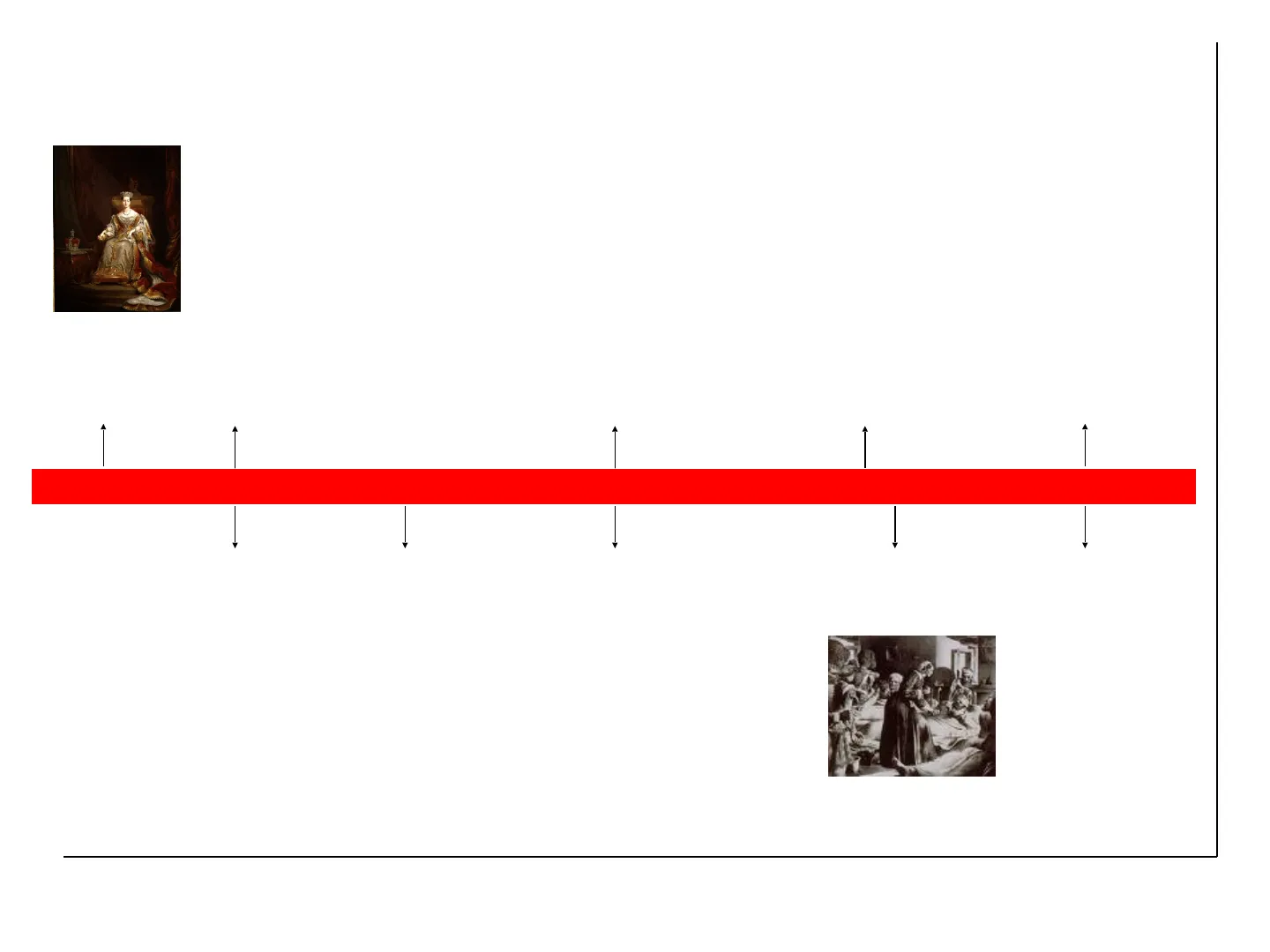
Victorian Era Timeline
1837 Queen
Victoria comes
to the throne.
1838 Publication of
Oliver Twist by
Charles Dickens.
1847 Publication of
Jane Eyre by
Charlotte Brontë.
1851 The Great
Exhibition opens
at Crystal Palace.
1861 Prince
Albert dies.
4-
1838 People's
Charter calls for
social reforms.
1840 Marriage 1847 Publication of
of Queen
Victoria to
Prince Albert.
Wuthering Heights by
Emily Brontë.
1853-56
Crimean War.
1861 Civil
War begins
in America.Queen Victoria
- Victoria became queen at the age of 18
in 1837. - She ruled for almost 64 years.
- Her sense of duty made her the ideal
head of a constitutional monarchy. - She provided her country with stability.Victoria and Albert
- Victoria and Albert of Saxe-Coburg-Gotha
married in 1840. They had nine children
and their family life provided a model of
respectability. - In 1857 Victoria gave Albert the title of
Prince Consort, in recognition of his importance
to the country. - Albert supported reform but in December 1861
he died suddenly at the age of 42. - In memory of her beloved husband she had the
Albert Memorial (1876) built in London.
+
o www.aviewoncities.comAn age of reforms
Victorian Reforms
1832
The Great Reform Act = voting privileges extended
to the large industrial towns.
1833
The Factory Act = prevented children from being
employed more than 48 hours a week.
1834
The Poor Law Amendment Act = workhouses
became a deterrent against poverty.1846
Abolition of the Corn Laws = which had kept price
of corn artificially high at a time of famine in
Ireland.
1867
The Second Reform Act = voting privileges
extended to part of urban male workers.
1872
Ballot Act = introduction of the secret ballot.Chartism
In 1838 a group of working-class radicals drew up a People's Charter
demanding:
- universal male suffrage;
- equal electoral districts;
- voting by secret ballot;
- pay for Members of Parliament;
- annual elections of Parliament.
The Chartist movement failed, although their influence was later felt in the
Second Reform Act in 1867.Foreign policy
Foreign Policy and Conflicts
Expansion of trade and the importance of new markets led to foreign
friction and in the mid-19th century England was involved in
two
Opium
Wars
Crimean
War
Indian
Mutiny
England gained access to five Chinese ports and the control of
Hong Kong after the Second Opium War.Foreign policy
- British rule acquired greater
responsibility after the Indian Mutiny
(unsuccessful rebellion of Indians
against British). - Florence Nightingale led a team of 38
nurses at Scutari base hospital during
the Crimean War. Once back to England,
she formed an institution for the
development of the nursing profession.
Florence Nightingale.CONNECTION TO THE EXPO
The Great Exhibition of 1851
The Great Exhibition
Housed at the Crystal Palace, in Hyde Park, 1851
What? Structure designed
by Sir
Joseph Paxton entirely
made of iron and glass.
Why? Symbol of Britain's
leading industrial and
economic position.
Who? Huge crowds
from all over the world
viewed the exhibition.CONNECTION TO THE EXPO
The Great Exhibition
Inside there were many exhibits from several countries, including
China, America, Canada and many more.
On each industrial country's exhibit, they showcased their biggest
designs, fabrics and their latest creations to show that their home
nation was better than any other.
The profits were used to fund important museums in London.
ED
China's section
America's section
Canada's sectionCity life in Victorian Britain
By 1851 more than 50% of population lived in towns:
- houses -
often overcrowded and unhygienic, especially for the
poor who lived in slums where disease and crime were widespread; - the mortality rate was high especially for
children; - only relief available in workhouses;
- gradual improvements with introduction of
running water, street lighting and
paved roads.Workhouses
Workhouses were places where, often in return for board and
lodging, employment was provided for: - the poor;
- the physically and mentally sick;
- the disabled;
- the elderly;
- unmarried mothers and orphans.
The government, to avoid encouraging laziness, made sure that people
feared the workhouse and would do anything to keep out of it - so made
the conditions as brutal as possible.
PARISH WORKHOUSThe Victorian compromise
Victorian Society and Compromise
The Victorian compromise:
- the Victorians were great moralisers -> they supported
personal duty, hard work, decorum, respectability,
chastity. - Respectability >> a mixture of morality and hypocrisy.
The unpleasant aspects of society - dissolution, poverty,
social unrest - were hidden under outward respectability. - 'Victorian', synonymous with prude, stood for extreme
repression; even furniture legs had to be concealed under
heavy cloth not to be 'suggestive'.The powerful middle-class was obsessed with gentility and decorum.
Decorum -> strict ideas about authority. - Victorian private lives were dominated by an authoritarian father.
- Women were subject to male authority; they were expected to
marry and make home a 'refuge'
for their husbands. - Single women with a child were marginalised as 'fallen' women.O
The age of fictionThe Victorian public
Victorian Literature and Novel
- There was a communion of interests and opinions between
writers and their readers. - The Victorians were avid consumers of literature.
- They borrowed books from circulating libraries and read various
periodicals.
JettA popular form of literature
The Victorian reading public established the novel as: - the most popular literary form of the age;
- the main source of entertainment since novels were read
aloud within the family.
Novels were first published in monthly instalments in
periodicals -> the writer felt in constant contact with his
public.
CONNECTION TO ITALY, FRANCE, USA = Age of Magazines, Journalism,
Popular middle-class literatureVictorian novelists - felt they had a moral and social responsibility to fulfill;
- reflected the social changes that had been in progress for a long
time, such as the Industrial Revolution; - described society as they saw it.
CONNECTION TO REALISM/
NATURALISM IN ITALY AND GIOVANNI
VERGA
Evert A. Duyckinick, Charles Dickens.Victorian novelists - Novelists were aware of the evils of their society, such as the
terrible conditions of manual workers and the exploitation of
children. Their criticism, however, was much less radical than
that of contemporary European writers. - Didacticism was one of the main features of Victorian novels,
because novelists also conceived of literature as a vehicle to
correct the vices and weaknesses of the age.
CONNECTION TO REALISM/NATURALISM IN ITALY AND
GIOVANNI VERGAThe Victorian novel: technique - The voice of the omniscient narrator provided comments
on the plot and erected a rigid barrier between 'right' and
'wrong', light and darkness. - Retribution and punishment were in the final chapter, where
the whole texture of events, adventures and incidents had
to be explained and justified.
CONNECTION TO REALISM/
NATURALISM IN ITALY AND GIOVANNI
VERGAThe Victorian novel: plot and setting - The plot was long and often complicated by subplots.
- The setting chosen by most Victorian novelists was the town,
which was the main symbol of industrial civilisation as well as
the expression of anonymous lives and lost identities.The Victorian novel: characters
Victorian novelists: - concentrated on the creation of realistic characters the public
could easily identify with; - achieved deeper analysis of the characters' inner lives.
CONNECTION TO REALISM/
NATURALISM IN ITALY AND GIOVANNI
VERGA
Oliver asks for more.
frange GratsbankThe Victorian novel: themes
The most important themes developed were: - differences and the dramatic contrast between the lower and
middle classes, between the rich and the poor; - children and their exploitation
orphans working in a
workhouse, cruelty in boarding schools; - education;
- women and their exploitation;
- middle-class family life.Types of novels
Social and
humanitarian novels
Į
main exponent:
Charles Dickens
Novels about
intense subjective experiences
I
main exponents:
Emily and Charlotte BrontëThe late
Victorian Age
(1861-1901)…
After Albert's death
The Late Victorian Age (1861-1901)
- Victoria withdrew from society and went into mourning for ten years.
- During this time, in politics there were two main political parties:
-
the Liberals with William Gladstone
- the Conservatives with Benjamin Disraeli
Between 1868 and 1880, Disraeli and Gladstone
alternated as Prime Minister: both men passed social and political reforms.
Foreign policy: - based on free trade and liberalism;
- time of greatest expansion of British Empire.Disraeli's home policy
Disraeli's government brought in social reforms to improve
conditions in the expanding towns.
1875.
Artisans' and Labourers' Dwellings Act
clearing of the
slums and housing for the poor;
Disraeli's Home Policy
1875
Public Health Act
-> sanitation and running water;
1878
Factory Act > limited working hours per week.Gladstone's home policy
1870.Education Act
introduction of 'board schools' in the poorer areas
of the towns;
Gladstone's Home Policy
1871. elementary education became compulsory by 1880.
1871. Trade Union Act ->
legalisation of trade unions;
1872.Ballot Act
-
introduction of the secret ballot at elections;
1884. Third Reform Act
> extended voting to all male householders
including miners, mill-workers and farm labourers.The British Empire
An area of 4 million square miles and more than 400 million people.
WORLD
British Empire throughout the World,
19th century, Private Collection.
Including:
Canada
Australia
New Zealand
India
South America
South AfricaImportant dates
British Empire and Key Dates
- 1875 Disraeli bought more shares in the Suez Canal Company to
protect the trade route to India. - 1877 Queen Victoria became Empress of India.
- 1880-1902 The Boer Wars in South Africa between the British and
the Dutch settlers over the occupation of the Transvaal area. - 1901 Death of Queen Victoria.Late Victorian ideas
Late Victorian Ideas and Pessimism
- The later years of Victoria's reign were marked
by the decline of Victorian optimism and a
growing pessimism influenced artists and
intellectuals. - In 1867 Karl Marx's expressed his theories in the
treatise Das Kapital, based upon research done
in England. - He protested against the harm caused by
industrialism in man's life and in the
environment.
Can’t find what you’re looking for?
Explore more topics in the Algor library or create your own materials with AI.
