Introduction to the cell: levels, origin, evolution, and eukaryotic structure
Slides from Universidad Europea about Unit 2. Introduction to the cell. The Pdf, a University Biology document, covers biological organization levels, cell origin and evolution, and eukaryotic cell structure, including a comparative table between prokaryotes and eukaryotes.
See more44 Pages

Unlock the full PDF for free
Sign up to get full access to the document and start transforming it with AI.
Preview
Unit 2. Introduction to the cell
1. Levels of organization 2. Introduction to the cell 3. Origin and evolution of the cell 4. Structure of the eukariotic cell QUESTION EVERYTHING ue Universidad Europea
1. LEVELS OF ORGANIZATION
Biology: The study of living beings
Cell: basic unit of life
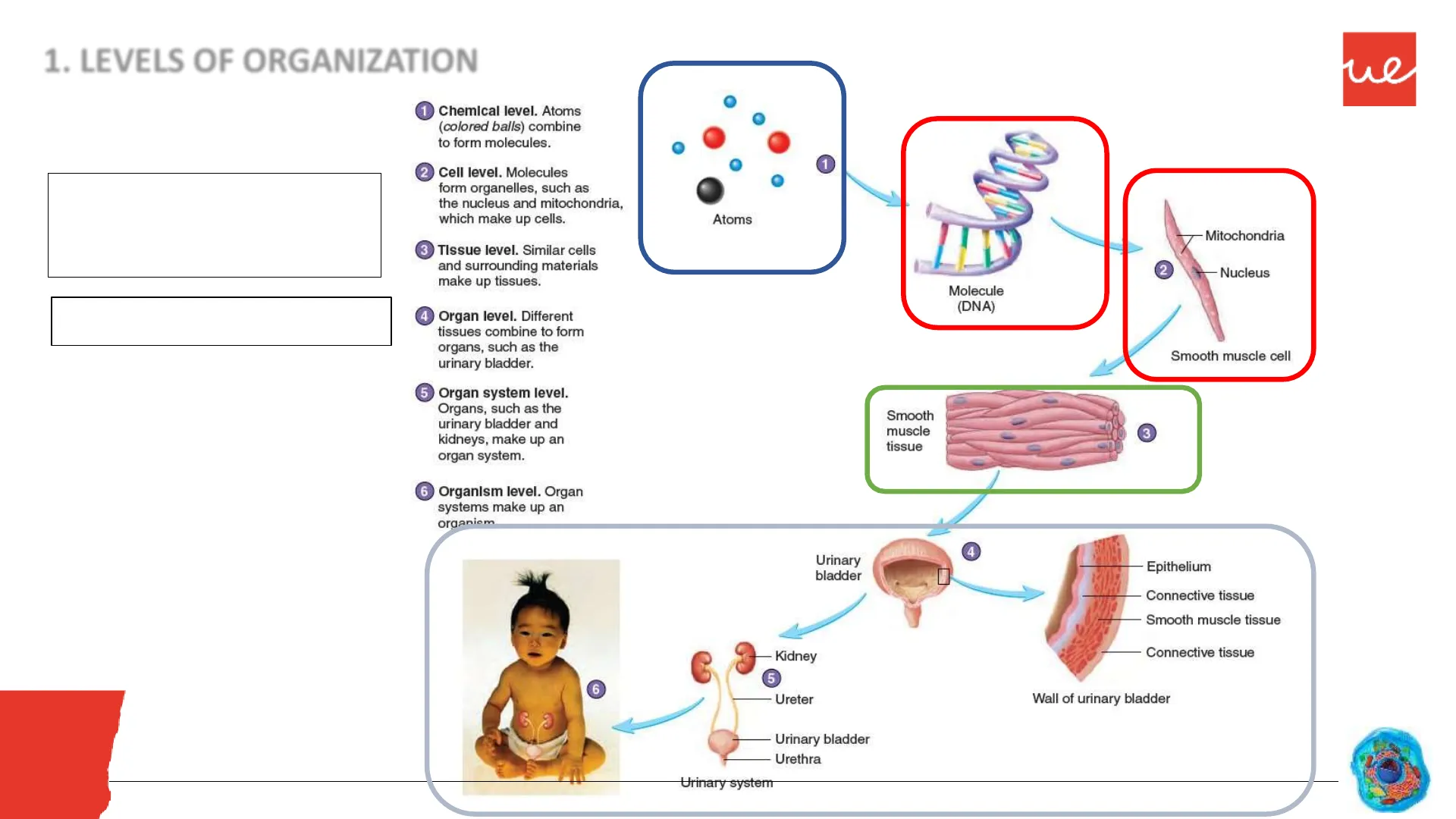
1 Chemical level. Atoms (colored balls) combine to form molecules.
2 Cell level. Molecules form organelles, such as the nucleus and mitochondria, which make up cells.
3 Tissue level. Similar cells and surrounding materials make up tissues.
Molecular Biology Cell Biology
1 O Atoms Mitochondria
2 Nucleus Chemistry Molecule (DNA) Smooth muscle cell Smooth muscle tissue
3 Tisular Biology
6 Organism level. Organ systems make up an organiem
4 Urinary bladder Epithelium Connective tissue Smooth muscle tissue Connective tissue Kidney
5 6 Ureter Wall of urinary bladder Urinary bladder Urethra
Physiology Urinary system Unit 1 - The cell
4 Organ level. Different tissues combine to form organs, such as the urinary bladder.
5 Organ system level. Organs, such as the urinary bladder and kidneys, make up an organ system.
1. LEVELS OF ORGANIZATION CELLULAR LEVEL
Atoms Molecule Macromolecule Organelle Cell Tissue Organ
6 C H N O H C ORGANISMAL LEVEL POPULATIONAL LEVEL Organ system Organism Population Species Community Ecosystem Biosphere 0.2 jam Unit 1 - The cell
2. INTRODUCTION TO THE CELL
The cell is the morphological and functional unit of any living being
Plasma membrane Mitochondria Able to metabolize Centrioles Able to reproduce Golgi apparatus Lysosome Nucleus Unit 1 - The cell
2.INTRODUCTION TO THE CELL Diversity of life
All living organisms (from all 5 kingdoms of life) are composed of cells.
Bacteria Prokaryotes Archaea Plantae Fungi Eukarya Animalia Protista
! Eukaryotic cells are not only animal/human cells Unit 1 - The cell ul
2. INTRODUCTION TO THE CELL CELL THEORY: PRINCIPLES
1. All organisms are composed of one or more living units called cells. How do we define "living" ?????? 4 TM PU 2308 Unit 1 - The cell
2. INTRODUCTION TO THE CELL CELL THEORY: PRINCIPLES (Continued)
1. All organisms are composed of one or more living units called cells. How do we define "living" ?????? "Life" is easy to recognize but difficult to define. Some of the characteristics of living organisms are "having an organized structure, requiring energy, responding to stimuli and adapting to environmental changes, and being capable of reproduction, growth, movement, metabolism, and death." TH PU 2308 Unit 1 - The cell 4 ue ֏
2. INTRODUCTION TO THE CELL CELL THEORY: PRINCIPLES (Continued)
1. All organisms are composed of one or more living units called cells. 2. The main metabolic reactions of the organism take place inside the cells. 3. Cells arise only by division of a previously existing cell. 4. Cells contain the hereditary material.
CONCLUSION: Cells
Grow Respond to stimulus Divide themselves Communicate to the environment Unit 1 - The cell
2. INTRODUCTION TO THE CELL Basic properties and functions of cells
Metabolic capacity: Cells use and transform matter and energy.
brain cells
Organization and complexity: Different cells perform different roles.
blood cells liver cells intestinal cells muscle cells
Self-replication: Cells have a genetic program by which they can replicate and transmit the genetic information to new cells.
Response to stimulus: Changes in shape and movement.
Self-regulation: Regulate their responses to internal and external changes
Relationship with the environment and other cells: Allows the exchange of matter, energy and information with the external medium.
Unit 1 - The cell
3. ORIGIN AND EVOLUTION OF THE CELL ORIGIN OF LIFE: STAGES
1. Chemical evolution: from inorganic to organic molecules 2. Protocellular evolution: from organic matter to first cells 3. Cellular evolution: from prokaryotic to eukaryotic cells
Gram -Positive CPR bacteria Cyanobacteria Bacteria Gram negative Vc 3 ??? JCA Thaymarchacosa Excavats plastica PAR lando Eukaryota LUCA Diversity of life A Prebiotic synthesis Archaea Polymers, vesicles Diaphoretickes Amorphen ... Protocells? ... Alternative: Panspermia theory Habitable world Euryarcharota
3. ORIGIN AND EVOLUTION OF THE CELL ORIGIN OF LIFE: STAGES (Continued)
1. Chemical evolution: from inorganic to organic molecules 2. Protocellular evolution: from organic matter to first cells 3. Cellular evolution: from prokaryotic to eukaryotic cells
Organic molecules formation
CO2 CH4 NH3 H2 Organic molecules (aminoacids, sugars, fatty acids, nucleotides) HEAT ELECTRICAL DISCHARGES An electric spark simulates a lightning storm electric spark chamber CH4 NH3 H2 H20 Energy from the spark powers reactions among molecules thought to be present in Earth's early atmosphere Boiling water adds water vapor to the artificial atmosphere condenser cool water flow boiling chamber water When the hot gases in the spark chamber are cooled, water vapor condenses and any soluble molecules present are dissolved Organic molecules appear after a few days O 2011 Pearson Education, Inc Early-Earth Chemical Evolution Peptides Radiation Synthesis Organic Inorganic Simple molecules RNA Complex Mixtures
3. ORIGIN AND EVOLUTION OF THE CELL ORIGIN OF LIFE: STAGES (Continued)
1. Chemical evolution: from inorganic to organic molecules 2. Protocellular evolution: from organic matter to first cells 3. Cellular evolution: from prokaryotic to eukaryotic cells
APPEARANCE OF SIMPLE MOLECULES
Primordial soup (Oparin and Haldane) Primordial 3.5-4 billion years O Fatty acid bilayers formation PROTOCELL (Carl Woose, 1980) ARN Membrana de fosfolípidos Agua Molécula de fosfolipidos: First cells (prokaryotic) Grupo hidrofitico Col hidrofóbica Separate inside from outside Agua Metabolism and reproduction At some point, simple cellular life evolved as membranes formed and bounded metabolic and self-replicating activities.
3. ORIGIN AND EVOLUTION OF THE CELL ORIGIN OF LIFE
ue 1. CHEMICAL Evolution 2. PROTOCELLULAR Evolution 3. CELLULAR Evolution From prokaryotic cells to eukaryotic
Key Concepts
V First living beings were: Single cell, prokaryotics, anaerobic.
Pilus Flagellum Capsule Cell wall Ribosomes Cytoplasm PROKARYOTICS A prokaryote (Pro = before, Karyos = nucleus) is a single-celled organism that lacks a nucleus and other membrane-bound organelles. ANAEROBIC living, active, occurring, or existing in the absence of free oxygen, usually get energy from fermentation.
- From one of these cells (Last Universal Common Ancestor) three evolutive lines rose
Meet your maker We're getting closer to understanding what the last universal common ancestor of all life on Earth, LUCA, was like and where it lived EUKARYOTES Complex cells including all plants and animaly ARCHAEA BACTERIA LUCA Plasma membrar -Nucleoid (DNA
3. ORIGIN AND EVOLUTION OF THE CELL RECAP
CO2 CH4 NH3 H2 Organic molecules (aminoacids, sugars, fatty acids, nucleotides) HEAT ELECTRICAL DISCHARGES Fatty acid bilayers formation Protocell Separate inside from outside Metabolism and reproduction Prokaryotic cells
3. ORIGIN AND EVOLUTION OF THE CELL ORIGIN OF LIFE (Continued)
1. Chemical evolution 2. Protocellular evolution 3. Cellular evolution: From prokaryotic to eukaryotic cells
- First living beings were: Single cell, prokaryotics, anaerobic
- Some cells began making organic molecules.
- How? Using atmospheric CO2. Photosyntesis started and, as a consequence, oxygen started to appear in the atmosphere.
- The presence of oxygen in the atmosphere caused death in many cells. The rest of them adapted to it and survived. New oxygen breathing life forms appeared.
3. ORIGIN AND EVOLUTION OF THE CELL Cellular evolution: From prokaryotic to eukaryotic cells
1. Appearance of an inner membrane system that allows: · Compartmentalization of the cellular inner space (organelles) to optimize cellular function. · Protection of the genetic material (nuclear envelope) 2. Appearance of energetic organelles: . Mitochondria and choloroplasts to increase the cellular energy efficiency. · Endosymbiotic theory (Lynn Margulis)
Prokaryotes Eukaryotes Animal cell lysosome ribosomes cillum centriole centrosome cell membrane peroxisome endoplasmic reticulum DNA (nucleoid) Plasma membrane nuclear pore nucleolus nucleoplasm nucleus nuclear envelope rough endoplasmic reticulum Golg apparatus mitochondrion secretory vesicles cytoplasm smooth Mesosome Bacterial Flagellum Capsule Cytoplasm Ribosomes Cell wall
3.ORIGIN AND EVOLUTION OF THE CELL The endosymbiotic theory: Lynn Margulis 1938-2011
Eukaryotic cells were created from a eukaryotic precursor, which was a large cell, that in a given moment would engulf other cells or procaryotic organisms. · Mitochondria (energy- aerobic breathing) and chloroplasts (photosynthesis) were once primitive bacterial cells that were phagocyted by a proto- eukaryote. . The precursor and the ingested bacteria became dependent on one another for survival, resulting in a permanent relationship (symbiosis). . After millions of years of evolution, mitochondria and chloroplasts cannot live outside the cell
The ENDOSYMBIOTIC THEORY
1 Infoldings in the plasma membrane of an ancestral prokaryote gave rise to endomembrane components, including a nucleus and endoplasmic reticulum.
3 In a second endosymbiotic event, the early eukaryote consumed photosynthetic bacteria that evolved into chloroplasts.
Nucleus Endoplasmic reticulum
3 - Photosynthetic bacterium Modern photosynthetic eukaryote
1 2 Proto-eukaryote
2 In a first endosymbiotic event, the ancestral eukaryote consumed aerobic bacteria that evolved into mitochondria.
Aerobic bacterium Mitochondrion The amoeba sisters: Endosymbiotic theory Modern heterotrophic eukaryote
3.ORIGIN AND EVOLUTION OF THE CELL 2 BASIC TYPE OF CELLS
Prokaryote:
- Absence of a membrane bounded nucleus.
- No internal membrane system.
- No membrane bounded organelles.
Prokaryotic Cell Structure Cytoplasm Nucleoid Capsule- Cell Wall Cytoplasmic Membrane Ribosomes
Which one is the dominant life form on the planet?
Pill Flagella Figure 1
Eukaryote:
- Presence of a membrane bounded nucleus.
- Internal membrane systems.
- Membrane bounded organelles.
Plasma membrane Cytoplasm Nuclear envelope -Nucleolus - Nucleus Mitochondrion- Ribosome Lysosome Free ribosome Lysosome fusing with incoming - phagocytic vesicle Rough endoplasmic reticulum Phagocytic vesicle Smooth endoplasmic reticulum Centrosome Centrioles Golgi apparatus Peroxisome Secretory vesicles -Microtubule network Cilia Microvilli e Unit 1 - The cell
Can’t find what you’re looking for?
Explore more topics in the Algor library or create your own materials with AI.
