Holidays Grammar Focus: Understanding "I am used to (doing)" in English
Slides from Ecampus University about Holidays Grammar Focus. The Pdf explores the English grammatical construction "I am used to (doing)", providing practical examples and explanations for university students studying Languages. The Pdf covers topics like Verbs, Discussing Holidays, and the structure of the grammar point.
See more47 Pages

Unlock the full PDF for free
Sign up to get full access to the document and start transforming it with AI.
Preview
e CAMPUS UNIVERSITÀ
Corso di Laurea: L24 Scienze e Tecniche Psicologiche Disciplina: Lingua Inglese Numero lezione: 10.11 Titolo: 01. Holidays_Grammar Focus Centro Linguistico di Ateneo
A e-CAMPUS Holidays
CLA-ELT Centro Linguistico di Ateneo Excellence in Linguistic Training
e CAMPUS UNIVERSITÀ
Corso di Laurea: L24 Scienze e Tecniche Psicologiche Disciplina: Lingua Inglese Numero lezione: 10.11 Titolo: 01. Holidays_Grammar Focus Centro Linguistico di Ateneo
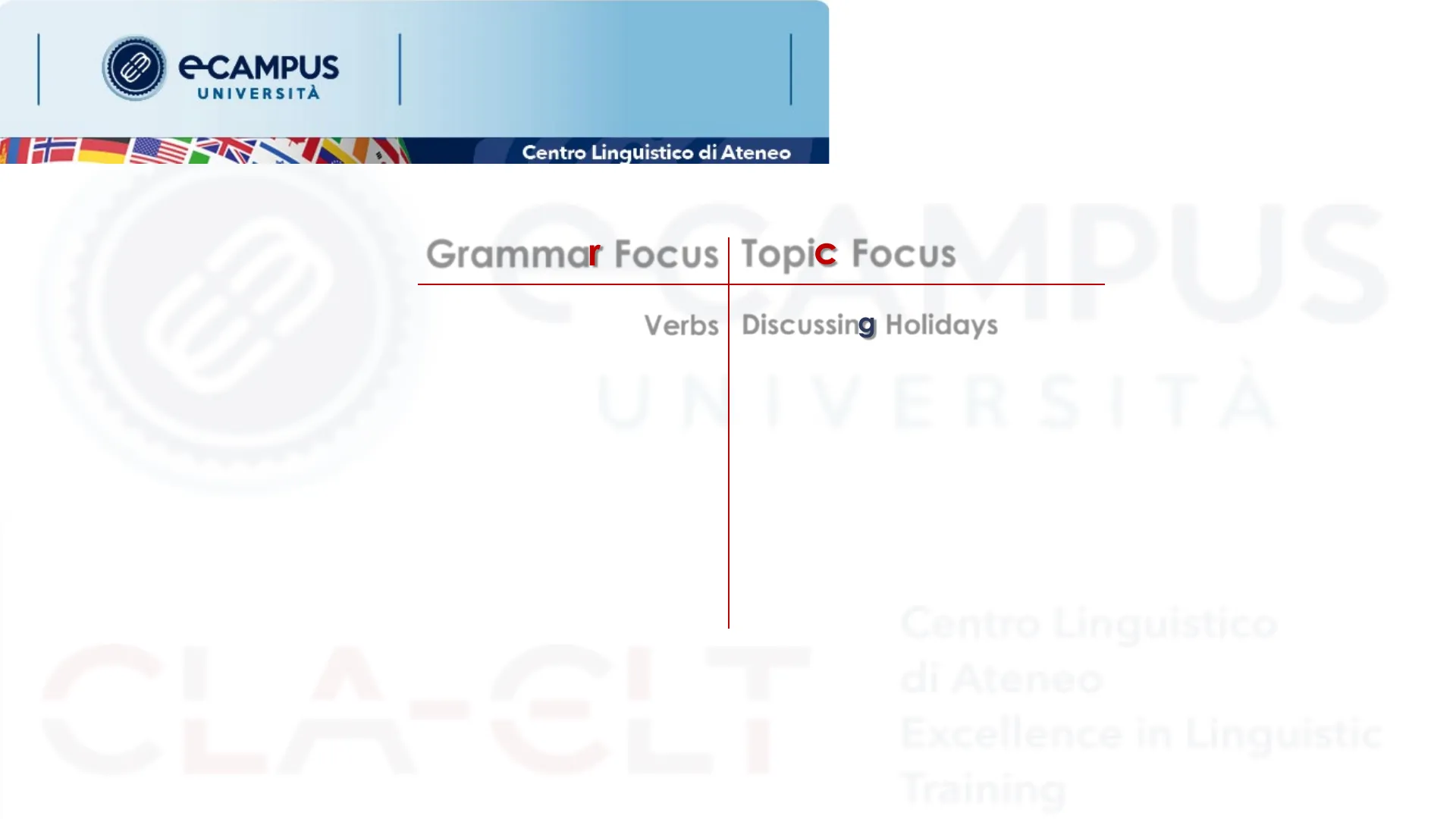
A Grammar Focus
Verbs
- Past Simple
- Past Continuous
- I used to (do)
- I am used to (doing)
- Would
- Present Participle
- Past Participle
IPUS Topic Focus
Discussing Holidays
- Types of holidays
RSITÀ Sites and resorts
- Means of transport
- Holiday equipment
Centro Linguistico di Ateneo Excellence in Linguistic Training CLA-ELT
e CAMPUS UNIVERSITÀ
Corso di Laurea: L24 Scienze e Tecniche Psicologiche Disciplina: Lingua Inglese Numero lezione: 10.11 Titolo: 01. Holidays_Grammar Focus Centro Linguistico di Ateneo
A e CAMPUS Past Simple
When we use it:
The Past Simple is the English verb tense that expresses the general concept of an action that took place in the past and no longer has any relationship with the present. The duration of the action is irrelevant. The action may have taken place in the near or distant past.
In order to put a verb in the Past Simple, three conditions must occur simultaneously:
- The action must have taken place in the past and be finished the moment you are speaking.
- The time in which the action took place must be expressed in the sentence or context.
- The time expressed must be passed and finished while speaking.
o Linguistico CLA-CLT di At Excellence in Linguistic Training
e CAMPUS UNIVERSITÀ
Corso di Laurea: L24 Scienze e Tecniche Psicologiche Disciplina: Lingua Inglese Numero lezione: 10.11 Titolo: 01. Holidays_Grammar Focus Centro Linguistico di Ateneo
A € CAMPUS Past Simple Examples
Christopher Columbus discovered America in 1492. Mozart wrote more than 600 pieces of music. I didn't do anything at the weekend.
UNIVERSITÀ
We went to the cinema yesterday. This morning I had pancakes for breakfast. John called me a few minutes ago. I work in an office, now. Before that, I worked in a travel agency. We went to the cinema, last night, but we didn't enjoy the film much.
As you can see, all these examples satisfy the three conditions:
- The action has taken place in the past and is finished the moment you are speaking.
- The time in which the action took place is expressed in the sentence or context.
- The time expressed is passed and finished while speaking.
Centro Linguistico Excellence in Linguistic Training
e CAMPUS UNIVERSITÀ
Corso di Laurea: L24 Scienze e Tecniche Psicologiche Disciplina: Lingua Inglese Numero lezione: 10.11 Titolo: 01. Holidays_Grammar Focus Centro Linguistico di Ateneo
A Past Simple
The Past Simple is always used to indicate when an event occurred; therefore, this tense is always associated with a certain type of temporal expressions.
Adverbs of frequency: often, sometimes, always
Last year I sometimes played golf in the afternoons. I often went to the mountains to ski.
VERSITÀ
: Expressions that indicate a precise moment in the past: last week, when I was a child, yesterday, six weeks ago, this morning We saw a good film last week. She finished her work at seven o'clock
Expressions that indicate an unspecified moment in the past: the other day, ages ago, a long time ago People lived in caves a long time ago. She played the piano when she was a child.
di Ateneo Note: Excellence in Linguistic The word ago is a useful term for expressing distance in the past. It is put after the time period: a week ago, three years ago, a minute ago, many centuries ago.
e CAMPUS UNIVERSITÀ
Corso di Laurea: L24 Scienze e Tecniche Psicologiche Disciplina: Lingua Inglese Numero lezione: 10.11 Titolo: 01. Holidays_Grammar Focus Centro Linguistico di Ateneo
Past Simple
AMPUS
The Past Simple is very easy to form.
: In regular verbs, simply add -ED at the end of the bare infinitive of the verb we need for all the persons to form the affirmative.
ERSITA
: In irregular verbs, take the 2nd column of the Irregular Verb List for all persons.
Since the Past Simple is a SIMPLE tense, we need an auxiliary verb, or "helping" verb, to form the question and negative forms of every verb *. This auxiliary verb is DO in the PAST, so DID. Questions are formed by DID + bare infinitive of the verb. Negatives are formed by DID + NOT = DIDN'T (contracted form) + bare infinitive of the verb.
Centro Linguistico Ater *This is true for all verbs with the exception of the verb BE, which being an auxiliary verb itself, is formed in a different way. Training
e CAMPUS UNIVERSITÀ
Corso di Laurea: L24 Scienze e Tecniche Psicologiche Disciplina: Lingua Inglese Numero lezione: 10.11 Titolo: 01. Holidays_Grammar Focus Centro Linguistico di Ateneo
Past Simple
CAMPUS
Let's take, for example, the verb EAT.
The affirmative is I ATE The question form is DID you EAT? The negative form is We DIDN'T EAT
UN
V ERSITÀ
| AFFIRMATIVE | INTERROGATIVE | NEGATIVE | CONTRACTED FORM |
| I ate | Did I eat? | I did not eat | I didn't eat |
| You ate | Did you eat? | You did not eat | You didn't eat |
| He, she it, ate | Did he, she, it eat? | He, she, it did not eat | He, she, it didn't eat |
| We ate | Did we eat? | We did not eat | We didn't eat |
| You ate | Did you eat? | You did not eat | You didn't eat |
| They ate | Did they eat? | They did not eat | They didn't eat |
C Training
A e CAMPUS UNIVERSITÀ
Corso di Laurea: L24 Scienze e Tecniche Psicologiche Disciplina: Lingua Inglese Numero lezione: 10.11 Titolo: 01. Holidays_Grammar Focus Centro Linguistico di Ateneo
Past Simple of BE
ust conjugate the second We said earlier that BE is an exception, as it is an auxiliary verb itself. We must conjugate the second column of the paradigm (Past Simple) to form the affirmative of the verb. The question form inverts the subject and the verb. The negative form adds NOT to the verb in the affirmative form.
ERSI
| AFFIRMATIVE | INTERROGATIVE | NEGATIVE | CONTRACTED FORM |
| I was | Was I? | I was not | I wasn't |
| You were | Were you? | You were not | You weren't |
| He, she it, was | Was he, she, it? | He, she, it was not | He, she, it wasn't |
| We were | Were we? | We were not | We weren't |
| You were | Were you? | You were not | You weren't |
| They were | Were they? | They were not | They weren't |
C istic Training
e CAMPUS UNIVERSITÀ
Corso di Laurea: L24 Scienze e Tecniche Psicologiche Disciplina: Lingua Inglese Numero lezione: 10.11 Titolo: 01. Holidays_Grammar Focus Centro Linguistico di Ateneo
A Compare the Present Perfect Simple and the Past Simple
Present Perfect Simple (I have done)
I've done a lot of work today We use the Present Perfect Simple for a period of time that continues UNTIL NOW. For example: today/this week/this year.
unfinished today past now
It hasn't snowed today. Have you seen Laura this morning? (it is still morning) We haven't played tennis this week. I have never been to Russia (in my life)
Past Simple (I did)
I did a lot of work yesterday We use the Past Simple for a FINISHED TIME IN THE PAST. For example: yesterday/last week/last year.
finished yesterday past juistico now
It didn't snow yesterday. Did you see Laura this morning? (it is now afternoon) We didnt' play tennis last week. I didn't go to Russia last year.
e CAMPUS UNIVERSITÀ
Corso di Laurea: L24 Scienze e Tecniche Psicologiche Disciplina: Lingua Inglese Numero lezione: 10.11 Titolo: 01. Holidays_Grammar Focus Centro Linguistico di Ateneo
Past Continuous (or Progressive)
The Past Continuous is used to describe actions or events that started in the past but continue and have consequences in the present. In other words, it expresses an action that is perceived (PERCEPITO) as incomplete or still ongoing in the past. I was doing something means that I was in the middle of doing something at a certain time. The action or situation had already started before this time, but had not finished. At this time last year I was living in England. What were you doing yesterday evening? I waved to George, but he wasn't looking.
CLA-ELT Centro Linguistico di Ateneo Excellence in Linguistic Training
e CAMPUS UNIVERSITÀ
Corso di Laurea: L24 Scienze e Tecniche Psicologiche Disciplina: Lingua Inglese Numero lezione: 10.11 Titolo: 01. Holidays_Grammar Focus Centro Linguistico di Ateneo
Past Continuous (or Progressive)
CAMPUS
When it is used:
The Past Continuous is often used to describe the context of a story written in the Past Simple. 'The rain was falling heavily, as the deer (CERVO) came out of the forest. The other animals were hiding in their dens (TANE), to protect themselves from the rain, but the deer moved very slowly. She was looking for her fawn (CERBIATTO), and she didn't notice the hunter who was watching her through his binoculars. She was running to protect her fawn when the shot rang out ... '
The Past Continuous is also used to describe an unfinished action that was interrupted by another event or action, expressed in the Past Simple, and usually introduced by when. I was taking a shower when the doorbell rang.
istico LA di Ateneo Excellence in Linguistic Training
e CAMPUS UNIVERSITÀ
Corso di Laurea: L24 Scienze e Tecniche Psicologiche Disciplina: Lingua Inglese Numero lezione: 10.11 Titolo: 01. Holidays_Grammar Focus -
6 Centro Linguistico di Ateneo
Past Continuous (or Progressive)
A PUS
When it is used:
€ We often use the Past Continuous and the Past Simple together to say that something happened in the middle of something else: 'I saw you in the park, yesterday. You were sitting on the grass and reading a book.' Here, we do not say 'You were sitting ... and you were reading', but just reading, because it is clear to whom we are referring to: to you. We sometimes use the word while in sentences like these, which means at the same time Mark phoned while we were having dinner.
Centro Linguistico But use the Past Simple to say that one thing happened after another: l'Ateneo I was walking along the river when I saw John. So I stopped and we had a chat. He told me about his new job and he asked me how you were. Training
Can’t find what you’re looking for?
Explore more topics in the Algor library or create your own materials with AI.
