AQA A Level Chemistry: Alcohols and their reactions
Document from Savemyexams about AQA A Level Chemistry. The Pdf provides a detailed overview of alcohols, covering their classification, production, oxidation, combustion, and elimination reactions. This High school Chemistry material is designed to support learning and revision, featuring clear explanations and structural diagrams.
See more17 Pages

Unlock the full PDF for free
Sign up to get full access to the document and start transforming it with AI.
Preview
Classifying Alcohols
Your notes
Classification of Alcohols
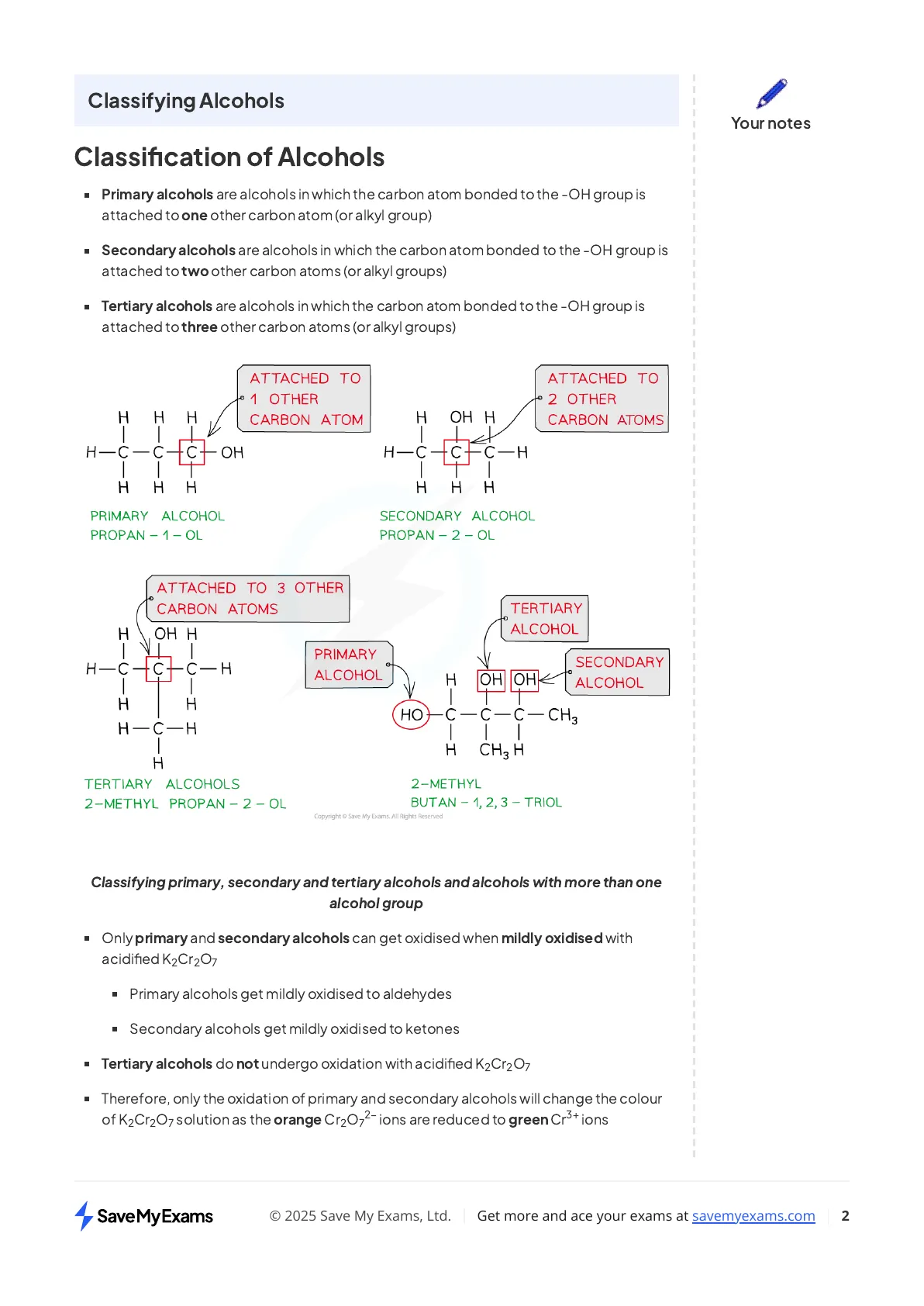
Primary alcohols are alcohols in which the carbon atom bonded to the -OH group is attached to one other carbon atom (or alkyl group) Secondary alcohols are alcohols in which the carbon atom bonded to the -OH group is attached to two other carbon atoms (or alkyl groups) Tertiary alcohols are alcohols in which the carbon atom bonded to the -OH group is attached to three other carbon atoms (or alkyl groups)
ATTACHED TO . 1 OTHER 2 OTHER H OH H CARBON ATOMS H-C- C- -C-H J-I - -I PRIMARY ALCOHOL PROPAN - 1 - OL SECONDARY ALCOHOL PROPAN - 2 - OL ATTACHED TO 3 OTHER CARBON ATOMS TERTIARY ALCOHOL PRIMARY ALCOHOL SECONDARY H OH JOH ALCOHOL H H H-C-H H TERTIARY ALCOHOLS 2-METHYL PROPAN - 2 - OL 2-METHYL BUTAN - 1, 2, 3 - TRIOL Copyright @ Save My Exams. All Rights Reserved
Classifying Primary, Secondary and Tertiary Alcohols
Classifying primary, secondary and tertiary alcohols and alcohols with more than one alcohol group Only primary and secondary alcohols can get oxidised when mildly oxidised with acidified K2Cr2O7 Primary alcohols get mildly oxidised to aldehydes Secondary alcohols get mildly oxidised to ketones • Tertiary alcohols do not undergo oxidation with acidified K2Cr2O7 Therefore, only the oxidation of primary and secondary alcohols will change the colour of K 2 Cr 2 O 7 solution as the orange Cr 2 O 7 2- ions are reduced to green Cr 3+ ions
ATTACHED TO I- I-U I-U- V H-C-C-FC- I OH H H I H H OH H H-C-ICHC-H 1 HO C-C-C-CH3 I 1 H CH3 H Save My Exams @ 2025 Save My Exams, Ltd. Get more and ace your exams at savemyexams.com 2
I CARBON ATOM1 Your notes PROPAN-1-OL (PRIMARY ALCOHOL) PROPAN-2-OL (SECONDARY ALCOHOL) 2-METHYL-PROPAN-2-OL (TERTIARY ALCOHOL) Copyright & Save My Exams. All Rights Reserved
Only primary and secondary alcohols can be oxidised, turning the orange solution green No colour change is observed with a tertiary alcohol Save My Exams @ 2025 Save My Exams, Ltd. Get more and ace your exams at savemyexams.com 3
Alcohol Production
Your notes
Alcohol Production Methods
Alcohols are compounds that contain at least one hydroxy (-OH) group The general formula of alcohols is CnH2n+1OH Alcohols can be prepared by a wide range of chemical reactions
Fermentation Process
Fermentation is a batch process, where sugar or starch is dissolved in water and yeast is added The mixture is then kept at between 15 and 35℃ with the absence of oxygen for a few days Enzymes within the yeast undergo anaerobic respiration to break the sugar down into ethanol and carbon dioxide
enzymes C 6 H 12 O 6 > 2CO2 + 2C2H 5OH
If the temperature is too low the reaction rate is low If the temperature is too high the enzymes are denatured • The enzymes in yeast are killed off once the concentration of alcohol reaches around 15%
Electrophilic Addition to Alkenes
• When hot steam is reacted with an alkene, using concentrated phosphoric(VI) acid (H3PO4) or sulfuric acid as a catalyst, electrophilic addition takes place to form an alcohol
H H C=C + H2O H H ETHENE STEAM Copyright @ Save My Exams. All Rights Reserved
H H - H-C-C-OH HEAT HH ETHANOL
Electrophilic addition of steam to alkenes to form an alcohol
Oxidation of Alkenes
Cold, dilute KMnO4 is a mild oxidising agent and oxidises alkenes The C=C double bond is broken open and a diol is formed A diol is a compound with two hydroxy, -OH, groups Save My Exams @ 2025 Save My Exams, Ltd. Get more and ace your exams at savemyexams.com 4
H3 PO4Your notes
Oxidation of alkenes using cold, dilute KMnO4 to form a diol
Nucleophilic Substitution of Halogenoalkanes
The halide atom in halogenoalkanes can be substituted when heated with aqueous NaOH in a nucleophilic substitution reaction
HH I - H-C-C-Br + NaOH H-C-C-OH + NaBr 1 H H H H ETHANOL Copyright Save My Exams. All Rights Reserved
Nucleophilic substitution of halogenoalkanes using NaOH to form an alcohol
Reduction of Aldehydes & Ketones
Aldehydes and ketones can be reduced by reducing agents such as NaBH 4 or LiAlH 4 Aldehydes are reduced to primary alcohols The carbon attached to the hydroxy group is bonded to one other alkyl group Ketones are reduced to secondary alcohols The carbon attached to the hydroxy group is bonded to two other alkyl groups
エ ー H-C-C \ H H H H ETHANAL ETHANOL (PRIMARY ALCOHOL) HOH H OH H - - H-C-C-C-H + 2[H] H-C-C-C-H 1 H H HH H PROPANONE PROPAN-2-OL (SECONDARY ALCOHOL) Copyright Save My Exams. All Rights Reserved Save My Exams @ 2025 Save My Exams, Ltd. Get more and ace your exams at savemyexams.com 5
H H C=C + H2O + [0] > HO-C-C-OH / H H ETHENE ETHANE - 1, 2 - DIOL Copyright @ Save My Exams. All Rights Reserved
H H I I BROMOETHANE H H - HEAT H H - + 2[H] H-C-C-OH -Reduction of aldehydes and ketones to form primary and secondary alcohols
Reduction of Carboxylic Acids
Similarly, carboxylic acids are reduced by NaBH 4 or LiAlH 4 to primary alcohols Carboxylic acids can also be reduced by H2 using a nickel catalyst and heat
I-L H-C -= 0 0=U + 4[H] - OH H HH ETHANOIC ACID ETHANOL OR H I- Ni CATALYST H-C-C + 2H2 HEAT - H HH I Copyright @ Save My Exams. All Rights Reserved
Reduction of carboxylic acids to primary alcohols
Hydrolysis of Esters
Esters are made by a condensation reaction between an alcohol and a carboxylic acid When an ester is heated with dilute acid or alkali, hydrolysis will take place and the carboxylic acid and alcohol will be reformed
I HO H - H-C-C-O-C-C-H + H2O + H-C-C-OH 1 1 H OH H H ETHYLETHANOATE ETHANOIC ACID ETHANOL H O エ ー H I- O H-C-C-O" Na+ H + H-C-C-OH H H SODIUM ETHANOATE ETHANOL Copyright Save My Exams. All Rights Reserved
Hydrolysis of esters to form alcohols
Alcohol Production Reactions Table
Save My Exams @ 2025 Save My Exams, Ltd. Get more and ace your exams at savemyexams.com 6
H+ (aq) I-O O=U - - -I H H H H H H-C-C-O-C-C-H + NaOH -I H H ETHYLETHANOATE エ ー H H HH I - H-C-C-OH + H2O / OH 0=0 HH - H-C-C-OH + H20 Your notesYour notes
| Reaction Type | Reagents | Conditions | Product |
|---|---|---|---|
| Electrophilic addition | Alkene Steam | Heat H3PO4 Catalyst | Alcohol |
| Oxidation | Alkenes Cold, dilute KMNO4 | Shaking of reagents | Diol |
| Nucleophilic Substitution | Halogenoalkanes Aqueous NaOH | Heat | Alcohol |
| Reduction | Aldehydes/ ketones NaBH4 or LiALH4 | Primary/ secondary alcohol | |
| Reduction | Carboxylic acid NaBH4 or LiALHA Or H2, Ni catalyst and heat | Primary alcohol | |
| Hydrolysis | Esters Dilute acid or alkali heat | Alcohol |
Copyright O Save My Exams. All Rights Reserved
Examiner Tips and Tricks
The symbol [O] is used to represent oxygen provided by an oxidising agent. Save My Exams @ 2025 Save My Exams, Ltd. Get more and ace your exams at savemyexams.com 7
Oxidation of Alcohols
Your notes
Oxidation of Alcohols Overview
Oxidation of alcohols Primary alcohols can be oxidised to form aldehydes which can undergo further oxidation to form carboxylic acids Secondary alcohols can be oxidised to form ketones only Tertiary alcohols do not undergo oxidation The oxidising agents of alcohols include acidified K2Cr2O7 or acidified KMnO4
Acidified Potassium Dichromate(VI)
Acidified potassium dichromate(VI), K2Cr2O7, is an orange oxidising agent Acidified means that the potassium dichromate(VI) is in a solution of dilute acid (such as dilute sulfuric acid) For potassium dichromate(VI) to act as an oxidising agent, it itself needs to be reduced This reduction requires hydrogen (H+) ions which are provided by the acidic medium When alcohols are oxidised the orange dichromate ions (Cr2O72-) are reduced to green Cr3+ ions
Acidified Potassium Manganate(VII)
Acidified potassium manganate(VII), KMnO4, is a purple oxidising agent As with acidified K2Cr2O7 the potassium manganate(VII) is in an acidic medium to allow reduction of potassium manganate(VII) to take place When alcohols are oxidised, the purple manganate ions (MnO4") are reduced to colourless Mn2+ ions
• The primary alcohol is added to the oxidising agent and warmed • The aldehyde product has a lower boiling point than the alcohol reactant so it can be distilled off as soon as it forms • If the aldehyde is not distilled off, further refluxing with excess oxidising agent will oxidise it to a carboxylic acid Since ketones cannot be further oxidised, the ketone product does not need to be distilled off straight away after it has been formed Save My Exams @ 2025 Save My Exams, Ltd. Get more and ace your exams at savemyexams.com 8
1 HH H H [O] [O] 1 H-C-C-OH H-C-C / -I OH I 工 H ETHANAL ETHANOIC ACID 2 H H H H 1 1 [O] I 1 H-CC 0=) - レ ー エ 1 - -I OH HH 工 PROPANAL (ALDEHYDE) PROPANOIC ACID Copyright & Save My Exams. All Rights Reserved
Oxidation Stages of Primary Alcohols
Save My Exams @ 2025 Save My Exams, Ltd. Get more and ace your exams at savemyexams.com 9
Your notes 0=0 1 / H ETHANOL (PRIMARY ALCOHOL) [O] = ACIDIFIED K2Cr2O7 OR ACIDIFIED KMNO4 H-CC 0=) / H 0=0Your notes
THE ALDEHYDE VAPOUR • IS CONDENSED BACK INTO A LIQUID ALDEHYDE HAS A LOWER BOILING POINT THAN C ALCOHOL SO IS DISTILLED OFF 0 THE ALDEHYDE IS COLLECTED 0 WARM PRIMARY ALCOHOL • IS MIXED WITH ACIDIFIED POTASSIUM DICHROMATE (VI) GENTLE HEAT HH エ ー - HEAT H-C-C-OH + [0] H-C-C. + H2O - -I H ETHANOL ETHANAL Copyright & Save My Exams. All Rights Reserved
Oxidation of Ethanol by Acidified K2Cr2O7
Oxidation of ethanol by acidified K2Cr2O7 to form an aldehyde by distillation Save My Exams @ 2025 Save My Exams, Ltd. Get more and ace your exams at savemyexams.com 10
- H 工 0=,Your notes
• OPEN TOP WATER OUT LIEBIG CONDENSER COLD WATER IN PEAR SHAPED FLASK G ANTI-BUMPING GRANULES 1 HEAT Copyright & Save My Exams. All Rights Reserved
Further Oxidation of Aldehydes
Further oxidation of the aldehyde via reflux can be done to produce a carboxylic acid
H OH H HH H H-C-C-C-H + [0] PROPAN-2-OL (SECONDARY ALCOHOL) HEAT H OH H-C-C-C-H + H2O I H I H PROPANONE (KETONE) Copyright Save My Exams. All Rights Reserved
Oxidation of Propan-2-ol
Oxidation of propan-2-ol by acidified K2Cr2O7 to form a ketone
Oxidation Products
Aldehydes and ketones are carbonyl compounds containing a C=O group They can be prepared from the oxidation of primary and secondary alcohols respectively
Oxidising Agents
The oxidising agents used to prepare aldehydes and ketones from alcohols include acidified potassium dichromate (K2Cr2O7) and acidified potassium manganate (KMNO4) The acidified potassium dichromate(VI), K2Cr2O7, is an orange oxidising agent When the alcohols are oxidised the orange dichromate ions (Cr2O72-) are reduced to green Cr3+ions Save My Exams @ 2025 Save My Exams, Ltd. Get more and ace your exams at savemyexams.com 11
Can’t find what you’re looking for?
Explore more topics in the Algor library or create your own materials with AI.
