Recording Drums: Techniques for High-Quality Audio
Document from Algor Library about Recording Drums. The Pdf provides a detailed guide on recording acoustic drums, exploring microphone techniques, sound management, and mixing. This document is useful for vocational education students in Technology.
See more17 Pages

Unlock the full PDF for free
Sign up to get full access to the document and start transforming it with AI.
Preview
Recording Drums: A Structured Approach
The drum kit can be one of the most time-consuming and frustrating of instruments to record, so it's worth taking a structured approach. The phenomenal advances in integrated drum machines and sample-based drum sources controlled by sequencers mean that few of us bother recording real drum kits any more. However, there are still a large number of drummers out there (they haven't all been caught yet!) and some people still like the sound of real drums.
Setting Up The Drums
The typical drum kit consists of a kick drum, snare, a couple of tom-toms mounted on stalks from the kick drum, a floor tom, a hi-hat, and a couple of cymbals - maybe a crash and a ride. Obviously, many drummers have a lot more to hit than this simple list, while some make do with less. The overriding element, though, is that it is all percussion. It sounds obvious, doesn't it - so why say it? Well, the thing about percussion is that it is very transient-rich and it's usually damn loud! Naturally, that affects the kinds of microphones we choose and use, the kind of processing that we apply, and the problems we can expect to encounter along the way.
Before the drummer starts to assemble the kit, ask if there are any elements that won't be used in the songs that you will be recording. Not rigging superfluous bits saves time and may reduce the likelihood of rattles, although empty fittings may also rattle more - you'll have to make an assessment with the drummer at the time. I once spent twenty minutes before recording a live gig trying to optimize a close tom-tom mic and the associated gate in the desk channel. A week later,when I was remixing the multitrack, I discovered that that particular drum wasn't used in the entire recording!
Before even unfolding the first mic stand, it is absolutely essential that the drum kit sounds good in the studio. A soggy, rattly kit will always sound soggy and rattly, no matter what magic you do with your microphones and sound desk. A tight, good-sounding kit will be a lot easier to record and will sound a lot nicer as a result, so it's well worth spending an hour retuning and sorting out the kit, compared with a day messing about with gates!
Studio Booths for Drums
Professional studios usually have a dedicated booth in which the drums (and drummer) are placed. This serves several purposes. The walls of the booth may well be made of brick or stone, to give a hard, bright, reflective sound that often suits rock drumming, or it may be well damped and absorptive so that it adds no character at all. The booth also provides a very high degree of isolation so that the drum sound does not spill onto the mics over a string section on the studio floor, for example. Very few home studios have the luxury of such facilities, but it may be possible to improvise something similar if you have a large multi-room venue at your disposal.
Acoustic Screens for Drums
If the drum kit has to be in the same room as the rest of the band, then acoustic screens are a good idea to try to stop too much drum sound finding its way into the other instrument and vocal mics. You can make very effective temporary screens out of piles of cardboard boxes or mattresses with simple wooden frames to hold them upright. You can either use a double mattress on its side, or several singles on end - or a combination of the two - the idea is to screen off as much of the kit from the rest of the band as possible. This won't provide total isolation of course, but it should make a considerable improvement and is generally worth the effort.
Duvet Screening for Overheads
It's not just about stopping the drums from leaking into other instrument and vocal mics, though. If the backline is loud you may well find its spill getting into the drum overheads. Hanging a duvet from a ceiling beam in front of the kit to provide some screening for the overhead mics can behelpful in this regard. Give some thought to sight lines too - the drummer may find it easier to play if he (or she) can see the rest of the band.
Tuning The Kit
All drum kits are not the same - there are different types of batter head, shell, and drum stick - the combination of which defines the overall sound. For example, snare drum heads with a black sound dot tend to have a fairly damped response, whereas plain ones ring on for longer. Heavy, thick heads tend to be louder and duller, and decay quicker than light, thin heads, which sound noticeably sharper in their attack and ring on longer. Likewise, cymbals will sound very different, depending on their size, manufacturer, shape and intended purpose.
As may now be obvious from the preceding paragraph, I'm no expert in drum kits, just as I know little about the different makes of Tuba or Bassoon - the choice and detail is down to the musician playing the instrument. However, I do know that if the kit is not tuned correctly, just as if the bassoon is not tuned, the results of a recording will be very disappointing. Tuning a drum kit is a reasonably complex job, not unlike tuning a piano - there are lots of tensioning adjusters to twiddle and they have to be correct in relation to one another to provide the ideal tuning.
Tuning Tom-Toms and Snares
With tom-toms and snares it is important that the head is tensioned equally around its rim. This is best done by backing all the tensioner keys off completely, then winding them up by hand until they just start to get tight. From this starting point, adjust keys in pairs on opposite sides of the head, much like you would the nuts on a car wheel. Start with a full turn (maybe two) to take up the tension, then apply a heavy pressure to the center of the head to stretch it a little and help it to equalize its position. Next, continue winding up the tension a half turn at a time, working on opposite pairs of nuts all around the head, until the desired pitch is achieved. You can check for an even tension by hitting the head close to the rim between each pair of adjusters - the pitch should be constant all around the head.
Drum Shell Resonance
The drum shell forms a resonant cavity and so the tuning of the head is dependent on the tuning of the shell - get the two properly matched and the shell reinforces the sound of the head, giving a loud, full tone. On snares (and toms if applicable), the bottom head is tuned in the same way, but its tuning relative to the top head is the critical thing. When the bottom head is removed from a tom it tends to make the drum louder, and affords a wider tuning range because the resonant frequency ofthe shell is broader. However, if the bottom head is fitted its tuning is critical. Tuning higher than the top head (up to about a fourth) gives a slightly duller attack, but an interesting pitch bending effect. If tuned lower, the attack is sharper but the sound is more damped.
Damping Drum Ring
Depending on the tuning and the condition of the heads, you may find some drums ring too much - most often the snare. Sometimes this can be cured by simply retensioning the skin, without changing the actual tuning. Some tom-toms have an internal damper which can be used - although in my experience they tend to rattle more than anything else and, since they tension the head at only one point, often don't do a particularly good job. A common solution is to make up a thin pad of tissue (or a handkerchief or duster), and tape this to the side of the head leaving the side facing the center open to vibrate freely and thereby help to damp the ring. Alternatively, putting thin strips of plastic insulating tape in wide parallel lines (or even a noughts and crosses pattern) across the skin can help a lot too. Take this damping too far, though, and you will suck all the life out of the kit - your drummer may as well play a pile of cardboard boxes - so listen critically to any modifications you make.
Snare Drum Tuning and Damping
When tuning a drum, make sure to tighten nuts in opposite pairs, as you would with a car wheel. It's also worth applying heavy pressure to the center of the drum head with your hand now and then in order to help even out the tension across the head. With a snare drum, a tight batter head gives a crisp, sharp sound, whereas a lower tuning provides a deeper, 'fatter' sound. Equally, setting the bottom head to be fairly loose gives a deep resonant tone, while a higher tuning gives a much crisper snare effect. The snare is probably the most frequent cause of unwanted rattles. Check the mechanics of the snare action and damp with masking tape if necessary. Some tissue paper folded between the snare wires and head can help control unwanted vibrations - try moving the tissue pad from the edge towards the center to find the optimum location.
Kick Drum Tuning
As regards the kick drum, a tight, well-tuned beater head gives an identifiable tone and a full body, whereas a looser head gives a more clicky sound with obvious attack - you are looking for the compromise that best suits the musical style. Clearly, a harder beater will also provide more attack and click than a soft beater.
Cymbal Damping and Hardware
In my experience there isn't much that can be done with cymbals (other than putting them back in the box), although radial strips of masking tape can help to dampen the ring, if found necessary. Once everything is tuned up properly, listen for squeaks and rattles. Loose hardware can be damped with masking tape, and a squirt of WD40 can cure most squeaks.
Enter The Microphones
Okay, so we have a well-tuned, good-sounding drum kit in an appropriate acoustic - be that well- damped with mattresses and cardboard boxes, or in a live room. The next thing to do is decide on how to mic it up. Almost every engineer will have their own preferred technique, and this is onearea where there really are very few rules. This is partly because, of all the band instruments, recorded drums are probably the one source where an inaccurate, unnatural sound is often a desirable thing.
Microphone Techniques for Acoustic Jazz
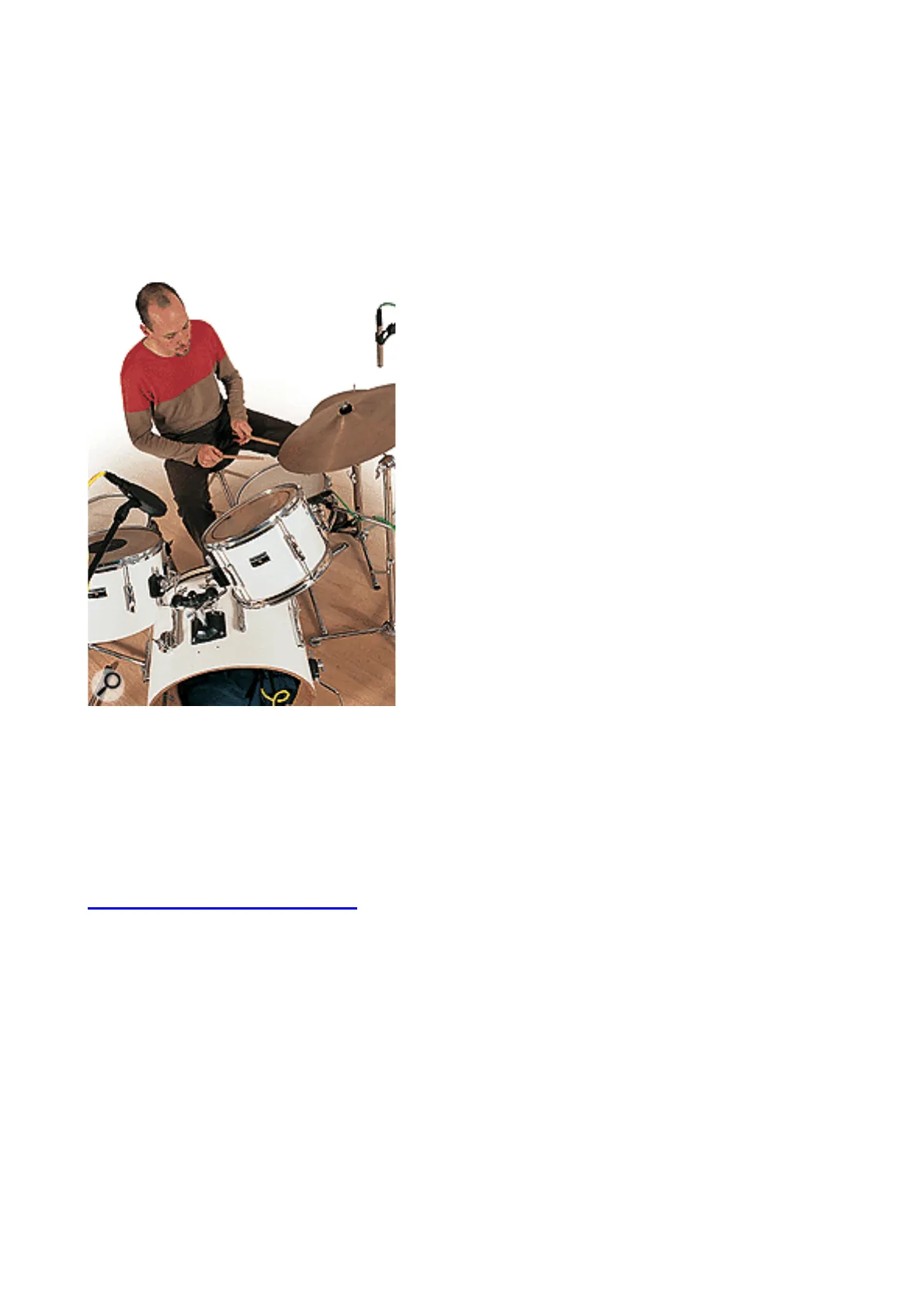
Probably the most purist approach is required in acoustic jazz, so let's start with this situation. Much like orchestral percussion, the most natural sound can be obtained with a high-quality condenser mic positioned overhead and either in front of or behind the kit. Most engineers prefer large- diaphragm condensers in this role, although small-diaphragm mics can be just as effective in most applications. You will see almost everything used in this role, including the Neumann U87, TLM170, TLM103, KM84 and KM184; the AKG C414B, C3000B, C4000B, C1000S and C451; the Sennheiser E664; and the Audio Technica AT4033 and AT4040. Pretty much any cardioid condenser will do. On pure jazz recordings, Coles 4033 ribbon mics also work very well indeed.
Mono and Stereo Mic Placement
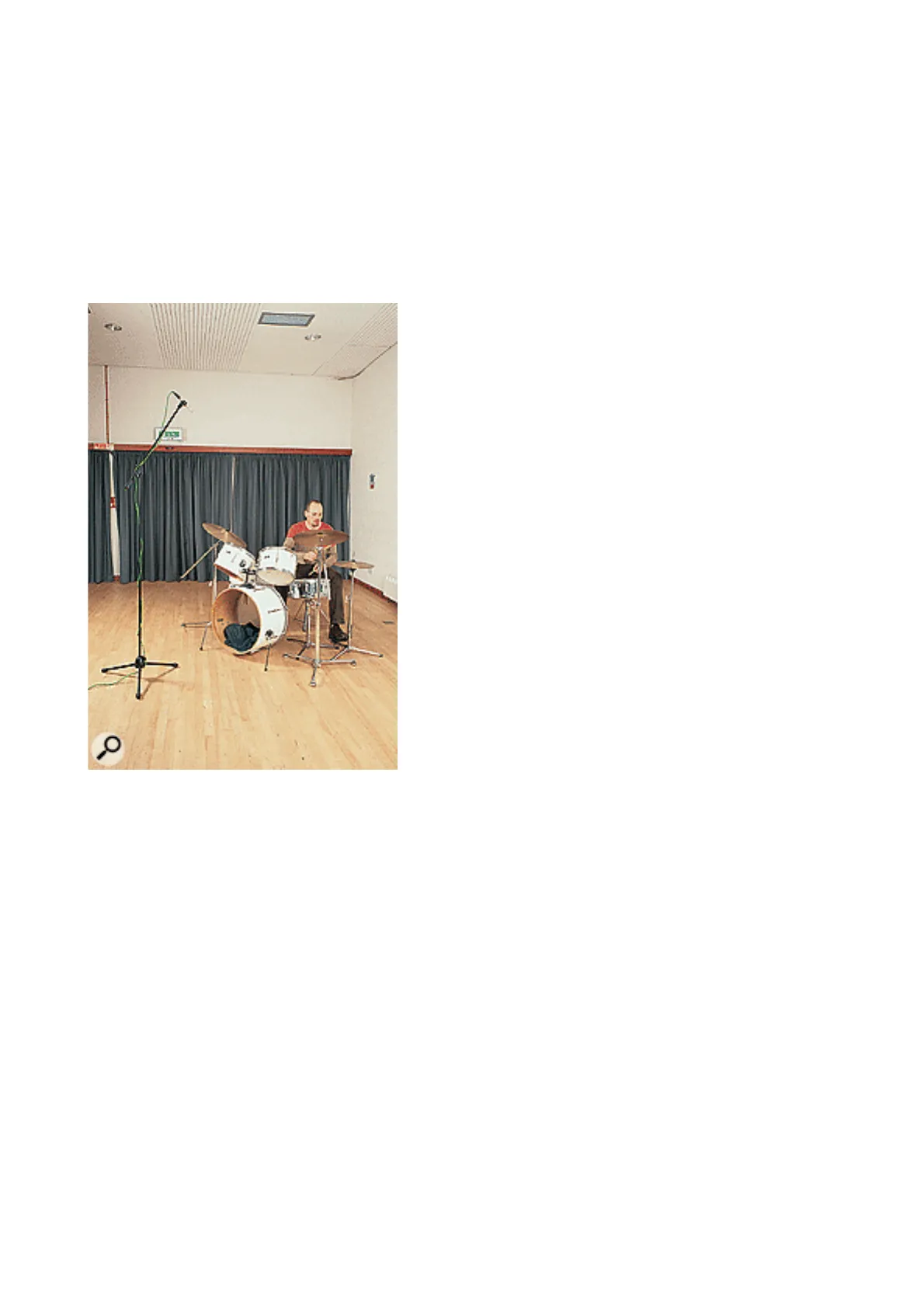
Back in the days when I was working in mono television broadcasting, I found a single, wide- cardioid mic placed above and behind the drummer's head worked very well. Placing a stereo mic (the Soundfield works extremely well in this role) in the same place usually provides a very natural and well-balanced sound too. The exact mic position will need to be played around with a little, naturally, to find the best balance of drums and cymbals in the acoustic, but it is quite a good starting point.
Cymbal and Hi-Hat Radiation Patterns
It is worth bearing in mind that, while the cymbals tend to radiate sound in a bipolar or figure-or- eight pattern above and below the metal plate, the hi-hats tend to radiate sound horizontally. This information provides two clues to help position your mics. Firstly, you can reduce the level of cymbals relative to drums by bringing the mic closer to the plane of the cymbals, where they will radiate little energy. If you want more cymbal, move higher and more directly above them.
Overhead and Under-Cymbal Miking
Since the cymbals radiate up and down, you can also place mics below the cymbals, closer to the drums themselves. In fact, this used to be a very common way of miking up kits in dance bands - often with just a single condenser cardioid mic in front of the bass drum on the plane of the hi-hat (to ensure it was heard clearly), and angled towards the snare. I wouldn't advocate this technique these days, but it is an educational thing to experiment with. However, in general, a better overall kit sound is obtained by going overhead, and you can often find an acceptable balance of most of the kit anywhere between two and three meters above the floor, and either behind or in front of the kit. The more distant positions obviously require a good acoustic environment and low levels of spill from other instruments.
C
Can’t find what you’re looking for?
Explore more topics in the Algor library or create your own materials with AI.
