Eating and Nutrition: Concepts, Nutrients, and Carbohydrates for High School
Slides from Doña Macarena Arechavaleta about Eating and Nutrition. The Pdf provides a clear and concise foundation on biology, covering the distinction between eating and nutrition, classifying organic and inorganic nutrients, and detailing carbohydrates. This High school Pdf is ideal for reviewing or learning the fundamentals of biology.
See more53 Pages


Unlock the full PDF for free
Sign up to get full access to the document and start transforming it with AI.
Preview
Eating and Nutrition Concepts
Eating vs. Nutrition Processes
Eating: conscious, voluntary process through we consume foods Nutrition: unconscious, involuntay process by which foods are transformed into nutrients
Foods: subtances from other living things that are ingested Nutrients: simplest molecules in foods that cells need to perform their functions.
Nutrients Overview
Nutrient Functions
- Provide cells the raw materials they need to build cellular structures, repair, grow and multiply.
- Supply the energy needed to perform life processes.
- Allow regulation of the chemical reactions that occur within the cells.
Nutrient Classification
· Can be classified: Organic · Carbohydrates · Fats · Proteins · Vitamins Inorganic · Water · Minerals
Two Types of Nutrients
Inorganic Nutrients
water oxygen calcium sodium
Inorganic nutrients are simple substances involved in chemical reactions, which are essential for the life processes of all living organisms. However, cells cannot use these nutrients as a source of energy.
Organic Nutrients
proteins carbohydrates fats
Organic nutrients are complex substances produced by living organisms. The cells in use them as a source of energy to survive. They make up the biomolecular base upon which cells are built.
Carbohydrates
Carbohydrate Composition and Function
· They are biomolecules formed of carbon, hydrogen and oxygen. . The main function is to produce energy.
Simple Carbohydrates
v Simple carbohydrates or sugars (glucose, fructose, sucrose, lactose). Easily enter the cells and supply energy for immediate consumption. All the different types of sugars are ultimately converted into glucose, which is delivered to the cells.
Complex Carbohydrates
v Complex carbohydrates, such as starch, glycogen, or cellulose are made of long chains of glucose. Cells cannot take in starch, but they are able to take in the sugars produced by the digestion in the digestive tract.
Cellulose and Fiber
Cellulose: Main component of the cell walls of plants
· Fiber is a complex carbohydrate of plant origin. Humans cannot digest fiber or use it as a source of energy or matter, but it is nonetheless essential for the functioning of the digestive system. Vegetables are fiber-dense foods.
Lipids or Fats
Lipid Composition and Functions
· Biomolecules made up of carbon, hydrogen and oxygen. · Produce energy, structural function and regulatory function.
Types of Fats
· Different types of fats: Unsaturated fats: usually liquid at room temperature. They are healthy Saturated fats: usually solid at room temperature. Less healthy Hydrogenated fats: originally unsaturated fats that have been transformed into saturated fats in the industrial processing of some foods. Best avoided in the diet.
Cholesterol
· Cholesterol: is a lipid found in foods of animal origin. . It helps to construct cell membranes. · Humans synthesize an adequate amount of cholesterol in the liver already, so no additional intake is needed.
Proteins
Protein Composition
· Biomolecules made up of carbon, hydrogen, oxygen and nitrogen. · Formed of long chains of simpler molecules, called amino acids. · 20 different amino acids. . Our cells are unable to produce 10 of them: they are essential amino acids and must be obtained from the foods we eat.
Protein Sources
Proteins of animal origin Provide the 10 essential aminoacids Proteins of plant origin Are missing one or more of the essential aminoacids
Functions of Proteins
The functions of proteins are: Transportation . They transport substances, such as the haemoglobin that carries oxygen in the blood. Immunological. . They help protect the body from infections via antibodies. Regulatory. . They regulate biochemical reactions. This is the case with enzymes and some hormones. Structural. . They form part of different structures. Proteins in cell membranes, keratin in nails and hair, and collagen in the skin are all formed of proteins.
Vitamins
Vitamin Characteristics
· Organic components that the body either cannot produce or produces only in insufficient quantities. These must be obtained from food. · All vitamins: 1. Are needed in small quantities. 2. Are essential for regulating many cellular processes in the body.
Fat-Soluble Vitamins
FAT- SOLUBLE VITAMINS Stored in the fatty tissues of the body and the liver.
- Vitamin A: important for vision · Milk, eggs, tomatoes, lettuce, carrots
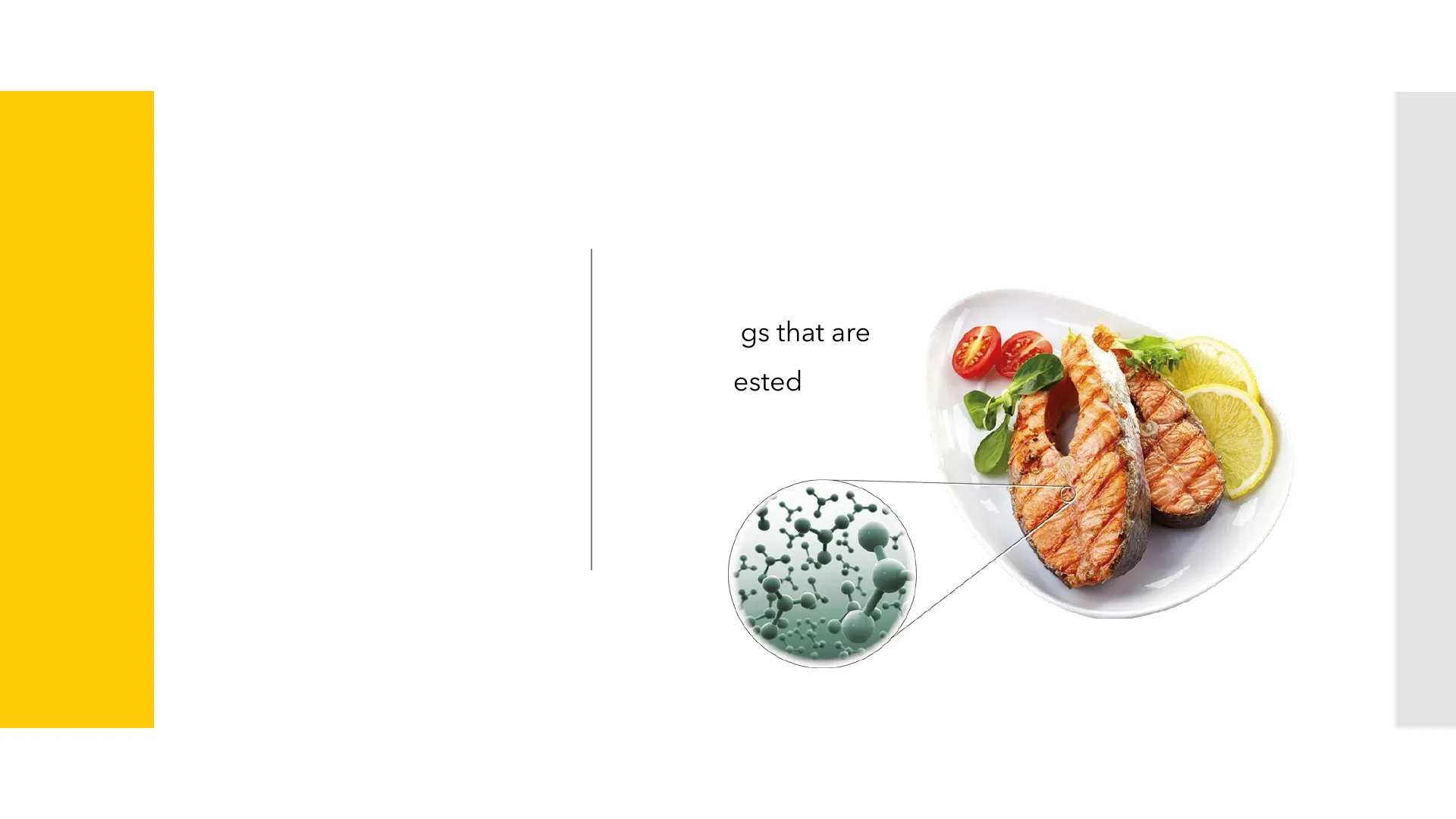
- Vitamin D: facilitates absorption of calcium and phosphorus and correct bone formation. · Oily fish, eggs and cheese
- Vitamin E: antioxidant. · Vegetable oils, eggs, butter
- Vitamin K: involved in blood clotting. · Spinach, liver, potatoes
Water-Soluble Vitamins
WATER- SOLUBLE VITAMINS Cannot be stored in the body and must be taken daily or any excess is excreted in urine.
- Vitamin B1: involved in metabolic processes. · Cereals, potatoes, vegetables.
- Vitamin B12: helps to form red blood cells and is involved in protein metabolism. · Liver, meat, eggs and fish.
- Vitamin C: involved in formation of connective tissue and bone, and metabolism of amino acids. · Kiwis, citrus fruit and fresh vegetables
Water
Water's Role in Living Matter
. Main component of living matter. · Medium where all biological processes occur.
Main Biological Functions of Water
· Main biological functions: v Dissolves many substances. v Facilitates chemical reactions of metabolism, also involved in many. v Basic component of organic fluids (blood, lymph, intra- and extracellular fluid). v Helps to control temperature.
The human body needs a daily intake of about 2 L of water, obtained from food and water
Mineral Salts
Mineral Salt Functions
" Inorganic substances. · Two functions: 1. Structural: form solid structures. Like calcium phosphates and carbonates in bones. 2. Regulatory: involved in various vital processes: v Blood clotting and muscle contraction (calcium) v Binding of oxygen (iron) V Transmission of nerve impulses (sodium and potassium)
Calcium Iron Magnesium Zinc Potassium
Daily Mineral Requirements
Daily mineral requirements, by age and sex
Age (years) Calcium (mg) Phosphorus (mg) Magnesium (mg) Iron (mg) Zinc (mg) Iodine (mg) Selenium (mg) < 0.5 400 300 40 6 5 0.11 0.01 Babies 0.5-1 600 500 60 10 5 0.13 0.02 1-3 800 800 80 10 10 0.07 0.02 Children 4-6 800 800 120 10 10 0.09 0.02 7-10 800 800 170 10 10 0.12 0.03 11-14 1,200 1,200 270 12 15 0.15 0.04 15-18 1,200 1,200 400 12 15 0.15 0.05 Men 19-24 1,200 1,200 350 10 15 0.15 0.07 25-50 800 800 350 10 15 0.15 0.07 > 51 800 800 350 10 15 0.15 0.07 11-14 1,200 1,200 280 15 12 0.15 0.05 15-18 1,200 1,200 300 15 12 0.15 0.05 Women 19-24 1,200 1,200 280 15 12 0.15 0.06 25-50 800 800 280 15 12 0.15 0.06 > 51 800 800 280 10 12 0.15 0.06
Mineral Concentration in Foods
CONCENTRATION OF MINERALS IN FOODS a All foods contain minerals. Review the mineral content of different foods and complete the table below. Round off the answers and express them without decimals.
Milk (mg/100g) Chickpeas (mg/100g) Bananas (mg/100g) Cumin (mg/100g) Potassium 140 875 362 1,783 Calcium 110 105 5 933 Phosphorus 89 366 22 500 Sodium 39 24 1 167 Magnesium 10 115 27 367
Food Groups
Food Group 1: Carbohydrates
1. Group 1 Potatoes, cereal products and sugar. Provide carbohydrates.
Food Group 2: Lipids
Group 2 Butter, oils and fats in general. Provide lipids.
Food Group 3: Dairy Proteins
3. Group 3 Dairy products. Provide proteins.
Food Group 4: Protein Sources
4. Group 4 Fish, meat and meat products, eggs, pulses and nuts. Provide proteins.
Food Group 5: Vegetables
5. Group 5 Vegetables. Provide vitamins and minerals. Rich in dietary fibre.
Food Group 6: Fruit
Group 6 Fruit. Provide vitamins and minerals. Rich in dietary fibre.
Nutritional Pyramid
NAOS Pyramid Guidelines
Ocassionally Several times a week Every week Several times a day Every day RICE 1-2 L of water everyday NAOS Pyramid. Created by the Spanish Food Safety and Nutrition Agency (AESAN).
Energy in Foods
Energy Measurement
Your body releases the chemical energy stored in the nutrients. This energy is usually measured in calories. · 1g Carbohydrates = 4 kcal. · 1g lipids = 9 kcal. · 1g proteins = 4 kcal. 1 calorie is the amount of energy needed to warm 1 g of water at a certain temperature by one degree. kilocalories (kcal) are used more often or the SI-unit Joule (1 cal = 4.18 J). (1 kcal= 1000 cal)
Nutrient Distribution in a Balanced Diet
15% proteins carbohydrates lipids 30% 55% % nutrients in a balanced diet
Diet and Health
Nutritional Needs and Healthy Diet
· Nutritional needs vary from one person to another (age, sex, physical activity and physiological state) . Diet: the amount and type of food we eat. · Healthy diet = complete and balanced. It provides all necessary nutrients in the correct proportions
9 1 10 kg 8 2 7 3 V2 6 4 V/2 · 5
Recommendations for a Healthy Diet
- Eat five small meals a day to facilitate digestion and intestinal absorption.
- Moderate your consumption of salt and salty foods, to prevent high blood pressure.
- Minimise your sugar consumption.
- Eat carbohydrate-rich foods, such as foods that contain a lot of starch (bread, rice, pulses, etc) often, because carbohydrates can be stored as an energy reserve.
- Reduce your consumption of unnecessary foods (cakes, sweets, soft drinks, etc.).
Further Healthy Diet Recommendations
- Eat a variety of foods from all the groups of the food wheel and eat the amounts recommended in the nutritional pyramid.
- Eat at least three pieces of fruit and two or more portions of fresh vegetables or salad every day, as these provide vitamins.
- Eat foods that are rich in dietary fibre, as they help you go to the toilet.
- Eat unsaturated fats and reduce consumption of foods that are rich in saturated fats and cholesterol , as they increase the risk of cardiovascular disease.
- Drink between 1.5 and 2 litres of water per day.
Types of Diets
Dietary Variations
- Low-calorie diet: for losing weight
- High-calorie diet: for people with high demand of calories (weight gain, sports)
- Low-fat diet: controversial, low-saturated fat is better
- Low-carb diet: seems to be beneficial but controversial
- Vegetarian diet: No animals (no meat or no meat and no fish)
- Vegan diet: No food derived of animals
- Mediterranean diet: olive oil as main source of lipids, fish and seafood as principal source of protein
Activity 1: Different Carbohydrates
Carbohydrate Table Completion
Complete the table by indicating whether each of following descriptions applies to sugars, complex carbohydrates (such as starch), or dietary fiber.
| Sugars | Complex carbohydrates | Dietary fiber | |
|---|---|---|---|
| Are a primary source of energy and matter | yes/no | yes/no | yes/no |
| Can be used immediately | yes/no | yes/no | yes/no |
| Are a primary source of glucose | yes/no | yes/no | yes/no |
| Facilitate intestinal transit | yes/no | yes/no | yes/no |
| Are complex molecules | yes/no | yes/no | yes/no |
Can’t find what you’re looking for?
Explore more topics in the Algor library or create your own materials with AI.
