Information Systems: Definitions, Models, and Organizational Strategies
Document from University about Information Systems. The Pdf provides a comprehensive overview of information systems, covering definitions, high and low-level models, organizational strategies, and performance indicators. It also delves into topics like COBIT, ERP, CRM, IT economics, and change management, suitable for Computer Science students.
See more56 Pages


Unlock the full PDF for free
Sign up to get full access to the document and start transforming it with AI.
Preview
Sommario
- Definitions
- High level models.
- Low level models
- Low level models - process
- Low level models - data
- Low level models - organization
- Low level models - Business rules
- Low level models - Technology
- Organizations
- Strategy
- KPI CSF BSC
- IS
- COBIT
- ES - ERP - CRM
- CRM
- IT Economics
- Transaction theory
- Agency theory.
- Decision theory
- Value of IT in an organization
- IT Governance
- Outsourcing
- Product functions.
- Change management.
Definitions
Organization: a group of people that accomplish a set of goals (enterprise, army, church .... )
- Managing resources
. Implementing business processes
- Work for profit
Business process: set of activities
Written by: Dario Marchitelli
1
13· Executed in a certain order (parallel or sequential)
· Performed by an organization
· Deliver a service/product
. Has defined inputs and outputs
Activity: time spent by people doing a task part of a business process
Business function: group of people/resources performing similar activities in an organization
(sales, marketing, HR ... )
Application: software that supports an activity/process
Software function: function offered by an application to support an activity or part of it
Application portfolio: set of applications used by an organization
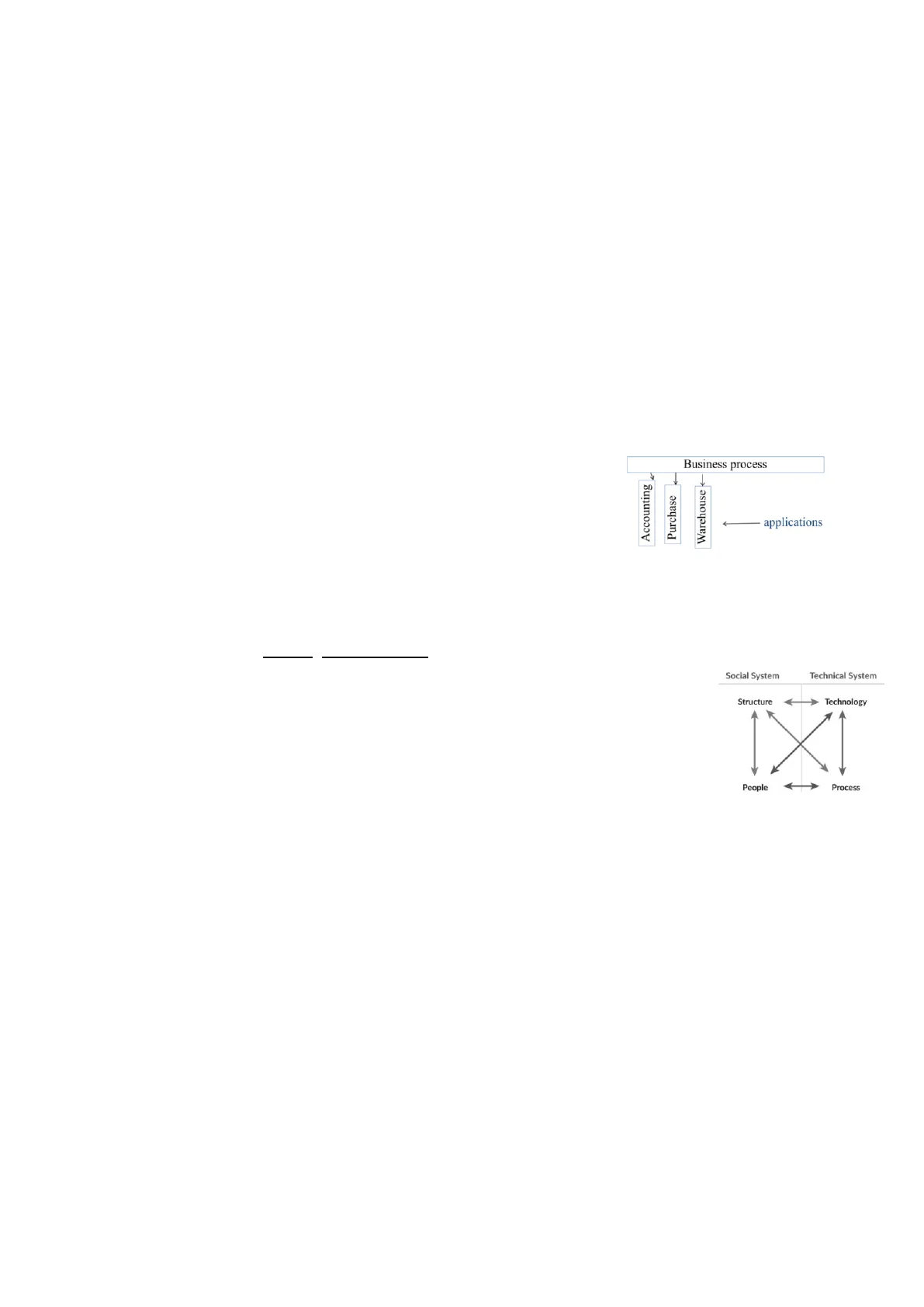
Often a business process can require software functions from many
applications, and a function can be required from many business
processes. So, it is a many-to-many relationship.
Business Process Relationships
Business process
Accounting
Purchase
Warehouse
applications
Legacy: is an older software that in same way is difficult or expensive to replace and we need to
deal with it.
Information system: a formal, sociotechnical, organizational system designed to collect, process,
store and distribute information.
Information System Components
Social System
. Formal: built and managed with a goal for the organization
. Sociotechnical: involves the social system (structure and people) with the
technical system (technology and process) that interact with each other
Technical System
Structure
Technology
People
Process
Technology: computers, networks, applications
People: individuals involved into the IS:
- End users
. Managers
· IT professionals
An understanding of the people involved is important when designing, implementing, and
troubleshooting an IS.
Structure: implicit or explicit rules that govern relationships between the people involved in the IS
- Hierarchy
· Communication lines
· Reward mechanisms
· Functions, divisions
Hidden or missing communication lines or user resistance often causes IS failure.
IS success: the IS supports the organization goals fulfilling its needs about information processing
and supporting efficiency and effectiveness.
Written by: Dario Marchitelli
2
IS failure: the IS is never completed, is never used, abandoned, or is working against the
organization goals.
IS Outcomes
IS outcomes:
- On people:
o
Positive: empowering employees and widening the scope of their responsibilities
o
Negative: deskilling, loss of responsibility, and the creation of a monotonous
working environment
. On the organization and its future opportunities
The four components of an IS are interdependent, changes in one component
may affect other components and, if not properly managed, also its outputs.
Considering only the technology dimension can cause lack of understanding of
systemic relationship and lack of considering information outside the technology
component.
IS Components Interaction
Social System
Technical System
Structure
Technology
People
Process
To adapt to the changing environment an organization (and its IS) need to evolve, there are three
levels of organizational change:
- First-Order Change: Automate
A First-Order change only infect the technical system, it occurs with the
introduction of an IT innovation that modifies how an existing process is
performed and it's the easiest to envision, justify and manage.
. Second-Order Change: Informate
A Second-Order change affect the people, it modify the way individuals
perform processes and the manner in which they interact with the
technology change.
It occurs when the information intensity of the process being performed
changes substantially due to the introduction of new IT.
To manage such a change the organization need to provide appropriate
training and overcome the human tendency to resist change.
. Third-Order Change: Transform
A Third-Order change affect the structure:
o
Technology: a change in the way the organization selects, uses and
manages technology
o People: a change in the reporting and authority structure of the
organization
o
Process: a novel way of task accomplishment or a new set of task
Managing it requires significant managerial and executive involvement.
Organizational Change Levels
Social System
Technical System
Structure
Technology
People
Process
Social System
Technical System
Structure
Technology
People
Process
Social System
Technical System
Structure
> Technology
People
Process
The technical system is made of several applications that read/write on several databases that
contains master data (list of entities: products, customers, suppliers) and transactional data (sales,
invoices). This interconnections generates the integration problem related to data or applications
that need to cooperate.
Written by: Dario Marchitelli
3
IS Time Dimension
The 5th dimension for IS is time, year by year the tecnology trends and
devices evolve, when this happens people often show a certain
resistance to change. Technology innovations have a cost and have a
certain learning curve that usually is different from the expected.
Learning Curve Graph
100
Didi do that!
But I keep
Now i get it
This actualy
makes sense.
doing it.
25
.
100
Learning Efforts (# Attempts)
Time
There are different issues when dealing with time:
- Application portfolio: in big organizations is quite difficult to make a census of present
applications with their goals, the AP knowledge helps to evaluate the IS and define
acquisitions/changes of applications
. Integration of data and applications
. Legacy software: when the IS is too old it can happen that the development environment,
the documentation, the source code or the vendor are unavailable, this can lead to
expensive and risky substitutions.
[FACTORY + WAREHOUSE EXAMPLE]
An IS is needed to:
- Transfer information (real time)
· Document (past and present):
o
All the steps must be recorded answering the questions who, what, when and also
why because we need to understand more when something goes wrong
· Monitor (past and present): summary data for the Management Control Loop (managers)
o
Documentation of the flow: instructions for the activities to be performed
When we create an IS the technology must be decided after analyzing the process:
- Flow: list of activities to be performed when something happens
. Data: entities and events that we need to record into the IS
· Business rules
When choosing the technology we have two choises:
- Use a different application for each piece of structure (production, warehouse, purchase
office, accounting ... )
. Use one overall db with a single application that has all the functions needed
In the example analyzed the information flow is parallel to a physical flow, in other cases there's
no physical flow at all (bank, insurance).
IT Dimension
The IT dimension has two main parts:
- Application Model: describes the software architecture and the software programs:
o
Presentation Layer: an IS communicates with the user through a GUI and different
inputs.
This layer can change a lot without touching the
Presentation Layer
business process.
Application Model
Business Rules Layer
Data Layer
o
Business Rules Layer: represent the logic driving
the processing of data entered in the IS through
the Presentation layer.
Processing Architecture
Server
Network Architecture
Lan, Man, Wan
Written by: Dario Marchitelli
4
Client
Technological Model
Experience
I don't know stmgIf the process changes surely this layer changes while the data layer remains stable.
Can be defined using the code or with Drools
Data Layer: database
o
. Technological Model: describes the hardware architecture.
The typical architecture that is always assumed is 3-tiers and client-
server but can also have only two tiers (fat to thin client).
Typical IT Architecture
Client
Web
Server
Application
Server
Data Server
A processing architecture must satisfy a few basic quality requirements:
- Response time: the interval between the request and the display of the response
. Scalability: the work load a system is able to sostain
· Availability: percentage of time the system is working
High level models
Control Loop Model
The control loop model has 4 parts:
- Input: the capture or collection of raw data from within the organization and its external
environment for processing in an information system
. Output: The distribution of processed information to the people and the activities that will
use it
. Process: the conversion, manipulation and analysis of
raw input into a more meaningful form
. Feedback: the output is used to evaluate and correct
the inputs
Control Loop and Environment
This model gives a view of the context and the environment,
organizations (and the related IS) are influenced with 5 types
of actors:
- Customers
· Suppliers
· Stakeholder
· Competitors
· Regulatory agencies (including law system)
ENVIRONMENT
Customers
Suppliers
ORGANIZATION
INFORMATION SYSTEM
INPUT
PROCESS
OUTPUT
FEEDBACK
Regulatory
Agencies
Stakeholders
Competitors
CRASO Model
The CRASO (Customer Request Activity organisation
Output) model shows the activities, the actors doing
activities and the assets treated by them.
The customer is always the start and the end of the loop.
The CRASO model can be:
Customer
Activity 1
Activity 2
Request
Activity 4
for a
Activity 3
Output
(products
and
services)
Service
or
product
Organization 1
Organization 2
Organization 3
Written by: Dario Marchitelli
5
CRASO Model Types
Mono-
organizational:
involves only one
organization
Mono-functional:
involves only one
business function
(exceptional case)
Corporate Dpts
Finance Dpt
Informa
tior
request
Collect data
Publish
report
Report
Analyze data
Business
Process
Management
reporting
Customer
Request
Activities performed
(summary)
Organizations involved
(summary)
Output
(summary)
Report
Inter-functional:
involves many
business functions
in the same
organization that
can have differend
SI and DB
Corporate Dpt
Supplier Order Dpt
Supplier
Shipment
Order-entry
Supply-
order
Supply/
delivery
Supply
delivered
Order-fulfilment
Business Process
Customer
Request
Activities performed
(summary)
Organizations Involved
(summary)
Output (summary)
Production Planning
Sales-dpt
Production-request
Assemble-production-plan,
Give-information,
Negotiate and execute the plan
Production planning-dpt, Materials-
management-dpt,
Factories
Approved
production plan
Service Famil
no MSin University of
d
Inter-organizational: involves many
organizations
Anthony's Pyramid Model
The Anthony's model (pyramid model) mixes the hierarchical levels into the
organization and the business functions putting them into a pyramid, where
at each intersection different IS functions are needed.
The organizational level is represented by horizontal strips (example for a
retail company):
- Operational level: composed by the employees that work day by day
and with repetitive activities.
(Implement a sale, replenish products on shelves)
. Knowledge level: composed by knowledge and data workers that
design new products/services on the present/future time frame (the
number of emplyees depends on the complexity of the
product/service). This level is present only in organizations that need
designing.
. Management level: composed by middle managers that control and
plan the activities of the operational level, working on the near future time frame (limited
number of employees).
(review of sales, monitor emplyees)
Organizational Levels and Business Functions
Organizational level
STRATEGIC LEVEL
MANAGEMENT LEY
KNOWLEDGE LEVEL
OPERATIONAL LEVEL
SALES &
MARKETING
MANUFACTURING FINANCE
ACCOUNTING HUMAN
RESOURCES
Business functions
IS Group Served by Organizational Level
Organizational level
Group served by IS
STRATEGIC LEVEL
SENIOR
MANAGERS
MANAGEMENT LEVEL
MIDDLE
MANAGERS
KNOWLEDGE LEVEL
KNOWLEDGE &
DATA WORKERS
OPERATIONAL
LEVEL
OPERATIONAL LEVEL
MANAGERS
Amazon
front-end
Bookshops
Logistic
services
Pick
Deliver
Request
Output
Process
orders
Customer
Request
Activities performed (summaryganizations Involved (summaryDutput (summary)
Book order
Processorder,
Orderpicking.
Book-delivery
Front-end,
Bookshop,
Logistic services
Delivery of books
Private customer
Corporate
Departments
Information
request
Data-collection
Data-analysis
Report-publication
Finance
Customer
Written by: Dario Marchitelli
6
Can’t find what you’re looking for?
Explore more topics in the Algor library or create your own materials with AI.
