Environmental Law and Policy: Historical Evolution and Key Principles
Slides from University about Environmental Law and Policy. The Pdf explores the historical evolution and fundamental principles of environmental law, covering international legal instruments and policies for Law students.
See more56 Pages


Unlock the full PDF for free
Sign up to get full access to the document and start transforming it with AI.
Preview
UNIT 1 FUNDAMENTALS
Evolution of International Environmental Law
1-2 Evolution of International Environmental Law 3. Guest Lecture: The 10 features of IEL UNIT 2 CORE LEGAL INSTRUMENTS 4-5. The Protection of the Atmosphere I & II 6-7. The Paris Agreement I & II
UNIT 3 CORE POLICY INSTRUMENTS
Regulatory Models and Market-Based Instruments
8. Guest Lecture: An Overview of Different Regulatory Models 9-10. Market-Based Instruments and a Regional Focus I & II: (EU and Switzerland) 11-12. Non-Market-Based Instruments and a Regional Focus I & II: (EU and Switzerland)
Class 1 - Origin and Principles of IEL
Learning Objectives
Learn concepts:
- Explain the evolution of international environmental law
- Explain the concept of "Sustainable Development"
- Explain the difference between "no harm", "prevention", and "precaution"
- Explain how the notion of balance is explained through the principles of "polluter-pays" and "CBDR"
Learn how to apply concepts:
- Assess how international environmental law has evolved to address complex, global environmental problems
- Evaluate whether the concept of sustainable development provides an adequate tool to deal with the environment/development tension
- Evaluate whether IEL deals adequately with the common/differential ambivalence of global environmental concerns
Origin and Evolution of IEL
Early Approach to International Environmental Law
The early approach to International Environmental Law can be traced back to a notable case, the Bearing Fur Seals Arbitration of 1893. This case involved a dispute over the rights to hunt fur seals in the Behring Sea. The arbitrators, including Baron de Courcel, Lord Hannen, Sir John Thompson, Marquis Visconti Venosta, and Mr. Gregers Gram, were tasked with deciding on several points related to the issue. The critical finding from this arbitration, particularly concerning the fifth point, was that the United States did not have any rights of protection or property over the fur seals that frequented the islands of the United States in the Behring Sea once these seals moved beyond the ordinary three-mile territorial limit. This decision highlighted the complexities of jurisdiction and the management of natural resources, which are central themes in the development of International Environmental Law.
The principles of international environmental law are fundamental guidelines that help shape and define the structure of a specific legal framework. These principles are positioned in terms of specificity between broader concepts and narrower rules. Concepts, such as guiding norms, provide the foundation for principles, which in turn serve as the basis for the implementation of more detailed and specific rules- - substantive regulations.
Principles of international environmental law are not as rigid as rules; instead, their application and interpretation often vary and are evaluated on a case-by-case basis. This flexibility allows for the nuanced application of principles to different environmental scenarios and legal contexts.
Entire environmental legal frameworks can be constructed around these principles. For instance, the climate change regime heavily relies on the precautionary principle, which advocates for preemptive measures against potential harm when scientific evidence is inconclusive. Simultaneously, this regime embraces the principle of common but differentiated responsibility, which acknowledges that while all nations are 1responsible for addressing global environmental damage, not all bear the same level of obligation or capacity to take action. This principle takes into account the varying capabilities and responsibilities of different countries in addressing environmental issues.
Brief History of Environmental Law
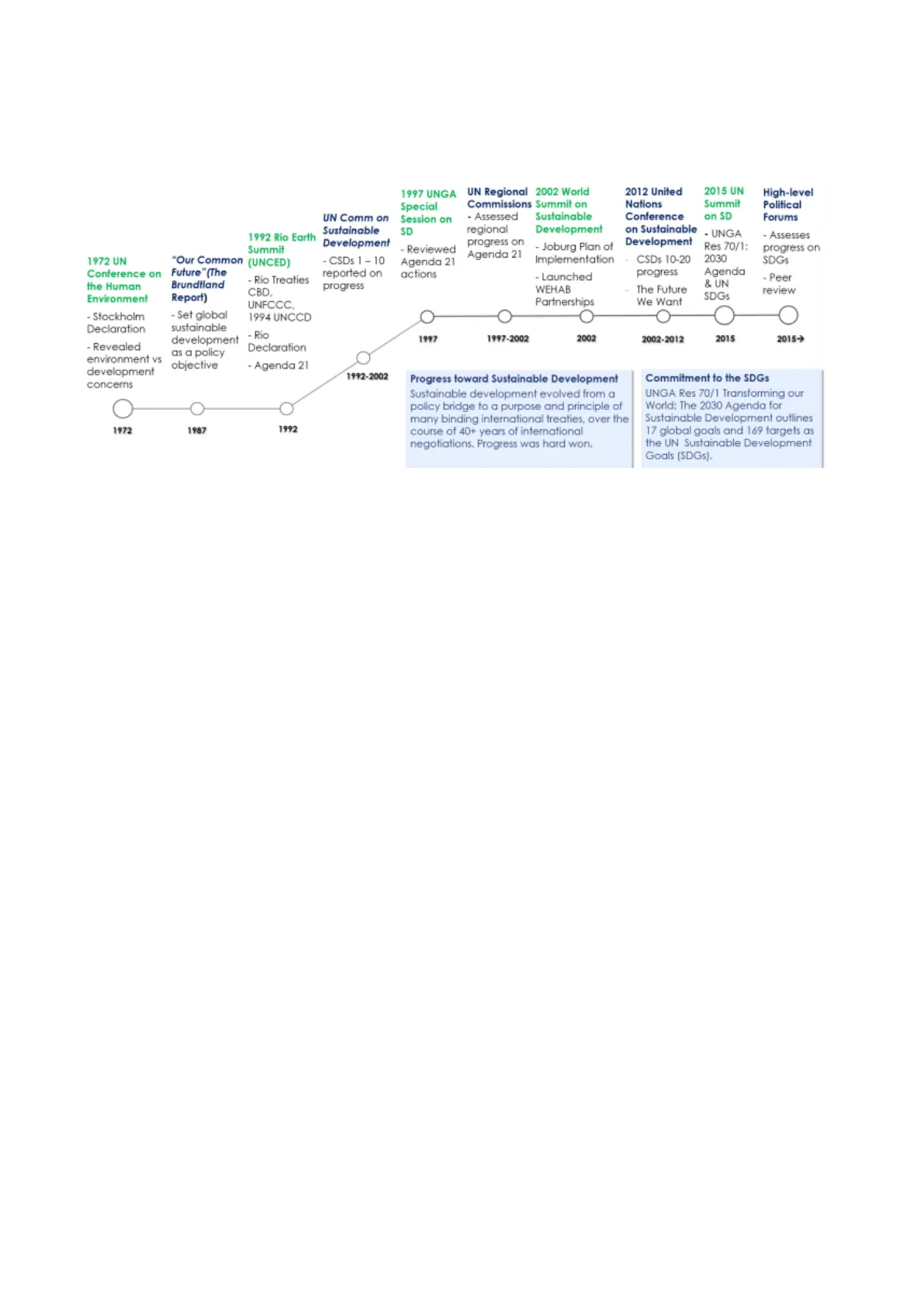
1997 UNGA UN Regional 2002 World Commissions Summit on 1992 Rio Earth Summit UN Comm on Sustainable Development - Assessed regional progress on Agenda 21 Sustainable Development 2012 United Nations Conference on Sustainable Development 2015 UN Summit on SD High-level Political Forums 1972 UN "Our Common (UNCED) Conference on Future"(The the Human Brundtland Report) Environment - Rio Treaties CBD. UNFCCC, 1994 UNCCD 0 1997 1997-2002 2002 2002-2012 2015 2015-> - Revealed environment vs development concerns as a policy objective - Agenda 21 1992-2002 Progress toward Sustainable Development Commitment to the SDGs UNGA Res 70/1 Transforming our World: The 2030 Agenda for Sustainable Development outlines 17 global goals and 169 targets as the UN Sustainable Development Goals (SDGs).
- Took place in Stockholm. Issued the Stockholm Declaration.
- Highlighted the conflict between environmental concerns and developmental goals.
1987: Our Common Future (The Brundtland Report)
- Defined sustainable development as a policy objective.
- Influenced global sustainability goals.
1992: UN Conference on Environment and Development (Rio Earth Summit)
- Produced important treaties like the Convention on Biological Diversity (CBD), United Nations Framework Convention on Climate Change (UNFCCC), and others.
- Introduced Agenda 21, a comprehensive plan of action to be taken globally, nationally, and locally by organizations of the UN, governments, and major groups in every area in which humans impact the environment.
1992-2002: Progress toward Sustainable Development
- Sustainable development evolved from a policy concept to a purpose and principle of many binding international treaties over the course of more than 40 years. This period notes that progress was hard- won, indicating numerous challenges and negotiations.
1997: UNGA Special Session on Sustainable Development
- Reviewed progress on Agenda 21 actions. Discussed Commission on Sustainable Development (CSD) issues from 1 to 10.
1997-2002: UN Regional Commissions
- Assessed regional progress on Agenda 21.
2002: World Summit on Sustainable Development
- Reviewed the Johannesburg Plan of Implementation.
- Initiated partnerships in the area of Water, Health, Agriculture, and Biodiversity (WEHAB).
2012: United Nations Conference on Sustainable Development (Rio+20)
- The United Nations General Assembly (UNGA) resolution 70/1 is cited, indicating progress on sustainable development goals.
- Commission on Sustainable Development (CSD) issues 10-20 were addressed.
- Documented "The Future We Want," which is likely a vision or statement for sustainable development.
2015: UN High-level Political Forum on Sustainable Development
- Assessed progress on the SDGs. - Joburg Plan of Implementation - CSDs 10-20 progress - UNGA Res 70/1: 2030 - Assesses progress on SDGs - CSDs 1 - 10 reported on progress - Reviewed Agenda 21 actions - Launched WEHAB Partnerships The Future We Want Agenda & UN SDGs - Peer review - Stockholm Declaration - Set global sustainable development - Rio Declaration Sustainable development evolved from a policy bridge to a purpose and principle of many binding international treaties, over the course of 40+ years of international negotiations. Progress was hard won. 1972 1987 1992 Special Session on SD
- Included peer review mechanisms to ensure accountability and progress. 2Post-2015: Commitment to the Sustainable Development Goals (SDGs)
- UNGA Resolution 70/1 "Transforming our World: The 2030 Agenda for Sustainable Development" was a major step in solidifying the global commitment to the SDGs.
- This resolution outlined 17 global goals and 169 targets as part of the UN Sustainable Development Goals.
Overview of Principles in IEL
Resource-Oriented Logic and Paradigm Shift
Initially, a resource-oriented logic prevailed, where the exploitation of resources was permissible as long as it yielded economic profit. However, since the 1972 Stockholm Declaration, there has been a shift towards prioritizing the preservation of natural resources. The Sustainable Development Goals (SDGs), established as the latest policy-oriented goals, are reflective of this paradigm shift and concern for environmental issues. These goals are underpinned by the following principles and concepts:
The principles serve several key functions: they provide identity to the legal regime, establish its architecture, aid in interpretation, and guide decision-making. Notably, provisions from declarations like the Rio Declaration can evolve into customary international principles. This occurs when numerous countries begin to feel an obligation to abide by these provisions, despite their non-legally binding nature initially, resulting in them effectively becoming binding. These principles, while global, are aimed at implementation on a national level.
Principles and Concepts of IEL
Principles (and concepts) Prevention Balance Substantive 1)No-harm Procedural 1)Cooperation, notification and consultation 2)Prior informed consent 3)Environmental impact assesment Principles 1) Polluter-pays 2)CBDR 3)Participation 4)Inter-generational equity Concepts 1)Common areas 2)Common heritage of mankind 3)Common concern of mankind 2)Prevention 3) Precaution Sustainable Development >
- Prevention: This is a substantive principle encompassing no-harm, prevention, and precaution.
- Balance: This includes principles that are more general and apply to various environmental law areas such as the polluter-pays principle, the principle of common but differentiated responsibilities (CBDR), and inter- generational equity.
- The concepts supporting these principles are ideas like common areas, common heritage of mankind, and common concern of mankind, reflecting the collective responsibility and shared benefits of natural resources.
- Procedural principles include cooperation, notification and consultation, prior informed consent, and environmental impact assessment, ensuring that environmental governance processes are participative and informed.
All these principles and concepts are fundamental to the broader aim of sustainable development, which seeks to harmonize environmental conservation with economic and social development.
The principles of International Environmental Law (IEL) are centered around two main values: prevention and balance.
Principles of Prevention in Environmental Law
Principles of Prevention: These are designed to avert environmental harm. The reason environmental law principles exist is to offer protection from damage - to prevent adverse effects that might be uncertain, as was evident in the environmental concerns raised in the 1990s. When it comes to putting these principles into action, substantive principles must be executed with respect to a variety of procedural duties. These procedures ensure that measures to prevent environmental damage are transparent, participatory, and based on informed decision-making.
Principles of Balance in Environmental Law
Principles of Balance: These seek to equitably distribute the responsibilities for environmental protection among different parties. They aim to strike a harmonious balance between environmental protection and other factors, such as economic development. This principle addresses the dichotomy between environmental concerns and developmental needs, as well as the needs of present versus future generations.
The concept of sustainable development is essential when applying both sets of principles. Sustainable development is about meeting the needs of the present without compromising the ability of future 3
Can’t find what you’re looking for?
Explore more topics in the Algor library or create your own materials with AI.
