Exploring the Landscape of Contemporary Issues in Banking
Document from University about Exploring Landscape of Contemporary Issues. The Pdf provides a clear overview of economic and macroeconomic challenges, technological advancements like AI and ML, and regulatory pressures in the banking sector. This University level Economics material is structured for quick review.
See more63 Pages

Unlock the full PDF for free
Sign up to get full access to the document and start transforming it with AI.
Preview
EXPLORING LANDSCAPE OF CONTEMPORARY ISSUES
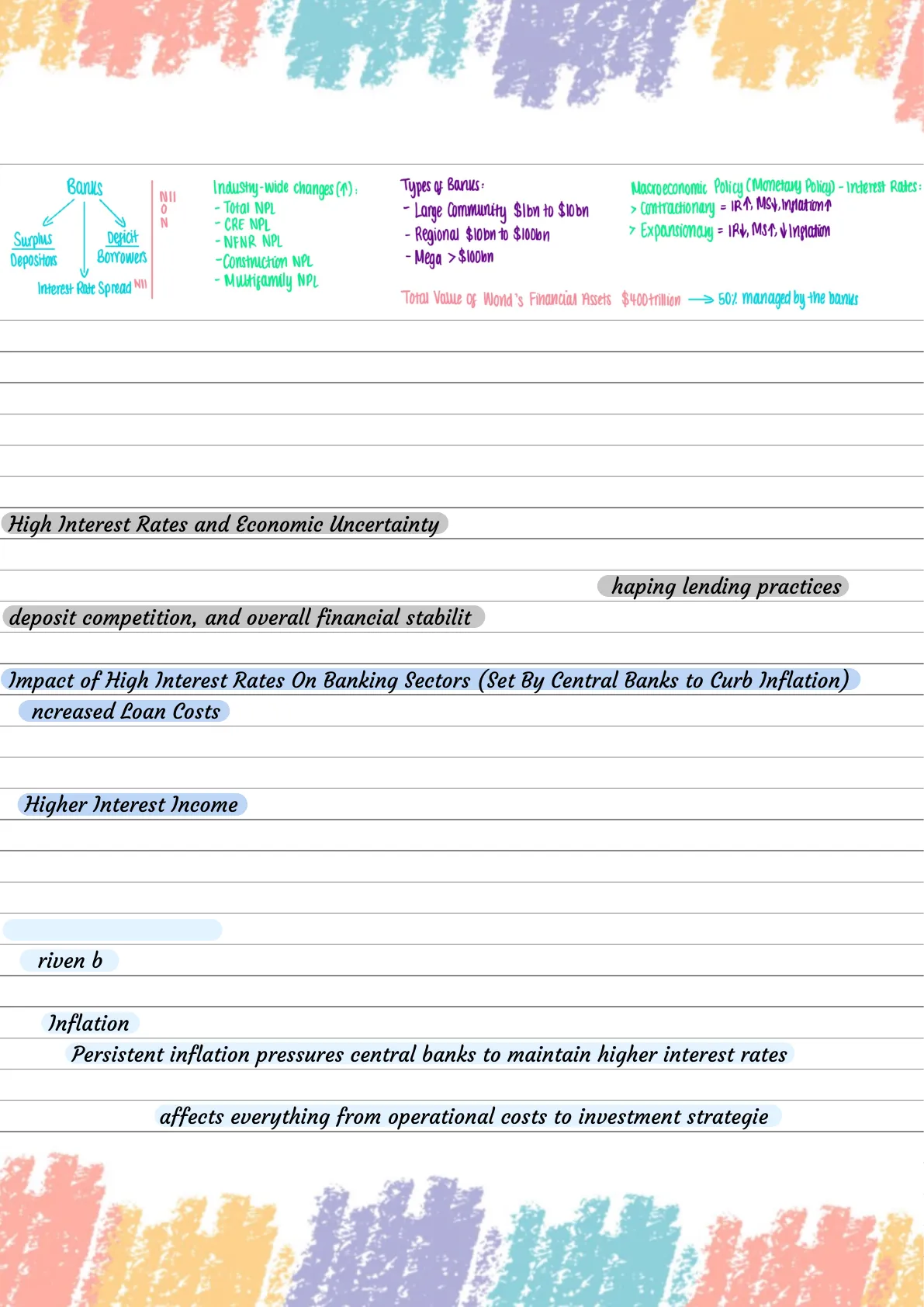
Banks
NII
0
N
Surplus
Depositors
Deficit
Borrowers
Interest Rate Spread NI!
Industry-wide Changes
- Total NPL
- CRE NPL
- NENR NPL
- Construction NPL
- Multifamily NPL
Types of Banks
- Large Community $Ibn to $10 bn
- Regional $10 bn to $100bn
- Mega > $100bn
Macroeconomic Policy (Monetary Policy) - Interest Rates
- contractionary = IR1; MSV, Inflation1
- Expansionary = IRV, MST, V Inflation
Total Value of World's Financial Assets $400 trillion -> 50% managed by the banks
NPL = Non-Performing Loan
CRE = Commercial Real Estate
NFNR = Non Farm Non Residential
ECONOMIC AND MACROECONOMIC CHALLENGES
High Interest Rates and Economic Uncertainty
Global economy and banking sector is affected by high interest rates and macroeconomic
factors, especially during periods of significant uncertainty - shaping lending practices,
deposit competition, and overall financial stability
Impact of High Interest Rates On Banking Sectors (Set By Central Banks to Curb Inflation)
- Increased Loan Costs: raise the cost of borrowing for consumers and businesses -> reduced
demand for loans and refinancing -> slows down the growth of banks' lending portfolios and
affect their profitability - Higher Interest Income: banks can earn more from the interest on loans -> this benefit is
often offset by the increased cost of deposits and other funding sources - Increase In Interest Rates = Increase In Mortgage
Economic Uncertainty
Driven by factors such as geopolitical tensions, supply chain disruptions, and the lingering
effects of the COVID-19 pandemic, poses additional challenges:
- Inflation:
Persistent inflation pressures central banks to maintain higher interest rates, which
further complicates the economic landscape for banks
Inflation affects everything from operational costs to investment strategies- Credit Quality:
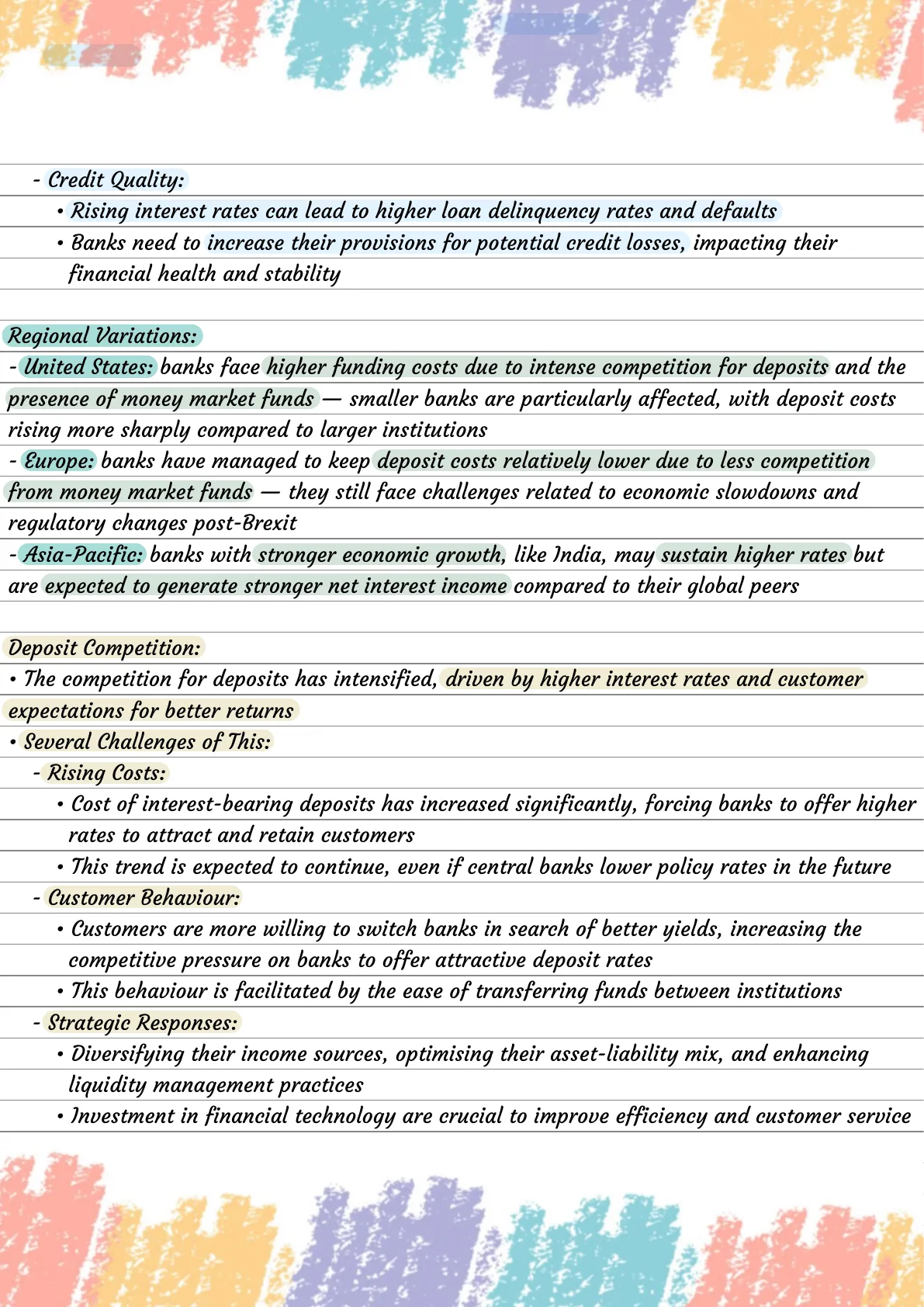
Rising interest rates can lead to higher loan delinquency rates and defaults
. Banks need to increase their provisions for potential credit losses, impacting their
financial health and stability
Regional Variations
- United States: banks face higher funding costs due to intense competition for deposits and the
presence of money market funds - smaller banks are particularly affected, with deposit costs
rising more sharply compared to larger institutions - Europe: banks have managed to keep deposit costs relatively lower due to less competition
from money market funds - they still face challenges related to economic slowdowns and
regulatory changes post-Brexit - Asia-Pacific: banks with stronger economic growth, like India, may sustain higher rates but
are expected to generate stronger net interest income compared to their global peers
Deposit Competition
The competition for deposits has intensified, driven by higher interest rates and customer
expectations for better returns
Several Challenges of This:
- Rising Costs:
Cost of interest-bearing deposits has increased significantly, forcing banks to offer higher
rates to attract and retain customers
. This trend is expected to continue, even if central banks lower policy rates in the future
- Customer Behaviour:
Customers are more willing to switch banks in search of better yields, increasing the
competitive pressure on banks to offer attractive deposit rates
. This behaviour is facilitated by the ease of transferring funds between institutions
- Strategic Responses:
Diversifying their income sources, optimising their asset-liability mix, and enhancing
liquidity management practices
Investment in financial technology are crucial to improve efficiency and customer service
TECHNOLOGICAL ADVANCEMENTS AND DIGITAL TRANSFORMATION
Changes Are Reshaping How Banks: operate - engage with customers - manage risk
Key Areas of Focus Include The Adoption of
- Artificial Intelligence (A)) and Machine Learning (ML)
- Rise of Digital Banking
- Implementation of Advanced Cybersecurity Measures
Adoption of Artificial Intelligence (A) and Machine Learning (ML)
Benefits: Automating Tasks - Enhancing Customer Service - Improving Risk Management
. Key Applications: A)-Powered Customer Service - Fraud Detection and Prevention - Risk
Management and Credit Scoring
A)-Powered Customer Service - Chatbots and Virtual Assistants
- A)-driven chatbots, such as Bank of America's Erica, provide round-the-clock customer
support, handling inquiries ranging from balance checks to loan information - Use Natural Language Processing (NLP) to understand and respond to customer queries,
freeing up human agents for more complex tasks and improving customer satisfaction
A)-Powered Customer Service - Personalised Services
A) enables banks to offer personalised product recommendations and services by analysing
customer data and preferences
This leads to more targeted marketing campaigns and improving customer engagement
Fraud Detection and Prevention - Real-Time Monitoring
- A) systems can analyse vast amounts of transaction data to detect unusual patterns or
anomalies that may indicate fraudulent activity - These systems continuously learn from new data, allowing them to adapt to emerging threats
and provide a proactive defence against fraud
Fraud Detection and Prevention - Enhancing Security
A) improves effectiveness of cybersecurity measures by predicting and preventing cyberattacks
Monitor internal threats and suggest corrective actions, thereby preventing data breaches and
ensuring the security of customer information
Risk Management and Credit Scoring - Predictive Analysis
- Better-informed lending decisions and improving risk management
Risk Management and Credit Scoring - Automation of Risk Assessment
A) automates the risk assessment process, making it faster and more accurate
Useful in credit scoring and loan origination, where timely and precise evaluations are crucial
REGULATORY AND COMPLIANCE PRESSURES
Reasons for Regulation
Public Money - Backbone of The Modern Economy
Regulatory and Compliance Pressures
- The banking sector is under increasing regulatory scrutiny and must navigate a complex
landscape of evolving regulations - These pressures stem from the need to enhance financial stability, protect consumers, and
address emerging risks
Key Areas of Focus Include The Implementation of Basel Standards
Heightened Regulatory
Scrutiny - Post-Brexit Regulatory Landscape
Implementation of Basel 11) Standards
Basel ") is a comprehensive set of reforms developed by the Basel Committee on Banking
Supervision in response to the financial crisis of 2007-2009
The Reforms Aim To Strengthen The: Regulation - Supervision - Risk Management of Banks
. Key Components Include: Capital Requirements - Liquidity Requirements - Risk Management
Enhancements
Basel 3.1
- Are being implemented in phases, with full compliance expected by 2025
- Measurement of RWAs - banks' capital ratios more consistent and comparable
Post-Brexit Regulatory Landscape
- UK's Financial Services and Markets Bill: principle-based approach that regulators greater
responsibility and emphasising flexibility, competitiveness, and innovation - Prudential Regulation Authority (PRA): has published policy statements covering the
implementation of Basel 3.1 standards, reflecting adjustments based on industry feedback to
ensure proportionality and clarity in the new rules - EU VS UK Approaches:
UK: a principles-based approach, focusing on growth and international competitiveness
- EU: prioritise financial stability, market integrity, and investor protection
CUSTOMER EXPECTATIONS AND EXPERIENCE
Customer Expectations and Experience
Shift in customer expectations, driven by advancements in technology and changing consumer
behaviour
Modern Customers' Demands: Personalised - Seamless - Convenient Banking Experiences
. Buy Now Pay Later (a loan)
Key Aspects of Personalisation
- Data Utilisation:
Insights From Large Datasets: use advanced analytics to understand customer behaviour
Personalised Product Recommendations: tailored financial products for different customers
segments
Targeted Marketing Campaigns: A) and real-time data enhance marketing efforts
> Example: A)-driven financial product offerings
- Customer Profiles:
Robust Profiles: transaction history - social media activity - non-traditional data
Hyper-Personalised Experiences: enhanced customer satisfaction
Financial Inclusion: servicing traditionally underserved communities
- Real-Time Interactions:
A) and Real-Time Data: priority for proactive and intelligent interactions
Proactive Financial Advice: timely - relevant advice for customers
Issue Alerts: early warnings on potential financial issues
Benefits of Personalisation
- Increased Customer Retention:
Higher Customer Satisfaction: personalised services lead to loyalty
- Customer Loyalty: customers feel understood and valued
> Example: long-term customer relationships
- Cross-Selling Opportunities:
Understanding Customer Needs: effective cross-selling of products and services
- Increased Revenue: higher deposit rates - lower delinquency rates
- Enhanced Customer Experience:
Improved Interactions: relevant and meaningful interactions
- Higher Engagement: stronger emotional connection with the bank
> Example: personalised customer journey
OPERATIONAL AND STRATEGIC CHALLENGES
Operational and Strategic Challenges
Primarily Driven By: technological advancements - competition from fintech companies -
the need for robust cybersecurity measures
Higher Efficiency = Higher Profits
Key Cybersecurity Challenges
Data Breaches
Banks are prime targets for cybercriminals due to sensitive financial information they hold
Data breaches can result in significant financial losses, reputational damage, and
regulatory penalties
Advanced Persistent Threats (APTs)
Sophisticated, long-term cyberattacks aimed at stealing data or disrupting operations
Banks must invest in advanced threat detection & response capabilities to mitigate this risk
Ransomware Attacks
Where cybercriminals encrypt data and demand a reason for its release - are on the rise
Banks need to implement robust backup and recovery plans to minimise the risk of these
CrowdStrike Incident
Fortune 500 stand to lose $5 billion
Coding error causes Window services shut down (in July 2024)
Cybersecurity Measures
- A)-Driven Security:
A) and ML are used to enhance cybersecurity
Analyse data from previous threats and predict potential attacks, helping banks stay ahead
of cybercriminals by identifying vulnerabilities and implementing preventive measures
- Blockchain Technology:
Provides a secure, decentralized ledger of transactions
Improves security and transparency of financial transactions, especially for international
transactions
Reduces settlement times and eliminates the need for intermediaries
- Regulatory Compliance:
Banks must comply with strict cybersecurity regulations and guidelines, e.g. General Data
Protection Regulation (GDPR) & Payment Card Industry Data Security Standard (PCI DSS),
to ensures that banks implement necessary security measures to protect customer data
Key Areas of Competition From Non-Traditional Players (Fintech Companies and Tech Giants)
- Digital Payments: fintech companies have revolutionized digital payments, offering seamless
and convenient payment solutions
Can’t find what you’re looking for?
Explore more topics in the Algor library or create your own materials with AI.
