An Introduction to Domestic and International Intellectual Property Law
Document from University about An Introduction to Domestic and International Intellectual Property Law. The Pdf explains intellectual property and its rights, detailing the four main types and exceptions, with a focus on copyright and territoriality. It is suitable for university students studying Law.
See more63 Pages


Unlock the full PDF for free
Sign up to get full access to the document and start transforming it with AI.
Preview
Domestic and International Intellectual Property Law
Domestic vs EU vs International IP Systems
The European law of IP is influenced by both the domestic and international IP systems.
An important aspect of the history and theory of EU IP systems is the different forms of international cooperation that have existed since the 19th century and that continue to exist and be developed alongside them:
- One reason is that international initiatives in IP share many of the aims of European initiatives.
- Another is that the international IP system represents a framework for the European IP system.
- And a third is that most of the international instruments comprising this system generate legal effects within the EU legal order and may thus be counted as sources of European IP law.
Domestic IP Law
What is intellectual property law?
Intellectual property law is the area of law concerned with the recognition and protection of private rights in respect of expressive and informational subject matter (intellectual products).
What are intellectual property rights?
1IP rights are transferable exclusionary rights in respect of a discrete and definable object, and are enforceable by their owner or the state in civil or criminal proceedings.
Thus, they confer the right to prohibit others from using the object to which they attach.
Which are the 4 types of IP rights?
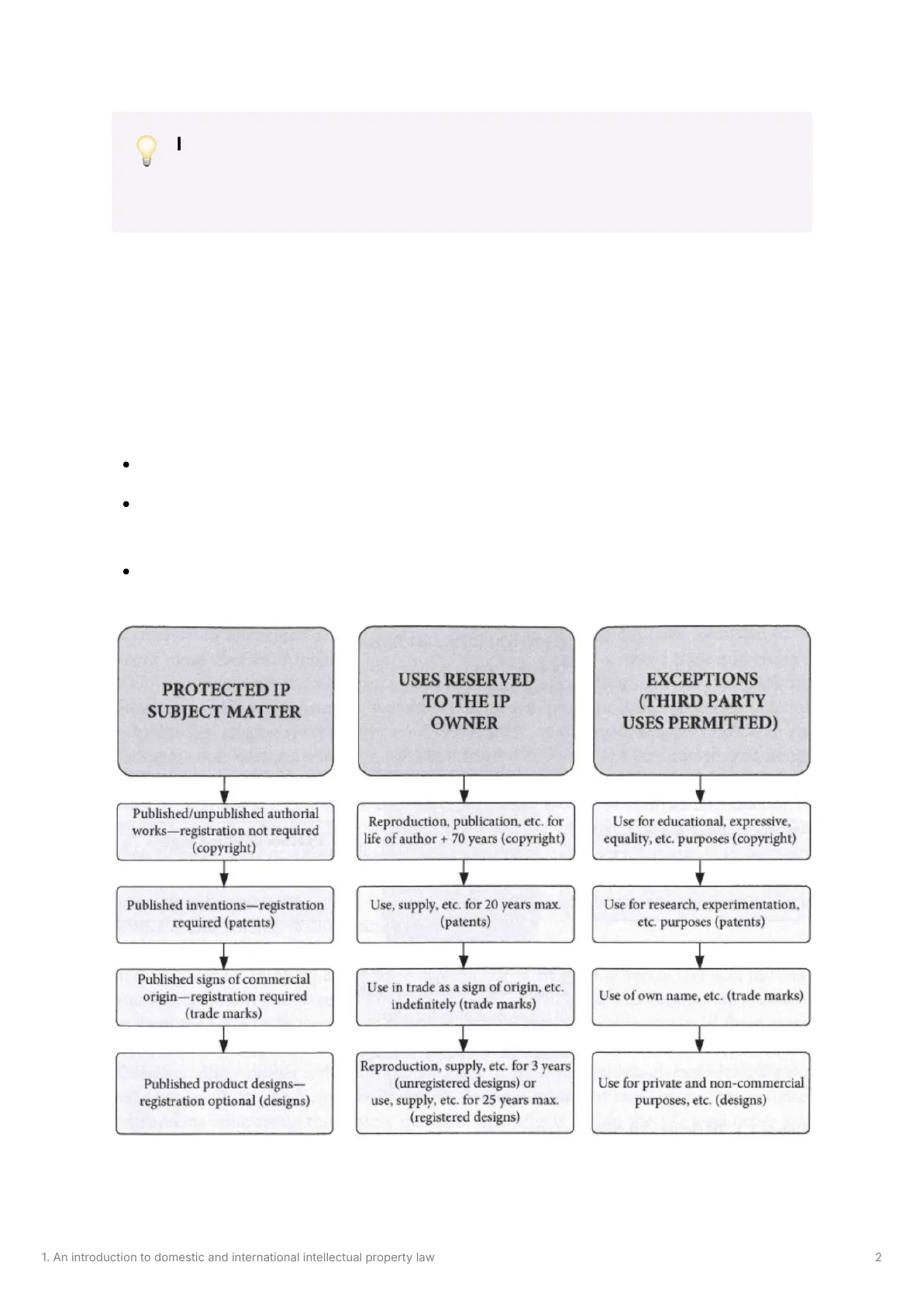
When considering different kinds of IP right it is useful to think in terms of three things:
- the subject matter to which the rights attach
- the uses of the subject matter that the law reserves to the holders of those rights
- the exceptions that permit third parties to use the owner's work
PROTECTED IP SUBJECT MATTER USES RESERVED TO THE IP OWNER EXCEPTIONS (THIRD PARTY USES PERMITTED) Published/unpublished authorial works-registration not required (copyright) Reproduction, publication, etc. for life of author + 70 years (copyright) Use for educational, expressive, equality, etc. purposes (copyright) Published inventions-registration required (patents) Use, supply, etc. for 20 years max. (patents) Use for research, experimentation, etc. purposes (patents) Published signs of commercial origin-registration required (trade marks) Use in trade as a sign of origin, etc. indefinitely (trade marks) Use of own name, etc. (trade marks) Published product designs- registration optional (designs) Reproduction, supply, etc. for 3 years (unregistered designs) or use, supply, etc. for 25 years max. (registered designs) Use for private and non-commercial purposes, etc. (designs)
Thus, there are four categories of IP rights:
2
- Copyright & Related rights: authorial works, performances, broadcast, performance fixations, and phonograms.
- Patents & Allied rights: inventions and plant varieties.
- Trade marks & Allied rights: signs of commercial origin, competition, geographical indications, and aspects of design.
- Rights in data & Information: trade secretes, data, and databases.
In the terminology of European law, all but copyright and related rights fall within the general category of industrial property rights.
History of Intellectual Property Law
Throughout its more than 600-year history, the law of IP has been dogged by persistent disagreement over its normative foundations.
A common starting point for these debates has been the intangible nature of the subject matter that IP rights protect. In fact, there is a distinction between the intangible subject matter protected by IP rights and their tangible manifestations (tangible objects).
In ancient times, cultural knowledge was considered to be a common good. There was no protection on the intangible parts of creation. In fact there were free riding problems.
Free riding occurs when one person invests in the production of the product and another one copies it.
Even if there was no protection on the intangible parts of creation, there was a rich production of works. This was thanks to patronage and procurement:
- In the procurement system, when there was a king who paid artists to produce poems and paintings, in that system the artist received a payment independently from the commercial success of the work.
- In the patronage system there is no time limit, meaning that when you buy a house, you own the house and your property right on it doesn't change in time.
Two Analytical Frameworks
3Before commencing our discussion about the history of IP law, it may be useful to introduce two analytical frameworks:
- The idea of IP law as private law and IP rights as private rights.
- The second analytical framework requires the intervention by the state through to recognise and protect property rights. This is a key insight of Lawrence Lessig, who, a part from law, identifies three mechanisms as having especial importance for IP: social norms; the market; and technology.
The Market Social Norms - willingness of individuals to pay for access - public desire for access - public belief that access is appropriate - opportunities for middlemen to secure access for payment Individuals Technology - real (physical) opportunities for unauthorized (including undetectable) access Law (including Copyright) - real (physical) restrictions imposed by authors and others in possession/control of authorial works to prevent unauthorized access - regulatory restrictions imposed by the state to discourage unauthorized access
Origins of Copyright
Roman Period
While the first copyright legislation was not introduced until the 18th century, the roots of copyright can be traced to the classical Roman period, where the idea of authorial property was already recognised and accepted. According to the Roman law principle of accessio, a person who painted a picture on a canvas thereby acquired ownership of the canvas.
Middle Ages (Ireland, circa 560 CE)
The idea of authorial works as objects of both personal and property rights was also apparent in the Middle Ages, when the famous Cathach of Columba case was heard, resulting in the world's first reported copyright judgment.
Cathach of Columba
The case was heard in Ireland in the 6th century, and involved a finding that literary copies of a manuscript belonged to the owner of the manuscript.
16th Century & 17th Century (Various States)
4While the idea of authorial property was well established by the Middle Ages, it acquired a new significance with the arrival in the West of printing technology; an event that raised new issues regarding the public dissemination of information and ideas.
The western countries responded by prohibiting the general public from using the new printing technology. They created printing monopolies and conferred them on individual printers in respect of specific works approved for public circulation.
The result is a system that encourages the creation and publication of popular works, and that discriminates against works likely to be of interest to a small section of the public only, or likely to have a long shelf life.
18th Century (England, Denmark, and France)
The English Stationers' system collapsed under the weight of the printers' and booksellers' trade war at the end of the 17th century, with the copy-right systems of other European states following thereafter. In their place emerged the first common and civil law copyright enactments:
- the English Statute of Anne of 1710
- the Danish copyright ordinance of 1741
The Statute of Anne was introduced to "encourage learned men to compose and write useful books", and to protect the "authors or proprietors" of such books from "ruinous" piracy.
The Statute is often described as reflecting a public interest or instrumentalist view of copyright, according to which authors' rights are privileges granted by a state for the purpose of encouraging the creation and dissemination of works for the benefit of its citizens.
19th Century (Europe)
By the 1880s, all European states had introduced legislation recognising and protecting the rights of authors, paving the way for the conclusion of the first international copyright treaty, the Berne Convention for the Protection of Literary and Artistic Property of 1886.
Conclusions on Copyright Development
Three themes emerge from the early development of copyright systems in Europe:
5
- A commitment to an individuated conception of authorship, premised on a view of authors as having a personal connection with and responsibility for the works they create.
- A recognition of informational and expressive works as objects of economic and social value capable of supporting property rights.
- A concern to balance the claims of authors to protection of their creations and of printers, publishers, and other intermediary service providers to protection of their commercial interests on the one hand with the freedom of third parties to express and access ideas and information and exploit fully the capacities of new technologies on the other.
Origins of Industrial Property Rights
Patents for Inventions
The practice of granting patents for inventions has its origins in the idea, often traced to Sicily (then part of Greece) in 500 BCE, of conferring exclusive manufacturing and other privileges as a reward or incentive for devising new and otherwise meritorious products and processes, including recipes for culinary dishes. This practice was also adopted by the early Romans. Much later, European states adopted the custom of conferring monopolies in respect of different aspects of manufacture and trade on companies of merchants and craftsmen. States' preferred method of doing this was to attract foreign workers with the promise of special trade privileges. The English Crown reportedly made the first grant under this policy in 1331.
By the 15th century, however, the use of monopolies to encourage innovation was becoming common in the city-states of Italy. In 1474 the first general patent statute was enacted in Venice, promising inventors who built new and useful devices disclose it right to manufacture it for 10 years to protect their honour and encourage other inventors to apply their genius and discover.
In 17th century England, the King's Bench established that monopolies were contrary to the public interest and thus to common law.
Under the Venetian system of the 15th century, patents were granted only after formal examination of the inventions for which they were claimed.
Later in the 17th century, the role of conducting preliminary examinations of patent applications was formalised in France at the instigation of the Parliament, and delegated to a public body of scientific and technological experts.
6
Can’t find what you’re looking for?
Explore more topics in the Algor library or create your own materials with AI.
