Efficiency and HR Planning: The Role of Human Resources in Competitiveness
Slides about Topic 1: Efficiency and Hr Planning. The Pdf explores the strategic management of HR, human capital, and alternative work regimes, including quizzes for self-assessment. This University Economics material, produced in 2024, offers a schematic and comprehensive overview of the subject.
See more63 Pages


Unlock the full PDF for free
Sign up to get full access to the document and start transforming it with AI.
Preview
Efficiency and HR Planning
What constitutes human resources (HR)? How do HR contribute to firm competitiveness? How to organize HR strategically?
The Basics of Firm Profitability
Every commercial firm wants to be profitable. A form enjoys a competitive advantage if it has a higher profitability than the average competitor. It could be achieved:
- By lowering costs
- And by increasing the value that the firm creates
The Role of Human Resources in Competitiveness
Wages Human resources Productivity Competitiveness Quality
- Productivity: the more workers produce the better: because they are engaged, motivated, capacitated, easier for them to produce than interact with each other
- Quality: what kind of human capital we have: experience, processes, knowledge accumulation and sharing, etc.
This three parameters will result in our competitive advantage (reduce cost with wages and productivity and quality will help us create value)
Human Capital and Human Resources Defined
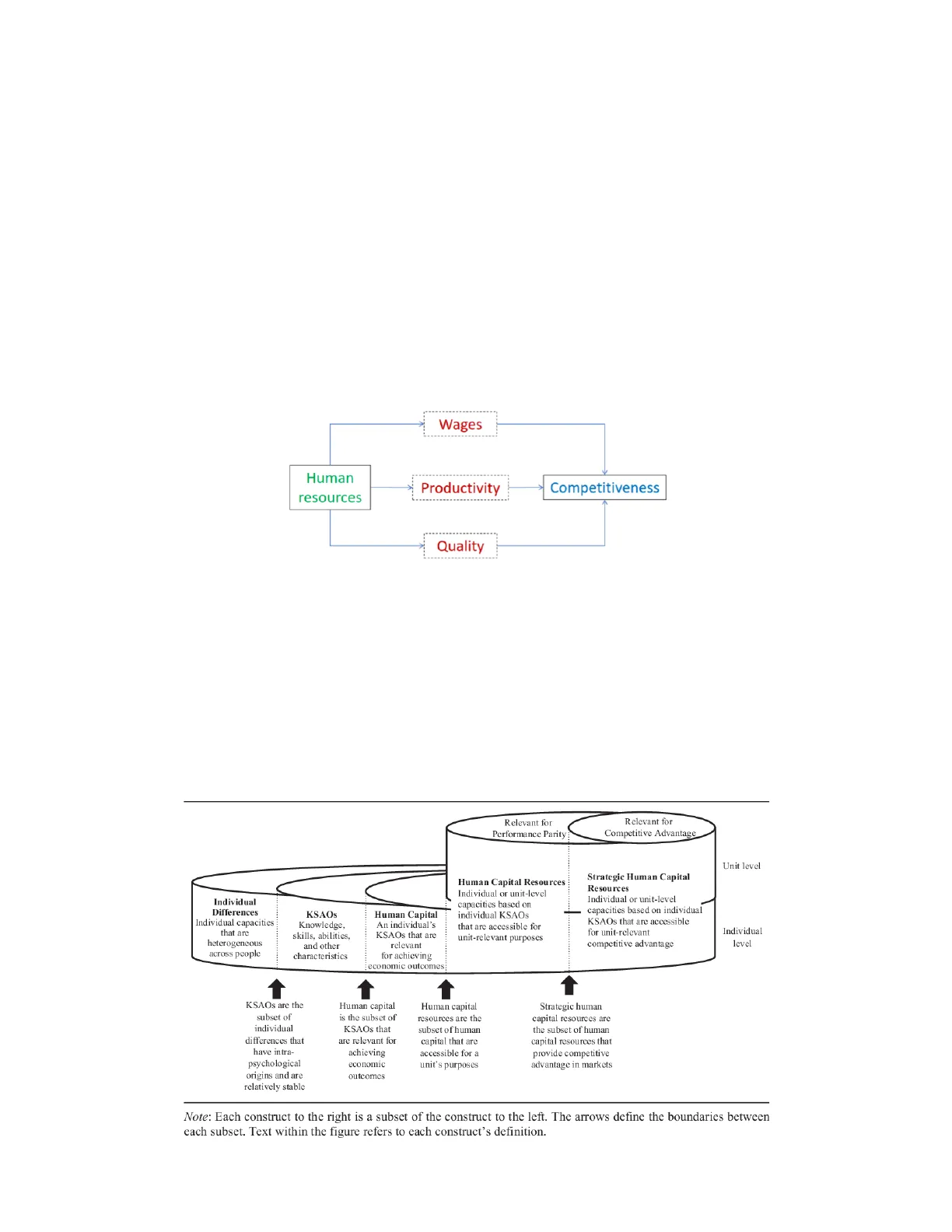
Relevant for Performance Parity Relevant for Competitive Advantage Unit level Strategic Human Capital Resources Individual Differences Individual capacities that are heterogeneous across people KSAOs Knowledge, skills, abilities, and other characteristics Human Capital An individual's KSAOs that are relevant for achieving ḷeconomic outcomes; Human Capital Resources Individual or unit-level capacities based on individual KSAOs that are accessible for unit-relevant purposes Individual or unit-level capacities based on individual KSAOs that are accessible for unit-relevant competitive advantage Individual level KSAOs are the subset of individual differences that have intra- psychological origins and are relatively stable Human capital is the subset of KSAOs that are relevant for achieving economic outcomes Human capital resources are the subset of human capital that are accessible for a unit's purposes Strategic human capital resources are the subset of human capital resources that provide competitive advantage in markets Note: Each construct to the right is a subset of the construct to the left. The arrows define the boundaries between each subset. Text within the figure refers to each construct's definition.
1It is not the same thing. Difficulty of managing people arises.
- Individual differences: different knowledge, skills, experiences and things we like to do. These create the uniqueness of the human capital we possess. KSAO (Knowledge, Skills, Abilities, Other) become useful for the organization and they become human capital when the organization can use them and the individual is willing to give it to them and the individual can obtain benefits from that.
- KSAOs: that could be used by the organization to produce economic outputs
- Human capital: From individual to group level. At the group level, people work together. If both of us know the same, double knowledge is useless but if we need skills which complement each other it is better to have diverse workers. Experience (previous) can be conflictive and instead of creating asynergy they create a conflict. Human Capital is nOT the same of KSAOs people have. It becomes HR when people get together and start producing sthg. Component of working together, matching, not matching, appears in the process of production of G and S
- Strategic: working towards competitive advantage
Managing Human Capital vs. Physical Capital
Can a firm manage Human Capital as it manages Physical Capital? Human Capital vs. Physical Capital Physical Capital: Fixed contract, specified conditions. Is usually one transaction. Human long-term contract Human Capital: Contract with a human: relationship contract, many conditions, impossible to control that the effort is exactly what you write in the contract. Humans can be motivated by future opportunities machines can not.
- Workers have free will -> attraction, motivation, retention
*They do whatever they want no matter what stated in the contract
- Unit-level human resources is more than the sum of its parts -> Synergies and externalities
*Complementary conflicts, coordination issues, unit level management is difficult
- Human relations beyond economic efficiency -> dignity, values, ethical principles to respect
*Beyond employment contract, legislation + ethics
From HR to Competitiveness Framework
Cost and value of goods and services of rival companies HUMAN RESOURCES Human capital Services of work incorporated to the production and sale Cost and value of goods and services of the company Competitiveness Services of other productive resources
* Cost and value of goods and services that the company produces: HR not only resources to take into account (people working together). How they are all matched together in the process of production and sales.
2Accumulation of knowledges (Training & Development) Motivation and commitment (Incentives & Compensation) Cost and value of goods and services of rival companies Human capital Services of work incorporated to the production and sale Cost and value of goods and services of the company Competitiveness New hires (Attraction & Staffing) Organization and technology (Jobs & Tasks) Services of other productive resources Experience (Retention)
*Different components that will affect the human capital: attraction and staffing (bringing new capital inside the organization or promoting them from inside). We need training and develop. We need to incentive workers so we need compensations, we need to organize the work and how we define the task and how we will perform. Retain people making sure they are happy at work.
Internal Firm Dynamics: HR and Competitiveness
Let's look inside the firm: From HR to Competitiveness In the short run labor is dynamic but capital is fixed (difficult to construct production line but monitor if we should hire more or less people and work more or less) . Production function: Q = aL · Q: Output . L: Labour or workers . a: Productivity of any given worker · Cost function: C(Q) = F +wL . F: Fix costs · W: Wage per worker · A company's problem: min(F + wL) L =Q Q a s.t. Q = al min F + "Q L: flexible resource C: no flexible resource C(Q)=F+"e Unit Labour Cost (ULC) of production needed to produce a unit of product: ULC = Cost per worker wage W Production per worker Productivity a Affected by wages and worker productivity Twor a > ULC *Optimal way: optimize costs We want to produce as cheap as possible, try to see our cost function in terms of key indicators that we can change (w=wages and a=labor productivity), minimize cost function through minimization of unit labor cost. The less we pay our workers the better, lower ULC better for organization.
3Does ULC capture competitiveness? - > From HR to Competitiveness Lower ULC more competitive? Price of the product + low unit cost but products can't not be purchased at a high price this is not competitive for our firm. T = pQ-C(Q) = pQ-F-MQ = pQ- F-WBQ ap W = pQ(1 -2) -F Revenue profit margin per € sold Fixed costs ULCR = Salary /Price Productiviy a W/p W/p NO want to minimize cost -> We want to maximize the profit => FROM THE PROFIT: output x price Real unit labour cost of production (ULCR) is the ULC adjusted by the salling price (p) as a measure of the value of the product for the customer. *Profit margin is the real unit labor cost (ULCR) The impact of HR on business competitiveness: wA pB aB ULCRA ULCRB WB pA aA . The difference only exists if products A and B are differentiated . The business competitiveness is a relative concept that depends on the relative wages, the relative prices and the relative productivity EXAMPLE: High qualified workers, high quality product, high revenue -> competitive firm Junior workers cost little, train there , decent products -> sold at a good price so competitive. -> In the short run only labor can be changed -> In the long run both capital and labor are flexible (take into account the capital) . Cobb-Douglas production function -> only looks at the productivity that depends on labor (partial) Q = AKª LB K: capital A: total factor productivity (aka technology) a, B: output elasticities of capital and labour
4· Monetary partial labor productivity for a given price: p.Q = p.A. p .Q K R · Z(a+B-1) p.Q L =p.A R K Z(a+B-1) Price: proxy for differentiation. There are a lot of ways to increase customers' perceived value Capital: more capital by worker improves productivity
- Scale (related to labour): under growing economies of scale, more labor increases productivity + increase in returns to scale is limited due to coordination and other issues.
*No more people -> more produce, no always more labour means more production.
External Firm Dynamics: Labor Market Model
Let's look outside the firm Labor Market Model Assumptions:
- All workers are the same (wages are also the same)
- Supply increases with price
- Demand decreases with price
- No transaction costs (all the info available)
- Perfect competition Market equilibrium defines the price No involuntary unemployment: everyone who wants to work is working
*Equally broom wage and amount of labour.
WA SL w*
> L* DLL Figure 2. Demand and Supply of Labour
Labor Market Model with Imperfect Equilibrium
Labor market model with imperfect equilibrium WA SL Minimum wage
> L* DI. L Limited labor supply WA SL W* L* DI. L
- For instance: minimum wage set by the government. Not enough demand for this higher wage.
*More workers that want to work than suppliers, so there is unemployment.
- Not enough workers, doesn't matter how price goes up because active new workers takes time
5Labor market model in dynamics More workers needed WA SI W W* W* Wʼ
> L* DLL L* DLL How much the line move wage can be lower than the beginning or the market is so difficult to enter that the resulting wage is higher. Real markets are imperfect
- Not all workers are the same
- There are transaction costs (cost to search, to search for jobs and employees, select employees)
- There is no perfect competition
Recap of HR and Competitiveness
RECAP (Attraction, motivation) Wage Available price (Service, quality) Productivity (Organisation, technology, investment)
- How does HR effect firm's competitiveness? Measured by profitability, one more profits than other the best
one have the competitive advantage. It is relative.
- Cut costs -> optimizations. Wages
- Increase value: producing more, producing for higher price, give more to customers or better. Productivity or quality.
- Why HC are so specific?
- Because humans are more complicated and you can't buy the humans as the machines, humans are unpredictable (they can leave the company when they want or not present to the job). Are relation contracts you have to be motivated ....
- Take in account externalities, synergyes
- Ethical standards like legislation, max hours working, etc. ensure minimum living
- What does ULCR (unit labour cost) show?
- Combination of costs of labour and value we obtain.
- Who is more competitive
- How does a firm can manage its ULCR?
- What role does the labor market play?
6 Workers move into highly· paid market WA SI
Can’t find what you’re looking for?
Explore more topics in the Algor library or create your own materials with AI.
