Matter: Classification of Pure Substances, Elements, and Compounds
Outlines from High school about Matter. The Summaries explore the classification of matter, distinguishing between pure substances and mixtures, with a focus on elements and compounds. This document, useful for Chemistry students, clarifies how atoms, molecules, elements, and compounds combine.
See more8 Pages

Unlock the full PDF for free
Sign up to get full access to the document and start transforming it with AI.
Preview
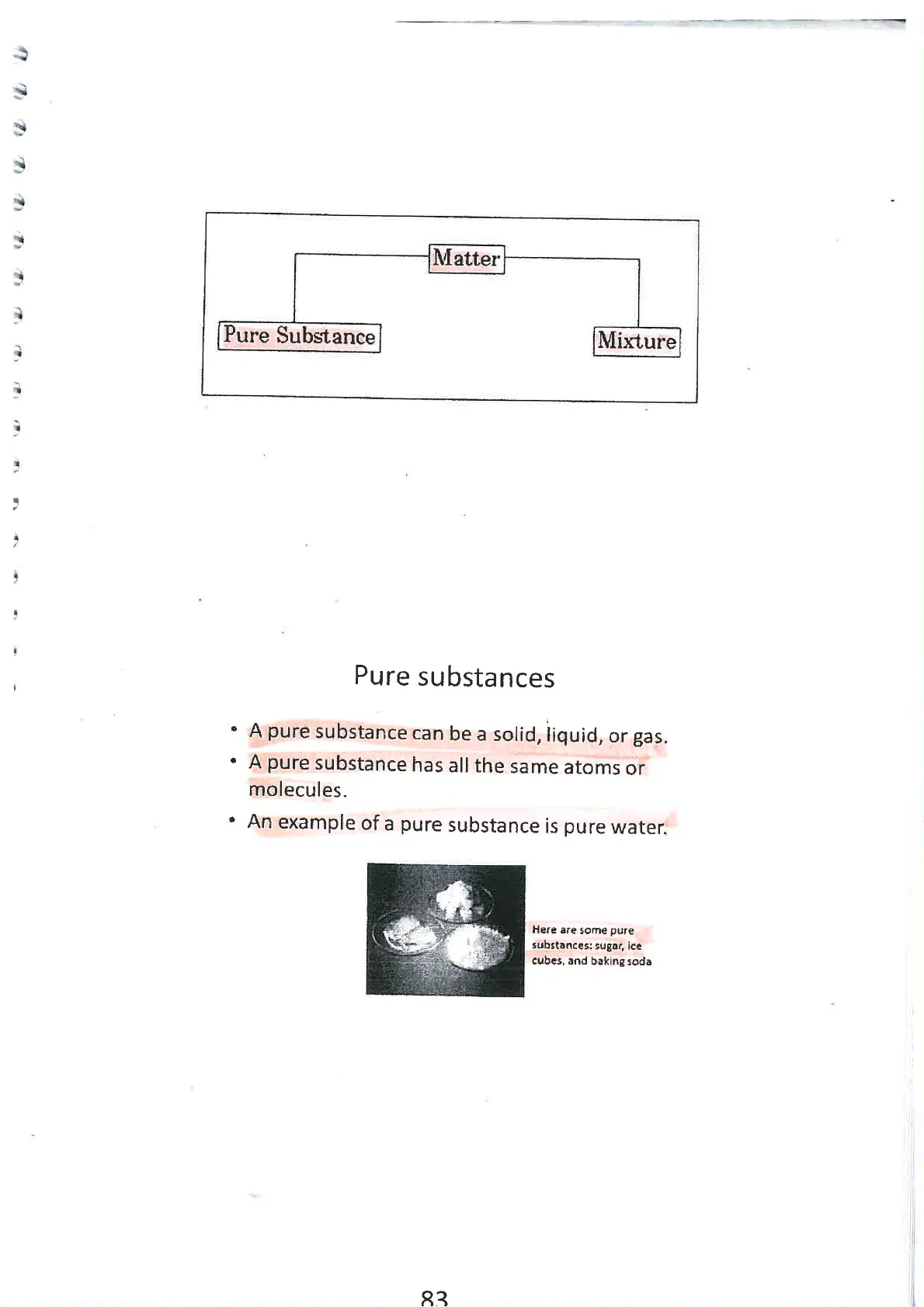
Matter Classification
Matter Pure Substance Mixture
Pure Substances Overview
Pure substances
- A pure substance can be a solid, liquid, or gas.
- A pure substance has all the same atoms or molecules.
- An example of a pure substance is pure water. Here are some pure substances: sugar, ice cubes, and baking soda 837
Characteristics of Pure Substances
Pure substances
- A pure substance can be a solid, liquid, or gas.
- A pure substance has all the same atoms or molecules.
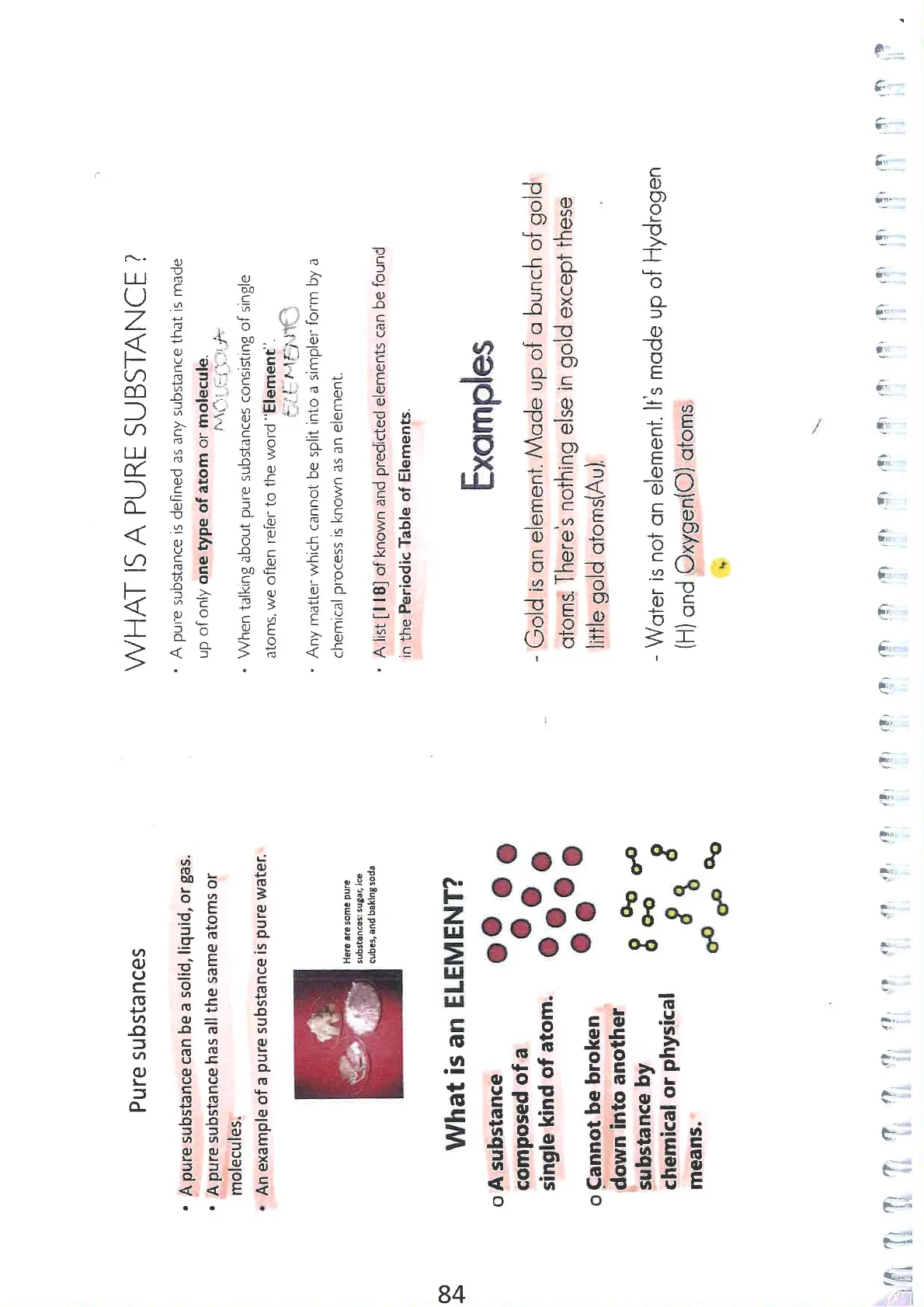
- An example of a pure substance is pure water. Here are some pure substances: sugar, ice cubes, and baking soda 84
Defining an Element
What is an ELEMENT?
o A substance composed of a single kind of atom. o Cannot be broken down into another substance by chemical or physical means. 800 00 o 8 00 o 00
Understanding Pure Substances
WHAT IS A PURE SUBSTANCE ?
- A pure substance is defined as any substance that is made up of only one type of atom or molecule. MOLECOLA
- When talking about pure substances consisting of single atoms, we often refer to the word "Element". ELEMENTO
- Any matter which cannot be split into a simpler form by a chemical process is known as an element.
- A list [118] of known and predicted elements can be found in the Periodic Table of Elements.
Examples of Elements and Non-Elements
Examples - Gold is an element. Made up of a bunch of gold atoms. There's nothing else in gold except these little gold atoms(Au). - Water is not an element. It's made up of Hydrogen (H) and Oxygen(O) atoms ±3
Composition of Pure Substances
Pure Substances Particles are identical
Elements and Compounds
Elements Particles are composed of identical atoms Compounds Particles are composed of different atoms
Compounds as Pure Substances
Pure substances: Compounds are pure substances that are made of more than one element bound together. - Examples: water (H2O), and carbon dioxide. Hydrogeni Oxygen
Molecules Formation
A molecule is formed when two or more atoms chemically combine. Example: water (H2O), O2 Oxygen
Defining a Compound
What is a COMPOUND?
o A substance in which two or more different elements are CHEMICALLY bonded together. 85
Elements and Atoms
Elements الدقة Elements are composed of only 1 type of atom. Example #1 2 2 2 Notice that two oxygen atoms are bonded (stuck) together. But there is still only 1 type: Oxygen Example #2 Ne Ne Ne Ne Ne Ne
Elements and Compounds Relationship
Elements and Compounds A compound is made up of two or more different types of atom combined together. Compound element element Oxygen + Hydrogen Water + O One atom of oxygen combines with two of hydrogen to form one particle of the compound water 86
Atomic Structure and Bonding
Elements Helium atoms Oxygen molecules Compound 2 Hydrogen atoms bonding with I oxygen atom Atoms are the smallest particle that substances are made of
Elements, Compounds, and Mixtures Definitions
Elements, compounds and Mixtures Elements are substances made of only one type of atom e.g. oxygen, gold Compounds are substances made of two or more different types of atoms chemically bonded e.g. sodium chloride Molecules are atoms bonded together e.g. O2 Keywords: atom, bond, compound, element, mixture, molecule 87
Pure Substances: Compounds and Molecules
Pure substances: Compounds are pure substances that are made of more than one element bound together. - Examples: water (H2O), and carbon dioxide. O Daypos A molecule is formed when two or more atoms chemically combine. Example: water (H2O), O2 Oxygen
Examples of Pure Substances
Elements Examples
- Elements: - Carbon - Oxygen - Gold - Neon - About 100 more! (If you are not sure, check the periodic table.) Periodic Table of the Elements .
Compounds Examples
- Compounds: - Water, H2O Sodium chloride, NaCl - Hydrogen peroxide, H2O2 - Methane, CH4 - Baking Soda NaHCO3 - Glucose C6H1206 - There thousands and thousands of known compounds! (If it has a chemical formula, it's a compound.)
What Is A Mixture?
What Is A Mixture? A mixture is made of 2 or more types of atoms that are NOT chemically combined together. Mixtures can take many forms: 2+ Solids 2+ Liquids 2+ Gases ANY combination of solids, liquids & gases Mixture A mixture is two or more substances that are combined, but together they do not form a new substance, They can be easily separated.
Types Of Mixtures
There are 2 major types of mixtures: Heterogeneous Homogeneous Means "different" Means "the same" You can see the different parts (phases) of the mixture easily You cannot see the different parts (phases) of the mixture
Solutions as Special Mixtures
Solutions A solution is a special type of mixture. A solution is a homogeneous mixture that combines a solute and a solvent.
Solute and Solvent
Solute Solvent The solld part that gets dissolved. e.g. salt, sugar The liquid part that does the dissolving. e.g. water 91 UU 3 5 € 2 3 €
Solubility Measurement
Solubility We can measure how easily a solute will dissolve in a certain solvent. This measurement is called solubility.
High and Low Solubility
HIGH Solubility LOW Solubility The solute dissolves quickly & easily e.g. salt in water The solute does not dissolve easily e.g. sand in water
Separating Mixtures Techniques
Separating Mixtures Funnel Magnet Bolling A funnel separates liquids from small solids A magnet separates metals from nonmetals. Boiling separates solids from a liquid. 92
Can’t find what you’re looking for?
Explore more topics in the Algor library or create your own materials with AI.
