Hydrostatics: Principles of Fluid Properties and Archimedes' Principle
Document from University about Hydrostatics. The Pdf explores the principles of hydrostatics, defining density, viscosity, and hydrostatic pressure with examples and formulas. This Physics document also illustrates Archimedes' principle and its applications, providing a clear understanding of fluid physics concepts.
See more8 Pages

Unlock the full PDF for free
Sign up to get full access to the document and start transforming it with AI.
Preview
Physics of Fluids and Fluid Mechanics
There will be 6 lectures in physics, mostly related to the general properties of fluid and fluid mechanics.
They are propaedeutic for physiology, anatomy and biochemistry:
- 4 lectures related to fluids and liquids, their static properties, mechanics and transport. This is important for the cardiovascular system
- 1 lecture on filtration, important for the regulation of plasma and fluid volume in the kidney
- 1 lecture on the physics of gas law. This is related to the part related to the respiratory system
Understanding Fluids
What is a Fluid?
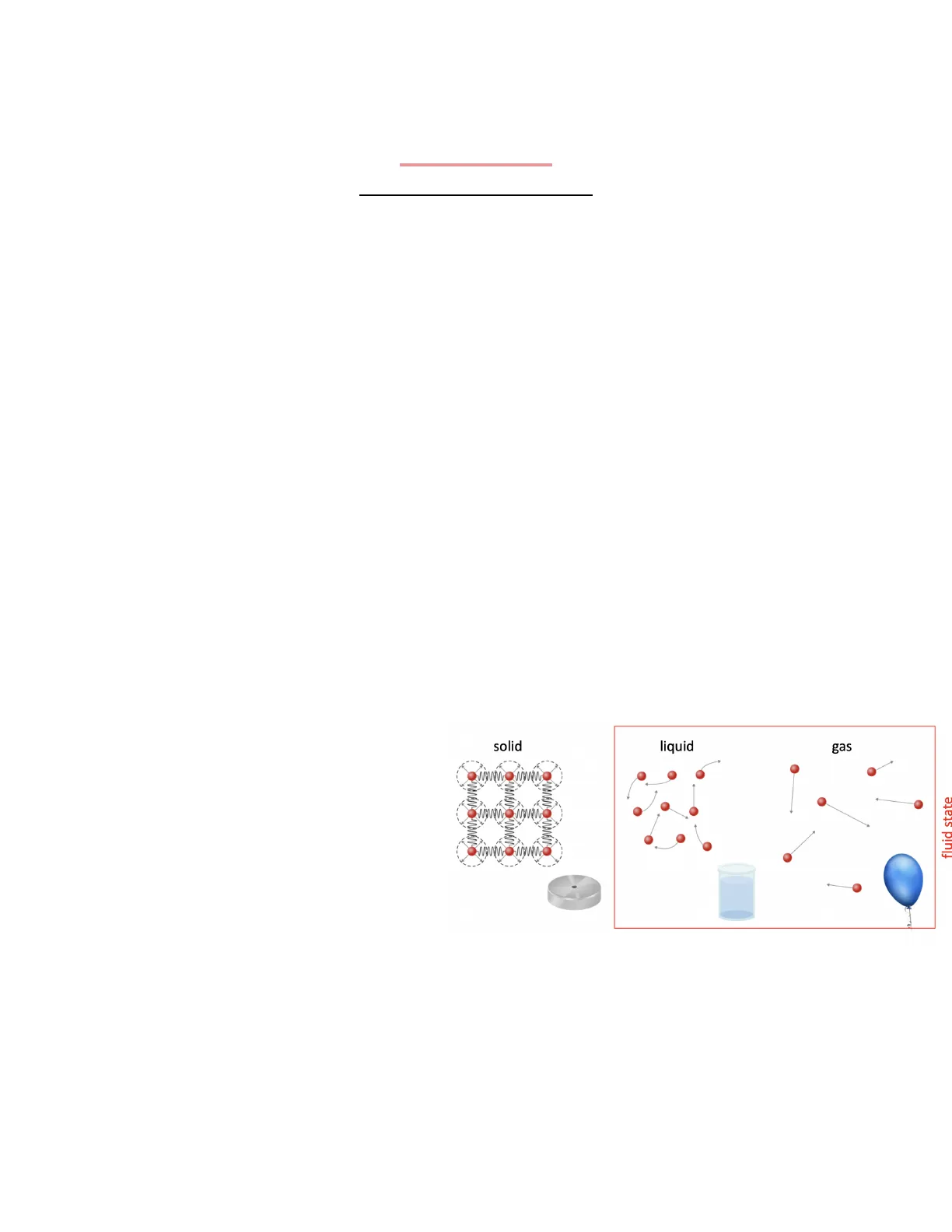
The general states of aggregation of atoms and molecules in matter are:
- Solid state= where atoms or molecules are fixed in their position
- Liquid state= molecules and atoms are not fixed but the density is comparable to that of the solid. In liquids, atoms are not forced to stay in a specific lattice, but their density is very high and the interaction between the atoms and molecules is very strong. Therefore, the interaction between molecules in liquids cannot be neglected. The atoms move randomly but there is this coordination and interaction between the molecules.
- Gaseous state= molecules are essentially free to move anywhere, theoretically. If we consider an ideal gas, then we also assume that there is no interaction between the molecules.
> Both the liquid and the gas are considered to be fluid states. Fluid because it's something that can move. Something that, under forces (like changes in height or pressure), are in motion. This happens because the particles are not fixed in space, but can move. As a consequence, fluids are characterized by a complete deformability, meaning that the shape of a fluid is the shape of their container, or determined by the interaction with other solid surfaces. For example, a drop of liquid on a solid surface will have different shapes depending on the energetic state of the droplet on the surface:
solid Mowy liquid gas fluid state
- If the surface is hydrophilic= the drop will just spread
- If the surface is hydrophobic= there will be a high energy barrier between the surface and the droplet, that will try to minimize as much as possible its interaction with the surface and be as close as possible to a sphere
1On the other hand, solids cannot be deformed, unless a very strong force is applied. They have a fixed shape and volume.
Liquid vs. Gas Differences
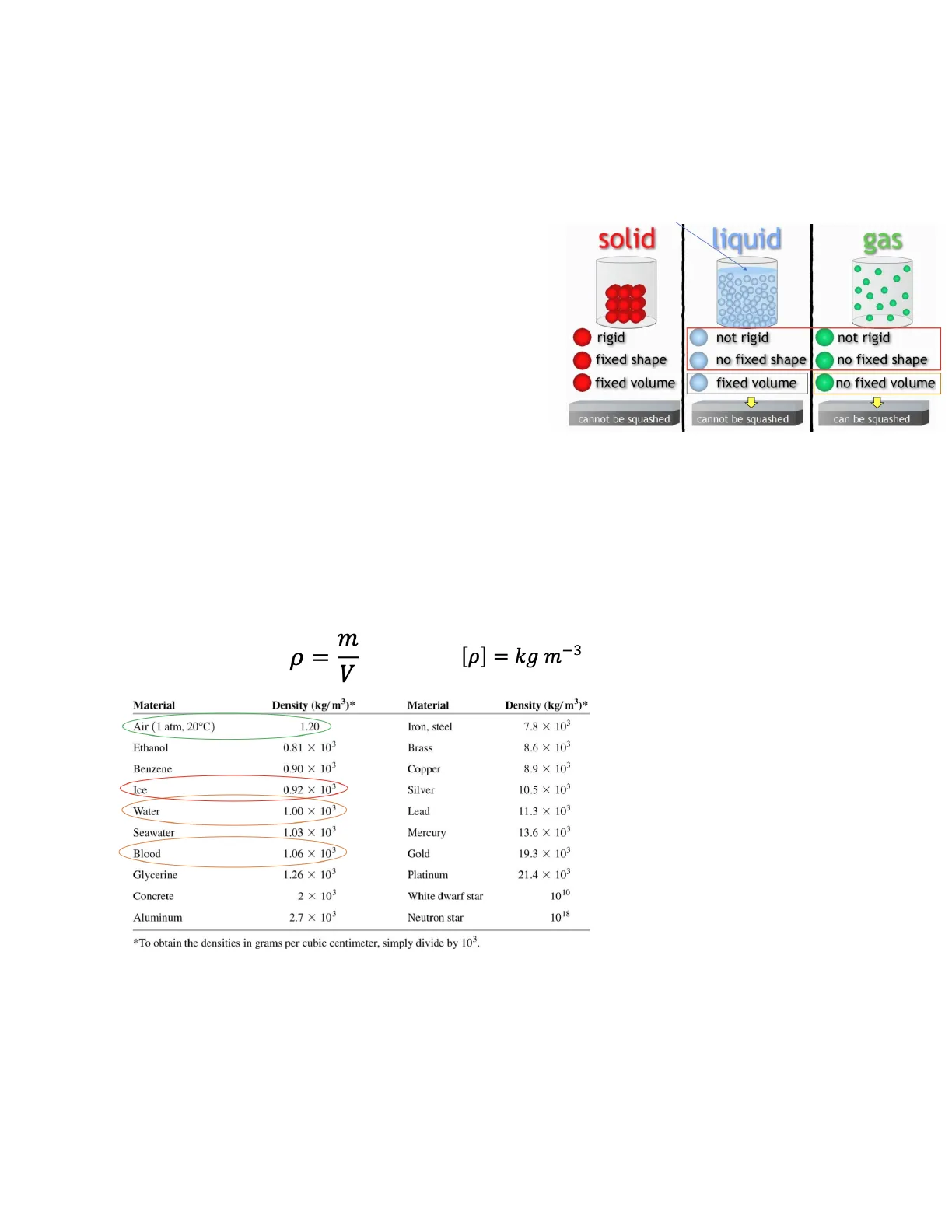
What is the difference between a liquid and a gas? Liquids are, in principle, incompressible because their molecules are already packed, with a density comparable to that of solids, they can just move around a little bit. This means that it's hard to compress it and change its volume. On the other hand, gasses are compressible. Whenever we expand the volume, they tend to take all the space available, while liquids will tend to occupy only a portion of the container.
solid liquid gas rigid not rigid not rigid fixed shape no fixed shape no fixed shape fixed volume fixed volume no fixed volume can be squashed Free surface= if a glass is filled with wine, there is always a cannot be squashed cannot be squashed free surface. The volume of the liquid will be mostly in contact with the container, but if the volume is smaller than the container, some air will remain in it creating a free surface that is always horizontal. The free surface also depends also on the surface tension, the energy of cohesion among molecules in a liquid. There is no surface tension in gasses.
Density of Materials
Density Forces and mass are not ideal to deal with fluids. Instead, density is used:
p = m V [p] = kg m-3
Material Density (kg/m3)* Material Density (kg/m3)* Air (1 atm, 20℃) 1.20 Iron, steel 7.8 × 10³ Ethanol 0.81 × 10³ Brass 8.6 × 10³ Benzene 0.90 × 10³ Copper 8.9 × 10³ Ice 0.92 × 10³ Silver 10.5 ×10³ Water 1.00 × 10³ Lead 11.3 × 10³ Seawater 1.03 × 10³ Mercury 13.6 × 10³ Blood 1.06 × 10³ Gold 19.3 × 10³ Glycerine 1.26 × 10³ Platinum 21.4 × 10³ Concrete 2 × 10³ White dwarf star 1010 Aluminum 2.7 × 10³ Neutron star 1018 *To obtain the densities in grams per cubic centimeter, simply divide by 103. Here are some examples of densities of some materials. Density of water is 1000 times higher than that of air. Blood has a density very close to that of water. Ice has a lower density than water
Viscosity and Temperature Effects
Viscosity= related to the motion of a fluid through a small conduct. Viscosity of blood is very different from that of water because in viscosity the presence of particles matters a lot. Both density and viscosity depend on temperature. Generally, as temperature increases, density decreases. Water is an exception because the density decreases as temperature increases only from 4℃ and up. Between 4° and 0℃, density decreases slightly as temperature decreases 2Density is related to the distribution of mass in a given volume and can be uniform or not. The density of a liquid is constant because they are incompressible. For a gas, density is variable because it depends on the moles but also on the container (therefore volume). For liquids, it depends on temperature. If the distribution of temperature is not uniform, then also that of density will not be. Convection currents= if a pan is heated from below, the lower layers of liquids reach a higher temperature and their density decreases, making them rise up. So that the warmer layers with a lower density will rise up, while the colder layers with a higher density will sink. This strictly depends on gravity.
Pressure in Fluids
Definition and Units of Pressure
Pressure Pressure is used for fluids instead of force because it's distributed all over the liquid. Pressure is the scalar product between the force (vector) acting on a surface S and n which is the normal, the vector that identifies the direction perpendicular to the surface.
F . n P = AS -IS AS AS scalar quantity [p] = Pa (pascal) = N m-2 = kg m-1 s-2 When talking about pressure, the only forces relevant are those acting perpendicularly to the surface of the liquid. Since pressure is the ratio between 2 aspects, it can be high if we have a strong force or if we have a very small area. Smaller is the area, the larger is the pressure of a given force. Example= a finger pushing against the arm of a patient is able to apply only a small pressure because the cross section of the finger is large, and is thus unable to penetrate the skin. On the other hand, if the same force is applied using a needle, a very large pressure is applied because the contact area is very small, allowing the needle to penetrate the skin.
Force Large area Small area Force Small pressure Large pressure 1 Pressure can be expressed using many units, which are important to know.
- Pascal= the international unit.
- Bar= 10° Pa, it's mostly used for atmospheric pressure.
- Atmospheres= very close to bar: 1.013 Bar.
- Torr= equivalent to 1 mm of mercury and used to measure blood pressure. 1 torr= 133 pascal.
Pa bar atm Torr 1 Pa 1 10 5 9.87 ×10⁶ 7.5×10⁻³ 1 bar 105 1 0.987 750.06 1 mbar 102 10-3 0.967 ×10⁻³ 0.75 1 atm 1.013×10⁵ 1.013 1 760 1 Torr 133.32 1.33 × 10⁻³ 1.32 × 10⁻³ 1 1 Torr = 1 millimeter of mercury (mmHg) 3> Pressure in a fluid is a scalar. There is no direction but only a value, because by definition the direction is always perpendicular to any surface of the liquid, which can be external or internal. The same is true for an object inside a liquid: the pressure acting on it is perpendicular to the surface of the object.
Pascal's Principle
Pascal principle Applicable to liquids. It says that a pressure change in any point of a liquid is transmitted throughout the liquid so that this variation in pressure occurs everywhere. Example= if a chamber full of a liquid is pushed with a piston, changing the internal pressure, the change will affect the liquid everywhere. This happens because liquids are incompressible. This principle is exploited to produce mechanical work, for example in the hydraulic car lift. A liquid is in contact with two pistons with different surface areas. When a second force is 10 times original force F2 = P2 A2 = 10 x F1 force is applied on the piston, hydraulic car lift PI = A1 F1 F2 pressure is conserved. If the pistons original force F1 = P1 A1 have a different surface area, for P1 = P2 A1 A2 F1 _F2 example if A2 is 10 times A1, then the force F2 applied on the piston A2 > 1 F2 >> F1 area A2 area A1 (A1 × 10) A1 that we want to raise will be 10 fluid times larger than the F1. P2 = - P1 - - F2 Az Pascal's principle P1 = P2 @ 2012 Encyclopædia Britannica, Inc. P2 - A2 - P F2 = F1 A2 A1 Considering an incompressible fluid in a large container, there is a free surface. Pressure will be on a plane that is horizontal and is always the same in the liquid, equal to the pressure of air on the liquid. Moving down in a liquid, pressure increases because, since pressure is the force exerted by the cubic volume of liquid, it's the weight of the liquid above pushing down due to gravity. The pressure at any point of depth will be the atmospheric pressure + the hydrostatic pressure.
Stevin's Law and Hydrostatic Pressure
Stevin's law Assuming that density is constant, this law says that as we move through a liquid, pressure increases linearly with the distance from the free surface. It depends on the density and gravitation.
Pa P . AS p Assumption: p is constant Pa: atmospheric pressure = Pat mg = Pa + PAS 9 = = Pa + p AS h g AS = Pa + p gh p g h: hydrostatic pressure p = Pa + p gh Stevin's law 4The pressure at the top of each liquid column is atmospheric pressure, Po- > Stevin's law does not apply to gasses, because we must assume that density is constant. In gasses, since density is not constant, Stevin's law cannot be used. In gasses, pressure tends to change with an exponential law. Using data: density of water is in the order of 1000 kg/mcube, while gravitation is in the order of 10. Therefore, moving down, every 10 meters there is a 10 increase in pressure, which is about 1 atmosphere. The higher the density, the heavier the liquid and stronger the hydrostatic pressure. In the absence of gravity, liquids will be only under the action of surface tension, causing them to become spheres because of the cohesion energy between molecules. The pressure at the bottom of each liquid column has the same value p. The difference between p and po is pgh, where h is the distance from the top to the bottom of the liquid column. Hence all columns have the same height. The other parameter that matters is the height of the column of water. If we consider containers with different shapes, the pressure is always the same because what matters is the distance from bottom to surface, not the shape. Pressure in liquids is defined as atmospheric pressure + hydrostatic pressure. The hydrostatic pressure is also called gauge pressure
Pabs = Patm + Pgauge Pgauge = Pabs - Patm Vacuum (Patm = 0) h Patm Pabs = hpg = Patm x Hg By measuring the pressure exerted by a column of liquid, Torricelli defined the unit of Torr. To measure the pressure of the atmosphere we can have a bar with a liquid such as mercury, which has a very large density, in an open container and on top of it a closed chamber. Be careful to remove as much as possible all the air on top of the enclosed container, which could be a capillary. The pressure on the surface of the liquid in the open container is just the atmospheric pressure, but if you consider the liquid underneath the capillary, the pressure is given by Stevin's law: density of the liquid x gravitational constant x height of the column, since we assume there's no air on top (vacuum). The atmospheric pressure is equal to the hydrostatic pressure of the liquid and they are constant, otherwise there would be motion of water. By knowing the density of mercury, the gravitational constant and by the height of the column, we can measure the atmospheric pressure. That's the reason why mmHg=Torr and in particular 760mmHg = 1 atm. 5
Can’t find what you’re looking for?
Explore more topics in the Algor library or create your own materials with AI.
