Comprehensive Guide to Image Analysis and Photography Lighting
Document about image analysis, covering composition, subject, technical features, and meaning. The Pdf explores the importance of light in photography, different types of lighting, and "magic hours," along with concepts of color and chromatic harmonies, ideal for high school students.
See more9 Pages


Unlock the full PDF for free
Sign up to get full access to the document and start transforming it with AI.
Preview
Image Analysis Elements
- Composition: what is in the background, in the middle ground and in the foreground; symmetry and harmony between the elements of the image
- Subject: general description of the subject (sex, age, particular features); what he/she/it is doing
- Technical features: light (p.13), colours (p.4), shots (p.30)
- Context: social, historical, geographic (if it's relevant)
- Meaning: what the picture communicates to the viewer
Importance of Light in Photography
1. Types of light p.13 THE IMPORTANCE OF LIGHT IN PHOTOGRAPHY ly is he Importance of light Proper lighting is crucial in photography because it underlines the real colours, dimensions and features of the subject, bringing out a three- dimensional image.
Sources of Light
id Sources of light The sources of light may be natural or artificial ® and can come from different angles:
- front lighting shows details and removes shadows;
- side lighting creates shadows and depth;
- back lighting generates glowing, silhouettes, or aura effects".
Natural and Artificial Lighting
Natural light depends on the position of the sun. At midday, sunlight falls vertically and produces harsh shadows and plenty of contrast, making images often overexposed and blown out. In the morning and at the end of the day, the sun is closer to the horizon, so photos taken at sunset or sunrise have softer shadows. Light is not very intense, therefore sometimes a long exposure ** is necessary to capture it. Artificial lighting is produced with special devices, such as a studio strobe ®*, LED light, a camera's flash, a streetlight or a lamp.
Magic Hours for Photography
Photographers use magic hours to define the two times of the day when sunlight is particularly suitable for taking pictures:
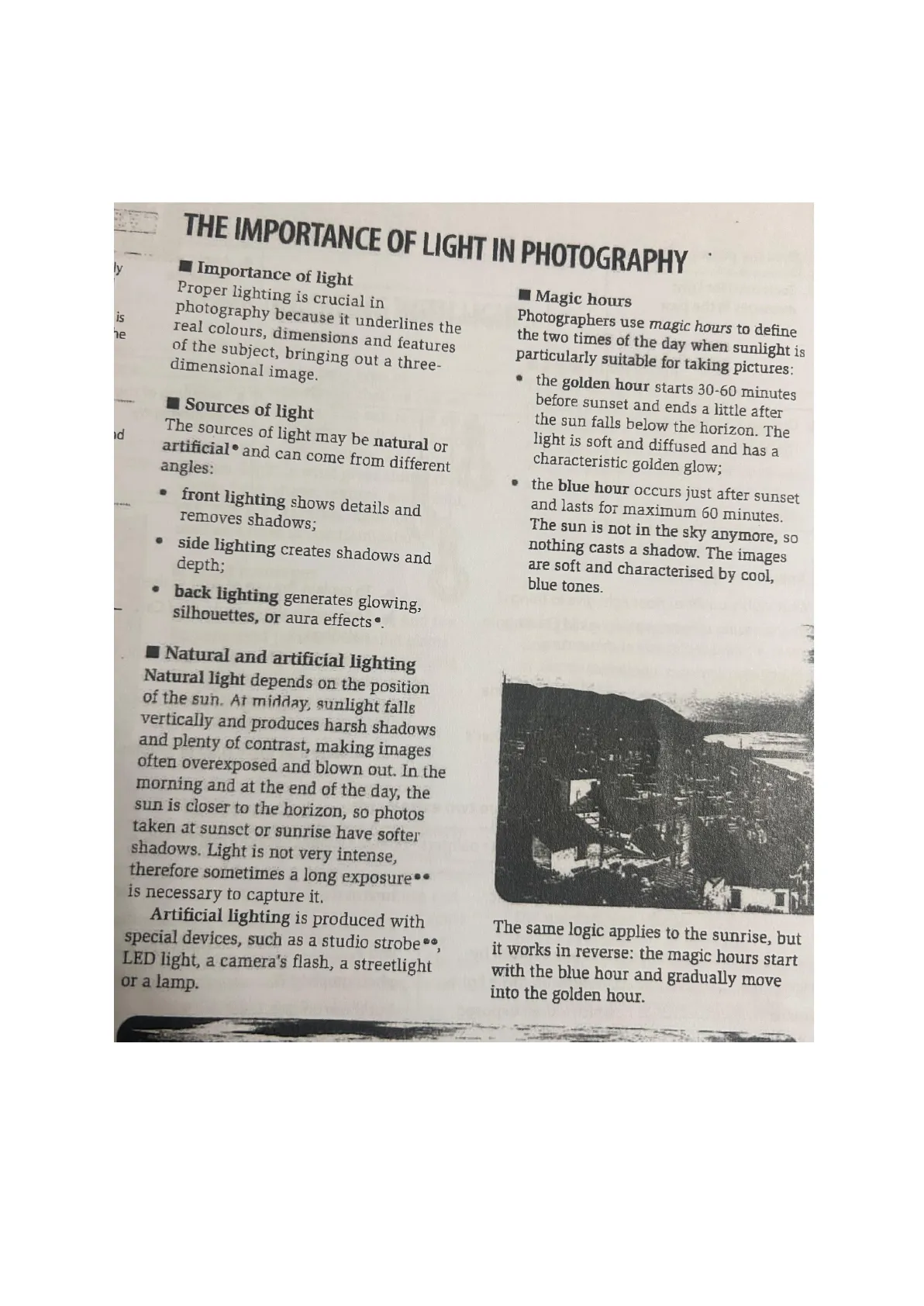
- the golden hour starts 30-60 minutes before sunset and ends a little after the sun falls below the horizon. The light is soft and diffused and has a characteristic golden glow;
- the blue hour occurs just after sunset and lasts for maximum 60 minutes. The sun is not in the sky anymore, so nothing casts a shadow. The images are soft and characterised by cool, blue tones.
The same logic applies to the sunrise, but it works in reverse: the magic hours start with the blue hour and gradually move into the golden hour.
Examples of Lighting Techniques
Examples of light:Backlighting (Example 1) A Picture I took to illustrate Backlighting: An Example from the internet: Side lighting (Example 1) This is an example of a photograph I took that shows Side Lighting: This is a photograph from the internet that shows side lighting: Onging These photographs are examples of side lighting, which can be used in film for several purposes, such as; showing a characters internal conflict, to show that a character has two sides a 'good' and 'bad' side and alsoFront Lighting (Example 1) An example of Front lighting in a picture I have taken: An example of front lighting from the internet: Front lighting is used on people and objects to draw our attention to them, it usually creates a very open and innocent look. Front Lighting can be used in film for many reason including; to show that a character is being open and honest, to create a sense of joy and happiness and sometimes just to show clearly the characters emotions and facial expressions.
Picture taken at the golden hourPicture taken at the blue hour
Colours in Photography
Colours
- PRIMARY COLOURS: RED, YELLOW, BLUE
- SECONDARY COLOURS: ORANGE, GREEN, PURPLE
- TERTIARY
- WARM COLOURS: RED, YELLOW, ORANGE
- COOL COLOURS: BLUE, GREEN, PURPLE
- NEUTRAL COLOURS: black and white + grey (combination of black and white) = for communicating nostalgia, melancholy, a vintage tone a classy touch
The Colour Wheel
The colour wheel All the main theories of colour start from a six-point colour wheel, · made up of three primary colours (red, yellow and blue), and three secondary colours (orange, green and purple), which derive from a combination of two primary colours. An imaginary line splits the wheel into warm colours (red, orange, and yellow), and cool colours (blue, green, and purple). .. Tertiary colours are the merging of primary and secondary colours ., and more colours are created in the same way in an endless number of mixtures. Black, white, and grey are considered neutral colours, even though black is sometimes considered as the absence of colour and white as the blending of all colours.
Hues, Shades, Tints and Tones
Hues, shades, tints and tones .. By adding black and white to a colour - which is the general term - hundreds of more colours can be created:
- hue refers to the dominant colour family on the colour wheel;
- tint refers to a colour to which some white has been added;
- shade refers to a colour to which some black has been added;
- tone refers to a colour to which grey (that is both black and white) has been added.
Colour Harmonies
Colour harmonies In order to design a successful layout, it is necessary to pay attention to the various combinations of colour, looking for harmonies of colours:
- monochromatic colours refer to the different shades, tints and tones of a single hue;
- complementary colours are the ones which are opposite a colour in the chromatic wheel;
- split-complementary colours include a colour and the two colours beside its complement;
- analogous colours are the two colours which are right next to a colour in the colour wheel;
- triadic/square colours are three/four colours that are equally spaced out on the colour wheel;
- tetradic or rectangle colours are two complementary colour pairs.
ANALOGOUS COMPLEMENTARY TRIAD MONOCHROMATIC TETRAD SPLIT COMPLEMENTARY SQUARE
Useful Expressions for Image Description
USEFUL EXPRESSIONS 2. In the background/foreground/middle ground there is\ there are it's possible to see It is represented There islisn't symmetry harmony between the elements because ..... 3. The subject represents a woman/ man .... Helshe is ..... years old he is young/middle-aged/old Helshe is doing. .usa il present continuous< verb to be+ing form 4. The light is ..... This picture was probably taken at the golden hour/the middle hour 5. In this picture there are mainly primary/secondary/tertiary (colours) the great majority of them/most of them are cool/warm/neutral
Can’t find what you’re looking for?
Explore more topics in the Algor library or create your own materials with AI.
