The Service Brigade: Restaurant Staff Organization and Roles
Document from The service brigade. The Pdf explores the organization of restaurant service staff, detailing key roles, responsibilities, and essential qualities for excellent service. The Pdf is designed for vocational training in the catering sector, covering topics like the waiter's uniform, mise en place, and dining room cleaning procedures.
See more10 Pages

Unlock the full PDF for free
Sign up to get full access to the document and start transforming it with AI.
Preview
The Service Brigade
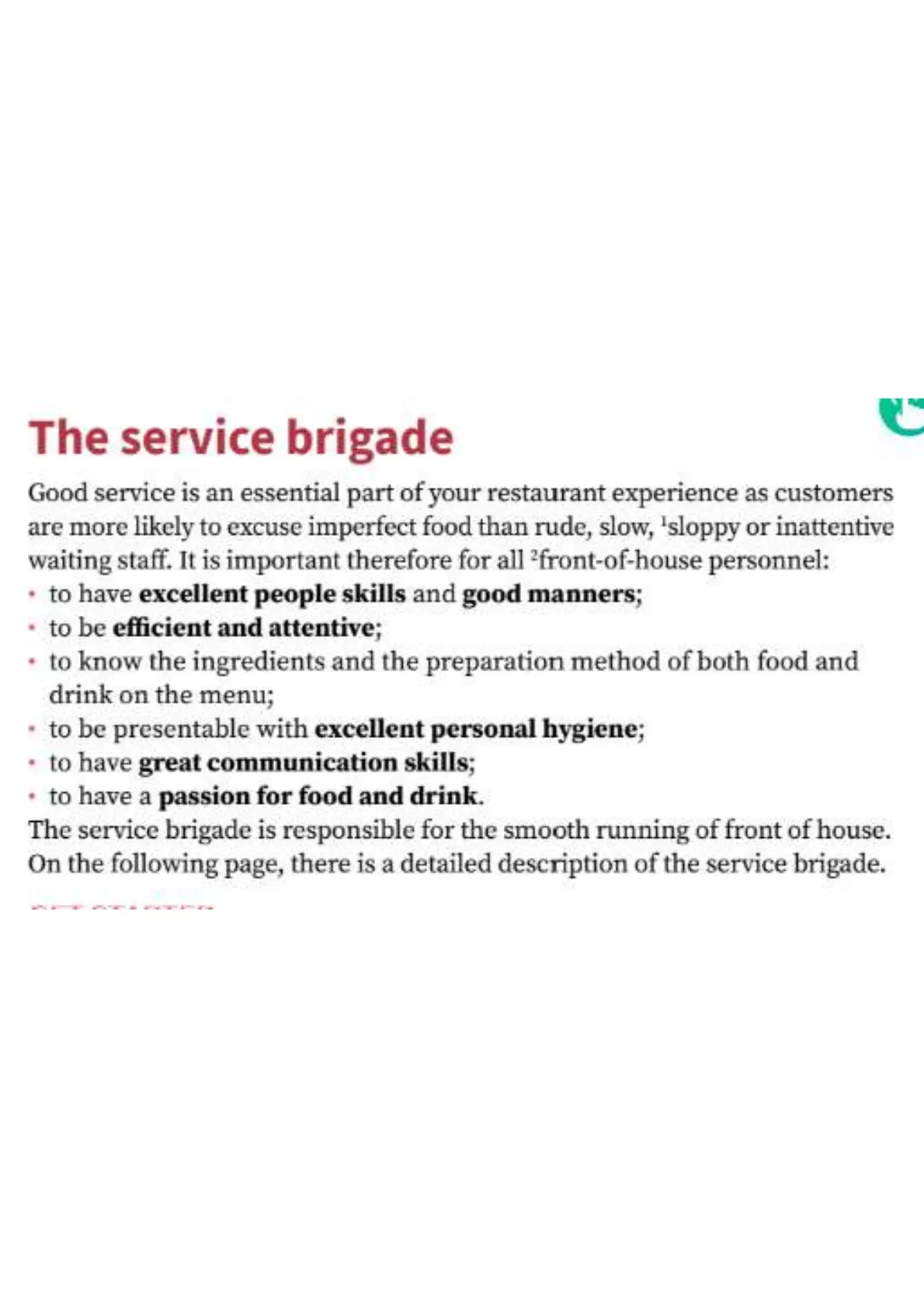
Good service is an essential part of your restaurant experience as customers are more likely to excuse imperfect food than rude, slow, 'sloppy or inattentive waiting staff. It is important therefore for all 2front-of-house personnel:
- to have excellent people skills and good manners;
- to be efficient and attentive;
- to know the ingredients and the preparation method of both food and drink on the menu; to be presentable with excellent personal hygiene;
- to have great communication skills;
- to have a passion for food and drink.
The service brigade is responsible for the smooth running of front of house. On the following page, there is a detailed description of the service brigade.THEORY / In the Restaurant
Restaurant Staff Roles
Food and Beverage Manager
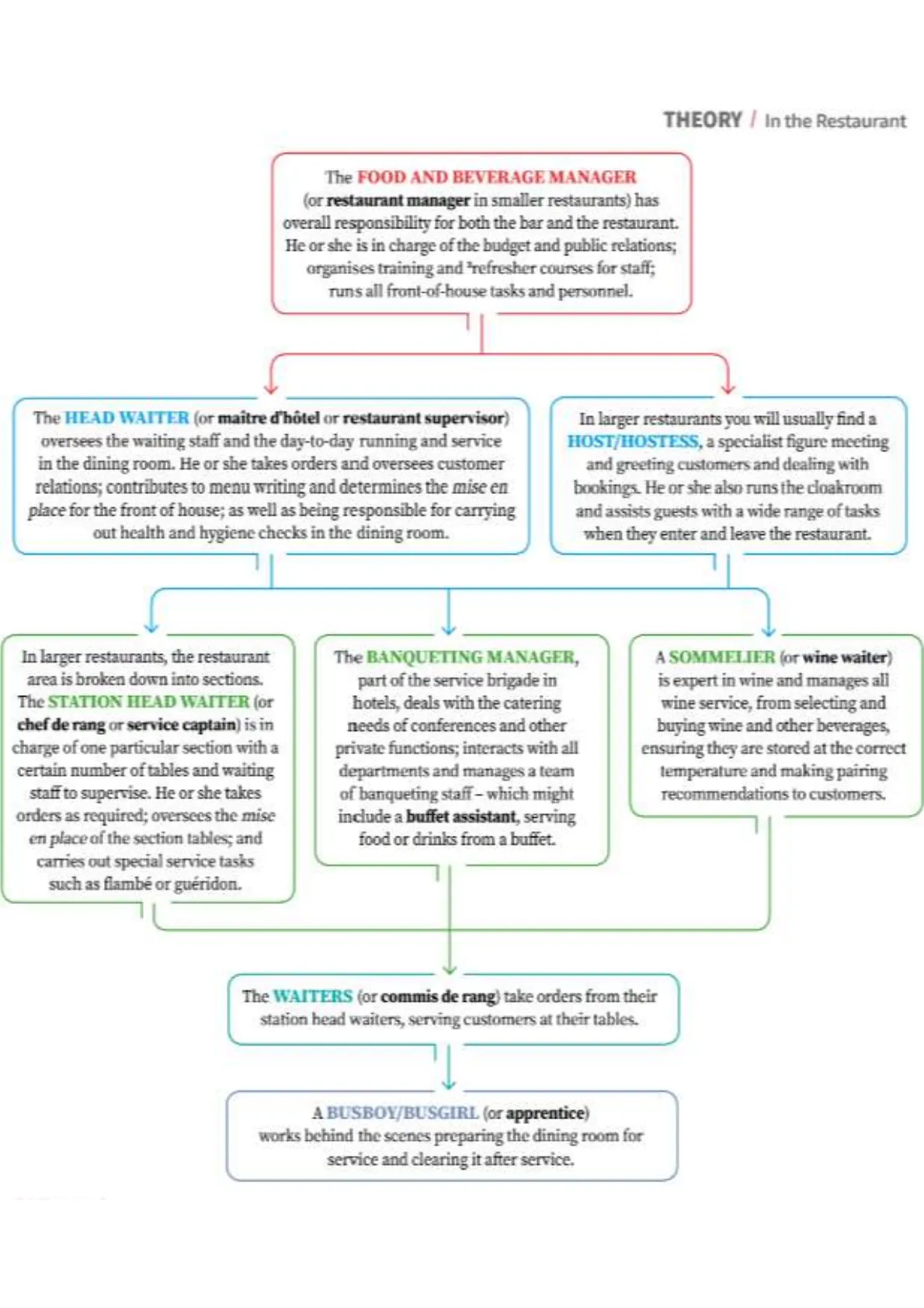
The FOOD AND BEVERAGE MANAGER (or restaurant manager in smaller restaurants) has overall responsibility for both the bar and the restaurant. He or she is in charge of the budget and public relations; organises training and 'refresher courses for staff; runs all front-of-house tasks and personnel.
Head Waiter
The HEAD WAITER (or maitre d'hôtel or restaurant supervisor) oversees the waiting staff and the day-to-day running and service in the dining room. He or she takes orders and oversees customer relations; contributes to menu writing and determines the mise en place for the front of house; as well as being responsible for carrying out health and hygiene checks in the dining room.
Host/Hostess
In larger restaurants you will usually find a HOST/HOSTESS, a specialist figure meeting and greeting customers and dealing with bookings. He or she also runs the cloakroom and assists guests with a wide range of tasks when they enter and leave the restaurant.
Station Head Waiter
In larger restaurants, the restaurant area is broken down into sections. The STATION HEAD WAITER (or chef de rang or service captain) is in charge of one particular section with a certain number of tables and waiting staff to supervise. He or she takes orders as required; oversees the mise en place of the section tables; and carries out special service tasks such as flambé or guéridon.
Banqueting Manager
The BANQUETING MANAGER, part of the service brigade in hotels, deals with the catering needs of conferences and other private functions; interacts with all departments and manages a team of banqueting staff - which might include a buffet assistant, serving food or drinks from a buffet.
Sommelier
A SOMMELIER (or wine waiter) is expert in wine and manages all wine service, from selecting and buying wine and other beverages, ensuring they are stored at the correct temperature and making pairing recommendations to customers.
Waiters and Busboys
The WAITERS (or commis de rang) take orders from their station head waiters, serving customers at their tables. A BUSBOY/BUSGIRL (or apprentice) works behind the scenes preparing the dining room for service and clearing it after service.
Waiter's Uniform
The classic walter's unif rm is sn d esslike: shirt, a black tie or bow tie, a jacket of irt four women, a long apron and a napl in over the m to 's safely. But as more people eat out and customers increasingly dress casually to go out, the hospitality int ustry is grad ually fol ing the trend. Nowadays restaurants are choosing their waiting staff's unif ns to reflect their own rticular style and the style of their customers. aiters in a casual or family restaurant might we r a plain T-shirt company logo, a pai jeans and an apron; while the uni arms of waiters in fine dining estaurants are e likely to follow the sic shi e style. The cret is no k sn er ur customers because it can make them feel uncomfortable. However, style and image are not the only factors to consider when choosing waiters' uniforms. Waiting tables is hard work, so waiters' uniforms also need to be functional and comfortable particularly their shoes. The uniform needs to 'stand up to the "wear and tear of the job and to frequent washing, without making it look worn, old or coloured. More recently some food outlets have turne he fashion industry to help them innovate their staff
Mise en Place and Clearing Front of House
Operations front of house consist of three phases: the mise en place, the service and clearing the dining room. Before service comes the MISE EN PLACE , which refers to getting everything ready for service. Each member of staff must ensure they have all the equipment to hand to enable them to carry out their duties efficiently, in accordance with the known bookings and predicted casual footfall. The basic procedure is as follows:
Denning dining roomn Aminging Laying the Arranging the chairs PorBoning the decorative Preparing the equipment Final che Stall briefing
During SERVICE sta should ensure that they continuously restock the cupboards as they use things in order not to run out of any vital elements of the mise en place. The busboys/busgirls are largely responsible for this task. Tables should also be cl ad d cleaned during service, as guests complete a course and move on to the next, but without the operations "impairing the enjoyment of the customers, After service the proper CLEAN-UP begins with all the tables being cleared of glassware, crockery and linen, so that it can be washed in preparation for the next service. The tables and chairs should be thoroughly cleaned and sanitised and the floor swept and washed. It is also a good id to open doors and win ws to freshen the air, and in order to clean them. In addition to this, large pieces of equipment, such as trolleys and guéridon, and small ones, such as trays, should also be thoroughly cleaned and dried after service. All unused dinnerware should be put away, after checking that it is quite clean. The dining room is now ready for the next service.
The Dining Room Layout
- Your dining room floor plan should be flexible and accessible to staff and customers. It is best if the room is divided up into sections of three or four tables, but avoid putting tables too close together or trying to put too many chairs around each table. Customers should be comfortable, and staff should have sufficient space to move around the dining room freely and easily.
- Diners should have enough space (between 1m2 and 1.5m2), with table covers positioned at the centre of the chairs. Try sitting in every seat in the restaurant, to see if there is enough leg and elbow room and you are not staring at a wall or unable to get out of your seat without disturbing other customers. Restaurant booths offer some great advantages over standard restaurant seating as they save space, but they are not as flexible for changes.
- Make sure tables and chairs are robust and easy to clean, so avoid styles with lots of intricate carvings and 'crevices, as they will be harder to wipe down and keep free of 2crumbs and 3debris. Treat 'fabric chairs with a stain resister before placing them in the dining room and professionally clean them twice a year. Some restaurants also have bar stools or benches, in order to fit more customers into their dining areas.
- Table linen refers to the fabric items used at mealtimes, such as tablecloths, napkins and runners at the centre of the table. In fine dining restaurants you are more likely to find simple, elegant white linen tablecloths and napkins. And a layered effect might indicate the higher end of that, or a special event such as a banquet or a wedding. With more casual dining restaurants, there will probably be attractive, bright linen shades creating a livelier, less formal atmosphere, as well as paper napkins. The key thing to remember here is: the more formal the dinner, the more coverage.
- The overall look you want to achieve in your restaurant is simplicity. The room should not be too light nor too dark. If there is a chandelier above the table, use a 5dimmer, or candlelight for a romantic touch. Fresh flower arrangements are pleasant, but they should not block the guests' view of each other. leroviene focerra 4fahrie di tocento
Service Equipment
Trays and trolleys are essential for waiter service. Trolleys allow staff to transport more dishes to a table at the same time as they have wheels. They also provide a safe place to 'stack unwanted serving dishes, but they can take up a lot of room in the restaurant aisles, so trays might be easier in smaller environments. Apart from serving trays and trolleys, restaurants will have other serving equipment to transport food and crockery to the table and keep them warm. These include: cloches, chafing dishes (metal pans containing a spirit lamp or burning charcoal, used for cooking at table), plate warmers, food warmers and hostess trolleys (heated trolleys with different compartments for plates and different dishes). A guéridon* is a special trolley used for guéridon service, to cook, finish or serve dishes to guests at their table. The trolley is equipped with a burner for cooking, a chopping board and cutlery drawer, with the necessary utensils for what the restaurant offers from the trolley. There will also be a selection of basic condiments such as mustard, oil, vinegar, etc. Sometimes restaurants also have fixed sideboards containing additional cutlery or crockery and displaying desserts. It should also contain a condiment ménage, napkins, chopping boards, trays and a cheese dish.
Table Setting
Tableware refe to the crockery, cutlery and glassware used for serving m a table. From ba , the type of tublev are nsider t ig capacity, Fanyt hing Crocker in plates, dishes, bowls, cups er similar ma "china. There should be t plates, deep plates and 5 le 1 dessert owls for cus tomer as well as es and C fee service with cup ind saucers, teapots nd coffe e pots, milk ugs and big how i er that dinner pla id de arger is on! 10 late A sta rant 12 ood range of ser ng pl ch he table; sufficient bu ménage I.vi di ensers fo th e tablet
Cutlery
Cutlery will vary according to the type of service offered. But it should consist in table knives, table forks, soup spoons, dessert knives, forks and spoons and teaspoons, as well as ch eese and butter knives ould also be fish kni es and forks, together with list equipment such as shellfish crackers, seafood forks and scoops, available upon request. For service there should be serving spoons and forks, ladies and carving knives. le est rule with cutlery is e always to the right te with the serrated Inted Inwards, Spoons he right of the knife and re to the left of the plate.
Glassware
Glassware also varies with service. More formal restaurants tend to have more elabo ate glassware and a greater quantity of it. Generally glassware clud es wine and water glass water jugs, as well as t mblers, liqueur and spirit glasses. There 0 your traditional table. the blet is always above of the blade of your knife d the glasses for your wines. For modem upły place one water might also be metal wine chillers and ice buckets to guarantee that wine is served at the correct ne wine glass, adding temperature. If they are needed.
Can’t find what you’re looking for?
Explore more topics in the Algor library or create your own materials with AI.
