Unit 1: Formal Criteria for Word Definition and Morphology
Document from University about Unit 1. The Pdf explores formal criteria for defining 'word' in linguistics, analyzing orthographic, phonological, morphological, semantic, and syntactic aspects. It discusses grammatical and lexical morphemes, allomorphy, and types of affixes for University students of Languages.
See more13 Pages

Unlock the full PDF for free
Sign up to get full access to the document and start transforming it with AI.
Preview
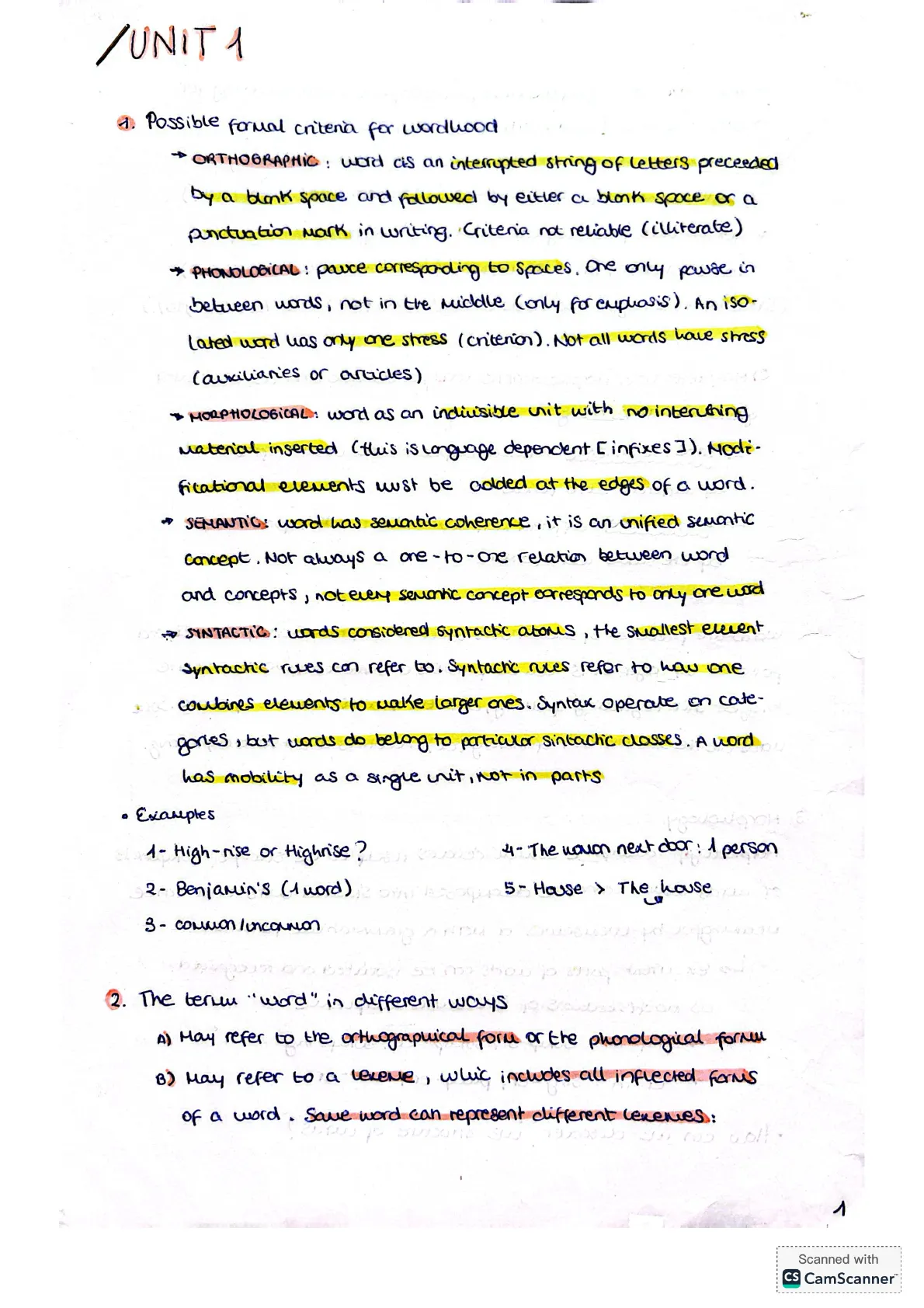
Possible Formal Criteria for Word Definition
Orthographic Criteria
ORTHOGRAPHIC : word as an interrupted string of letters proceeded by a blank space and followed by either a blank space or a punctuation Mark in writing. Criteria not reliable (illiterate)
Phonological Criteria
PHONOLOGICAL: pouce corresponding to spaces. One only pause in between words, not in the Middle ( only for emphasis). An iso- lated word was only one stress (criterion). Not all words have stress (auxiliaries or articles)
Morphological Criteria
MORPHOLOGICAL: word as an indivisible unit with no intervening Material inserted ( this is language dependent [ infixes ]). Node- ficational elements must be added at the edges of a word .
Semantic Criteria
SEMANTIC: word was semantic coherence, it is an unified semantic concept. Not always a one-to-one relation between word and concepts , not every semantic concept corresponds to only one word
Syntactic Criteria
SYNTACTIC : words considered syntactic atoms , the smallest element Syntactic rules can refer to . Syntactic rules refer to how one combines elements to make larger ones . Syntax operate on cate - gones , but words do belong to particular sintactic classes . A word has mobility as a single unit, Not in parts
- Examples
- High-rise or Highrise ?
- The wovon next door : 1 person
- Benjamin's (1 word)
- House > The house
- common / uncommon
The Term "Word" in Different Ways
A ) May refer to the orthographical form of the phonological formul B) May refer to a levere , which includes all inflected forms of a word . Save word can represent different leveres :
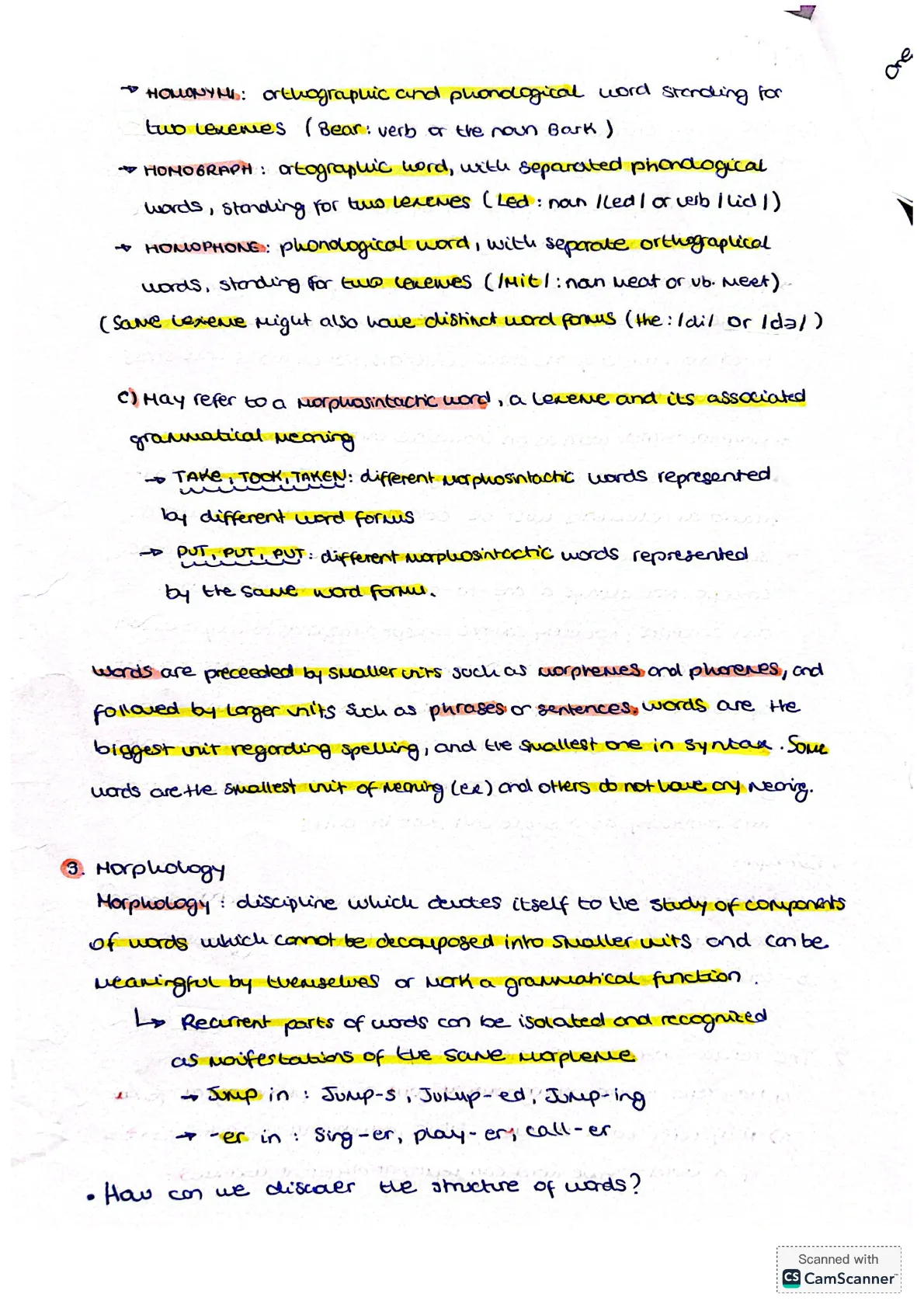
HOMONYMI: orthographic and phonological word standing for two leveres ( Bear: verb or the noun Bask ) HOMOGRAPH : ortographic word , with separated phonological words, standing for two textmes (Led): nan / Led / or verb / lid 1) + HOMOPHONE: phonological word , with separate orthographical words , standing for two tenewes ( I Mit 1 : nan meat or ub . Meet ) ( Same levene might also have distinct word formus ( the: Idil or Ida) ) c ) Hay refer to a Morphosintactic word , a levere and its associated grammatical Meaning
- TAKE , TOOK, TAKEN : different morphosintactic words represented by different word formus
- PUT, PUT, PUT : different morphosintactic words represented by the same word formul .
words are preceded by smaller units such as morphemes and phareves , and followed by larger units such as phrases or sentences , words are the biggest unit regarding spelling , and the smallest one in syntax . Some words are the smallest unit of meaning ( ex ) and others do not have any Nearing.
Morphology
Morphology Definition
Morphology: discipline which devotes itself to the study of components of words which cannot be decomposed into smaller with and can be meaningful by themselves or Mark a grammatical function
L Recurrent parts of words can be isolated and recognized as manifestations of the same mapleme
- Jump in: Jump-s, Julup-ed. Jumping
- -er in : Sing- er, play - ery call - er
Discovering Word Structure
. How can we discover the structure of words? One procedure is the principle of contrast: contrasting forms that differ in sand/ letter sequences or in Meaning / function, because the morphological units in which words are composed of the combination of morphemes are not rondom , but guided by morph . and phon . roces .
Sentence Structure
. Phrase : group of words related both semantically and gramatically and that was internal structure . Between the word and the clause . functions as a single unit in a sentence. Ex : In the garden brie . clause : Sentence that contains one lexical verb and other elements this verb requires. Between phrases and sentences . Ex : Alison laughed . Sentences : Largest unit in grammar . String of words which are held together by sintactic relations . Made of clauses . Expresses a complete thought . Ex : The cat slept because he was tired .
If a word consist of one morpheme it is called simple ; if it is two or more worprevue, complex If a sentence consist of one clause , it is a simple sentence ; if it is composed of two or more clauses , complex sentence
Morpheme
Morpheme Definition and Characteristics
A Morpheme is the smallest meaningful unit in a language. They can stand alone as independent words ( non- inflected words) and others Must be attached to other morphemes. Ex: Headphones : 3 morph. Characteristics :
- Internally indivisible
- transportable
- refers to class of forms
- Internal stability
- free distribution and abstractions {}
Types of Morphemes
- Grammatical morphemes: express limited number of very common meanings and relations within the sentence. They do not constitute open categories and their occurence is predictable by the grammatical rules of the sentence ( tense, number, gender, voice). They can be inflectional affixes ( part of word ) or function words ( articles, prep ... )
- Lexical Morphemes: express lexical meaning and can be into the major word classes ( man, verbs , adj, adv ) . They are open categories. Independent content words or derivational affixes.
We have to distinguish Morpheve from morph . A morph is the actual spoken or written form that represents a morpheme . They are represen- ted by phonetic forms . When a morpheme exits but was no concrete phonetic or written form , one speaks of a Zero morph . Ex : Fish {fish }+ (pl )
Allomorphy
Allomorphy Definition
Same morphs can have distinct shapes ( The : ( de) / da /) . This is phono - logically conditioned , because these allowopus are subject to a rule : whether the next word starts with lower or consument .
- Different morphs representing same morpheNe ! Allomorphs
. This phenomenon is known as allomorphy
Types of Allomorphy
Two types of allomorphy Base Allomorphy: Bases (roots) can also be subject to allomorphy due to morphological conditions (following morpheme): Explain Suffix allomorphy: Suffix can be subject to allomorphy due to DHA phonological conditioning ( final segment / letter of the base) Ex: - AL /-AR endings (2).
Free and Bound Morphs
Free Morphs Bound Morphs
- stand alone as a word
- attached to a morph
- root. Carries meaning
- do not carry meaning
Roots, Bases, and Stems
Root: bases that cannot be split into Morphemes Base : part of a word to which an affix is attached to . It morphs Stem: used for bases and inflectional or derivational affixes (NO) -> The denied word is referred to as derivative
Bound Roots
Bound roots: roots that can be bound morphs. They are often borrowings that were free on his original language but Not in English. Roots because prefixes can be added but they can't stand alone. Normally they have latin origins (- ceive, - vert ) , but some are native English (- Kempt,- coutu) and are call etymemes
Affixes
AffixES : does not carry meaning and it is alway bound to a root . Suffix : end of roots Prefix: beginning of roots . INFixES : inserted in the middle of words , but nowadays only use with humourous purposes (in-bloody-possible)
Derivational vs. Inflectional Affixes
DERIVATIONAL AFFIXES INFLECTIONAL AFFIXES Prefixes or suffixes Only suffixes one or more per word one per word idiosincraticaly attached to some attach to all verbers of a word
- convert a part of speech
- indicate grammar Meaning
- change the root meaning preceedes the inflectional suffix follows the derivational affix v. 3.
Productive and Non-Productive Inflections
- Productive inflections : attach to any new word entering the language. Express grammatical category Nans: plural (-5) and possessive (-5) verbs: present (-5), past (-ed), past pl (-ed), present pp(ing) Adjectives; comparative (er) and superlative (-est)
- Non productive : found on selected number of a class but never added to a new word.
Plural alternation: tooth - teeth Superlative - most : foremost
- en past participle : write - written
past tense vowel alternation : ring - rang
Enclitics
Encitics: a kind of contraction, band form which dences from an independent word and must be attached to the preceeding word .
- contracted auxiliaries: attached to the preceeding Subject ( will , shall , have, be, are .) . Not all ( can, should .. )
- Contracted negatives, attached to the preceeding auxiliary ( won't , short , haven't , can't .... )
Morphological Types of Words
simple : I free root . Morphological types complex: free root + band morph of words compand : 2 free roots complex - compand : 2 free roots + bounds andlazas
Inflectional morphemes can be realizes by few different forms, or the Sove formul denote different inflectional wopleves. So, it is usual to use descriptive designations for them , such as {pl ? for plural or { poss} For the possessive.
Morpheme Analysis
SI " Morpheme analysis
- Nans: teeth 1 morph > teeth 2 morphemes> {TOOTH} + {pl} verbs: working 2 morphs> working 3 morphenes > {WORK} + {genund} +{sg} adjectives: Smallest 2 morphs> small/est 2 worptenes> {SMALL} +{supl]
- pronouns: him 1 morph> him 4 morphenes > {3rd p }+{sg}+{n}+{00;}
Morphological Realization Rules
- morphological realization rule . Agglutinative rule : two morphemes realized by distinct Morphs that are "gled" together. Adding suffixes at the end. Writer- Writers
. Fusional rule: tup morphemes realized by morphs which not remain distinct but are fused together . New form is obtained which is not ' gued " so it can't be split . tooth + teeth .Nul realization : Horphere is never realized as a morphe in any word , such as {56 }. This is by default and there's no suffix to Mark it . work + pres work . Zero rule: porprewe realized as a zero morph in particular Members of a word class. Very particular cases where the same Form is sg / pl or pres / past . sleep sleep / Put - Put. . These rules can be combined . Put is either null ( pres ) or tero ( past). Morphemes have predictable variants called allomorphs . They are semantically similar and have complementary distribution, but they are phonologically condi- tioned: the final sound of the root determines the plural pronunciation: 151, It/ .
Processes of Word Formation
Derivation
. Derivation: the addition of a derivational affix to a word, creating a new one with some of these changes:
- phonological change : reduce - reduction , clear -clarity
- orthographic change to the roof: deny- denial, happy - happiness
- semantic change: went-eventual, everge - emergency
- change in word class: cat (v), catable (ART) impress (v)- impression (n)
Principle of Compositionality
According to the principle of compositionality, the meaning of complex words is the sum of the content of its parts. This is broken by expressions such as "kick the bucket" . phenomenon rarely seen .
Possible Words
Possible words: word whose semantic, morphological or phonological struc- ture is in accordance with the rules of regularities of the language. Ex: transitive verbs turn into adjectives by -able: afford > affordable
Can’t find what you’re looking for?
Explore more topics in the Algor library or create your own materials with AI.
