Enzymes: Biological Catalysts and Their Activity in Biology
Document from The National Orthodox School Shmaisani about Enzymes. The Pdf provides a concise overview of enzymes, their mechanisms of action, and the impact of temperature and pH on their activity, suitable for high school Biology students.
See more18 Pages

Unlock the full PDF for free
Sign up to get full access to the document and start transforming it with AI.
Preview
Orthodox Educational Sou
The National Orthodox School Shmaisani 1957
Biology Department
Booklet 5 Grade 9 IGCSE
Name: section: 5
Enzymes
5.1 Enzymes
Supplement
- Describe a catalyst as a substance that increases the rate of a chemical reaction and is not changed by the reaction
- Describe enzymes as proteins that are involved in all metabolic reactions, where they function as biological catalysts
- Describe why enzymes are important in all living organisms in terms of a reaction rate necessary to sustain life
- Describe enzyme action with reference to the shape of the active site of an enzyme being complementary to its substrate and the formation of products
- Investigate and describe the effect of changes in temperature and pH on enzyme activity with reference to optimum temperature and denaturation
Core
- Explain enzyme action with reference to: active site, enzyme-substrate complex, substrate and product
- Explain the specificity of enzymes in terms of the complementary shape and fit of the active site with the substrate
- Explain the effect of changes in temperature on enzyme activity in terms of kinetic energy, shape and fit, frequency of effective collisions and denaturation
- Explain the effect of changes in pH on enzyme activity in terms of shape and fit and denaturation
1Enzymes: Enzymes are proteins that function as biological catalysts, used to speed up the rate of reactions, without being consumed. Catalyst: Substances that speed up the rate of chemical reactions, without being changed by the reaction or used up.
The shape of an enzyme
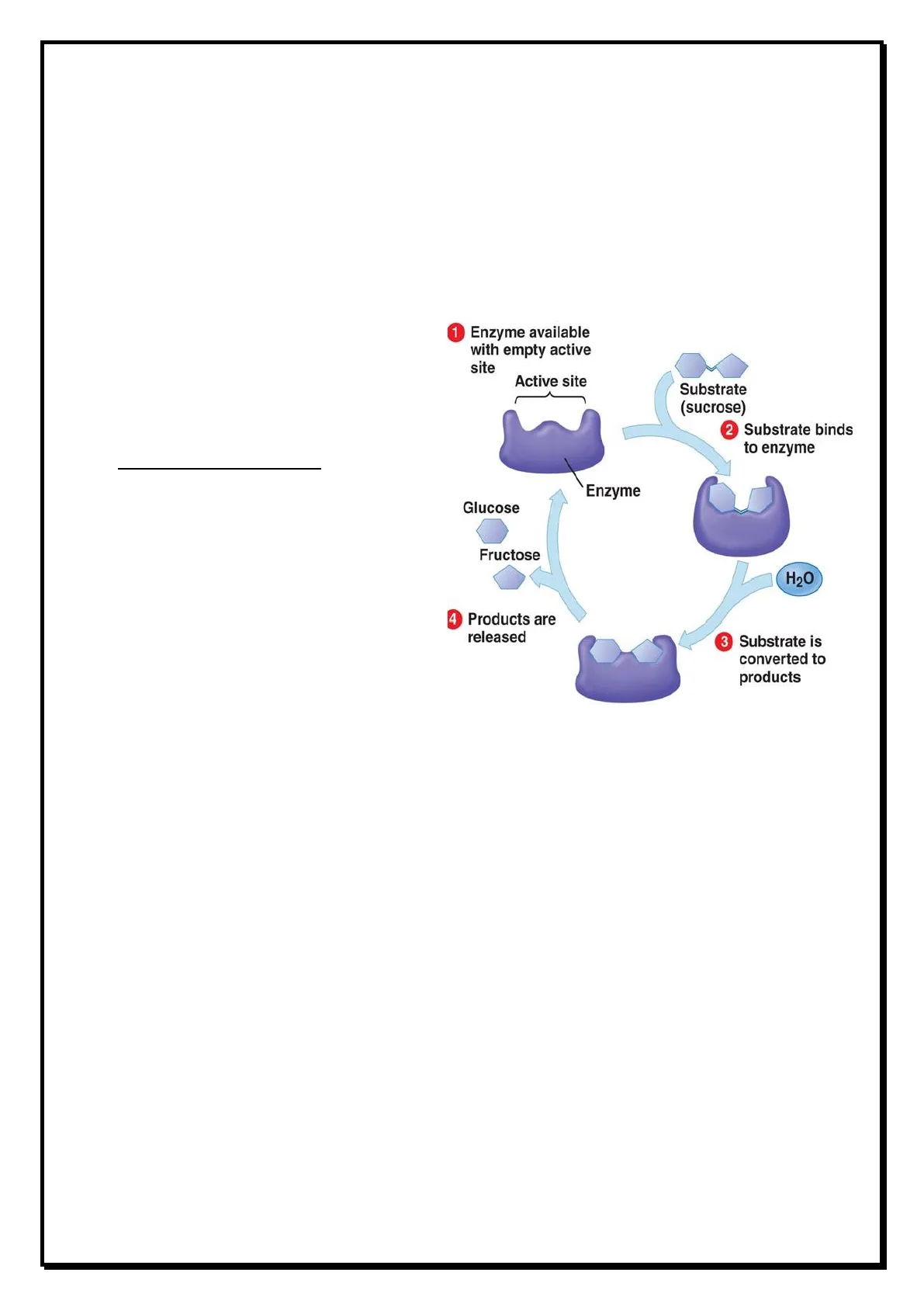
Enzymes have an active site which is complementary to the shape of the substrate. Consider this reaction: Sucrose > Glucose and fructose This metabolic reaction takes place in our digestive system during the process of digestion. This reaction is catalysed by an enzyme.
1 Enzyme available with empty active site Active site Substrate (sucrose) 2 Substrate binds to enzyme Enzyme Glucose Fructose H2O 4 Products are released 3 Substrate is converted to products
The enzyme catalyses the breaking down of sucrose into the monosaccharides glucose and fructose. The substance which the enzymes works on in a chemical reaction is called the substrate ( in this example it is sucrose) and the substances which are formed at the end of the reaction are called the products ( in this case they are glucose and fructose).
2Enzymes are specific The substrate binds to a region in the enzyme called the active site forming an enzyme-substrate complex. The active site matches the shape of the substrate molecule "they are complementary " because the substrate fits into this space in the enzyme
- The active site of each enzyme has a specific shape, and only substrates that have a shape complementary to the shape of the active site will be able to bind to the enzyme.
Each enzyme can catalyze only one particular kind of reaction. And because we have many different chemical reactions occurring in our bodies, there many different enzymes are found, one for each of the many different metabolic reactions that must take place for us to stay alive.
Enzyme E Active site SA SD Substrate A Substrate D SB Sc Substrate B Substrate C
What the Enzyme told his substrate ...
You complete me! "Life"ology 08/03/10 or\Eo\80 .It6.oloBA
This feature resembles the Lock and Key model. Just as a key must exactly fit the shape of a door lock, so must a substrate exactly fit the shape the active site of the enzyme!
- If the substrate fits into the active site of the enzyme, then the enzyme will be able to catalyze the reaction , if does not the reaction won't be catalyzed. That's why enzymes are said to be "specific".
Substrate (a) Active site Key (substrate) Lock (enzyme) Enzyme (b) Lock-Key Complex Enzyme-Substrate Complex
3. Enzymes are not used during reactions, once the reaction that the enzyme is catalyzing is over, the enzyme will be free to catalyze a new reaction. A single enzyme can carry out many reactions of the same type (with the same substrates or those that are structurally similar to each other) because enzymes are specific.
enzyme active site substrates
Enzymes are proteins > so they must be produced on ribosomes (site of protein synthesis) > ribosomes get instructions for synthesizing proteins from the genes that the nucleus of the cell contains > the genes control the types and quantities of enzymes produced inside the cell > so it controls the type of chemical reactions that take place inside the cell. Since different cells have different types of chemical reactions (specialization) > nucleus controls what the cell will be e.g. Blood cell, Muscle cell, nerve cell .. Etc. Genes > proteins (enzymes) > catalyze reactions
4Gene Nucleus Chromosome Segment of DNA of a particular length carries instructions for synthesis of proteins in the cell DNA Cell Histone proteins
The Effect of High temperature on enzymes
Proteins are affected by high temperatures. High temperatures ruin the shape of the protein and it causes the protein to lose its function. Why? Because high temperatures break the bonds between the amino acids that hold the protein, Substrate as a result the protein loses its 3D shape > Denatured Heat Above 40℃ Enzyme Enzyme The active site of the enzyme changes shape and can no longer bind to the substrate. It has been denatured. Since all enzymes are proteins they are also affected by high temperatures. High temperatures change the shape of the active site of the enzyme, as a result, the substrate won't be able to fit to the shape of the active site and form an enzyme-substrate complex anymore, as a result, the enzyme loses the ability to catalyze reactions and is said to be "Denatured".
5Hydrogen peroxide (H2O2), is a waste product of some chemical reactions in the cell. This waste product is very toxic so it needs to be broken down immediately. Our Body breaks hydrogen peroxide down with an enzyme called catalase (a common enzyme found in the cells of both animals and plants e.g. liver cells and potato cells) according to this equation: H2O2> H2O +O2
DENATURATION
Denaturation Normal protein Denatured protein
Naming enzymes
Typically, to generate the name of an enzyme, the suffix -ase is added to the name of its substrate or the reaction they promote For example: Enzymes that catalyze the breakdown of carbohydrates are called > Carbohydrases Enzymes that catalyze the breakdown of proteins are called > Proteases Enzymes that catalyze the breakdown of Fats (lipids) > Lipases Exceptions: Trypsin, pepsin An enzyme that acts on sucrose as its substrate is called surcrase and it is considered a carbohydrase An enzyme that removes hydrogen from its substrate is called dehydrogenase
6Amylase 1) Starch Maltose Step 1 Maltase Maltose Glucose Step 2 Proteases 2) Protein amino acids Protease is a large group of enzymes (including pepsin, trypsin) Lipase 3- Fats (lipids) 3 fatty acids + glycerol
Factors affecting the enzyme activity
Temperature pH Concentration of the substrate Concentration of the enzyme The presence of inhibitors
1-Temperature:
Optimum Temperature What happens to to enzymes at high temperatures? DENATURED Rate of Enzyme Activity What happens to to enzymes at low temperatures? INACTIVE Temperature ℃
7As the temperature increases, the activity of the enzyme increases, this happens because the kinetic energy of molecules increases with increasing temperature ( they move faster) , so more effective collisions take place between enzymes and substrates, so more enzyme-substrate complexes will form so the activity of the enzyme increases. The temperature at which the activity reaches its maximum is called "The Optimum Temperature". If the temperature increases too much above the optimum temperature, the bonds holding the shape of the enzyme will start to break, changing the shape of the active site permanently and denaturing the enzyme > the rate of reaction drops sharply . Enzyme is inactive at low temperatures At low temperatures, the enzyme and the substrate molecules move slowly, so they take longer time to collide ( less effective collisions ) with enough force to start the reaction. Optimum Temperature: is the temperature at which the activity of the enzyme at the maximum level. "The enzyme works best at this temperature" The optimum temperature for enzymes that work in organs at the center of the human body is 37 ℃. Denaturation of human enzymes begins to happen at 40 ℃ and above
- The optimum temperature for plant enzymes is 28 -30 ℃ . Note: Enzymes from bacteria that live in hot springs may have optimums as high as 75℃
2- The Effect of pH on the activity of Enzymes:
pH is the measure of H+ ions in the solution The greater the number of H+ ions in a solution the greater it's acidity and the lower its pH
8Rate of reaction-+ Optimal pH for pepsin (stomach enzyme) Optimal pH for trypsin (intestinal enzyme) 1. - 0 1 2 3 4 5 6 7 8 9 10 pH (b) Optimal pH for two enzymes
Different enzymes work best in different degrees of acidity. The best pH for each enzyme to work at is called optimum pH. Extremes of pH (very high-> very alkaline or very low-> very acidic) can slow down the rate of action of the enzyme by causing the enzyme to lose its shape and become denatured, this means that the active site will no longer fit to the substrate and so the enzyme can no longer catalyze the reaction. Activity here drops gradually unlike the previous graph (Temp Vs Enzyme activity), where the activity drops sharply. This is because an increase in temperature has a greater effect on the shape of the active site than an increase or decrease in pH.
Examples on enzymes and their optimal pH
- Proteases: work in the stomach at optimum pH=2 > HCI in the stomach provides the optimum pH for Pepsin
- Salivary amylase: in the saliva optimum PH= 7
- Enzymes secreted by the pancreas: Lipase, trypsin and pancreatic amylase work at pH 9
Most Enzymes work best at neutral conditions pH= 7
Can’t find what you’re looking for?
Explore more topics in the Algor library or create your own materials with AI.
