Circulatory System: Blood Pressure and Blood Velocity
Slides about Circulatory System: Blood Pressure & Blood Velocity. The Pdf explores the circulatory system, defining blood pressure and its relation to blood velocity. The Pdf, suitable for High school Biology, discusses factors like salt intake and arteriosclerosis, and the impact of blood loss.
See more25 Pages


Unlock the full PDF for free
Sign up to get full access to the document and start transforming it with AI.
Preview
Circulatory System Overview
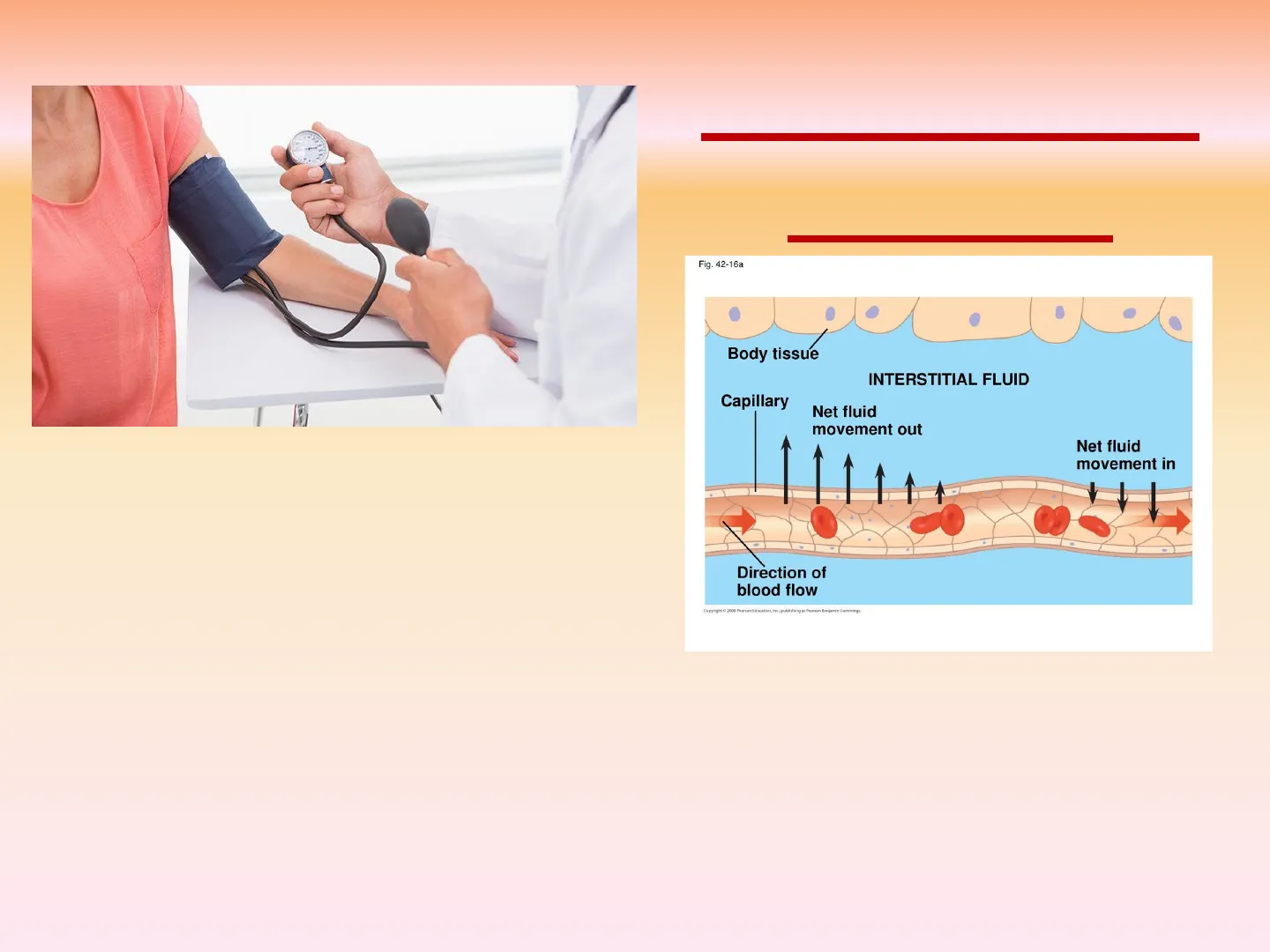
Circulatory System Fig. 42-16a Body tissue INTERSTITIAL FLUID Capillary Net fluid movement out Net fluid movement in . Direction of blood flow Copyright O 2008 Pearson Education, Inc., publishing as Pearson Benjamin Cummings.
Blood Pressure and Blood Velocity
Blood Pressure Definition
Blood Pressure is the force exerted by the blood on the wall of a blood vessel (artery) as the blood flows through the vessel.
Measured with a Sphygmomanometer using the brachial artery of the arm.
"Normal" adult blood pressure is 120/80 to 110/70, measured in mmHg.
The top number is the Systole (ventricles contract and "pump" the blood) and the bottom number is the Diastole (ventricles relax).
120 SYS 80 START DIA mmHg 60 PULSE /min
Blood Pressure Categories
| BLOOD PRESSURE CATEGORY | SYSTOLIC mm Hg (upper number) | DIASTOLIC mm Hg (lower number) | |
|---|---|---|---|
| NORMAL | LESS THAN 120 | and | LESS THAN 80 |
| ELEVATED | 120 - 129 | and | LESS THAN 80 |
| HIGH BLOOD PRESSURE (HYPERTENSION) STAGE 1 | 130 - 139 | or | 80 - 89 |
| HIGH BLOOD PRESSURE (HYPERTENSION) STAGE 2 | 140 OR HIGHER | or | 90 OR HIGHER |
| HYPERTENSIVE CRISIS (consult your doctor immediately) | HIGHER THAN 180 | and/or | HIGHER THAN 120 |
Blood Vessels and Pressure
Blood Vessels, Part 2: Crash Course A&P #28 BLOOD VESSELS part 2 28 BLOOD PRESSURE KILLS
Factors Affecting Blood Pressure
Factors affecting Blood Pressure Worksheet
- Physical activity:
- Distance from the left ventricle:
- Systole/ diastole:
- Inhalation/exhalation:
- Diet high in salt:
- Arteriosclerosis (atherosclerosis)
- Blood loss due to injury:
Physical Activity and Blood Pressure
1. Physical Activity Increases blood pressure temporarily during the activity: -> As physical activity increases, there is more demand on the muscles -> greater need for oxygen (to supply the muscles for cellular respiration to make ATP) - so the heart pumps stronger and faster to allow more blood to reach the lungs and pick up more O2.
In the long term, regular physical activity works to decrease resting blood pressure!
Distance from the Left Ventricle and Blood Pressure
2. Distance from the Left Ventricle Blood pressure decreases with greater distance from the heart. ➔ As blood moves farther from the heart, it is further away from the direct pumping action of the heart as well, so is under less direct pressure.
Systole vs. Diastole and Blood Pressure
3. Systole v. Diastole · This refers to change in pressure during the heartbeat, so they do not affect the overall blood pressure. · Systole is contraction of the ventricles, so there is higher blood pressure during systole. This is the top BP value! · Diastole is relaxation of the ventricles, so there is lower blood pressure during diastole. This is the lower BP value!
Inhalation vs. Exhalation and Blood Pressure
4. Inhalation v. Exhalation Breathing in or out does NOT affect overall Blood Pressure. > During Inhalation, there is temporarily less pressure in the chest cavity and during exhalation there is temporarily more pressure in the chest cavity, but this is NOT blood pressure.
Diet High in Salt and Blood Pressure
5. Diet high in Salt High salt diets can lead to higher blood pressure (Hypertension) over time. > Eating more salt causes there to be a greater osmotic pressure in the blood (due to the presence of salt), and therefore more water moves into the blood vessels. ➔ A greater blood volume leads to greater blood pressure.
In addition, some foods or drugs may either cause the blood vessels to dilate (get larger) or constrict (get smaller), which can also alter blood pressure.
Arteriosclerosis and Blood Pressure
6. Arteriosclerosis Increases blood pressure. > Consumption of fatty foods contributes to the formation of fatty deposits in the arteries. > These fatty deposits, called plaques, accumulate and enlarge over time. > The lumen of the arteries gradually narrow in diameter due to the fatty deposits inside the vessel. > The same volume of blood is forced to move through a smaller opening > Leads to higher blood pressure.
Blood Loss Due to Injury and Blood Pressure
7. Blood Loss due to Injury Blood loss decreases blood pressure. Blood loss results in a lower volume of blood in the body, so there is less pressure of the blood against the walls of the vessels. · A person who loses a lot of blood often goes into "shock". This is a serious condition because the person's organs are not receiving enough blood, which can lead to organ damage and death if not treated. Symptoms of shock include: · cool, clammy & pale skin (due to vasoconstriction) · rapid breathing and heartbeat (to try to pump enough blood around the body) · dizziness and vomiting
Blood Pressure, Velocity, and Cross-Sectional Area
Blood Pressure, Blood Velocity and Cross-Sectional Area of the Vessels
blood pressure total cross-sectional area of vessels velocity blood flow arteries capillaries veins arterioles venules
Blood Pressure in Different Vessels
Blood Pressure · Blood pressure is highest in the aorta and other arteries, since the blood is being pumped directly into the vessels from the heart. · Arteries also have more smooth muscle and elastic tissue to help with exerting pressure.
blood pressure total cross-sectional area of vessels velocity blood flow arteries capillaries veins arterioles venules
Blood Pressure Blood Pressure is lowest in the capillaries due to the large cross-sectional area in the capillary beds.
blood pressure . total cross-sectional area of vessels velocity blood flow arteries capillaries veins arterioles venules
Blood Pressure . Blood Pressure is still quite low in the veins since the veins are far from the pumping of the heart. · Veins have weaker vessel walls (less muscle and elastic tissue).
blood pressure total cross-sectional area of vessels u velocity blood flow arteries capillaries veins arterioles venules
Cross-Sectional Area of Vessels
Cross-Sectional Area of the Vessels · Total cross-sectional area of the blood vessels in the body is highest in the capillaries, because they are small but very numerous! · Total cross-sectional area decreases as the size of the blood vessels increases. - Cross-sectional area is lowest in the arteries and veins, higher in the arterioles and venules, and highest in the capillaries.
Relative cross- sectional area of different vessels of the vascular bed Total 5000 area (cm2) of the vascular bed 4000 3000 2000 1000 0 50 Velocity of blood flow (cm/s) 40 30 20 10 0 Aorta Arteries Arterioles Capillaries Venules Veins Venae cavae Copyright 2004 Pearson Education, Inc., publishing as Benjamin Cummings.
Blood Velocity in Vessels
Blood Velocity · Blood Velocity is highest in the arteries, because they are nearest the pumping action of the heart. · Blood velocity is the lowest in the capillaries because there is such a large cross-sectional area, and the blood must move slowly in the capillary beds so that the exchange of materials can take place. · Blood velocity is slightly higher in the veins but is still low, since skeletal muscles are needed to help to "push" the blood back to the heart.
Movement of Blood Through Veins
Movement of Blood through the Veins Skeletal muscles contract and push blood through the open valves. The valves then close and prevent the blood from flowing backwards.
Valves Open Valves Closed Valve closed Valve opened Open Valves Valve closed . Blood Flows To Heart Contracted muscle Closed Valves Vein
Varicose Veins
Varicose Veins . Caused by valves that become weak and ineffective due to the backward pressure of blood. · Weak valves allow blood to flow backwards. · Blood pools in areas causing veins to bulge.
Normal veins Varicose veins Incompetent valves 1 O MAYO FOUNDATION FOR MEDICAL EDUCATION AND RESEARCH. ALL RIGHTS RESERVED.
Treatments for Varicose Veins
Treatments for Varicose Veins Wearing compression socks or stockings. These squeeze the leg, making it easier for blood to move through the veins and not pool. They promote circulation. They are useful for anyone who stands a lot or people with varicose veins.
SIGY Surgery ● Sclerotherapy - saline injections cause the affected vessels to collapse ● Endovenous laser - uses a laser to heat the vessel from the inside and destroy it. . Vein ligation and stripping - the affected vessel is cut, tied off and pulled out surgically.
Can’t find what you’re looking for?
Explore more topics in the Algor library or create your own materials with AI.
