Endocrinology: Hormones, Endocrine System, and Regulation
Document from University about Endocrinology. The Pdf provides a comprehensive overview of endocrinology, covering chemical classification of hormones, circadian rhythms, hypothalamus, and pituitary gland, suitable for Biology students.
See more19 Pages

Unlock the full PDF for free
Sign up to get full access to the document and start transforming it with AI.
Preview
GIORDANO ENDOCRINOLOGY
The slides are enough for the exam, but the professor uploaded some additional files on moodle that we could read for our interest. She clarified to refer only to her slides or to the suggested books: Textbook of Endocrinology - 14th Edition; Shlomo Melmed & Ronald Koenig & Clifford Rosen & Richard Auchus & Allison Goldfine; 2019.
Endocrinology is a scientific and medical discipline that focuses on hormones. As endocrinology covers many activities in our body, It utilizes a multidisciplinary approach to understand normal and pathologic hormone production and action, as well as diseases related to abnormal hormone signaling.
The first hormone discovered was secretin, which is important to stimulate pancreatic secretion and it's secreted by the small intestine.
After this discovery, over the next several decades, different authors described hormones as substances, peptides and steroid hormones secreted into the bloodstream by endocrine glands or other organs (bowel, stomach .. ).
Hormones are broadly defined as chemical signals secreted into the bloodstream (by endocrine system) that act on distant tissues, usually in a regulatory fashion.
The effect of a substance on a short distance is called paracrine action.
The endocrine system consists of several glands, all in different parts of the body, that secrete hormones directly into the blood rather than into a duct system. Therefore, endocrine glands are regarded as ductless glands.
Hormones have many different functions and modes of action; one hormone may have several effects on different target organs, and, conversely, one target organ may be affected by more than one hormone. In fact, one hormone can affect all the organs in which a receptor is expressed.
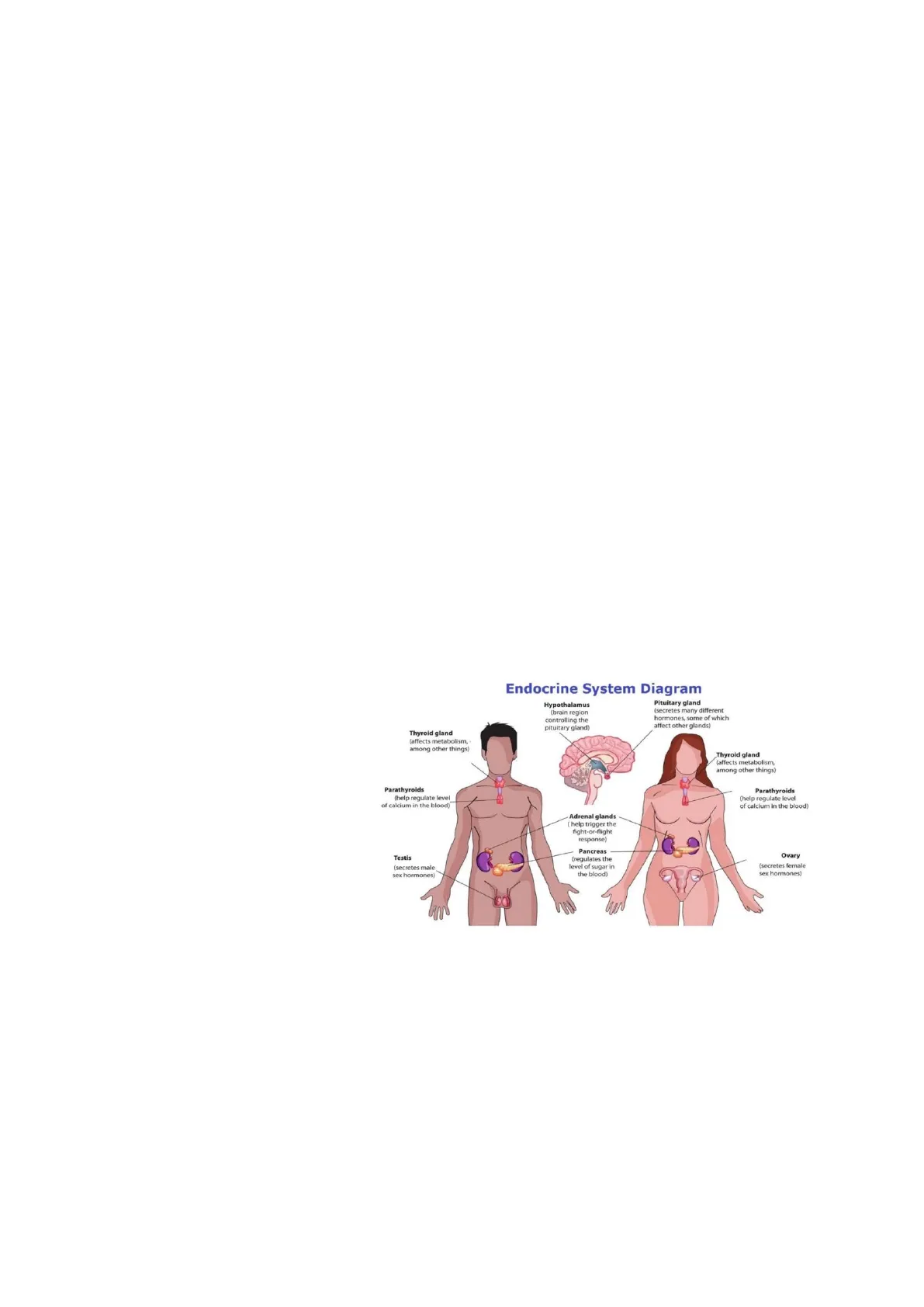
Endocrine System Diagram
Fig. 1 [Fig.1] These are the main glands included in the endocrine system: HYPOTHALAMUS is located inside the CNS. It is a particular brain region which is able to control the PITUITARY GLAND (placed next to the CNS); THYROID; PARATHYROID; ADRENAL GLANDS;
- PANCREAS (we won't discuss it, it will be explained in the metabolism module);
- GONADS: TESTIS and OVARIES Hypothalamus (brain region controlling the pituitary gland) Pituitary gland (secretes many different hormones, some of which affect other glands) Thyroid gland (affects metabolism, among other things) Thyroid gland (affects metabolism, among other things) Parathyroids (help regulate level of calcium in the blood) Parathyroids (help regulate level of calcium in the blood) Adrenal glands ( help trigger the fight-or-flight response) Testis (secretes male sex hormones) Pancreas (regulates the level of sugar in the blood) Ovary (secretes female sex hormones)
CHEMICAL CLASSIFICATION OF HORMONES
Hormones can be classified in classes according to their chemical features, which exert with the same modalities: (Professor said that she will never ask us this kind of classification, but it is important for us to remember which hormones exert which activity)
- Peptides or AAs derivatives
- Polypeptides (three to more than 200 amino acid residues) are hormones secreted by the pituitary gland -> PRL, ACTH, AVP, oxytocin
- the pancreas > insulin, glucagon
- the parathyroid glands -> PTH
- the thyroid -> calcitonin
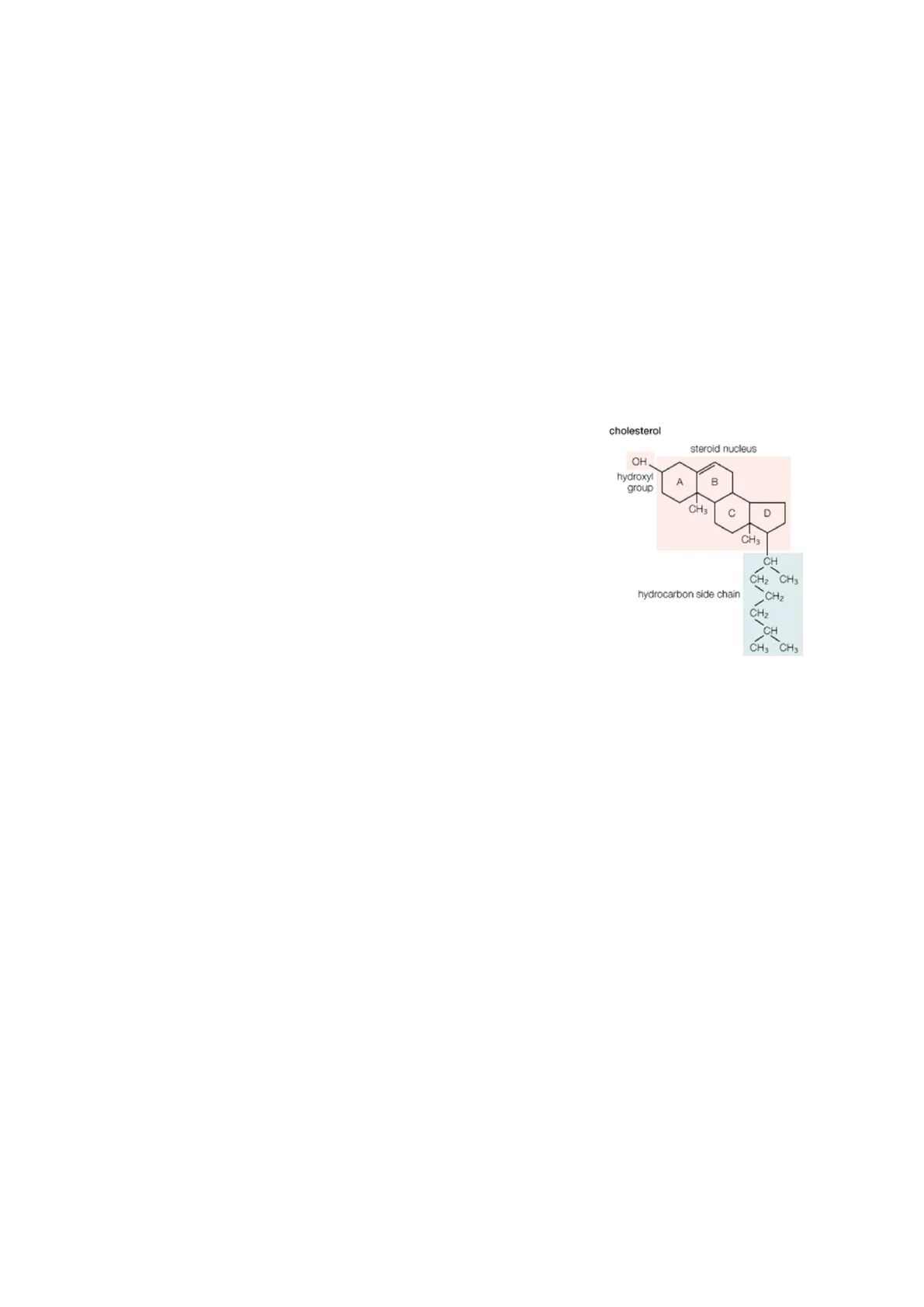
- the stomach -> ghrelin, which is important for neuromodulation Glycoprotein: the remaining hormones secreted by the pituitary gland > TSH, FSH, LH. Protein: hormones secreted by the pituitary gland -> GH. Dipeptides: Thyroid hormones derived from the combination of two iodinated tyrosine amino acid residues -> T3 and T4 Derivatives of single amino acids derive from the medullary part of the adrenal glands: Catecholamines derived from tyrosine > norepinephrine, epinephrine and dopamine. Steroids (derived from cholesterol) [Fig.2] (possible exam question: what is steroids' precursor) They can be grouped into two types according to their chemical structure: cholesterol steroid nucleus OH hydroxyl group A B CH3 C D CH3 CH CH2 CH3 hydrocarbon side chain CH2 / CH2 1 액 CH3 CH3 Fig.2
- those with an intact steroid nucleus (adrenal and gonadal steroids), divided into five groups based on the receptors they bind to: o glucocorticoids; o mineralocorticoids, o androgens; o estrogens; o progestogens Fig.3 Endocrine gland Associated hormones Chemical class Effect Pituitary (anterior) Growth hormone (GH) Protein Promotes growth of body tissues Pituitary (anterior) Prolactin (PRL) Peptide Promotes milk production
2. those in which the B ring of the steroid has been cleaved > vitamin D (considered an hormone because of function and structure) and its various metabolites, which are produced by the skin.
Pituitary (anterior) Thyroid-stimulating hormone (TSH) Glycoprotein Stimulates thyroid hormone release Pituitary (anterior) Adrenocorticotropic hormone (ACTH) Peptide cortex Stimulates hormone release by adrenal [Fig.3] here we have a repetition of what said before. Pituitary (anterior) Follicle-stimulating hormone (FSH) Glycoprotein Stimulates gamete production Pituitary (anterior) Luteinizing hormone (LH) Glycoprotein Stimulates androgen production by gonads It's important to remember that hormones are produced by endocrine cells or other tissues (stomach, skin, bowel .. ), and are in general stored (some in very large Pituitary (posterior) Antidiuretic hormone (ADH) Peptide Stimulates water reabsorption by kidneys Pituitary Peptide (posterior) Oxytocin childbirth Stimulates uterine contractions during amounts, ready to be released in response to specific stimuli) and then transported in the bloodstream in order to exert their effect on different distant tissues.
Hormones formation may occur either in the endocrine glands (which are localized collections of specific cells), or in cells that have additional roles.
Many protein hormones, such as growth hormone (GH), PTH, prolactin (PRL), insulin, and glucagon, are produced in dedicated cells by standard protein synthetic mechanisms (common to all cells).
These secretory cells contain specialized secretory granules designed to store large amounts of hormones and to release them in response to specific signals (that are common to all these hormones).
The initial product is often a large molecule that is progressively shortened in distinct steps (e.g. POMC - proopiomelanocortin to ACTH).
Steroid hormones and amines are synthesized from smaller precursor molecules, usually in specific glands such as the adrenals, gonads, or thyroid.
In the case of the steroid hormones, the precursor is cholesterol (that we get from the diet), which is modified to form the glucocorticoids, androgens, estrogens (produced by adipose tissue or conversion of androgens), and their biologically active derivatives.
In patients with very low cholesterol sometimes the synthesis of these hormones is reduced. We can face it in some diseases, with particular diets or the intake of particular drugs.
OTHER ORGANS CAN PRODUCE HORMONES
Not all hormones are formed in dedicated and specialized endocrine glands: the adipose tissue, enteroendocrine system, and others are now also recognized to be complex endocrine systems.
Thus, with the discovery of novel peptides and amino acid or steroid-based molecules and their regulatory functions, the field of endocrinology and metabolism has recently been greatly expanded.
In [Fig.4] there is an endocrine cell that produces and secretes hormones in the bloodstream. Hormone Secretory cell (endocrine cell) The rate of hormone release from an endocrine organ is limited ultimately by the rate of its synthesis. Most trophic hormones and regulatory factors act by controlling the rate of hormone synthesis. There are both stimulatory factors and inhibitory factors. In most instances only limited quantities of hormones are stored within the body. Continuous synthesis and turnover of hormones is the usual state. Blood vessel Non-target cell (no receptors) Receptor Target cell Fig.4
RECEPTOR PROTEINS
Fig.5 Capillary Water-soluble hormone Extracellular fluid Cell membrane receptor Water-soluble hormones are membrane insoluble. They bind to membrane receptors. G protein (activated) 2The binding activates a G protein. -Adenylyl cyclase ATP 3 The activated G protein activates adenylyl cyclase. Nucleus CAMP Cytoplasm DNA Protein kinase 4 Adenylyl cyclase catalyzes the conversion of ATP to CAMP, the secondary messenger in this pathway. ATP Activated- protein kinase 5 cAMP activates protein kinases. The tissue can respond to the hormone only if there is the receptor. The receptor can be either proteic or not. Receptor proteins may be localized on the cell membrane, in the cytoplasm, or in the nucleus. Polypeptide hormone receptors are cell membrane associated; steroid hormones selectively bind soluble intracellular proteins. e.g. Protein hormones [Fig.5] and some small molecules, such as catecholamines, are water soluble and rapidly transported via the the circulatory system without any specific transport mechanism.
Lipid-soluble · hormone Capillary Extracellular fluid 1 Lipid-soluble hormone diffuses through plasma membrane Cytoplasm Fig.6 2 Hormone binds with receptor in cytoplasm, forming a receptor-hormone complex Receptor-hormone complex Nucleus -DNA Transcription -mRNA 3 Receptor-hormone complex enters the nucleus and triggers gene transcription - Translation 4 Transcribed mRNA is translated into proteins that alter cell activity Activated protein even there is a normal hormone production. They cannot diffuse through the cell membrane. They must bind to a surface cell-membrane receptor. e.g. Others [Fig.6] are nearly insoluble in water (e.g., steroid and thyroid hormones), they are lipid-soluble hormones and require specific carrier mechanisms (transport protein). As unbound hormones diffuse through the cell membrane and bind to a receptor in cytoplasm. Hence, protein hormones can't directly cross the membrane (because they are water soluble) while, steroid hormones (liposoluble) can. To overcome this, protein hormones need to bind with the receptor. The lack of transport proteins can be a cause of disease The time of action in fact is different. Steroid hormones directly affect the nucleus and directly induce the synthesis of proteins. So they have a short mechanism of action. Protein hormones' action takes more time.
FEEDBACK MECHANISMS
[Fig. 7] Feedback relationship regulates the action of an hormone. Most hormones are regulated by feedback mechanisms.
Most hormone feedback mechanisms involve negative feedback loops: . A negative feedback keeps the concentration of a hormone within a narrow range. the hormone is able to inhibit the stimulus that induces its secretion. . A positive feedback reinforces the stimulus and increases the hormone secretion. It is generally limited to the female gonads 1) Negative feedback: the response counteracts the stimulus shutting off the response loop. Response loop shuts off :- Initial stimulus Response + Stimulus (b) Positive feedback: the response reinforces the stimulus sending the parameter farther from the setpoint. Fig.7 Initial stimulus Response Feedback cycle An outside factor is required to shut off | feedback cycle. + + Stimulus
Can’t find what you’re looking for?
Explore more topics in the Algor library or create your own materials with AI.
