English Phonetics and Phonology: Speech Production and Perception
Slides from Universidad De Murcia about English Phonetics and Phonology. The Pdf explores speech production, transmission, and perception, including phonation and glottal states. This University level material, suitable for Languages, covers various voice qualities and is structured in units and lectures, making it ideal for autonomous study.
See more22 Pages


Unlock the full PDF for free
Sign up to get full access to the document and start transforming it with AI.
Preview
English Phonetics and Phonology Overview
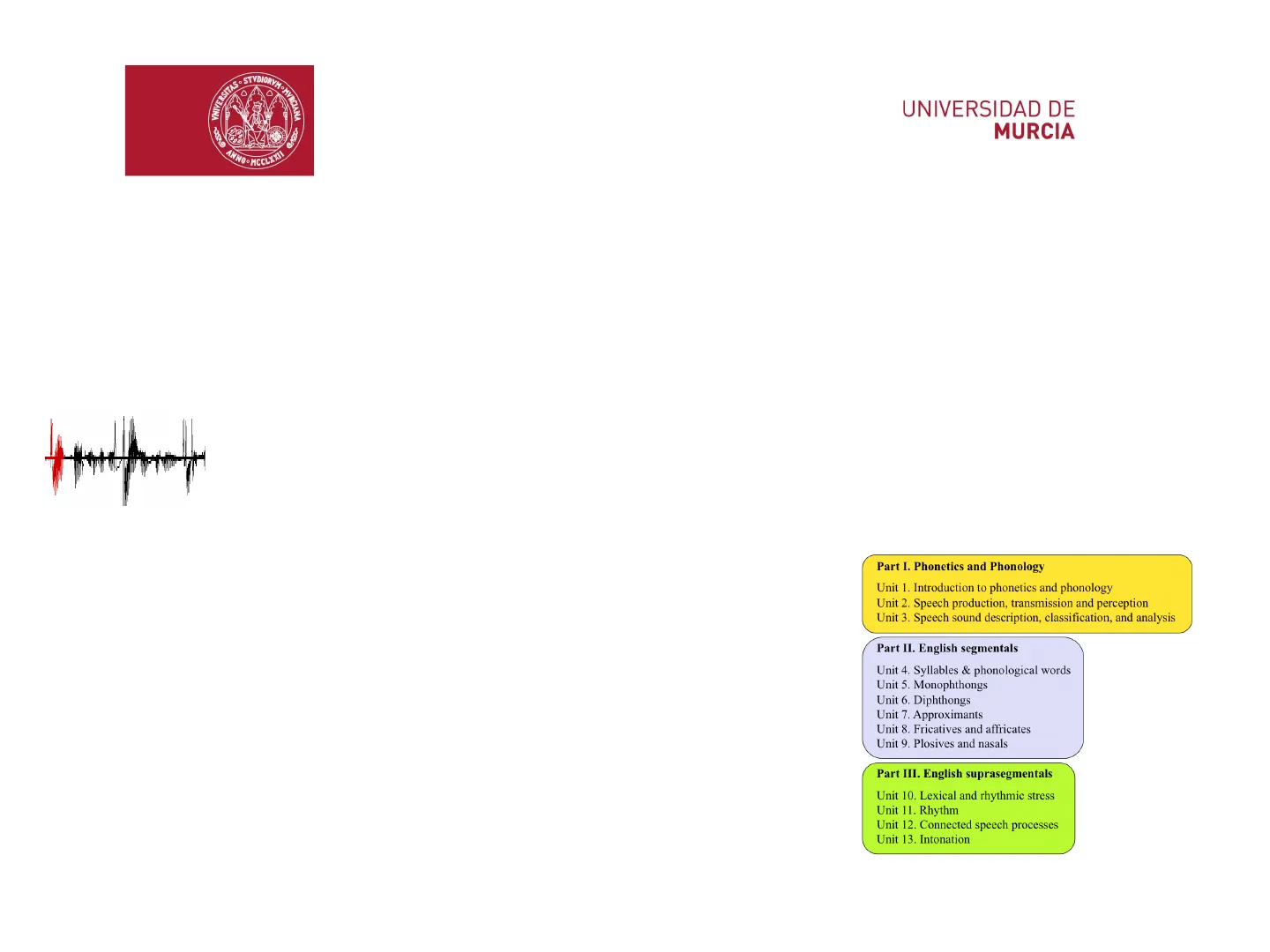
Part I. Phonetics and Phonology
- Unit 1. Introduction to phonetics and phonology
- Unit 2. Speech production, transmission and perception
- Unit 3. Speech sound description, classification, and analysis
Part II. English Segmentals
- Unit 4. Syllables & phonological words
- Unit 5. Monophthongs
- Unit 6. Diphthongs
- Unit 7. Approximants
- Unit 8. Fricatives and affricates
- Unit 9. Plosives and nasals
Part III. English Suprasegmentals
- Unit 10. Lexical and rhythmic stress
- Unit 11. Rhythm
- Unit 12. Connected speech processes
- Unit 13. Intonation
Unit 2 Overview
Speech production (lectures 1, 2) Speech transmission and perception (lectures 3, 4)
Lectures 1 & 2 Overview
- Mechanisms of speech production
- Subglottal system and initiation
- Laryngeal system and phonation
- 1. Laryngeal structures
- 2. Aerodynamic theory of phonation
- 3. States of the glottis
- Supraglottal system and articulation
- 1. Cavities
- 2. Articulators
- Summary
Supraglottal system ARTICULATION PHONATION Larynx INITIATION Subglottal system
Vocal Folds Function
How do the vocal folds work?
Aerodynamic Theory of Phonation
The vocal folds are essential for phonation (or 'voicing'), the process by which the VFs produce certain sounds through quasi-periodic vibration. The aerodynamic theory of phonation explains this. According to this theory, in order to produce speech, the following set of steps take place:
i. The VFs close due to their natural elastic qualities. ii. Bottom part ('lower lip') gets together first
Aerodynamic Theory Steps
iii. The VFs are parted by subglottal air pressure. iv. The Bernoulli effect is then produced (reduction in pressure in a constricted fluid flow) v. Air coming from lungs rushes though VFs. vi. Once completely closed, the cycle repeats many times per sec. hundreds of times per sec, producing what we hear as voice.
m2 m m1 1
Demonstration of Aerodynamic Theory
- Y Hold two pieces of thin paper vertically a short distance apart and blow down into the space between them.
Vocal Fold Cycle Diagram
one cycle another cycle Upper Lip Upper Lip Lower Lip Lower Lip Vocal tract air column P k m Vocal fold P UCLA Hea
Vocal Fold Vibration Rate
Although the vocal fold cycle is the same for all human beings ... .... do all speakers' vocal folds vibrate at the same rate? ? wooclap
Typical Phonation Rates
Males' normal phonation typically involves 110 cycles per second = lower pitch. Females' normal phonation typically involves 180 to 220 cycles per second = medium pitch. Children's normal phonation typically involves 300 cycles per second = very high pitch
States of the Glottis
The states of the glottis and action of the VFs can be complex. To start with, we distinguish between phonation and lack of it. There are also different phonation types.
Phonation Types
Phonation types (or 'voice quality' types) Lack of phonation a) Normal/modal voice b) Breathy voice c) Creaky voice d) Falsetto voice a) Open glottis b) Whisper c) Closed glottis (glottal stop)
Voice Quality Types
Phonation types ('voice quality') Normal/modal voice a) Normal/modal voice b) Breathy voice (e.g. English [h] in ahead) Breathy voice c) Creaky voice (e.g. word-final /t/ in colloquial what) d) Falsetto voice (in singing) Creaky voice Thyroid Cartilage Vocal Folds Cricoid Cartilage Arytenoid Cartilage Glottis
Lack of Phonation
Lack of phonation [ffff ssss] Open glottis (voicelessness) a) Open glottis (voiceless, breathing) b) Whisper WHISPER 1 - whisper c) Closed glottis (e.g. glottal stops as in uh-uh! [A?A?]) Thyroid Cartilage Vocal Folds Cricoid Cartilage Arytenoid Cartilage Glottis - Closed glottis (glottal stop)
Breathy Voice vs. Whisper
What's the difference between breathy voice and whisper? (read at home) THINK! Breathy voice whisper In breathy voice (also known as 'whispery voice'), the vocal folds vibrate as they do in normal (modal) voicing, but separated along a portion at the arytenoids to allow the passage of large volumes of air. This produces a sighing-like sound. In whisper there is no voice at all. The vocal folds are abducted so that they don't vibrate. Air passes between the arytenoids to create audible turbulence during speech.
Supraglottal System
The vocal tract contains three chambers or cavities. a) the pharynx b) the nasal cavity c) the oral cavity (or mouth cavity) ALVEOLAR RIDGE NASAL CAVITY HARD PALATE LIP SOFT PALATE TEETH- LIP UVULA PHARYNX TONGUE Tip EPIGLOTTIS LARYNX Blade OESOPHAGUS Front Back VOCAL FOLDS - TRACHEA
Cavities of the Supraglottal System
The Pharynx
a) The pharynx o Area above the larynx, below the uvula. o Various areas: oropharynx, nasopharynx and laryngopharynx. o Parts: lower and upper pharyngeal walls; velopharyngeal port, epiglottis.
The Nasal Cavity
b) The nasal cavity Velic closure (oral) Velic opening (nasal, nasalised) velic closure vs. velic opening
The Oral Cavity
c) The oral cavity Uvula Velum (soft palate) Hard palate Alveolar ridge Teeth (upper & lower) Lips (upper & lower) Tongue with ... Upper Teeth Alveolar Hard ridge palate Velum/ soft palate Upper lip Lower lip Tongue Uvula Lower Teeth Blade Front Tip Back -Root Tongue tip/apex, blade, front, back, root
Articulators
Articulators: structures/parts of the vocal tract that interact to create specific sounds.
Active Articulators
Active articulators o Lower lip THINK! o Tongue and its parts o Epiglottis
Passive Articulators
Passive articulators o Upper lip THINK! O Teeth Alveolar ridge Hard palate Velum (soft palate) o Uvula THINK! o Pharyngeal wall
Articulators Diagram
uvula Alveolar Hard ridge palate velum teeth lips Tongue teeth uvula Alveolar Hard ridge palate velum teeth lips front back teeth tip bla de Tongue
Summary of Speech Production
Subglottal System
Subglottal system - diaphragm, lungs, trachea
Larynx Structures and Function
Laryx Structures - Unpaired cartilages (thyroid, cricoid, epiglottis) - Paired cartilages (arytenoid, cuneiform, corniculate) - Muscles (extrinsic, intrinsic) - Connective tissue (true/false vocal folds) Aerodynamic theory of vocal fold action States of the glottis: - No Voicing: whisper, voicelessness, closed glottis - Voicing: modal/normal, breathy, creaky, falsetto
Supraglottal System and Airstream
Supraglottal system - Pharynx - Nasal cavity: velic closure vs. velic opening - Oral cavity: articulators (passive & active) Direction of the airstream Initiation Pulmonic Glottalic Pulmonic Velaric ingressive Implosive Clicks egressive No name Ejective --
References
- Abercrombie, D. 1967. Elements of General Phonetics. Edinburgh: Edinburgh University Press. Chapter 2 & 4.
- Catford, J. C. 1988. A Practical Introduction to Phonetics. Oxford: OUP.
- Clark, J., & Yallop, C. 1995. An Introduction to Phonetics and Phonology. Oxford: Basil Blackwell.
- Ladefoged, P. 2001. A Course in Phonetics. Fort Worth, TX: Hartcourt Brace Jovanovich. 4th ed.
- Roach, P. 2001. Phonetics. Oxford: OUP.
- Rogers, H. 2000. The Sounds of Language: An Introduction to Phonetics. Harlow, UK: Pearson Education.
Can’t find what you’re looking for?
Explore more topics in the Algor library or create your own materials with AI.
