Learning: Non-associative Learning, Habituation and Sensitization by Universidad Europea
Slides from Universidad Europea about Learning: Unit 2. Non-associative Learning. Habituation and Sensitization. The Pdf explores non-associative learning, focusing on habituation and sensitization, presenting characteristics and the dual-process theory by Groves & Thompson, with graphic and experimental examples for University Psychology students.
See more22 Pages


Unlock the full PDF for free
Sign up to get full access to the document and start transforming it with AI.
Preview
Non-Associative Learning Overview
LEARNING: Unit 2. NON-ASSOCIATIVE LEARNING. HABITUATION AND SENSITIZATION Memory and Learning Processes ue 2024/2025 David Prada CrespoNON-ASSOCIATIVE LEARNING
-
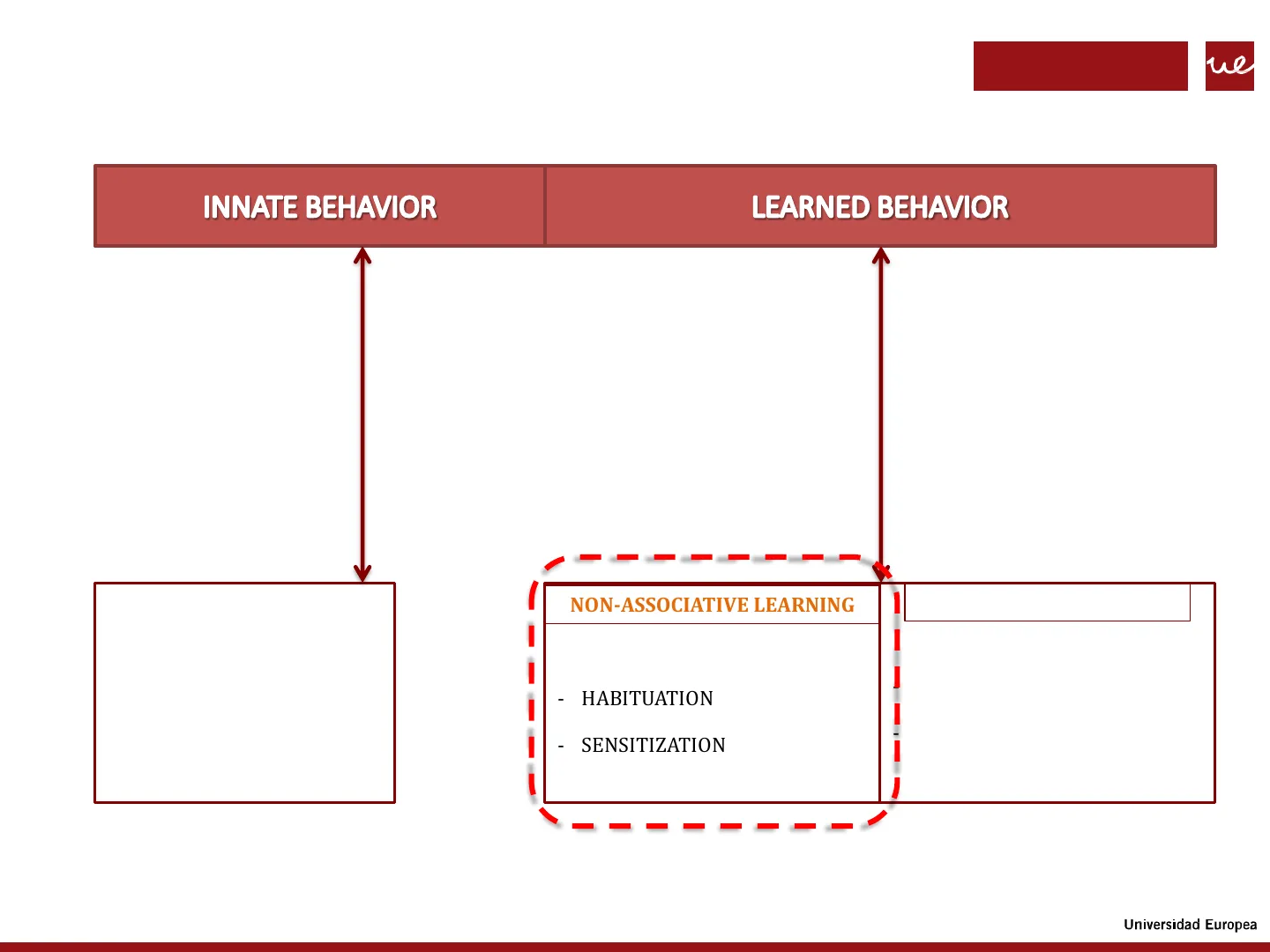
INNATE BEHAVIOR LEARNED BEHAVIOR Automatic and involuntary. Shared by members within the same species. - REFLEX - MODAL ACTION PATTERNS - IMPRINTING Related to individual's experiences. Acquisition by learning.
NON-ASSOCIATIVE LEARNING ASSOCIATIVE LEARNING CLASSICAL CONDITIONING
- HABITUATION
- SENSITIZATION INSTRUMENTAL CONDITIONING Universidad EuropeaNON-ASSOCIATIVE LEARNING
-
INNATE BEHAVIOR LEARNED BEHAVIOR Automatic and involuntary. Shared by members within Related to individual's experiences. Acquisition by learning.
- Simplest form of learning.
-
Implies the presentation of one stimulus, more or less isolated, repeated times.
- After the stimulus repetition, behavior changes (learning happens). NON-ASSOCIATIVE LEARNING
- HABITUATION
-
SENSITIZATION ASSOCIATIVE LEARNING CLASSICAL CONDITIONING INSTRUMENTAL CONDITIONING Universidad Europea
Habituation
Habituation https://www.youtube.com/watch?v=Kfu0FAAu-10 Universidad EuropeaHABITUATION ue Habituation: The decline in response that occurs after the repeated stimulus presentation. HABITUATION - BY LUKEPIERCE14 WWW.TOONDOO.COM
n Machines scare me! These things are starting to grow on me I am - no longer bothered by machines. Universidad EuropeaHABITUATION ue Habituation: The decline in response that occurs after the repeated stimulus presentation. Habituation is a conserved behavioral process that has come about because of a phylogenetic history. Those animals that habituated were more likely to survive and produce offspring-passing on their genes to the next generation. An herbivore that runs away each time the grass rustles gets less to eat than one that stands its ground. A rustling sound of grass may indicate the presence of a predator, or simply the wind blowing. Repeated, unnecessary activation of respondent mechanisms also causes stress to the animal, which is not good in terms of health and physiology. Animals that were better habituated to certain stimuli were better able to survive. Universidad EuropeaHABITUATION ue Habituation: The decline in response that occurs after the repeated stimulus presentation. 5.0 4.5 4.0 3.5 3.0 60 Salivation 2.5 2.0 1.5 1.0 0.5 0.0 2 4 6 8 10 Salivation in response to a taste stimulus (lemon) > The hedonic value decreased as well. Epstein et al., 1992 Universidad EuropeaHABITUATION ue Characteristics:
- Selects information: ignores irrelevant information (e.g .: we can read and ignore repeated noises)
- Stimulus specific: the decrease in responding is specific to the habituated stimulus.
- Habituation can be easily reversed by changing the stimulus (e.g .: if the noise changes, we pay attention to it) 5.0 4.5 4.0 3.5 3.0 Salivation (g) 2.5 1 2.0 1.5 1.0 0.5 0.0 2 4 6 8 10 Salivation in response to a taste stimulus lemon (10 first trials) and lime (11th trial) Epstein et al., 1992 Universidad EuropeaHABITUATION ue Characteristics:
- Spontaneous recovery: After habituation, if the stimulus is not presented for a period of time, the response will recover when the stimulus is presented again.
- Re-learning: further habituation processes will be faster. 45 Startle response intensity 40 35 Rest for several hours 30 25 20 15 10 5 0 Trial 1 Trial 2 Trial 3 Trial 4 Trial 4 45 40 Spontaneous recovery 35 30 25 20 15 1 10 5 0 Trial 1 Trial 2 Trial 3 Trial 4 Fast habituation process Universidad EuropeaHABITUATION ue Dimensions influencing habituation: Intensity: The more the intense of the stimulus -> the slower the habituation process to that stimulus (e.g .: It is easier to habituate to a quiet noise than to a loud noise). Frequency: Higher frequency of presentation of the stimulus faster habituation process. Complexity: The habituation process is faster when the stimulus involved is a simple one than when responding to complex stimulus. Universidad Europeaue HABITUATION Habituation in phobias: https://www.youtube.com/watch?v=lMZ5o2uruXY Universidad EuropeaHABITUATION Processes different from habituation: Sensory adaptation
- Sensory receptors change their sensitivity to the stimulus.
- Sensory receptors become exposed to stimuli for a prolonged period > they lose their ability to respond and develop a diminished sensitivity to the stimulus.
- Sensory adaptation occurs with all of our senses. e.g: our hands adjust to cold or hot water. Universidad Europeaue HABITUATION Processes different from habituation: Motor fatigue
- Occurs if the muscles involved become incapacitated by fatigue.
- Our muscles are not longer able to response to the stimulus due to fatigue, It is not a matter of habituation.
- Motor fatigue occurs at our muscles level. e.g .: a muscle response to repeated electric shocks finally will end because the muscle is exhausted. Universidad EuropeaHABITUATION ue Processes different from habituation: Habituation occurs within the Central Nervous System, while motor fatigue and sensory adaptation occur outside the CNS. Sensory neuron Sense organ Site of sensory adaptation Central nervous system Motor neuron Muscle Site of response fatigue Site of habituation and sensitization Universidad Europea
Sensitization
Sensitization Universidad EuropeaSENSITIZATION ue SENSITIZATION: progressive amplification of a response after repeated administrations of a stimulus. Key-ideas: It is not very adaptative to habituate to some stimuli (boiling oil, electric shocks, ... ). Thus, many times dangerous stimuli lead to sensitization responses. Sensitization usually occurs when our arousal level is high (e.g .: someone taps your shoulder when seating in a classroom vs. someone taps your shoulder in a dark alley at 4:00 a.m) Also, sensitization process is generalized to similar stimulus (it is adaptative). Is not as stimulus-specific as habituation. Sensitization does not usually have long lasting effects. Universidad EuropeaSENSITIZATION ue SENSITIZATION: progressive amplification of a response after repeated administrations of a stimulus. Dimensions influencing sensitization:
- Frequency: High frequency less sensitization effect.
- Intensity: The more the intense of the stimulus > more intensity in the sensitization response (e.g., the sensitization process is stronger to strong electric shocks than to weak electric shocks).
- Duration: The longer the stimulus lasts the stronger the sensitization. Universidad Europeaue HABITUATION 1. Helps us to ignore irrelevant stimuli. 2. Stimulus specific. 3. Habituation is faster when: - Less intensity, duration and complexity of the stimulus. - More frequency of the stimulus. SENSITIZATION 1. Increases our response to relevant (especially dangerous) stimuli. 2. Generalizes to similar stimuli. 3. Sensitization is stronger when: - More intensity and duration of the stimulus. - Less frequency of presentation of the stimulus. Non-associative learning: Habituation and sensitization involve learning about just one stimulus. https://www.youtube.com/watch?v=GDBrG-xyg2A Universidad Europea
Dual-Process Theory
Dual-process theory (Groves & Thompson, 1970) ue The habituation and sensitization processes are not mutually exclusive. In fact, often both are activated at the same time. The observable behavior will be the sum of these two processes.
+ + Sensitization Sensitization Net Effect = Sensitization 0 0 - Net Effect = Habituation Habituation Habituation Universidad EuropeaDual-process theory ue (Groves & Thompson, 1970)
+ + Sensitization Sensitization Net Effect = Sensitization 0 0 Net Effect = Habituation Habituation Habituation Ruido de fondo 60 dB Ruido de fondo 80 dB 40 30 Respuesta de sobresalto T 20 . 10 T 2 4 6 8 10 2 4 6 8 10 (Davis, 1974) Bloques de 10 tonos Rat 2 repeatedly heard a tone. In addition, there was a loud background sound (80 decibels). Universidad Europea Rat 1 repeatedly heard a tone. In addition, there was a weak background sound (60 decibels).ue Think of 1 example of habituation, sensitization, sensory adaptation and motor fatigue in your everyday life. Universidad Europea
Key Ideas Summary
ue KEY IDEAS
- Non-associative learning implies the repeated presence of one stimulus. There is no learning of association between two stimuli.
- Habituation > the decrease of response over time when a stimulus is presented repeatedly. Takes place within the CNS.
- Sensory adaptation > receptors' sensitivity to stimulus decreases. Takes place at the senses level.
- Motor fatigue > muscles are not longer able to respond to the stimulus. Takes place at the muscles level.
- Sensitization > Increase of response when a stimulus is repeatedly presented.
- Dual process theory states that both processes can occur simultaneously and the observable response will reflect the sum of both of them. Universidad Europea
Can’t find what you’re looking for?
Explore more topics in the Algor library or create your own materials with AI.
