Microbiota intestinale e malattie cardiovascolari: prospettiva traslazionale
Slide dalla Sapienza Università di Roma su microbiota intestinale e malattie cardiovascolari: prospettiva traslazionale. Il Pdf esplora il ruolo del microbiota intestinale e della disbiosi nello sviluppo delle malattie cardiovascolari, con schemi dettagliati sui percorsi metabolici e meccanismi di segnalazione cellulare, utile per Biologia a livello universitario.
Mostra di più16 pagine

Visualizza gratis il Pdf completo
Registrati per accedere all’intero documento e trasformarlo con l’AI.
Anteprima
GUT MICROBIOTA AND CARDIOVASCULAR DISEASE: TRANSLATIONAL PERSPECTIVE
(Flora batterica intestinale e patologie cardiovascolari: prospettiva traslazionale)
Gut microbiota -> La flora batterica del nostro intestino.
Il nostro intestino contiene tante specie di batteri, che devono essere in perfetto equilibrio, altrimenti si genera la disbiosi. La disbiosi può portare alla rottura delle maglie intestinali (tight junctions). Gli enterociti infatti sono fortemente legati tra loro dalle tight junctions e se queste si rompono si ha l'aumento della permeabilità intestinale: batteri e derivati vanno così in circolo, e possono causare danni.
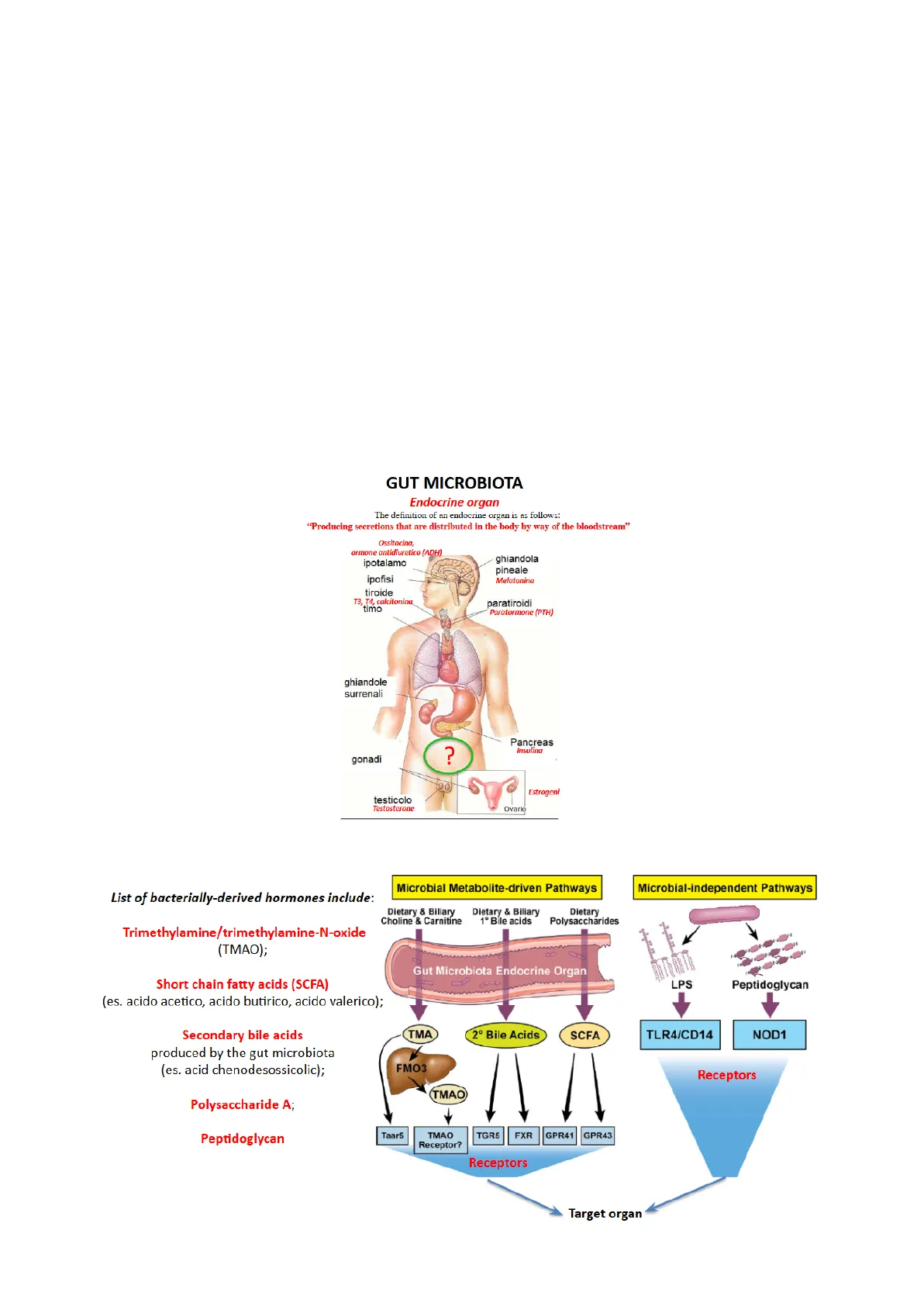
L'intestino viene considerato a tutti gli effetti un apparato endocrino, perché rilascia dei prodotti che vanno in circolo. I prodotti principali sono:
- TMAO -> trimetilammina
- SCFA -> corte catene di acidi grassi
- POLISACCARIDI -> pezzi polisaccaridici della parete batterica, che durante il metabolismo batterico si distaccano. Se le maglie intestinali sono rotte, questi polisaccaridi possono traslocare ed andare in circolo. Tra questi, quello che crea più danno è l'LPS: il lipopolisaccaride di E. Coli.
GUT MICROBIOTA Endocrine organ
The definition of an endocrine organ is as follows:
"Producing secretions that are distributed in the body by way of the bloodstream"
Ossitocina, ormone antidiuretico (ADH) ipotalamo ghiandola pineale Melatonina ipofisi tiroide T3, T4, calcitonina timo paratiroidi Paratormone (PTH) ghiandole surrenali Pancreas Insulina ? gonadi Estrogeni testicolo Testosterone Ovario
Microbial Metabolite-driven Pathways
Microbial-independent Pathways
Dietary & Biliary Choline & Carnitine Dietary & Biliary 1° Bile acids Dietary Polysaccharides 8 Gut Microbiota Endocrine Organ
- 0000 LPS Peptidoglycan TMA 2° Bile Acids SCFA TLR4/CD14 NOD1 FMO3 Receptors TMAO Taar5 TMAO Receptor? TGR5 FXR GPR41 GPR43 Receptors Target organ
List of bacterially-derived hormones include:
- Trimethylamine/trimethylamine-N-oxide (TMAO);
- Short chain fatty acids (SCFA) (es. acido acetico, acido butirico, acido valerico);
- Secondary bile acids produced by the gut microbiota (es. acid chenodesossicolic);
- Polysaccharide A;
- PeptidoglycanPer stare in forma e in salute, per avere l'equilibrio, occorre seguire uno stile di vita corretto, non prendere troppi antibiotici ... Però è difficile mantenere questo equilibrio della flora batterica, che è influenzato normalmente da fattori come dieta ed età.
Hall et al, Nature Rev Gen 2017
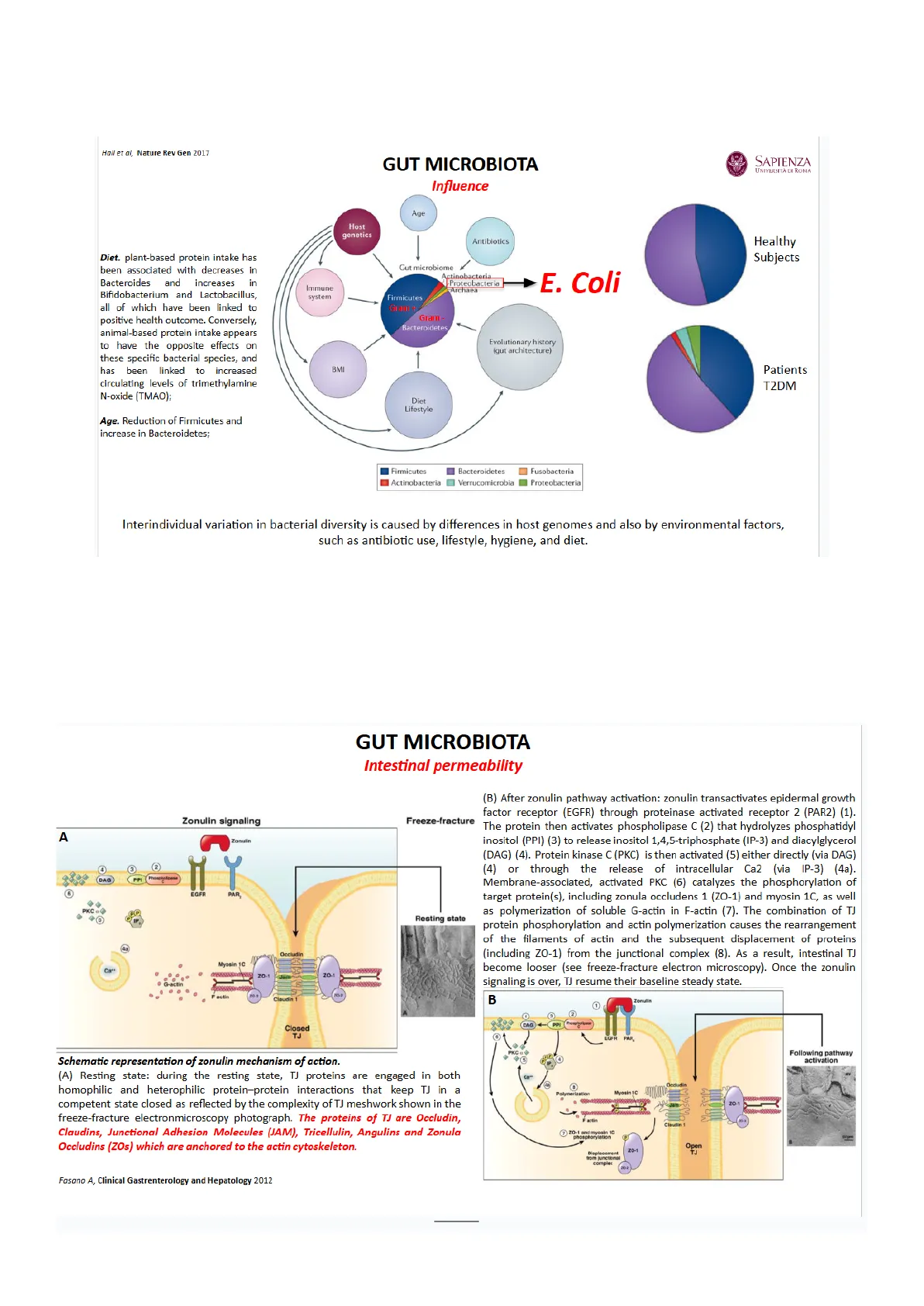
GUT MICROBIOTA Influence
SAPIENZA UNIVERSITÀ DI ROMA
Age Host genetics Antibiotics Healthy Subjects Gut microbiome Actinobacteria Proteobacteria Archaea E. Coli Immune system Firmicutes Gram + Gram - Bacteroidetes Evolutionary history (gut architecture) BMI Patients T2DM Die Lifestyle Firmicutes Bacteroidetes Verrucomicrobia Fusobacteria Actinobacteria Proteobacteria
Interindividual variation in bacterial diversity is caused by differences in host genomes and also by environmental factors, such as antibiotic use, lifestyle, hygiene, and diet.
Oggi si parla dell'effetto della disbiosi, della distruzione delle maglie intestinali, e in particolar modo dell'aumento della zonulina. Quando si è in disbiosi, la proteina intestinale zonulina viene rilasciata dagli enterociti e si lega a dei recettori di membrana degli enterociti, inducendo una sorta di risposta infiammatoria che porta alla rottura fisica delle tight junctions e proteine di giunzione degli enterociti.
A causa della disbiosi, I'LPS va in circolo e può causare diversi danni.
GUT MICROBIOTA Intestinal permeability
Zonulin signaling
Freeze-fracture A Zonulin 2 JAG PP Phospholipas EGER PAR PKC . Resting state Occludin Myosin 1C Ca ** 20-1 G-actin Factin Claudin 1 B Zonun DAG PPI C EGFR PAR, PKC . Following pathway activation 1 Oceludin Polymerization Myosin 1C MMEM 20-1 Factin Claudin 1 7 20-1 and mycsin 10 phosphorylation Open ZO-1 Displacement nent from junctiona complex Fasano A, Clinical Gastrenterologiand Hepatology 2012
(B) After zonulin pathway activation: zonulin transactivates epidermal growth factor receptor (EGFR) through proteinase activated receptor 2 (PAR2) (1). The protein then activates phospholipase C (2) that hydrolyzes phosphatidyl inositol (PPI) (3) to release inositol 1,4,5-triphosphate (IP-3) and diacylglycerol (DAG) (4). Protein kinase C (PKC) is then activated (5) either directly (via DAG) (4) or through the release of intracellular Ca2 (via IP-3) (4a). Membrane-associated, activated PKC (6) catalyzes the phosphorylation of target protein(s), including zonula occludens 1 (ZO-1) and myosin 1C, as well as polymerization of soluble G-actin in F-actin (7). The combination of TJ protein phosphorylation and actin polymerization causes the rearrangement of the filaments of actin and the subsequent displacement of proteins (including ZO-1) from the junctional complex (8). As a result, intestinal TJ become looser (see freeze-fracture electron microscopy). Once the zonulin signaling is over, TJ resume their baseline steady state.
Closed TJ Schematic representation of zonulin mechanism of action. (A) Resting state: during the resting state, TJ proteins are engaged in both homophilic and heterophilic protein-protein interactions that keep TJ in a competent state closed as reflected by the complexity of TJ meshwork shown in the freeze-fracture electronmicroscopy photograph. The proteins of TJ are Occludin, Claudins, Junctional Adhesion Molecules (JAM), Tricellulin, Angulins and Zonula Occludens (ZOs) which are anchored to the actin cytoskeleton.
Diet. plant-based protein intake has been associated with decreases in Bacteroides and increases in Bifidobacterium and Lactobacillus, all of which have been linked to positive health outcome. Conversely, animal-based protein intake appears to have the opposite effects on these specific bacterial species, and has been linked to increased circulating levels of trimethylamine N-oxide (TMAO); Age. Reduction of Firmicutes and increase in Bacteroidetes;
Table 1. List of CIDs in which zonulin has been implicated.
Disease Category Disease Model Disease Association References
Autoimmune Celiac Disease Human Specific role in pathogenesis 3,11,103,106-108
Inflammatory Bowel Disease/Colitis Mouse Possible role in pathogenesis 12,114
Metabolic Disorders Obesity/Insulin resistance Human Upregulated 121,122
Type-2-Diabetes Human Upregulated 125,126
Lung Disease Acute Lung Injury Mouse Possible role in pathogenesis Possible role in pathogenesis 12
Neurological Disease Glioma Human, Cell culture Upregulated 134,135
Systemic Infectious Diseases Septicemia Human Upregulated 137,138
HIV Human Downregulated 142,143
Intestinal Diseases Irritable Bowel Syndrome Human Upregulated 149
Non-Celiac gluten sensitivity Human Upregulated Environmental Enteropathy Human Associated 150
Necrotizing Enterocolitis Rat, Cell Culture Upregulated 153
CARDIOVASCULAR DISEASE?
L'aumentata permeabilità intestinale è importante in molte patologie, prevalentemente intestinali e di natura autoimmune.
Il prof. e colleghi si sono chiesti se l'aumentata permeabilità intestinale fosse associata a un aumento di disturbi cardiovascolari di natura aterosclerotica. Se un soggetto ha aumentata permeabilità intestinale, va incontro a uno sviluppo o progressione più accelerati dell'aterosclerosi?
GUT MICROBIOTA
CARDIOVASCULAR DISEASES (atherosclerosis)
CIRCULATING LPS (E. Coli)
DOMANDA 1: Correlazione tra LPS e attivazione piastrinica nella patologia cardiovascolare
Pazienti con rischio cardiovascolare: misurarne le LPS e marcatori della permeabilità intestinale (zonulina) e vedere se i livelli sono più alti rispetto ai soggetti sani.
Pazienti con CAP (polmonite acquisita in comunità): non sono pz prevalentemente a rischio cardiovascolare.
Pazienti con AF (fibrillazione atriale): sono pz a rischio cardiovascolare (ischemia, ictus ... )
2,12,34,35,57,78,85,86,88,90-92
Type-1-Diabetes Human, Rat Possible role in pathogenesis 9
Multiple sclerosis / EAE Human, Mouse Possible role in pathogenesis 119-121
Polycystic ovary syndrome Human Upregulated 129
Asthma Human 144Comm -acc pneu
Alla ibriJ'ation
Rischio cardiovascolare di pazienti con CAP al pronto soccorso dell'Umberto I
- il 48 % di questi pz non avevano le troponine mosse; non erano a rischio cardiovascolare.
- il 41 % di questi pz avevano troponine mosse ma non erano a rischio immediato/elevato. Tuttavia alcuni di questi pz, dopo due mesi di follow up, avevano un infarto.
- l'11 % di questi pz avevano troponina altissima; erano ad alto rischio cardiovascolare. Questi pz avevano zonulina e LPS più alti rispetto agli altri due gruppi di pz. L'aumento di zonulina correlava con l'aumento di LPS; l'aumento di LPS correlava con l'aumento di troponina.
Le piastrine erano inoltre più attivate, e l'LPS correlava anche con l'attivazione piastrinica.
COMMUNITY-ACQUIRED PNEUMONIA (CAP)
PNEUMONIA AND MI
1. 11% MI 48% hs-cTnT≤0.014 µg/L 41% hs-cTnT>0.014 µg/L
Table 1 Clinical characteristics of CAP patients.
2. CAP patients Controls p N= 278 50 Age (years)" 70 + 16 71 + 6 0.555 BMI (kg/m2)ª 26.4 ± 4.1 25.6 ± 3.7 0.404 Sex (males) 62% 54% 0.346 Ejection fraction (%)ª 56.3 ± 6.3 54.2 ± 5.4 0.423 Preexisting comorbid conditions · CHD 36% 42% 0.429 · Previous stroke 12% 10% 0.814 · T2DM 243 32% 0.288 . Hypertension 69% 86% 0.163 · COPD 36% 40% 0.633 · PAP 13% 16% 0.508 · CAF 16% 149 0.835 . Peripheral artery disease 6% 8% 0.541 · Dyslipidemia 21% 24% 0.580 · Renal failure 18% 20% 0.695 ASA 44% 489 0.644 Statins 345 369 0.877 PSI score 93 1 32 r.a. n.a. Plasma sP-selectin (ng/ml)l 19 [13-26] 14 [10-16] <0.001 Serum LPS (pg/ml)" 219 [141-298] 20 [7-42] <0.001 Serum sNOX2-dp (pg/ml)b 24 [18-34] 18 [12-25] <0.001 Serum zonulin (ng/ml)ª 3.07 ± 0.74 1.97 ± 0.74 <0.001 ASA: acetylsalicylic acid; BMI: body mass index; COPD: chronic obstructive pulmonary disease; CHD: coronary heart disease; CAF: chronic (persistent or permanent) atrial fibrillation; PAF: paroxysmal atrial fibrillation; PSI: Pneumonia Severity Index; TZDM: type 2 dia- betes mellitus. · Data are expressed are means ± SD. " Data are expressed as median [IQR].
Non hai trovato quello che cercavi?
Esplora altri argomenti nella Algor library o crea direttamente i tuoi materiali con l’AI.