Training Materials on Vessel Stability by Searegs Training
Document from Searegs Training about Training Materials - Code Vessel Stability. The Pdf provides a comprehensive overview of vessel stability, covering key concepts like metacentre and center of gravity, and the effects of weight movement. It is suitable for vocational education in the maritime sector.
See more27 Pages

Unlock the full PDF for free
Sign up to get full access to the document and start transforming it with AI.
Preview
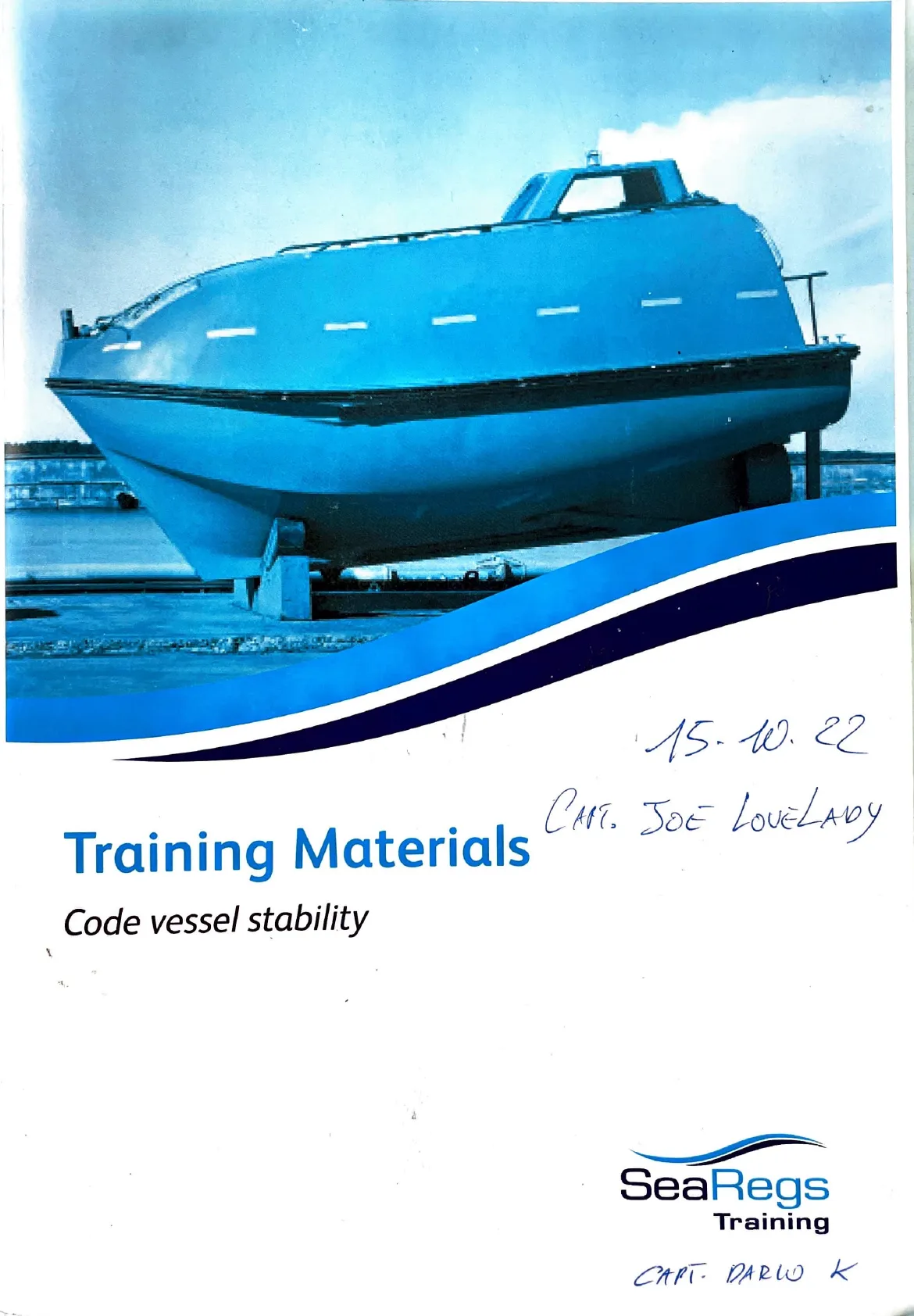
Training Materials
Code vessel stability 15.10. 22 CART. JOE LOVELADY SeaRegs Training CAPT. DARIO KSeaRegs Training
Code Vessel Stability Training Materials
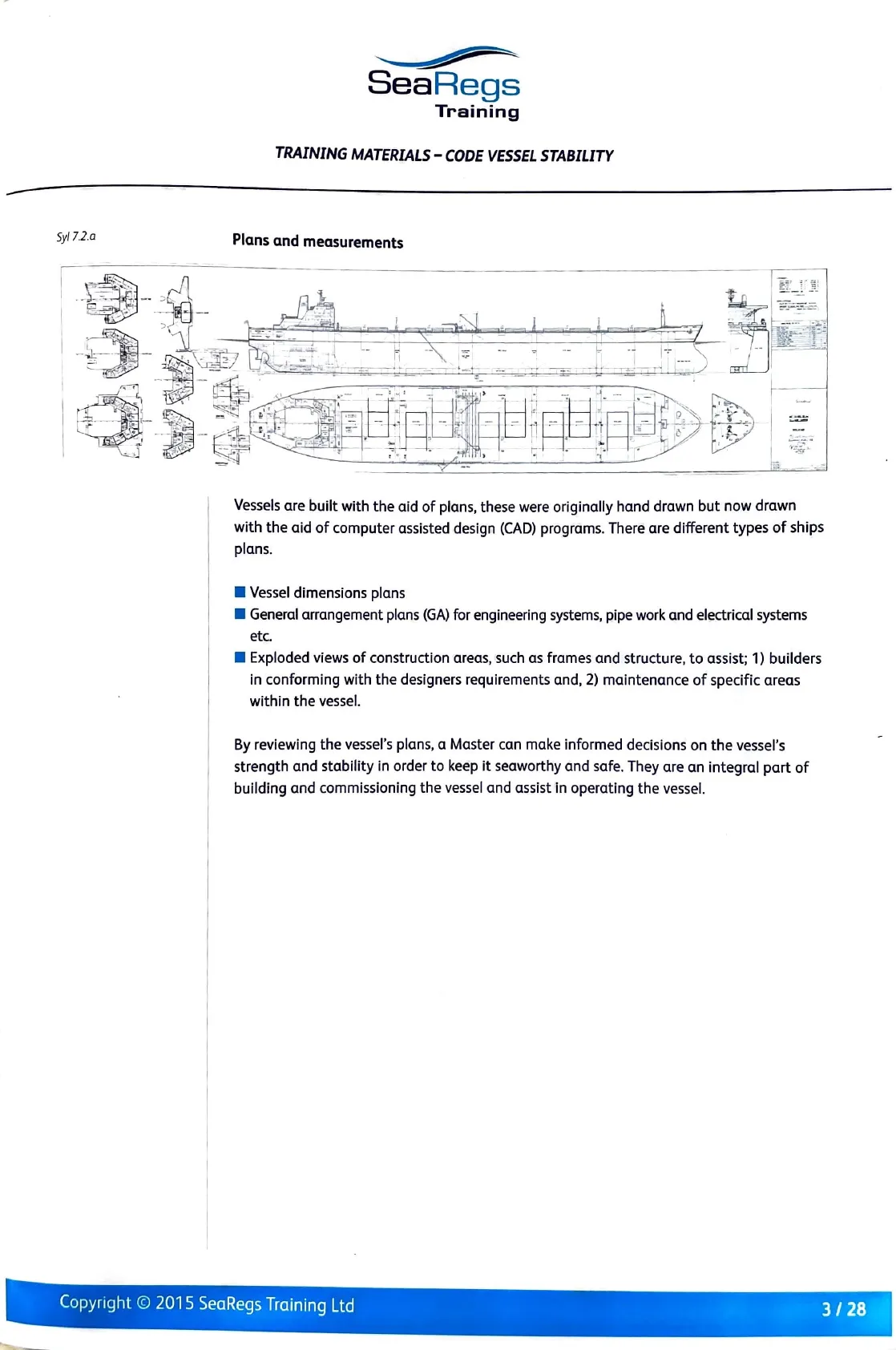
Plans and Measurements
Syl 7.2.a
Vessels are built with the aid of plans, these were originally hand drawn but now drawn with the aid of computer assisted design (CAD) programs. There are different types of ships plans.
- Vessel dimensions plans
- General arrangement plans (GA) for engineering systems, pipe work and electrical systems etc.
- Exploded views of construction areas, such as frames and structure, to assist; 1) builders in conforming with the designers requirements and, 2) maintenance of specific areas within the vessel.
By reviewing the vessel's plans, a Master can make informed decisions on the vessel's strength and stability in order to keep it seaworthy and safe. They are an integral part of building and commissioning the vessel and assist in operating the vessel.
Copyright @ 2015 SeaRegs Training Ltd 3 / 28SeaRegs Training
Code Vessel Stability Measurements
Vessel Measurements
Syl 7.3.c.d
LOA LBP LWL
A ship is measured in many different ways, depending on what information is required.
- LOA: Length Overall is measured from the extreme forward end of the bow to the extreme aft end of the stern.
- LBP: Length Between Perpendiculars is measured from the bow perpendicular beam, to the sternpost.
- LWL: Length Water Line is the waterline length - this can change due to loading. LWL is part of the calculation to establish design speed.
Air draft Freeboard A Depth Draft Ý Beam
- Beam is a ship's breadth across the widest part.
- Draft (draught) is the depth of the vessel from the waterline down. Draft can change due to loading and fore and aft trim.
- Freeboard is the distance from the waterline to the deck edge.
- Air draft is the height from the waterline to the uppermost point on the vessel and is required for clearance under cables and bridges. If draft changes, so will air draft.
- Depth of the vessel is often referred to as the measurement from keel to deck edge.
4 / 28 Copyright @ 2015 SeaRegs Training LtdSeaRegs Training
Code Vessel Stability Weights and Displacement
Vessel Weights and Displacement
Syl 7.3.d £
Displacement Tonnage
Displacement tonnage is the weight of the volume of water displaced by the ship stated in tonnes.
Gross Tonnage (GT)
Gross tonnage is a measure of volume inside a vessel. This includes all areas from bow to stern and keel to funnel. The volume is multiplied using a formula to give the Gross tonnage GT. Gross tonnage is used to determine manning, life saving appliances, registration, and vessel equipment fit-out. Often vessels will be built with a low GT so owners can reduce costs.
Gross Registered Tonnage
Net Tonnage (NT) and Dead Weight Tonnage (DWT)
Net tonnage is a measure of the available capacity for cargo and passengers. Dead weight tonnage refers to the carrying capacity of a vessel.
Net Tonnage
Copyright @ 2015 SeaRegs Training Ltd 5 / 28SeaRegs Training
Code Vessel Stability Waterlines and Load Lines
Waterlines and Load Lines
Syl 7.3.d
A waterline is the line where the hull of a ship meets the surface of the water. This line is marked amidships and is known as the International Load Line or sometimes referred to as the Plimsoll line. The load line marking indicates the draft of the ship and the legal limit to which a ship may be loaded. A load line certificate is granted if there is sufficient minimum distance between load line and the deck edge to give freeboard.
Water salinity changes its density; for instance seawater (1025kg/m3) is more dense than freshwater (1000kg/m3), also warm and cold water temperatures create different buoyancies. Therefore the standard loadline is calculated for seawater in summer, but other markings show the loadlines for different times of the year or different areas where salinity changes.
Load Line Markings
Freeboard. The freeboard assigned is the distance measured vertically downwards amidships from the upper edge of the deck line to the upper edge of the related load line.
LR Lloyds Register or initials of the classification society to which the ship was built and issued the load line certificate.
TF 8 6 T 4 R 2 S 8M 8 W 6 4 WNA 2 7M 8 6 4 2 6M 8 6 4 2 5M Load line the encircled line based on the Summer load line TF. Tropical Fresh Water Load Line F. The Fresh Water Load Line T. Tropical Load Line S. Summer Load Line W. Winter Load Line WNA. Winter North Atlantic Load Line
6 / 28 Copyright @ 2015 SeaRegs Training Ltd FSeaRegs Training
Ship Stability Factors
Why Things Float
Syl 7.3.a
There are a few factors that determine whether or not something floats or sinks. The main factors are density, volume and weight.
1m 1m3 1m 1m
Volume
Syl 7.3.
Volume is the amount of three dimensional space an object occupies.
Density and Weight/Mass
Density is a measure of how much mass is packed into a volume.
Steel is denser than wood and wood is denser than foam. Three cubes of the same volume filled with either steel, wood or foam will have different weights, but they will be the same size.
Mass is a measure of how much matter something contains.
Weight is a measure of how strongly gravity pulls downwards. For simplicity we will refer to weight and mass as one.
If something is denser than water, in general, it will sink. If it is less dense than water, it will float.
Copyright @ 2015 SeaRegs Training Ltd 7 / 28SeaRegs Training
Densities and Buoyancy
Densities
Foam 50 kg/m3 Wood 500 kg/m3 Hollow steel box 250 kg/m3 Sea water 1025 kg/m3 Steel 7500 kg/m3
Above: Lumps of steel are great anchors, whereas a steel box can float. Objects less dense than water float therefore foam floats very well and is used for lifejackets.
The density of seawater is 1025kg per cubed metre (1025kg/m3). If an object is denser than Seawater, it sinks and if it is less dense it floats.
The density of fresh water is 1000kg/m3 (less than seawater), therefore after heavy rain, freshwater entering a tidal river will float on top of seawater in rivers in estuaries.
A trunk of timber floats. If that same trunk of timber was sawn into planks and made into a watertight hull, the density would reduce because the volume increases - the hull shape would be filled with air.
A lump of steel naturally sinks, that is why we use the material for anchors. But flatten it out, shape it into a box and increase the volume for the same weight and it floats.
If 1m3 of steel weighs 7500kg:
Using that weight of steel if we made a 10m3 hollow box the density would be 750kg/m3, therefore it would now be less dense than seawater (1025kg/m3) and float.
Therefore vessels stay afloat if they have a greater volume than their weight. When this happens a buoyant force is created
Buoyant force 100T Weight of iron Weight of iron Left: The block of iron sinks whilst the same weight of iron formed into a vessel with less density and more volume floats.
8 / 28 Copyright @ 2015 SeaReas Training LtdSeaRegs Training
Displacement and Archimedes Principle
Displacement
Syl 7.3.d
Archimedes Principle
The Greek philosopher Archimedes discovered the principle:
That an immersed object will be buoyed upwards by a force equal to the weight of the water that it displaces. It is important to note that it is the weight of the displaced water and not the weight of the object.
Gravity Buoyancy DREAMSTIME@DESIGNUA
The two most prominent points are that;
- the weight of water displaced (not the weight of the object) is equal to the buoyant force,
- the depth of the immersion does not effect this - therefore importantly, the displacement is the same at any depth or any pressure.
G Gravitational force and weight of the boat pushes down Displaced water forming buoyancy B pushes up
Copyright @ 2015 SeaRegs Training Ltd 9 / 28SeaRegs Training
Buoyancy and Gravity in Vessel Stability
Buoyancy and Gravity
Syl 7.3. e
The forces exerted by buoyancy and gravity have the greatest effect on the overall stability of the vessel.
Centre of Buoyancy
Buoyancy is provided by the volume of the underwater parts of the vessel.
Reserve buoyancy is the watertight volume above the water line expressed as a percentage of the total volume of the hull.
= B Buoyant forces acting on the hull
To assist calculation the centre of buoyancy (B) is the sum of buoyant forces acting through one point
Buoyancy acts on all the parts of the hull that are underwater. For clarity and to assist calculation, the sum total of this buoyant upward force is centred through one point, known as the centre of buoyancy (B).
Centre of Gravity
Gravity is exerted by the combined weight of its hull, equipment, fuel, stores and cargo.
= G Total weights of the vessel
Total weights acting through one point is the Centre of Gravity (G)
Above: The total weight of the vessel, including all the stores, fuel, equipment and any cargo, can be represented as acting through one single point, we call this the centre of gravity (G).
10 / 28 Copyright @ 2015 SeaRegs Training LtdSeaRegs Training
Movement of Gravity and Buoyancy
Movement of Gravity and Buoyancy
Syl 7.3.e. g
These described centres of gravity and buoyancy are inline when the vessel is upright. But as the vessel heels they reposition themselves, relative to the vessels heel, and form new centres of gravity and buoyancy.
Moving Buoyancy
CL CL B B B Centre of buoyancy moves from centre line to heeled side B1
The centre of buoyancy (B) moves away from the centreline as the vessel heels to an angle. The new parts of the hull entering the water on the heeled side add buoyancy to that side, whereas those parts of the hull on the other side come out of the water and reduce buoyancy. The centre of buoyancy moves away from the centreline to a new position towards the vessels heel to form a new centre of buoyancy (B1).
2
Moving Gravity
Unloaded centre of gravity Cargo G G Cargo B B
The centre of gravity (G) also changes position as it tends to move towards any added weight.
Weight added high up in the vessel raises the centre of gravity and can make the boat top heavy. A vessel that is too top heavy is liable to capsize.
Weight added low down in the vessel will lower the centre of gravity and adds to her tendency to stay upright.
The centre of gravity can be changed by how the vessel is loaded and during normal running. For example, the using of fuel and water from the tanks, and the positioning for stowage of supplies and cargo, sea water and rain water trapped on the weather deck, will all change the centre of gravity position, and thus make the vessel top heavy.
Copyright @ 2015 SeaRegs Training Ltd 11 / 28
Can’t find what you’re looking for?
Explore more topics in the Algor library or create your own materials with AI.
