Glacier Movement: Key Factors Influencing Ice Dynamics
Slides from University about Glacier Movement. The Pdf explores the dynamics of glaciers, detailing how climate, ice thickness, and slope angle affect their motion. This University-level Geography material, produced in a concise slide format, is ideal for quick review of the main concepts.
See more27 Pages

Unlock the full PDF for free
Sign up to get full access to the document and start transforming it with AI.
Preview
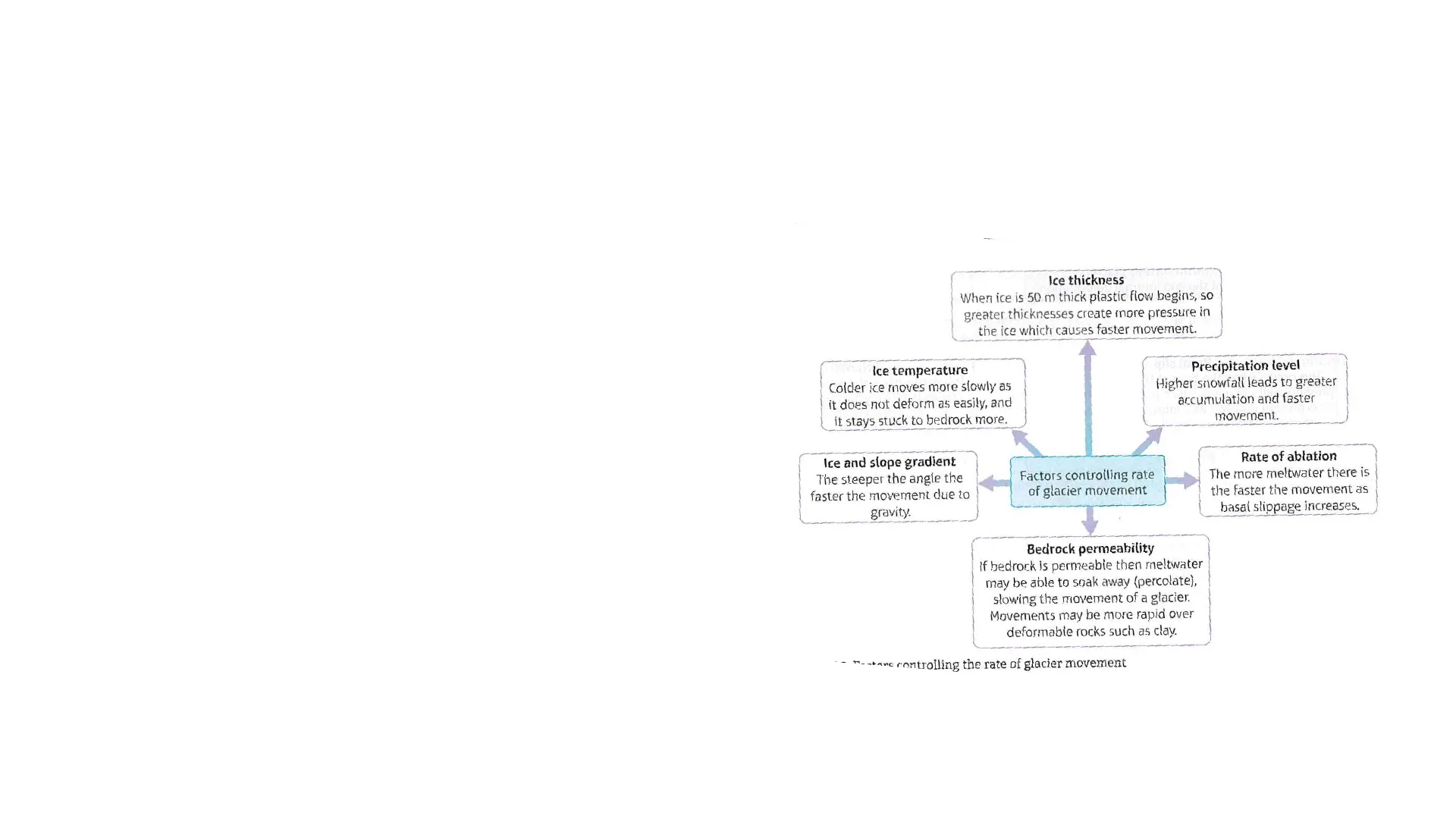
Factors Controlling Rate of Glacier Movement
Ice Thickness
When ice is 50 m thick plastic flow begins, so greater thicknesses create more pressure in the ice which causes faster movement.
Ice Temperature
Colder ice moves more slowly as it does not deform as easily, and it stays stuck to bedrock more.
Precipitation Level
Higher snowfall leads to greater accumulation and faster movement.
Ice and Slope Gradient
The steeper the angle the faster the movement due to gravity.
Rate of Ablation
The more meltwater there is the faster the movement as basal slippage increases.
Bedrock Permeability
If bedrock is permeable then meltwater may be able to soak away (percolate), slowing the movement of a glacier. Movements may be more rapid over deformable rocks such as clay.
Understanding Glacier Movement
we controlling the rate of glacier movementGlacier movement ...
- Glacier movement can refer to changing position of the glacier snout ...
- But it can also refer to the movement of active ice within the glacierWhy do glaciers move? . Glaciers move when shear stress due to gravity acting on an ice mass overcomes the resisting force of friction and causes it to move downslope · Active ice in glaciers moves due to 3 movement mechanisms: · Internal Flow/Deformation (ice creep) · Basal sliding (including regelation slip) - warm based glaciers only · Subglacial bed deformation - sat on loose sediment - warm based glaciers
Evidence for Glacier Movement and Mass Balance
Evidence that suggests glacier movement is due to variations in mass balance . Mass balance can affect the position of the snout at different times of the year BUT ... . Positive mass balance will also affect the rate of ice movement within the glacier . Extra ice in the accumulation zone will steepen glacier surface gradient, increase shear stress due to gravity and this will increase rate of ice flow
Mass Balance Continued
. Negative mass balance - losing ice, this will lead to a movement in position of glacier snout- it recede back up the valley . Also, losing ice in the ablation zone will steepen glacier surface gradient, increase shear stress due to gravity and increase rate of flow . Furthermore, the extra meltwater under the ice can also facilitate movement by basal sliding and subglacial bed deformation - increasing rate of ice flow · Zero mass balance - snout will not change but the glacier will continue to flow downslope due to gravity
Other Factors Affecting Movement Rate
Other factors that affect movement and rate · Climate · Slope angle/gradient/relief . Ice thickness · Geology of glacier bed . Location on the glacier · Subglacial lakes & glacier surges · Sea temperatures
Climate & Ice Movement
· Important! · Climate determines whether glacier is warm or cold based · Cold-based glaciers are frozen, only flow via internal flow = rate of movement is slow · Warm-based glacier - basal sliding and internal flow = faster rate of movement . Evaluation: climate is arguable the key factor determining ice movement as it also controls mass balance . All glaciers are in dynamic equilibrium with their climate (adjusting to stay in balance) Evidence: climate and global warming leading to the recession/disappearance Cold-based glaciers = 2- 3m/yr Warm-based glaciers = 2/3cm day
Slope Angle
· Relief/gradient · Steep gradient = increase shear stress which lead to extensional flow and faster ice velocity · Ice extends, thins and forms crevasses. · Gentle gradient = less shear stress, glacier will compress (compressing flow) glaciers close
Ice Thickness Impact
· Internal flow via ice creep will only occur if ice is at least 30m thick due to lack of pressure for the ice crystals to deform. . Impact of friction with glacier bed is greater if the glacier is thinner. · Ice will move faster if glacier is thicker as the impact of friction will be minimal
Location on the Glacier
· Ice flow is faster in the centre due to friction on the valley sides · Larger ice masses such as ice cap/ice sheets. These consist of a dome ice · Ice will not move consistently across · Areas of fast flowing ice known as ice streams
Greenland Ice Sheet Dynamics
Melting on the lower Parts of the surface, icebergs calve off from ice sheet edges into ice fjords and the sea
Antarctica Ice Sheet Dynamics
Ice shelves, with subglacial melting, Icebergs calve off from ice shelves Snow accumulation Equilibrium line Ice sheet low Iceberg calving Ice Ice shelf Abtation Ice flow Iceberg calving Ocean Subglacial melting Ocean Bedrock
Geology of Bedrock
· Glaciers on solid rock geology will only move via internal flow & basal sliding . Some glaciers will sit on sediment not directly on bedrock. - Sitting on lose material and experience subglacial bed deformation (if it is a warm-based glacier) · Bedrock permeability - less permeable rock will result in less meltwater percolating - increase the rate of movement.
Sea Temperatures and Polar Glaciers
· Issue for polar glaciers · The snout of polar sheets often reach the sea as a floating iceshelf. . Warm sea temperature = increase ablation with rapid iceberg calving and increase movement · Examples: Sea temperatures are increasing and therefore rate of ice movement in Greenland and Antarctica Ice sheets
Glacier Surges
. Sometimes glaciers can surge 100x faster than their normal rate of movement . Why? Lots of water/lakes trapped under the glacier. That can encourage rapid movement = surge · Example: Hubbard Glacier, Alaska
Evaluating Glacier Movement Factors
Evaluate the view that the rate of glacier movement is mainly determined by variations in the mass balance of a glacier (20) Do you agree? Do you think that mass balance is the most important factor that influences rate of movement or are there other factors we need to consider?
Evaluate the View
. Why do people hold this view? Let's have some other views as well Then you can make a judgement. . Do you agree with this view? How to conclude/make a judgement? · DO "Agree but ... " or "disagree but ... " . DO NOT sit on the fence ie not making a judgement · AVOID extreme agreement or extreme disagreement
Structure for Evaluation
· Introduction . Discuss mass balance (evaluate, link back to the question) . Discuss other factors - 2 other factors? · Conclusion
Structure for Essay
· Introduction · Part 1 - Arguments and evidence that suggest glacier movement (rate) is due to variations in mass balance . Part 2 - Are there any other factors that lead to the movement of glaciers and impact the rate ? · Conclusion - Make a decision Use these connectives to help you evaluate - Whereas, however, moreover, On the other hand
Introduction to Essay
· Paraphrase the question · Include a definition . Outline the other factors (that affect rate of movement) that you are going to discuss in your essay
Part One: Discuss Mass Balance
. Explain mass balance - balance between accumulation and ablation over a year. . Explain accumulation - how do we add snow/ice to the glacial system? . Explain ablation - loss of ice from the glacier . Explain links between mass balance & glacier movement - moving in position of glacier snout . Explain how the difference between ablation and accumulation can affect the RATE of movement . Evaluate how important this is to rate of movement
Part 2: Other Factors Affecting Rate of Movement
· Climate · Slope angle/gradient/relief . Ice thickness · Geology of glacier bed . Location on the glacier · Subglacial lakes & glacier surges · Sea temperatures Discuss some of these - not all Are these important to the rate of movement - more important than mass balance?
Conclusion for Evaluation
· Paragraph coming to a reasoned judgement and answer the question set · Substantiated conclusion - your judgement must be supported by evidence . Do not repeat summarise the essay
Conclusion: Agree or Disagree
To what extent do you agree or disagree? Possible concluding comments Mass balance controls movement in position of glacier snout and also influences the rate of ice flow BUT climate is the main factors determining rate of glacier movement Climate controls: Mass balance Whether glacier is warm or cold based Sea temperature and rate of calving Ice thickness Presence of subglacial lakes and the ability of a glacier to surge Other factors also play a role e.g. relief & slope angle, geology of glacier bed
Highlighting Key Elements
Have you ... highlight the following . Defined key terms . Evaluated - provided both sides of the argument, included key connectives/evaluative language · Addressed key words from the question .... . Use developed sentences with a rage of connectives and a clear paragraph structure (PEEL) and essay structure (intro/main/conclusion) · Used evidence - in the form of relevant examples/mini-case studies (several mini-case studies better than a single large case study), data (facts & figures)
Assessment Level 1
1-5 marks A01 Point Only isolated points made. Some inaccurate or irrelevant
Assessment Level 2
6-10 marks Points made. Some inaccurate or irrelevant AO2 Evidence Limited evidence to support points. Interpretation lacks coherence Some evidence to support points but interpretation lacks coherence AO2 Explain links with question Limited explanation of links/relationships that lacks logical connections Limited but logical explanation of links/relationships A02 Evaluate/ judgements Makes generic or unsupported judgements. Arguments unbalanced or incoherent Makes partially supported judgements. Arguments unbalanced or limited coherence
Assessment Level 3
11- 15 marks Points are mostly accurate and relevant Some evidence to support points. Partial but coherent interpretation Some logical explanation of links/relationships Makes judgements that are largely supported. Arguments may be unbalanced or incoherent in parts
Assessment Level 4
16-20 marks Points are all accurate and relevant Evidence used well to support points. Full and coherent interpretation Detailed and logical explanation of links/relationships Makes well supported judgements throughout. Arguments are balanced and coherent.
WWW (What Went Well)
1. Used a range of key words 2. Good application to question - command word evaluate - weighing up different factors to reach a conclusion (A02) 3. Good knowledge and understanding (AO1) 4. A range of case study info/example/evidence to support explanation 5. A coherent, well developed conclusion 6. Good essay structure - paragraphs, PEEL, introduction/conclusion 7. Detailed and developed explanations of mass balance and other factors affecting glacial movement
EBI (Even Better If)
A. Used a range of key words on the topic B. Good application to question - command word evaluate - weighing up different factors to reach a conclusion (AO2) C. Good knowledge and understanding (AO1) D. A range of case study info/example/evidence to support explanation E. A coherent, well developed conclusion F. Improve structure - paragraphs, PEEL, introduction/conclusion
Can’t find what you’re looking for?
Explore more topics in the Algor library or create your own materials with AI.
