Lithosphere and mining extraction techniques
Slides about Lithosphere - Extraction. The Pdf explores the lithosphere and mining extraction techniques, presenting key definitions and introductory questions. The Pdf, suitable for high school Science students, also includes a section on metamorphic rocks and magnetometry.
See more29 Pages


Unlock the full PDF for free
Sign up to get full access to the document and start transforming it with AI.
Preview
Lithosphere - Extraction Starter
- Define the lithosphere
- Define ore
- What is an igneous intrusion?
- Give two examples of rocks formed through metamorphism
- How do evaporites create ore deposits?
- Give one example of mineral formed from biological sediment
- How does magnetometry work?
continental crust
oceanic crust
astenosphere
lithosphere
(crust and uppermost
solid mantle)
mantle
2900 km
outer core
(liquid)
5100 km
inner core
(solid)
6378 km
Lithosphere End of Topic Test
Group D - Tuesday 16th Jan
Group E - Monday 15th Jan
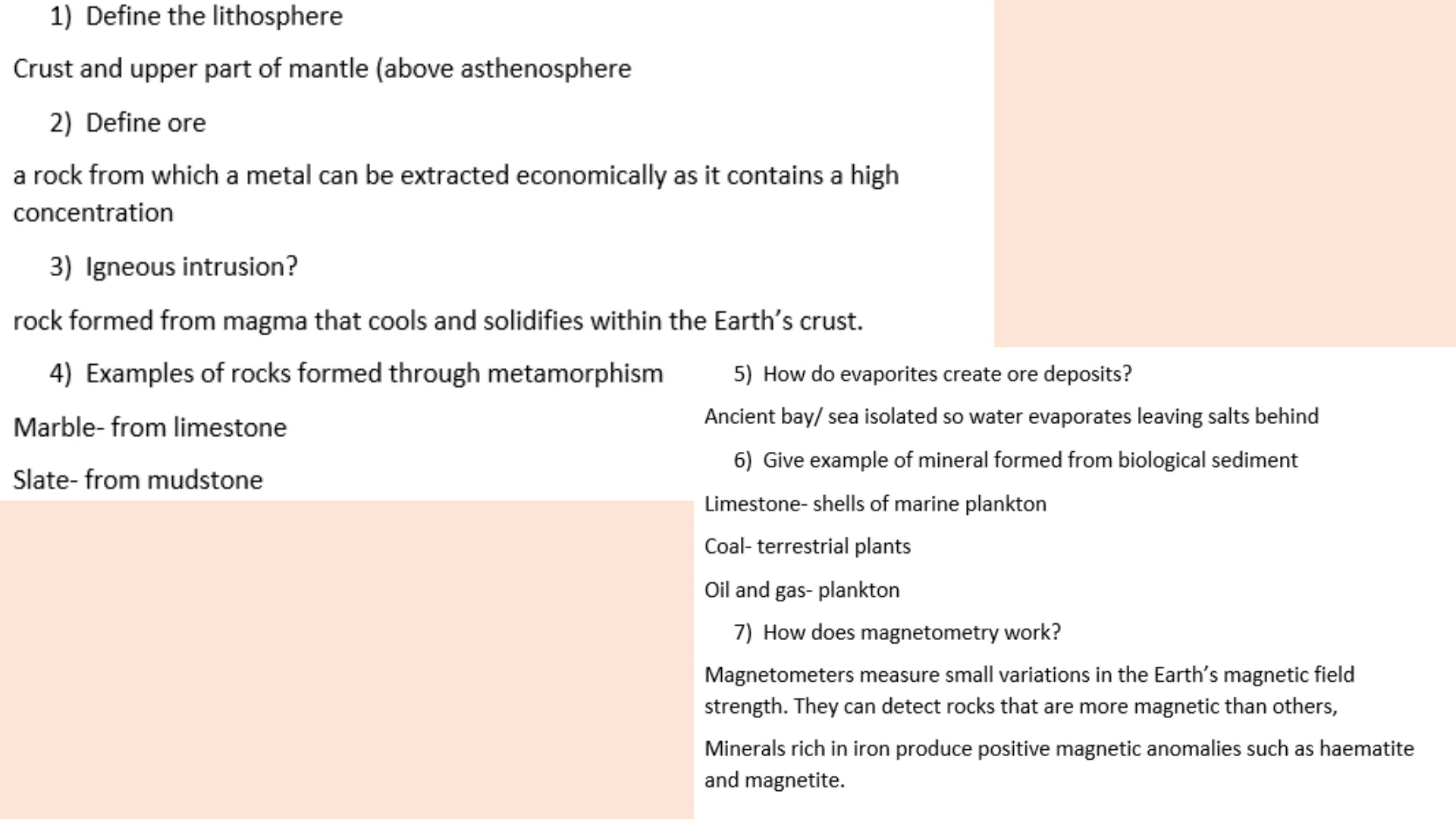
- Define the lithosphere
Crust and upper part of mantle (above asthenosphere - Define ore
a rock from which a metal can be extracted economically as it contains a high
concentration - Igneous intrusion?
rock formed from magma that cools and solidifies within the Earth's crust. - Examples of rocks formed through metamorphism
Marble- from limestone
Slate- from mudstone - How do evaporites create ore deposits?
Ancient bay/ sea isolated so water evaporates leaving salts behind - Give example of mineral formed from biological sediment
Limestone- shells of marine plankton
Coal- terrestrial plants
Oil and gas- plankton - How does magnetometry work?
Magnetometers measure small variations in the Earth's magnetic field
strength. They can detect rocks that are more magnetic than others,
Minerals rich in iron produce positive magnetic anomalies such as haematite
and magnetite.
Learning Outcomes
- Describe Lasky's principle and explain the difference
between reserves, stock and resource, - Briefly define open-cast mining and dredging,
- Discuss the geological and economic conditions that need to
be met for a mining operation to be viable.
Recap - Minerals from the Lithosphere
- These are Non- renewable
- They are formed extremely slowly so cannot be replaced
in the timescale for human use. - We can only continue to use if we:
- Find alternatives
- Increase supplies
- Extend their use
- Recycle them
Crust 0-100 km
thick
Lithosphere (crust
plus the upper
mantle)
Asthenosphere
Mantle
Mantle
2900 km
Outer Core
Liquid
Core
5100 km
Solid
Inner Core
http://polarpedia.eu/wp-content/uploads/2017/07/Lithosphere.jpg
Key Terms for Mineral Deposits
- Mineral deposit: any rock containing at
least one mineral (either in concentrated
veins or disseminated through the rock), - Ore: a rock containing a mineral that can
be exploited commercially, - Grade (ore purity): the % of metal in the
ore: higher grade= higher % of metal, - Cut-off grade: the % of metal in the ore
needed for it to be economically viable
Difference Between Resources, Reserves and Stock
This Photo by Unknown Author is licensed under CC BY
How Much Do We Have?
- Stock (resource base): all of the material
in the lithosphere, including the minerals
that will never be exploited, - Resource: all of the material that is
theoretically available for exploitation,
including the deposits that cannot be
exploited now e.g. too deep, low grade, land
use conflict etc. - Reserve: proportion of resources that can
be exploited now economically, using
existing technology.
RESERVE
RESOURCE
INCREASING DEGREE OF
GEOLOGICAL ASSURANCE
Factors Affecting Reserve Quantity
- If market price for the ore
increases or if new extraction
techniques become
economically viable then the
reserves will increase, - If market price drops then
reserves may decrease and
become resource.
1000
GOLD PRICE ($/oz), 1970 - Present
800
600
400
200
Www.USAGOLD.com
Copyright 2008 USAGOLD - Centennial Precious Metals, Inc.
0
'70 '72 '74 '76 '78 '80
'82
'84
'86 '88
'90 '92 '94 '96
'98
'00
'02
'04
'06
'08
Factors Preventing Resource Exploitation
Resources: technology
for exploitation exists
but ore purity is too low
for viable economic
exploitation
Resources: ore purity
is too low for
economic exploitation
and technology for
exploitation does not
exist.
Ore purity
Reserves:
economically
exploitable with
existing
technology
Resource: ore purity
is high but
technology does not
exist for economic
exploitation
Level of technology
Relationship Between Reserves, Resource and Stock
Low
Stock
Ore purity
Resources
Reserves
Level of technology for
exploitation
Draw
this
diagram!
The effect of ore purity and
technology on reserves and resource
Low
Exploitation
not
economically
viable.
Ore purity
Exploitation
is
economically
viable.
Technology exists for exploitation
No existing technology
How Technology and Cut-Off Grade Affect Reserves
Reserves increase as the Cut
Of Grade falls and exploitation
of lower grade ores becomes
economically
viable.
Resources.
Ore quality
Reserves
-
Reserves
increase as
better
technology
makes
economic
exploitation
technology
possible.
Level of technology for exploitation
Lasky's Principle
- As the purity of the mineral
decreases, the amount of the
mineral present increases
exponentially - Major problem with future
supplies is the need to be able to
exploit low-grade ore deposits, - Sketch out the graph and write a
couple of sentences underneath
explaining what it shows.
Logarithmic graph - Can show a
large range of values/data
10 11
B. Lasky Relation
1010
Cumulative Ore Tonnage
109
10º
107
1
106
Copper Deposits
105
!
0
2
4
6
8
10
12
Average Grade (percent)
Figure 13-1 B, Mineral Resources, Economics
and the Environment, S.E. Kesler, Macmillan
Extraction of Minerals: Methods
Methods used to extract minerals from the lithosphere:
- Deep mining/
- open cast mining,
- Dredging.
SHAFT TOWER
CONCRETE PLANT
OPEN-PIT
EXTRACTION
ELEVATOR
RAMP
SHAFT
CHIMNEY FOR
STERILE MINERAL
- VENTILATION
CHIMNEY
OREBODY -
PIPE
CRUSHING
MINERAL HOPPER
EXPLORATION GALLERY
Deep Mining Techniques
Some Types of Mines
Slope Mine
headframe
hoist house
outcrop
Open Pit Mine
crosscut
ore
inclined
shaft
level
vein
- level
level
stope
massive
ore deposit
leve
1st level
skip hoist
drift
raise
sump
2nd level
winze
undiscovered
ore
sump
bottom level
prospecting drift
Digging for Hope: Inside an Ohio coal mine - YouTube
Vertical
Shaft
Single
Stage
Hoisting
Mine
cage
(181) Inside the Resolution Copper Mine, 1.3 Miles Underground -
YouTube
Underground mining,
sometimes called deep mining,
is used when the mineral
(usually coal) is more than 200
feet below the surface.
Deep Mining: Advantages and Disadvantages
Advantages
Extracts less gangue (matrix) material
than open-cast
Less habitat destruction at surface
Disadvantages
Labour intensive
Cannot use the larger equipment
Suffers with problems of ventilation,
overburden support and drainage,
Can cause subsidence on ground surface.
Open Cast Mining
surface mining technique that
extracts minerals from an open
pit in the ground
Topsoil stripping
Overburden & interburden removal
Rehabilitation
Dragline excavation
Trucks & shovel
Drill & blast
Mine support & maintenance
UK's LARGEST open cast mine
- YouTube
Coal remova 181) Inside Sweden's copper mega-mine | DW News - YouTube
Open Cast: Advantages and Disadvantages
Advantages
Can use larger machinery- makes it
faster,
Safer for workers as don't go
underground
Cheaper
Can be re-purposed when mining is
finished e.g. Eden Project
Disadvantages
Cannot access deeper coal as becomes
too expensive,
Affects a larger area of land- habitat
destruction
Causes more noise, dust and aesthetic
pollution
Can lead to land-use conflict
UK Coal Mining Overview
Only 3 open cast mines left in the UK
(2021)
The last operating deep coal mine
in the United Kingdom, Kellingley
colliery in North Yorkshire, closed
in December 2015.
Kellingley Colliery: Britain's last coal mine closes - YouTube
English Coalfields
1 Northumberland
2 Durham
3 Naworth
4 Cumberland
5 Stainmore
-
Brora
31
32
7 Lancashire
8 Yorkshire
29
10 Nottinghamshire
Ballycastle
27
26 2
11 Leicestershire
12 Cheshire
13 Shropshire
14 Staffordshire
15 Worcestershire
16 Clee Hill
17 Wyre
b
18 Warwickshire
19 Newent
20 Forest of Dean
Connaught
8
៛
7
10
25 Bideford
12
9
Leinster
14
Slieve Ardagh
18
17
Munster
20 /19
F
21
A
Anglesey
24)
22
1
C
Denbighshire
D
Monmouthshire
E
Breconshire
25
F
Glamorganshire
G
Carmarthenshire
h
H
Pembrokeshire
Non Coal Measures Coalfields
a
North Yorks Moors
27
Sanquhar
h
Coxwold
28
Ayrshire
North Pennines
29
Argyllshire
d
Crosby Ravensworth
30
Lanarkshire
Yorkshire Dales
f
Lune Valley
Buxton
h
Bovey Tracey
1
Kent lignite
34
6 Ingleton
33
9 Derbyshire
3
2
Coalisland
5,
a
d
6
21 Gloucestershire
22 Bristol
23 Somerset
24 Kent
g
11
16: 15
Welsh Coalfields
D
34
Fifeshire
31
West & Mid Lothian
32
East Lothian
33
Peebles-shire
Y
Scottish Coalfields
26
Canonbie
B
Flintshire
Countries Mining the Most Coal
- China - 3902 mil tonnes
- India - 757 mil tonnes
- Indonesia - 563 mil tonnes
- USA - 485 mil tonnes
- Australia - 477 mil tonnes
Acme Quarry - Mine Plan
The Quarrying Process (8 Steps)
STAGE 1
Phase 3
Phase 2
phase 1
Acme Quarry - MINE PLAN
The Quarrying Process
(From raw material to sustainable products in 8 steps!)
For more information visit www.quarrying.org
IQ
The Institute
of Quarrying
""Lime can be used
to capture carbon
dioxideand reduce
emissions"
CO
EGEO
"We use drones
and satellites to
accurately
map thesite"
DANGER
EXPLOSIVE
STAGE 8
Waste material
In [eg old
concrete blocks
Power Station 4
"The safe use of
explosives on site
is one of the key
priorities here!"
PLAST
Products recycled
or re-used
wherever possible
to reduce lifetime
carbon emissions.
LA Demolition Site
STAGE 2
& EGEO
& GEO
&LARC
ABLAE
A BIAS
OPT
QCT
100
Sand | Aggregate | Cement
Products used to
create sustainable
solutions that
positively impact
on peoples lives.
& CMT
STAGE 6
STAGE 4
ADM & PFM
& HR
& TRN
ROPT
& HS
Weight
Support and
Administration
Services
Visualised by www.crackerjackvisualthinking.com
The industry takes a WHOLE LIFE APPROACH to quarrying. This aims to reduce the impact of quarrying at all stages of the process including final use or recycling.
JOB ROLES
KEY
ADM Administrators
BLAE Blasting Engineer
BLAS Blasting Supervisor
CMT
Commercial Team
EGEO Engineering Geologist
ENG
GEO
HR
Geologists
Human Resources
Health and Safety
LARC
Landscape Architect
PFM
MAT
Maintenance Engineers
Plant Fleet Manager
PE
Processing Engineers
Operators
05
STM
OPT
OCT
Quality Control Technician
TRN
Building
Materials
OPT
Add extra value to
processed
materials using
additional
processing
technologies.
"Limestone is
heated in the kiln
to turn it into lime
('cakining')."
Concrete
Process materials
using crushing
and screening
technologies.
PE
SCREENING
AGGREGATE
Asphalt Production
Lime and
Powders
Kiln
Coarse
STAGE 5b
SAND
Fine
& ENG
E
Lime
Lima
Quick
Lime
C
STAGE 5a
OPT AQCT
CRUSHING
Extends product
Lifetime
Re chicas
products "mattina
CO2 amissions
Reduces
demandfor oRW
natural IRSOurCES
OUT
IN
Wa sve maser is !
ous (e.g. crushed
conctele block
used as aggregstel
STAGE 3
Remove the top
layer of material
(the 'over burden').
Drill holes, insert
explosives and
blast rock face to
loosen material.
STAGE 7
OPT
"As Site Manager,
I'm responsible for
the safe and efficient
operation of the site
and its people"
& STM
Transport
materials for
processing (known
as load and haul).
Transport finished
products to
customers and
partner
organisations.
HMS 100
Quantity Surveyor
Site Manager
Training and Competency
Engineers
Create a mine plan
to map and
coordinate the
activity on site.
Can’t find what you’re looking for?
Explore more topics in the Algor library or create your own materials with AI.
