Commerce Things to Study: Rules of Law and Legal Concepts
Document from Rule of Law Education Centre about Commerce things to study: Rules of law. The Pdf provides an overview of the Australian legal system, covering fundamental principles, classification of laws, and the structure of government and judiciary. It includes details on negligence, breach of contract, and the role of juries for university-level Law students.
See more16 Pages

Unlock the full PDF for free
Sign up to get full access to the document and start transforming it with AI.
Preview
Rules of Law
Commerce things to study:
- Rules of law
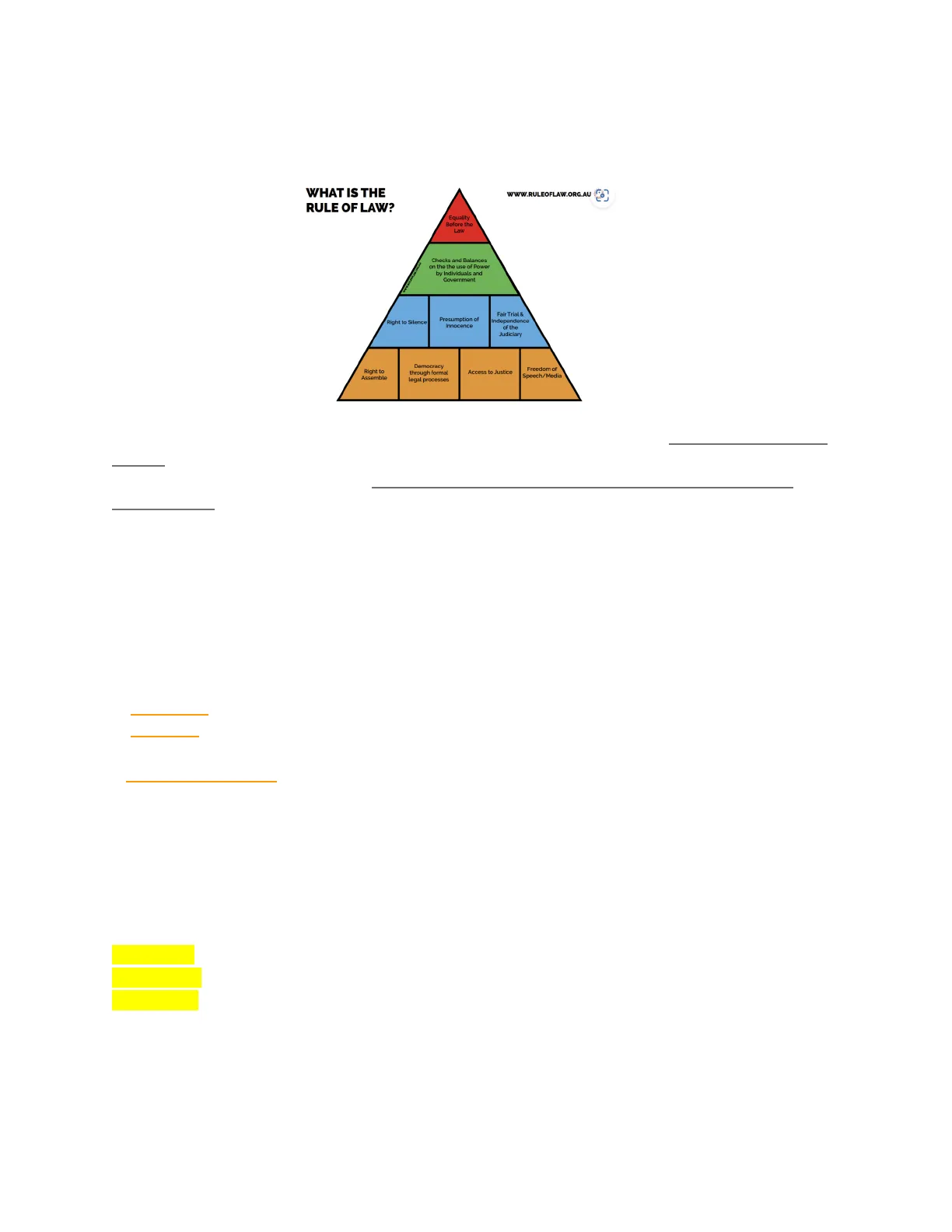
WHAT IS THE
RULE OF LAW?
WWW.RULEOFLAW.ORG.AU
Equality
Before the
Law
Checks and Balances
on the the use of Power
by Individuals and
Government
Right to Silence
Presumption of
Innocence
Fair Trial &
Independence
of the
Judiciary
Right to
Assemble
Democracy
through formal
legal processes
Access to Justice
Freedom of
Speech/Media
that the people (including, one should add, the government) should be ruled by the law and
obey it and
that the law should be such that people will be able (and, one should add, willing) to be
guided by jt."
Features of Good Law
- Features of a good law
Consistent/stable
Flexible
Fair & Just
Clear & Understood
Roles of Law
- Roles of law
- Protection - Laws can protect us from others and ourselves. e.g. driving a boat while drinking
- Freedom - to allow citizens certain rights and privileges. e.g. buy property and move freely
between states - Resolving Disputes - to stop individuals from abusing the law. e.g. taking down your
neighbours fence
Examples of Legislation
- Examples of legislation
Marriage Act 1961 (Cth)
Crimes Act 1900 (NSW)
Racial Discrimination Act 1975 (Cth)
Anti-Discrimination Act 1977 (NSW)
Classifying Law
- Classifying law
Public Law - Criminal, Administrative, Constitutional
Private Law(civil) - Contract, Property, Torts
Family Law - form of civil law
State Government Structure
- What makes up the state government
- An upper house (the Legislative Council) and a lower house (the Legislative Assembly).
- The head of the government is the Premier
- The head of state is the Governor
Legislative Assembly
- Legislative assembly
The Legislative Assembly is the lower house in the parliamentary system of Australian states
and territories. Members, called MLAs (Members of the Legislative Assembly), represent
specific electoral districts. They are elected by the public and have key responsibilities:
introducing, debating, and voting on laws, representing constituents, and scrutinizing the
government. The party with a majority in the Assembly forms the government, and its leader
becomes the Premier.
Statutory Interpretation
- Statutory Interpretation
Statutory interpretation is the process by which the courts interpret and apply legislation. (i.e.
Acts of Parliament). Laws made by Parliament often use complicated language. This language
is used in an attempt to fully explain what the law means, and to try to cover all the possible
situations to which the law is relevant.
Judgements made that are similar to previous decisions in the courts
Judges need to follow precedent set by higher courts
If no previous decision exists, a judge can set a new precedent
Court Structure and Hierarchy
- Court structure and hierarchy
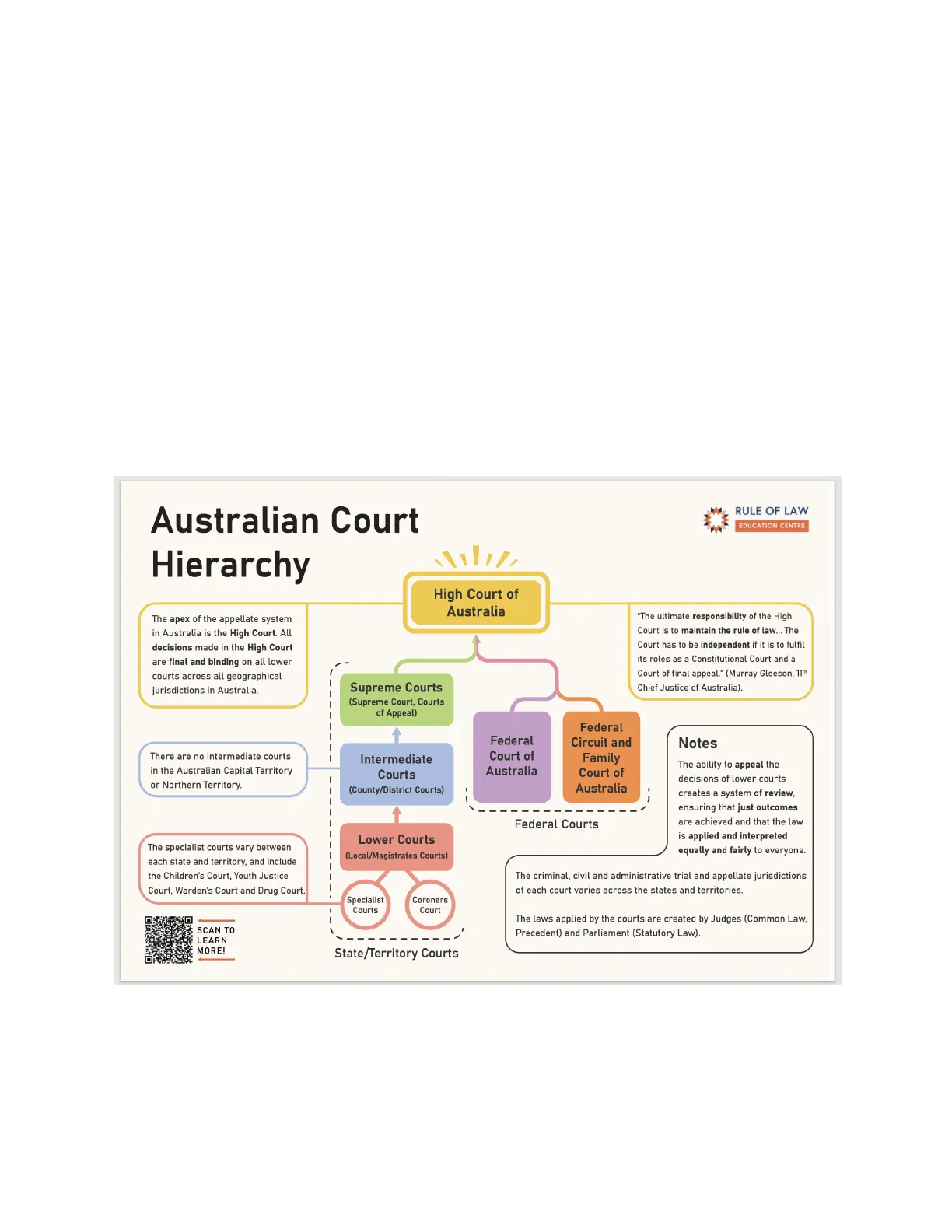
Australian Court
Hierarchy
RULE OF LAW
EDUCATION CENTRE
High Court of
Australia
The apex of the appellate system
in Australia is the High Court. All
decisions made in the High Court
are final and binding on all lower
courts across all geographical
jurisdictions in Australia.
"The ultimate responsibility of the High
Court is to maintain the rule of law ... The
Court has to be independent if it is to fulfil
its roles as a Constitutional Court and a
Court of final appeal." (Murray Gleeson, 11th
Chief Justice of Australia).
Supreme Courts
(Supreme Court, Courts
of Appeal)
Federal
Court of
Australia
Federal
Circuit and
Family
Court of
Australia
Notes
There are no intermediate courts
in the Australian Capital Territory
or Northern Territory.
Intermediate
Courts
(County/District Courts)
--
Federal Courts
The ability to appeal the
decisions of lower courts
creates a system of review,
ensuring that just outcomes
are achieved and that the law
is applied and interpreted
equally and fairly to everyone.
Lower Courts
(Local/Magistrates Courts)
The specialist courts vary between
each state and territory, and include
the Children's Court, Youth Justice
Court, Warden's Court and Drug Court.
The criminal, civil and administrative trial and appellate jurisdictions
of each court varies across the states and territories.
Specialist
Courts
Coroners
Court
The laws applied by the courts are created by Judges (Common Law,
Precedent) and Parliament (Statutory Law).
SCAN TO
LEARN
MORE!
State/Territory Courts
High Court of Australia
High Court: The High Court of Australia, located in Canberra, handles appeals from state or
territory Supreme Courts and cases concerning the interpretation of the Constitution. By
interpreting and applying the Constitution, it creates laws that influence the powers of
parliaments, often shifting power from states to the Commonwealth. As the highest court in the
country, its decisions are final and apply nationwide. It is the federal court of Australia.
Supreme Court
Supreme court: The Supreme Court is the highest court state court and handles the most
serious criminal cases, such as murder, treason, and serious sexual assault, as well as civil
cases involving claims exceeding $750,000. It is led by the Chief Justice, and judges also travel
to regional centres in a practice known as "going on circuit." It can impose a wide range of
sentences. In the Supreme Court, when someone pleads not guilty to a criminal charge, the
case goes to trial. A jury evaluates the evidence and follows the judge's legal directions to
decide if the accused is guilty or not guilty.
Court of Appeal
Court of Appeal: The Court of Appeal is part of the Supreme Court system and reviews
appeals from lower courts or single-judge decisions. It examines cases for legal errors
but does not conduct new trials. Its decisions are binding on lower courts.
Family Court
Family court: The Family Court handles legal disputes related to family matters, including
divorce, property settlements, child custody, visitation arrangements, and spousal maintenance.
Its primary focus is on the best interests of children during family breakdowns. In Australia, this
role is fulfilled by the Federal Circuit and Family Court - so it is a part of the federal courts.
District/County Court
District/County court: The District Court is an intermediate court that handles Major civil cases
involving claims between $100,000 and $750,000, as well as motor vehicle accident cases. It
also deals with most serious criminal matters like armed robbery and manslaughter. Trials may
involve a jury to determine guilt, while sentencing is decided by a judge. The court also hears
appeals from the Local Court.
Local Court
Local court: The Local Court of NSW deals with indictable offences like manslaughter,
homicide, or armed robbery through committal hearings, where magistrates assess evidence
to decide if the case should move to a higher court. It also handles minor civil disputes up to
$100,000. Magistrates-legal experts without a jury-can sentence offenders to up to two
years per offence or five years total. They oversee bail applications, arrest warrants, search
warrants, AVOs, and more. Over 90% of civil and all criminal cases begin in this court.
Specialist Local Courts
Specialist local courts ->
Children's Court
Children's court: The Children's Court handles matters related to the care,
protection, and criminal cases of individuals under 18 at the time of the offence. It
is not open to the public or media, ensuring privacy. While it shares similar
personnel with the Local Court, the staff are specially trained to work with young
people.
Coroners Court
Coroners court: The Coroner's Court is a special Local Court that investigates
deaths by unnatural causes in order to determine the identity of the deceased
and the date, place, circumstances and medical cause of death. Coroners also
investigate the cause and origin of fires or explosions.
Drug Court
Drug court: The Drug Court focuses on breaking the cycle of drug use and crime
by helping offenders overcome substance abuse, gain employment, and reduce
criminal behavior. Offenders must qualify for the Drug Court Program, which
begins with assessment and detoxification. A personalized plan is created to
support their recovery. Participants undergo regular drug tests and report
progress to the court. Positive milestones, like staying drug-free, are celebrated
with encouragement from the court.
Reasons for Law
- Reasons for law
- The law is a collection set rules that society must follow
- A main difference between a rule and a law is its level of enforceability
In extreme cases, an absence of law (Government) can lead to a state of anarchy
Barriers to Law
- Barriers to law
Includes financial constraints (cost), lack of awareness of legal rights and processes,
communication issues, language barriers, barriers between those with disabilities and cultural
differences.
Separation of Powers
- Separation of powers
The Legislature:
A bicameral parliament made up of the house of representatives, the senate and the governor
general (as the Queen's representative) to debate change and pass Australian laws. Members
are elected by the people.
The executive council:
The Cabinet-government ministers headed by the Prime Minister. The executive puts laws into
action and administers them through government agencies.
The Judiciary:
Judges interpret the constitution and administer Australian laws through the levels of federal
courts including the high court.
Types of Law
- Types of law
TYPES OF LAW:
Criminal law
civil law
Actions brought by
Crown Prosecution Service
Claimant
Actions brough against
Accused
Defendent
Proof required
Beyond Reasonable doubt
Balance of Probabilities
Determinat of guilt
SERIOUS OFFENCE = Jury
Judge
Sentence / award determined :
SERIOUS OFENCE = Judge
Judge
case described as
Regina vs Jones
Smith vs Jones
What is Criminal Law
- What is criminal law
Criminal law is a branch of public law designed to protect individuals and maintain social order
by defining actions considered harmful or unacceptable. It involves prosecution, conviction, and
punishment for those who violate the law. The police prosecute criminal cases, courts impose
penalties, and accused individuals can present their defense. Punishments may include fines,
court orders, or imprisonment.
Crimes are categorized into two main types:- Indictable offences: Serious crimes like murder, armed robbery, and homicide,
requiring a trial in higher courts such as the District and Supreme Courts. In these cases,
guilt is determined by a judge and jury. - Summary offences: Less severe crimes like petty theft or traffic violations, handled
quickly in lower courts, usually by a magistrate without a jury.
MINOR OFFENSE = Magistrate
MINOR OFFENCE = Magistrate
- Indictable offences: Serious crimes like murder, armed robbery, and homicide,
Can’t find what you’re looking for?
Explore more topics in the Algor library or create your own materials with AI.