Why ATP? A Creation Model Perspective on Cellular Energy
Document from University about Why ATP? A Creation Model Perspective. The Pdf analyzes ATP as the cellular energy currency, comparing it to economic currency and discussing its metabolic efficiency. This university-level document in Biology explores theories on ATP's origin in evolutionary and prebiotic contexts.
See more16 Pages


Unlock the full PDF for free
Sign up to get full access to the document and start transforming it with AI.
Preview
Why ATP? A Creation Model Perspective
By Fazale Rana
There's quite a buzz surrounding cryptocurrency these days. Many people see investing in cryptocurrencies as a way to get rich quickly.
To be frank, I'm not sure I understand the ins and outs of cryptocurrency well enough to be comfortable investing in it. Currency is a standardized form of exchange in an economy. It's a universal store of value that can be presented or received in exchange for goods or services. The use of currency is so commonplace that it becomes easy to overlook its genius as a human invention and its critical importance to any economy. Without currency, we would all have to barter for goods and services. Bartering is exceptionally cumbersome and inefficient.
The Cell's Energy Currency
Currency not only ensures the efficient operation of economies but also the efficient operation of biochemical processes inside the cell. These processes require energy. That energy is almost always supplied by the biomolecule ATP (adenosine triphosphate)-a molecule dubbed the cell's energy currency. Biochemists have learned that for the cell's biochemical processes to be suitably efficient, they require an energy currency molecule such as ATP. What's the best explanation for how this indispensable energy currency emerged?
Broken Bonds Provide Energy
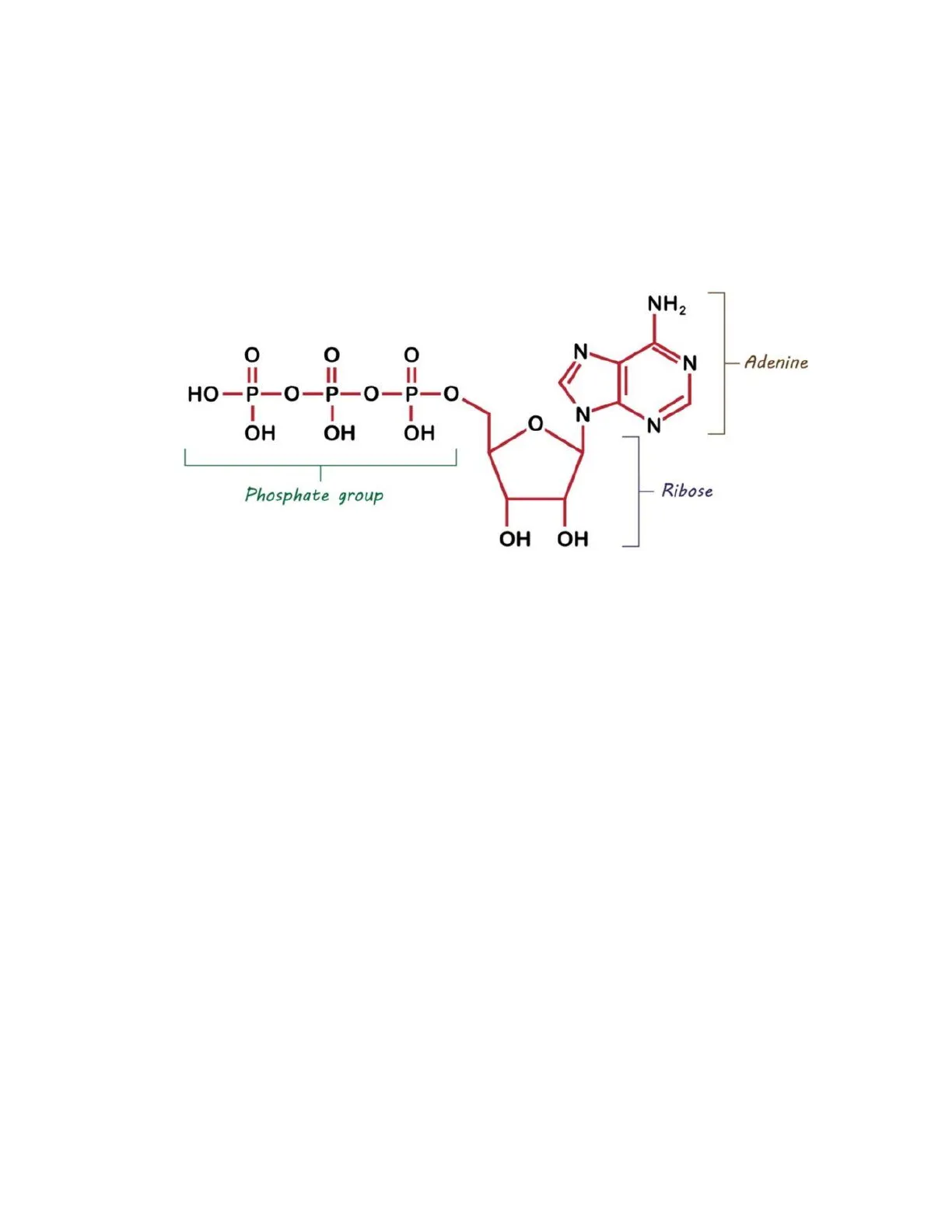
Let's start with the structure of the biochemical energy source. ATP consists of an adenine attached to the sugar, ribose. A triphosphate group is also bound to the ribose (see Figure 1).
NH2 0 O O N N - Adenine HO-P-O-P-O-P-O I I N O N OH OH OH Ribose Phosphate group OH OH Figure 1: The Structure of ATP Credit: Shutterstock
The triphosphate portion of ATP is the source of energy used to drive biochemical activities. The three phosphoryl groups are labeled as alpha (a), beta (B), and, for the terminal phosphate, gamma (y). The triphosphate group is joined to ribose via a phosphoester linkage. Two phosphoanhydride linkages join the three phosphoryl groups. Biochemists refer to the phosphoanhydride linkages as high-energy bonds. When these bonds are broken, the released chemical energy powers the energy-requiring processes within the cell.
When the bond between the gamma and beta phosphoryl groups is broken, the compound ADP forms and releases a phosphate molecule. AMP and pyrophosphate form when the linkagebetween the beta and alpha phosphoryl groups is broken (see Figure 2). The phosphoanhydride linkage joining the two phosphate moieties of pyrophosphate can be further broken down into two phosphate molecules, releasing additional energy that can also be used to power cellular activities.
ATP Adenine Triphosphate A P P P Phosphate Ribose P Energy absorb (from food) ATP-ADP cycle Energy released (for cell) P Phosphate P P Adenine Diphosphate Ribose ADP Figure 2: Hydrolysis of ATP Credit: Shutterstock
ATP forms in the cell through a variety of biochemical pathways. These pathways involve the breakdown of "fuel" molecules (such as sugars and fats), which, in turn, release chemical energy that drives the formation of ATP from ADP and inorganic phosphate. The enzyme complex ATP synthase ultimately makes most of the cell's ATP.
The Cellular Economy
Using a single molecular species (primarily) to store and supply energy for biochemical operations relies on the same logic that undergirds the use of currency to drive an economy. Hence, ATP is called the energy currency of the cell.
Imagine that you work for a farmer to appreciate the ingenuity of using a single molecular species as the energy currency. Without currency, he can only pay you for your labor with goods, say, oranges in his orchard. If you need shoes, you must hope the shoemaker needs oranges. If he doesn't, you can't get the shoes. You now need to find someone who will take the oranges and provide you with the goods that the shoemaker needs.
If no one wants oranges, you are out of luck procuring goods and services. And you (and anybody else for that matter) are unlikely to work for the farmer unless he agrees to give you some other commodity for your labor that you can easily exchange for the goods and services you desire. If he can't, then you will lose a job, and he will lose labor.
Currency eliminates all these problems. Because it is a standardized medium of exchange that has value, it can be used to pay laborers who, in turn, can use it to buy whatever productsthey want. Shopkeepers can accept currency from them because they are confident they can use it to buy whatever they want.
Similarly to this imaginary scenario, the cell could employ a bartering system. Instead of using ATP as an energy store and currency, the energy released when the chemical bonds of "fuel" molecules break apart, in principle, could be directly used to drive biochemical activities. However, if specific biochemical operations were coupled to the breakdown of particular molecules (or the breakdown of specific bonds within specific molecules), it would lead to molecular-scale inefficiencies in the same way that bartering frustrates economic efficiency. Specific biochemical processes in the cell could only occur if the just-right type of "fuel" molecule were present in the cell or at the just-right levels. For example, if a particular biochemical process required the breakdown of a specific chemical bond in the sugar molecule, glucose, and if insufficient glucose levels existed in the cell, the necessary biochemical process couldn't occur until other metabolites were converted into glucose.
This conversion would most likely involve a highly convoluted series of chemical reactions-in the same way that multiple exchanges must occur in a barter economy to satisfy everyone involved. The inefficiency of a barter-based metabolic economy would be so extreme that it raises questions-at least for me as a biochemist-about the possibility of life without some type of energy currency.
Additionally, ATP's use as an energy currency helps maintain balanced biochemical processes in the cell. In the same way that economies can be slowed down or ramped up by controlling theamount of currency, the metabolic operations in the cell can be dialed up or down based on ATP levels. When ATP levels are high, energy-harvesting pathways slow down, and energy-consuming pathways speed up. When ATP levels are low, the reverse scenario occurs, with energy-generating pathways speeding up their operation and energy-consuming pathways slowing down.
Biochemical Energy Currency and the Watchmaker Argument
The remarkable similarity between the role ATP plays in the cell's economy and currency plays in human economies allows us to advance a version of the Watchmaker argument for God's existence and role in the origin and design of life.
British natural theologian William Paley (1743-1805) proposed this argument by highlighting the characteristics of a watch, specifically the complex interaction of its precision parts to tell time. He maintained that the contrivances integral to the watch's design implied the work of an intelligent designer-a watchmaker. Paley demonstrated that systems in biology share the same characteristics that cause us to recognize a watch as the product of a designer. Therefore, by analogy, as a watch requires a watchmaker, life also requires a Creator.
In my book The Cell's Design, I argue that the latest insights into the structure and function of biomolecules add new vitality to Paley's Watchmaker argument. For example, many molecular-level biomachines are strict analogs to human-made machines concerning their architecture, operation, and assembly. As a case in point, some protein complexes, such as ATP synthase (the enzyme complex that makes ATP from ADP andphosphate), bear astonishingly similar to motors designed by humans. These protein complexes have rotors, stators, drive shafts, cams, turbines, and universal joints. The one-to-one relationship between the parts of human-made machines and the molecular components of biomachines is startling and further justifies Paley's conclusion that life stems from the work of a Creator. We can add the discovery of ATP's role as the cell's energy currency to the revitalized Watchmaker argument.
The use of currency to generate economic efficiency is a human invention. It might be the greatest, most ingenious human invention of all time-even more significant than the wheel. If not for the invention of currency, efficient economies would be impossible-and so would human civilization. And suppose using currency to generate economic efficiency is an ingenious human design. In that case, the use of biochemical energy currency must also reflect an intelligent agent's ingenuity.
Why ATP?
Scientists now recognize the necessary role of a biochemical energy currency. But why was ATP "selected" as the energy currency? Why not some other biomolecule?
ATP serves universally as the biochemical energy currency. Every organism on Earth uses ATP to power its metabolic operations. From an evolutionary perspective, this recognition means ATP must have been employed as the cell's energy currency in LUCA (the last universal common ancestor) and perhaps in the cells that preceded LUCA. In an evolutionary framework, ATP's usefulness as the biochemical energy currency must have been an early invention.
Many evolutionary biologists would argue that ATP's choice as the cell's energy currency was happenstance. It resulted from the outworking of an unguided, undirected evolutionary process constrained by history. In other words, there was no rhyme or reason for why ATP was selected as the cell's energy currency. It's just the accidental outcome of evolutionary history.
Alternatively, other researchers propose that the forces of natural selection led to ATP as the optimal (or near-optimal) choice as the cell's energy currency.
As it turns out, biochemists have identified several reasons why ATP is well-suited for its role as the biochemical currency for the cell's energy. This fact explains ATP's ascendency as the universal energy currency.
One reason relates to other roles ATP plays in the cell. Not only does ATP function as the cell's energy currency, but along with the ribonucleotides GTP, CTP, and UTP, ATP is one of the building block components for RNA. This class of biomolecules plays a critical role in expressing the information found in DNA. For example, the cell's machinery produces messenger RNA by copying the information harbored in the DNA molecule in regions (called genes). The RNA copies, in turn, direct the production of specific proteins. These biomolecules then form the structures that comprise the cell's components and carry out the cell's operations. By utilizing one of the building blocks of RNA as the biochemical energy currency, gene expression is linked to the cell's energy status. Minimizing gene expression overall is best when the cell's energy status is low. On the other hand, it makes sense to accelerate the expression of genes that code for proteins that play a role in energy-harvesting processes.
Can’t find what you’re looking for?
Explore more topics in the Algor library or create your own materials with AI.