Management principles: institutions and companies as open systems
Slides from Iulm about Management. The Pdf explains the fundamental concepts of Management, focusing on institutions and companies as open systems, their functioning, and results. The Pdf, useful for university students of Economics, covers inputs, activities, outputs, and stakeholder satisfaction.
See more40 Pages


Unlock the full PDF for free
Sign up to get full access to the document and start transforming it with AI.
Preview
Management and Institutions
Management deals with the economic functioning institutions, with the aim of identifying and recommending the rules for the healthy functioning of institutions. Institutions => a group of people that join together for a purpose, a permanent group such as
- Families
- Companies
- Government
- No profit
All the institutions have to take decisions that involve economic dimension. The aims are more than one, and "making money" is not enough for an institution, the final purpose is the "mission".
Company Definition
COMPANY: => The firm that a group of people uses to perform economic activities for a common business goal => An organization that operates on a for-profit basis and participates in selling goods or services to the customers => An entity that has a separate legal existence from its owners (shareholders). Its legal status gives the company the same rights as a physical person, which means that a company can incure debt, sue and be sued
The Company as an Open Input-Output System
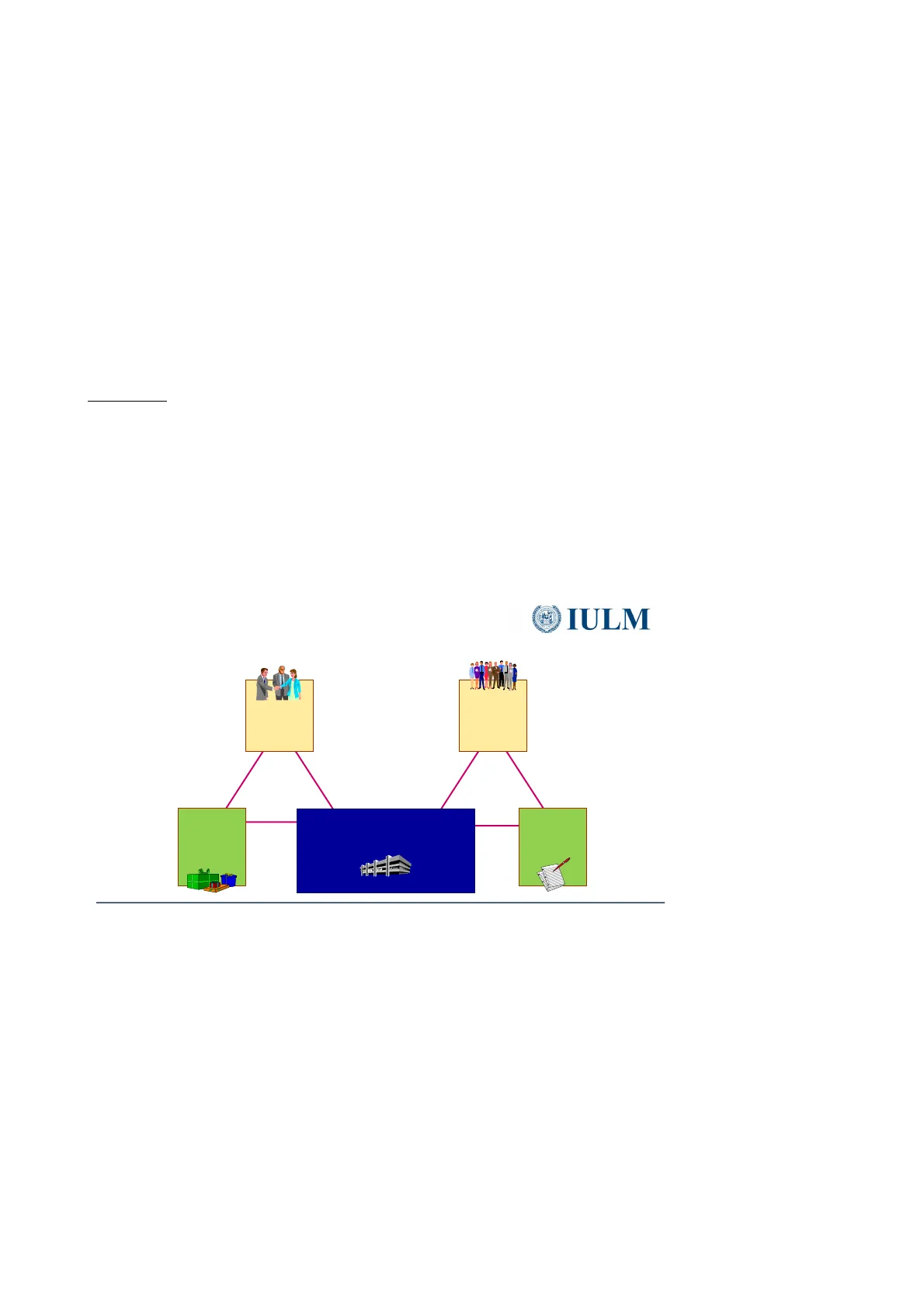
IULM THE COMPANY AS AN OPEN INPUT-OUPUT SYSTEM (MODEL) Resources suppliers Customers Product «system» offered The company as a system Collaboration offers 25 => Product system: when you buy an object, you don't just buy the object but you also buy the quality and the image of the company. "Product system" highlights the fact that a product has both the physical and the intangible part => Open system: the company interacts with the external environment. It is called a "system" because it is made up of different but interrelated components, that work together for a common purpose. Its aim is to create wealth over time, through transforming inputs into outputs (resources into products). The company has to ensure to obtain its resources => so it offers to its suppliers and gives them both money and intangible objects.The "External environment" is . on one side the ability to sell the product system to the customers and, . on the other side the ability to get from the resources suppliers all the resources that the company needs to obtain its product. To be sure that the company can ensure itself to obtain the resources, the company offers to these suppliers (employees, banks, government) a set of intangible offers. Going back to the scheme: we call the left side of the scheme the competitive environment and we call the right side the institutional environment.
The Firm and its Environments
THE FIRM (2) => The company at the bottom in the center + left side = competitive environment => Right side = institutional/social environment. => The company exchanges with both environments. We think of the company as an open system, because it is in continuous exchange with these 2 environments. => The company breathes by exchanging different things (products, services, money, ... ) with these two environments
Inputs, Activities, and Outputs
INPUTS ACTIVITIES OUTPUTS
Primary Resources
Primary resources: * Labor * Money * Organization
Derivative Resources
Derivative resources: * Accounting * Technical-industrial * Commercial * Management
Results
Financial Competitive Institutional * The company needs resources to survive, and these can be tangible or intangible. * Technical-industrial resources => how to produce the product * Commercial resources => related to how to sell the product * Management activities => related to the business of the company * Organization activities => how you organize your staff, so division of labor and selecting * Accounting activities => about numbers, information that we need to understand if the company is doing well, numbers enable managers to understand if something into the company has to be changed * Results => competitive, institutional and financial
Management Activities
Management activities are related to business activities and we have two types of them:
- Strategic decisions => long term, fundamental for the survival of the company, affect it in a long run. These decisions also decide how primitive resources are transformed into derivative resources. So labor and capital invested into technical-industrial and commercial resources
- Operation decisions => short visions, day-to-day activities
Resources and Management Activities Diagram
RESOURCES AND MANAGEMENT ACTIVITIES IULM Legenda Stock of resources Flows of operations DERIVATIVE RESOURCES Strategic management Operations management PRIMARY RESOURCES 27
Primary Resources and Strategic Management
Primary resources Strategic management TECHNICAL- INDUSTRIAL RESOURCES Purchases ¡Derivative resources! ( Operations management) Investments Production LABOUR CAPITAL COMMERCIAL RESOURCES Sales
Outputs of a Company
OUTPUTS: There are three types
- Competitive
- Institutional (like the 2 environments with which the company exchanges)
- Financial
Commercial resource that is not created by investing => if a company, despite all the marketing campaigns, is not satisfying all the needs of the customers, it will still have a bad reputation => there are resources that don't come from investing money but from the operations of the company => from how the company operates. * Resources that are built overtime: o know-how o reputation * Resources that you get by doing:o sale-commercial resources = reputation + production-technical and industrial resources = learn how to better produce a product by doing so a lot overtime.
IKEA Case Study
IKEA CASE Represent IKEA according to the input-output system model
- Analyze the three components of the blue box (resources-activities- results)
- Analyze how Ikea behaves within the competitive environment and with the institutional environment
=> Why do we call the company a system? = > It is made up of different but interrelated elements that work together for the common purpose of the functioning and well-being of the company => creates wealth by transforming inputs into outputs. => It is an open system, because to function it needs the exchange with the external environments.
Primary Resources at IKEA
1) Primary resources: capital and labor. => Capital: row net capital in 2015 is 34896 while in 2016 it is 38907 millions = the capital that the funding family originally invested was much lower than this => the row net capital of 2016 is the value of the company itself in that year => why does this change overtime? The capital increases overtime because of the performance of the company. If the company is healthy, it produces wealth that can be re-invested in the company and the capital increases => the capital therefore consists in the profits that are re-invested in the company. The capital can also increase because the shareholders put their money in the company. It can also be profits that a healthy company makes and that are re-invested and make the capital increase. Net capital is also called "equity" Þ Debt, compared to equity, is 15.060 and it is around less than half of the net capital. Debt = what the company owes to a bank and needs to give it back. Ikea uses lots of capital and little amount of debt; so the specific strategy of the company is earning money before spending them/ re-invest your own profits and not the money given by the bank. => Labor: 163000 employees (relevant amount) => Ikea has a relevant amount of primary resources. An international company that has to produce a lot of products to sell worldwide => they need a lot of capital and lots of people. Capital also depends on the size of the company; to sell all these products to lots of customers all over the world, a lot of capital and of employees are needed. Primary resources are used to buy derivative resources. Which derivative resources has Ikea acquired by investing primary resources? Which commercial resources and which technical- industrial resources?
Technical and Industrial Resources at IKEA
- Technical and industrial resources: strategic decision to invest in alternative materials that are cheaper and of higher quality with attention to the environment; suppliers network (intangible resource related to the industrial part of the business)+ know how on how to select suppliers (criteria that came out from good and bad experience that came from running the business) ; engines for production; ikea lab, where ikea tests all material; designers employed; warehouse; knowledge, ...
Commercial Resources at IKEA
- Commercial resources: model rooms where the customer is the protagonist in the store to present the furniture; online and offline catalogue; software for customers to build up their rooms on their own; From the know-how of modular design, which means buying different parts of a chair from different designers, Ikea saves money.
Activities at IKEA
- Activities: strategic management = big decisions and related activities with long-term impact (what customers' needs do we want to satisfy? Where do we want to sell our products?)
- Operations management = day-to-day activities of routine for the firm to produce and sell goods in the market => decisions and activities that exploit the already existing structure.
Results at IKEA
RESULTS: Competitive results measure customers' satisfaction, because if customers are satisfied with products of a company, they will not turn to competitors if the price of the goods raises a little. How can I make customers satisfied? A balance between the customers' needs, resources and activities of the company and the product system of a company. * Customers of Ikea are young customers that want to save money, usually * Ikeas has a business system (resources+ activities) that makes products the needs of these customers in a different way from other competitors.
Measuring Customer Satisfaction
How can we measure customers' satisfaction? => Indicator: market share of the company = how much the brand is actually selling => greatest indicator to measure competitive results => Market share is measured by the percentage of sales in an industry generated by a particular company => The company market share is the portion of total sale a company does in relation to the industry it operates in. Company sales in a year / total sales of all the companies of that industry in that same year. => Range: from 0 to 100 %. If the company has 0% market share, the company doesn't sell anything. If the company has 100% market share in a specific year, it means that the company is the only company everyone buys from => monopoly in a specific industry * Example: I have three bars that sell coffee. Bar 1 sells 10 coffees, bar 2 sells 20 and bar 3 sells 30 => total market = 60. Price of bar 1 per coffee = 1,50; bar 2= 1; bar 3= 1 => bar 1 = 15 euros, bar 2 = 20; bar 3 = 30 euros => total market = 65 euros. Market share of bar 3 =? = > company (bar3) sale / total sales in the industry/market = 30/65 = 46% of market share in the market (bar 3) -> bar 3 has shares of almost half of the market. Market share of bar 1= 15/65= 23% In the Ikea case, we have revenues but we don't have the size of the total market of the industry, so we can't measure the results using the market share. But we know that Ikea is a leader in the market in which it operates and it has a market share of 15%. If I have a market share of 15% and I just have one competitor, my competitor will have 85% of market share. Instead, if the market has a lot of players, my competitors will have 0.85% of the market share each (not even 1%), which is a great result. Therefore, to properly interpret the market share, the number is not sufficient, because the same number can have very different meanings according to the number of competitors in the market. With Ikea, we don't have information regards to the size of the market, however we can use a proxy (similar measure) to calculate competitive success that is calculating the growth in sales overtime => You can calculate the growth in sales from 2007 to 2016 or from one year to the other and then compare it to the growth in sales of competitors => the higher our growth in sales is compared to competitors the happier we are. The growth in shops, employees, ... are not measures for competitive success but just of the size of the business or of attempts of a company to grow but will not necessary equate a growth in sales.
Institutional Results
=> Institutional results: satisfaction of suppliers and stakeholders in general. We don't have one general measurement to measure social results, but specific stakeholder measurements. Ex .: turnover rate (number of employees that have left the company/number of employees at the beginning of the year)
Can’t find what you’re looking for?
Explore more topics in the Algor library or create your own materials with AI.
