Types of Vessels: Transportation, Cargo, and Leisure Crafts
Slides about Types of Vessels, classifying them by purpose: transport, assistance, fishing, leisure, and military. The Pdf details general cargo ships, bulk carriers, recreational craft, and the general arrangement plan of a ship, including internal sections and maritime terminology. Useful for university students studying naval classifications.
See more42 Pages

Unlock the full PDF for free
Sign up to get full access to the document and start transforming it with AI.
Preview
Types of Vessels
P
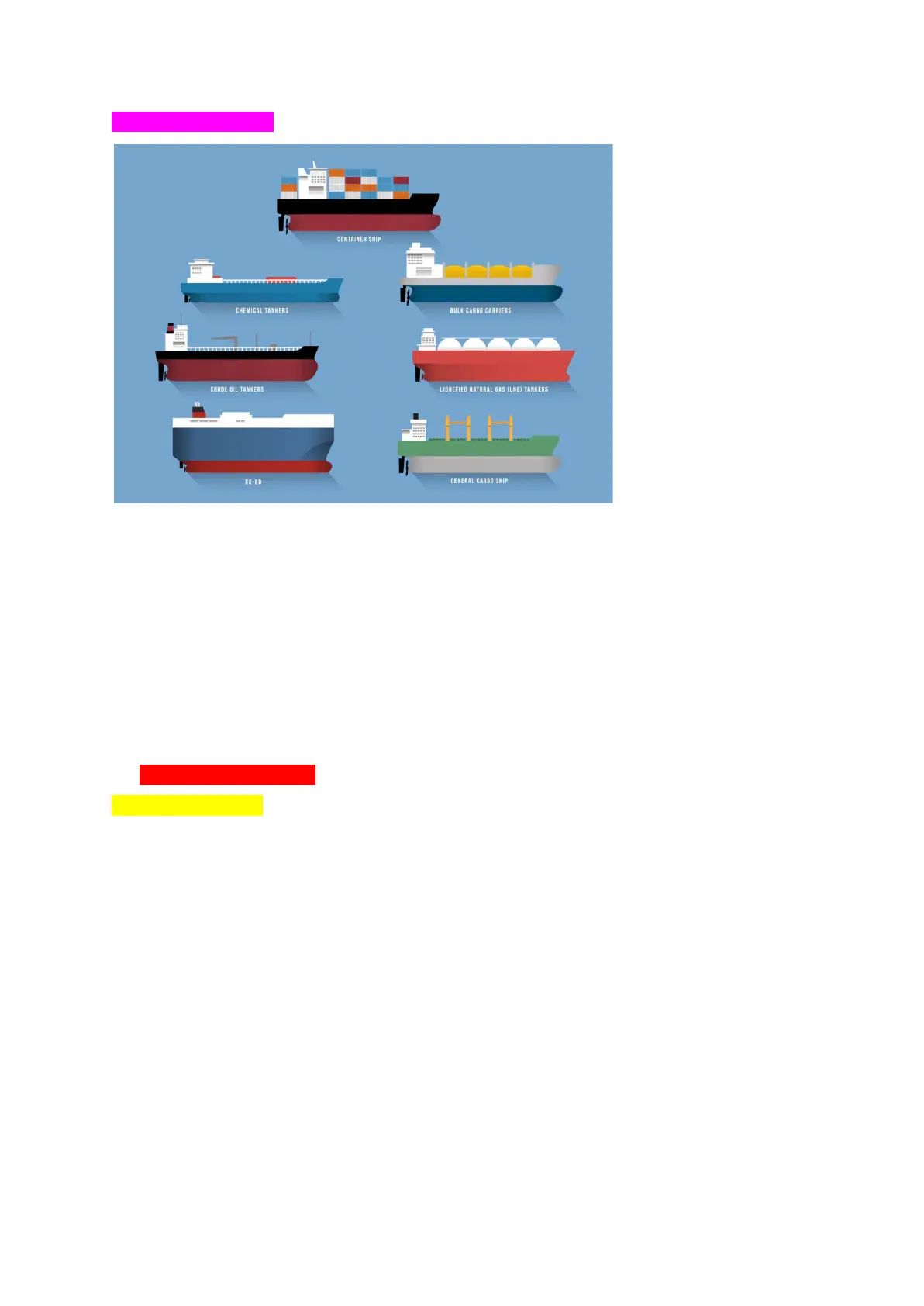
CONTAINER SHIP CHEMICAL TANKERS BULK CARGO CARRIERS CRUDE OIL TANKERS LIQUEFIED NATURAL GAS (LNG) TANKERS RO-RO GENERAL CARGO SHIP
Vessels are classified according to the purpose they serve
- Transportation of cargo or/and passengers
- Assistance and service (special)
- The catching on fish (fishing vessels)
- Leisure
- Peace keeping (warships)
Transportation Vessels
Liners vs Tramps
Vessels designed to transport cargo and/or passengers are merchant ships. They may be classified as liners or tramps.
Liner Shipping
Liner Shipping means liner services when a Shipping company engage their feet of ships to carry cargo between predetermined ports at regular intervals under publicly advertised schedule.
- Fixed lines, fixed ports, fixed schedule, fixed freight rate, shipping mode is container shipping.
Tramp Shipping
Tramp shipping is irregular shipping, mainly over nonstandard routes, with no definite schedule
- no fixed lines, no fixed ports, no fixed schedule, freight rate is not fixed, shipping mode is bulk shipping, homogeneous product.
General Cargo Ships
- Generalcargo is cargo that has been packed in crates, boxes or bags, or cargo coming in pieces. No carry liquids
- Cargo Is Loaded and discharged by the derricks of the vessel or by shore based cranes.
- Thesearebecomingrather obsolete since general cargo is more and more transported by vessels that have been designed to carry general cargo in containers.
- Do not have place for containers. They have their own gruas inside the ship used to do charges and unloads in the ports.
- It does transport of dry and irregular charge and it's not apt for containers.
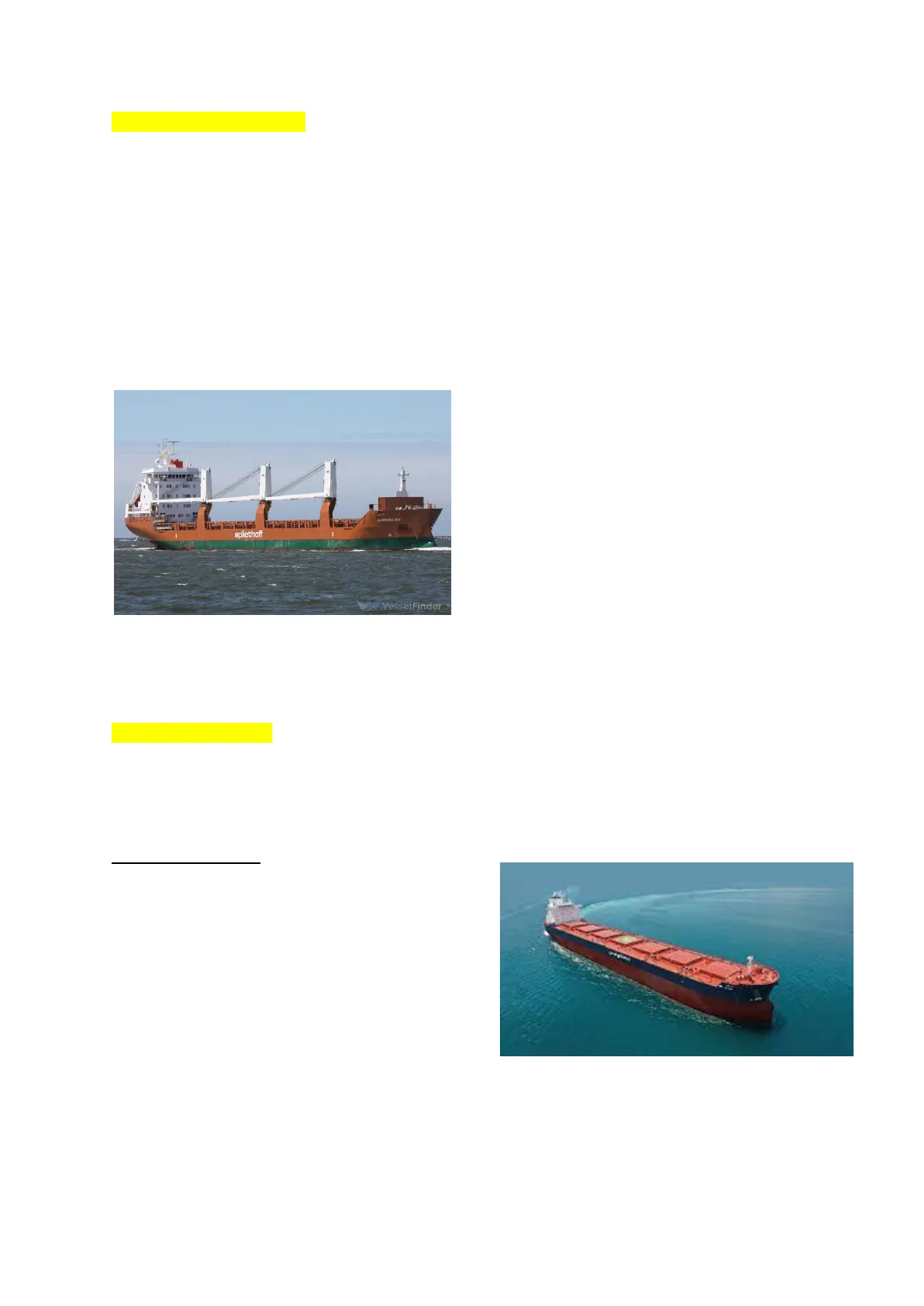
MARSGRACHT spliethoff VesselFinder
Bulk Cargo Ships
These ships carry their cargo in bulk (a granel) Bulk can be: dry bulk or liquid bulk
Dry Bulk Cargo
A dry bulk carrier is a vessel designed to carry dry cargoes in bulk. Cargoes such as grains, minerals, iron ore, coal, bauxite, alumina, phosrock etc, but also general cargo such as bagged cargoes, forest products and steel products. Can not be liquid or gaseous
- Bulkcargo is unpacked cargo of one commodity.
- Dry bulk cargo, such as grain, ore, fertilizers, etc. is carried in specially designed vessels with holds (bodegas) that have been divided into compartments by longitudinal and transverse separations, so that the stability of the ship is not affected by a full cargo.
- Drybulkcargo is loaded and discharged by cranes with grabs or by pumps
Liquid Bulk Cargo (Gas Tankers) (LNG)
Is a tank that carries bulk liquid freight, such as gas, acids, agrichemical products, and hazardous materials, in a trailer pulled by a freight truck. The tanks are usually cylindrical Liquid bulk cargo can be classified into various categories based on the nature of the liquid and its characteristics. Some common types of that include:
- Crude Oil: Unrefined petroleum extracted from oil wells is transported to refineries for processing.
- Petroleum Products: Refined products derived from crude oil, such as gasoline, diesel, jet fuel, and liquefied petroleum gas (LPG).
- Chemicals: A wide range of chemicals, including industrial chemicals, acids, solvents, fertilizers, and pharmaceutical ingredients.
- Liquefied Natural Gas (LNG): Natural gas cooled to a liquid state for efficient storage and transport.
- Liquid cargoes such as crude oil, petroleum, edible oils, etc. are carried in tankers, for example in VLCC, chemical tankers, such as Liquefied Petroleum Gas Tankers (LPG carriers) or Liquefied Natural Gas tankers (LNG carriers).
- For Safety reasons tankers must be fitted with double bottoms. These spaces also provide storage for fuel, lubricating oil and waters
Food and Beverage Liquids: This includes edible oils, fruit juices, wine, milk, and other liquid food products.
L N G Oil tanker with stainless steel piping Source image: https://products.damen.com/en/ranges/oil-tanker/tanker-5700 / Liquefied Gas Carrier
Oil Tankers VLCC (Very Large Crude Carriers)
- Se toman muchas precauciones (safe and incident free)
- 99.99% of the petroil arrives on destination without incidents
- The professionals who work on these types of vessels are very trained and have a lot of professional skills. The captain crew must be well prepared
- Nowadays the ships have a lot of technology. 2 GPS which works independently. 2 radar systems constantly scanning the surrounders and many others to operate the ship safely. Its also have redundant engineering; below-deck tankers feature tho identical engine rooms each capable of driving the ship.
- Water is contained completely within a waterlight inner half if a breach occurs on the outer hull the inner hall prevents cargo from escaping.
29 m Coastal Tanker (205 m) 34 m Aframax (255 m) 45 m Suez-Max (285 m) 55 m VLCC (330 m) 63 m ULCC (415 m) PEMP
Container Ships
Cargo that has been containerized is carried by container ships Containers are often measured in Twenty Foot Equivalent Units (TEU's) and are stowed in a cellular arrangement in Rows, Bays and Tiers.
TIERS MOBILUNE BAYS ROWS
Roll-On / Roll-Off Ships (RORO)
On a Ro/Ro ship, cargo is rolled on and rolled off. The advantage of this system is that no cargo handling equipment is required. The loaded vehicles are driven via ramps through special stern (popa) and bow (proa) doors are properly secured. Upon arrival in the port pf discharge, the vehicles are released and driven ashore to their destinations.
RORO 2300
Refrigerated-Cargo Vessel (Reefer)
Refrigerated-cargo vessels are ships that carry perishable cargoes, such as meat or fruit. These cargoes require cooling and must be stored in spaces that have precise temperature and humidity controls during the voyage Reefers are equipped with refrigerating plants
Reefer Types
- SIDE- DOOR VESSELS: have water-tight ports (puertos herméticos) on the ship's hull, which open into a cargo hold. Elevators or ramps leading from the quay (muelle) serve as loading and discharging access for the forklifts or conveyors (carretillas elevadoras o transportadores). This special design makes the vessels particularly well suited for inclement weather operations as the tops of the cargo holds are always closed against rain and sun. This ship type is well suited for the handling of palletized and loose cargo (carga suelta o paletizada).
Teoriade
- CONVENTIONAL VESSELS: have a traditional cargo operation with top opening hatches (escotillas) and cranes (grúas) /derricks (cables). On such ships, when facing wet weather, the hatches need to be closed to prevent heavy rain from flooding the holds (inunden las bodegas). This ship type is well suited for the handling of palletized and loose cargo
GREEN REEFERS
- REFRIGERATED CONTAINER SHIPS: These ships differ from conventional container ships in their design, power generation, and electrical distribution equipment in order to power each container's cooling system. Because of their ease of loading and unloading cargo many container ships are now being built or redesigned to carry refrigerated containers.
MARISE MAERI
- MAERSK LINE Knowing the reefer Maersk Line - YouTube
Heavy-Load Vessels
Heavy-load vessels have been designed to lift and carry extremely heavy cargo on the main deck. (coberta principal) Their cargoes, such as drilling platforms, engines, yachts, trains, derelicts (abandonos) and wrecks (naufragio), are loaded onto the main deck, which is flat and free from any obstacles. A special way of loading and carrying heavy cargo is performed by submerging the ship and having the cargo-module float over it. Pot enfonsar se 16m i 110.000t pot suportar
JUMBO SHIPPING Heavy lift cranes Source in
Multi-Purpose Vessels
Cargo ships that carry general cargo, bulk cargo and containerized cargo are called multi purpose (or multi-load) vessels. The difference between Multi-Purpose Vessels (MPV) and General Cargo Vessels (GCV) is that GCVdon't carry liquids, whereas MPV do. These ships are equipped with a variety of cargo handling gears/equipment to load and discharge the different types of cargoes. An OBO-ship has been designed to carry oil/bulk/ore(mineral). This ship has been subdivided in such a way that oil can be carried in the largest compartments and ore can be carried in the smaller compartments
Cruise Ships and Ferries
Cruise ship: designed for longer voyages and take passengers to places on vacation. Some cruise run as short as one or two nights while others can last 100 or 120 nights. Cruise ships offer a variety of cabins to sleep, a variety of dining choices, entertainment, many offer spas, gyms, pools, bars, cafes and other amenities one would not find on a ferry but in a hotel or vacation resort. Ferry: is a smaller, utility based ship that transports passengers, cargo, crew and some times vehicles like cars, trucks, trains or busses from one portion of land to another over a body of water. Typically a ferry will be a day-long or over night type ride or shorter. Ferry boats do not typically offer any rooms or entertainment. They may offer a snack bar or cafe, but nothing as substantial as a cruise ship.
Assistance and Service Vessels
Vessels that assist and give service have been designed to perform specific tasks, for example assisting other vessels or providing special services to navigation
Tugs
A tug (remolcador) is a vessel that assists other vessels to enter or leave port, tows (to pull using a line or chain) an oil rig to its position or assists with a salvage operation. Their Engines must be capable of developing enormous powers. The largest and most powerful tugs are often fitted with Controllable Pitch (inclinación) Propellers (C.P.P) that have adjustable blades. (helices de inclinación controlables que tienen palas ajustables) Their maneuverability will be enhanced even more by bow (proa) and stern (popa) thrusters (propulsores) N.B .: The difference between aft and stern is that aft is the inside (onboard) rearmost part of the vessel, while stern refers to the outside (offboard) rearmost part of the vessel. The stern is opposite the bow, the "outside" (offboard) of the front of the boat. Fore is the opposite of aft. Su maniobrabilidad se verá reforzada aún más por las hélices (propulsores) de proa (proa) y popa (popa) N.B .: La diferencia entre popa y popa es que popa es la parte trasera interior (a bordo) de la embarcación, mientras que popa se refiere a la parte trasera exterior (fuera de borda) de la embarcación. La popa es thrusters
Buoyage Vessel / Buoy Laying Vessel
A buoyage vessel places and maintains buoys. Her aft deck is flat (su cubierta de popa es plana) and provides room to carry or haul (arrastrar) in the buoys with her hoisting (izar) installation
Can’t find what you’re looking for?
Explore more topics in the Algor library or create your own materials with AI.
