Meiosis: Formation of Germ Cells, Universidad Europea
Slides from Universidad Europea about Meiosis: Formation of Germ Cells. The Pdf explores the phases of meiosis, its characteristics, and comparison with mitosis, analyzing genetic variation and gamete formation. The Pdf, a presentation for University Biology, presents complex concepts clearly with diagrams, making it useful for autonomous study.
See more42 Pages

Unlock the full PDF for free
Sign up to get full access to the document and start transforming it with AI.
Preview
UNIT 5
Meiosis: Formation of Germ Cells
- Sexual reproduction and meiosis
- Features of meiosis
- Phases of meiosis
- Comparison mitosis vs meiosis
- Genetic variation
- Formation of gametes
- Fertilization
QUESTION EVERYTHING
ue Universidad Europea¿What is meiosis?
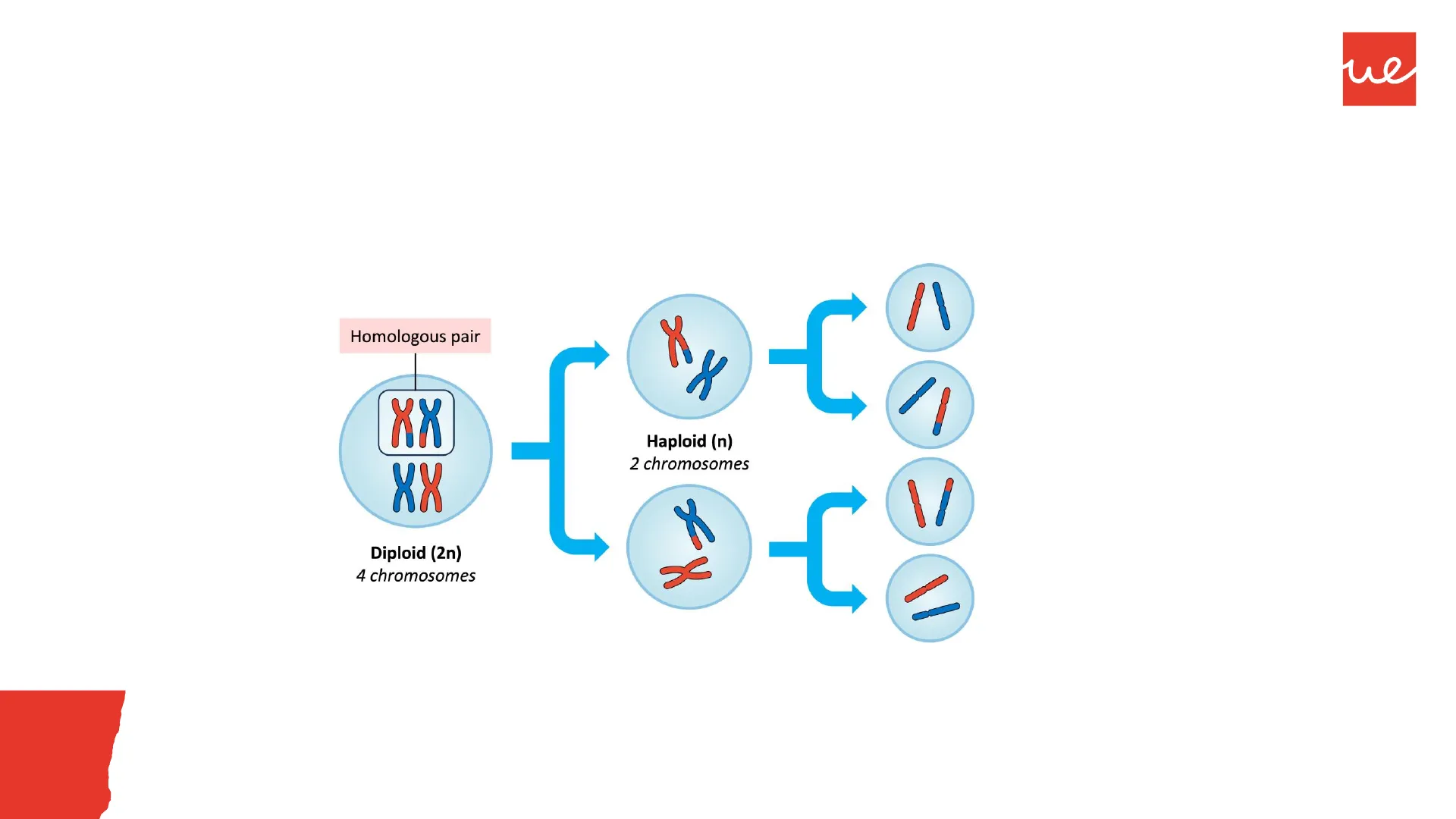
ue Meiosis is a type of cell division that reduces the number of chromosomes in the parent cell by half and produces four haploid cells.
Homologous pair X X XX Haploid (n) 2 chromosomes
XX Diploid (2n) 4 chromosomes X It is a sequence of two nuclear divisions: · The first division is reductional (2n -> n) (homologous chromosomes are distributed). · The second division is similar to mitosis (sister chromatids are distributed).Remember ... . Homologous chromosomes: Present in diploid (2n) organisms.
Diploid (2N) Haploid (N) One chromosome of each homologous pair comes from the mother (called a maternal chromosome) and one comes from the father (paternal chromosome).
Homologous chromosomes are similar but not identical. Each carries the same genes in the same order, but the versions of each gene may not be the same.
D Homologous pair (chromosome 1)
Homologous pair (chromosome 2) Paternal copy (from father) Maternal copy (from mother)3. CHROMOSOMES Other important concepts: Locus (plural loci): A fixed position on a chromosome, such as the position of a gene or genetic marker
19p13.2 19p13.12 19p12 19q12 19q13.13 19q13.31 19q13.33 19q13.42 Alleles: Different variants of a gene
Homologous chromosomes Allele for attached earlobes (e)
Allele for free earlobes (E)
Gene for earlobesChromosomes and alleles In a pair of homologous chromosomes, one is inherited from the male parent, and the other from the female parent.
Paternal homologue
Maternal homologue
KT 1 2 3 4 5 r r 6 7 8 9 10 11 12
P P At each genetic locus, an individual has two alleles, one on each homologous chromosome.
13 14 15 16 17 18
AA = Homozygous - dominant
A A
19 20 21 22 X/Y
bb = Homozygous recessive
b b
- Three gene pairs at three different loci
Cc = Heterozygous-> C C
4 A genetic locus is the location of a particular gene on a chromosome.ue Types of cells in a sexually reproducing organism Somatic cells: These are all the cells that make up the body except for the reproductive cells. E.g .: skin, liver, eyebal. They are diploid (2n) and divide through mitosis > ensure genetic consistency in all body cells.
Germ cells: These are specialized cells involved in reproduction, giving rise to gametes (sperm and egg cells). They produce haploid gametes through meiosis -> create genetic variation.
n 1 1 1 1
C . . L 1 11 12 13 15 - - 5 x . 1 . € 1Sexual reproduction and meiosis Gametes: Only one set of chromosomes > haploid cells (n) During sexual reproduction: the haploid sperm and egg unite to form a single diploid cell and the number of chromosomes is restored in the offspring
Haploid sperm
Paternal homologue
Fertilization - Maternal homologue
Diploid zygote
Haploid egg
The zygote increases their amount of cells by mitotic divisions
Gametes Male (n) Female (n)
Meiosis
Fertilization
HAPLOID (n)
DIPLOID (2n)
Zygote (2n)
Mature organism (2n)
In the diplontic life cycle, the organism is diploid and the gametes are the only haploid stage.Sexual reproduction and meiosis
ue Meiosis produces four gamete cells that are genetically different from each other and from the mother cell (Process of recombination- gene exchange)
Meiosis consists of two divisions with one round of DNA replication: the parent cell undergoes two rounds of cell division (Meiosis I and Meiosis II) with no replication of genetic material between them.
In meiosis I, the homologue chromosomes divide, reducing the chromosome number to the haploid state (n, reductive division).
Meiosis II (second division without prior replication): similar to mitotic división . Sister chromatids become separated.
Each haploid daughter cell (n) " Contains one single set of chromosomes Has a new combination of genes Is different from the mother cell and from the other daughter cells
Increased diversity of the genetic pool (species level)
10Sexual reproduction and meiosis
MITOSIS VS MEIOSIS
ue MITOSIS VS
Before Division Homologous pair of chromosomes one diploid parent cell
Interphase - chromosomes replicate
Homologous pair of replicated chromosomes
5 Meiosis I - first cell division
Homologous pair of replicated chromosomes separates
X Meiosis II - second cell division
Sister chromatids separate
1 four haploid daughter cells
Attack of the clones! @Amoeba Sisters
MEIOSIS 1(A)
MEIOSIS (B)
MITOSIS
paternal homolog
MEIOTICS PHASE
maternal homolog
Į DNA REPLICATION
DNA REPLICATION
Meiosis: S phase + two rounds of chromosome segregation
>
Meiosis I (genetic recombination) Homologues pair up and are segregated into daughter nuclei.
Meiosis II: sister chromatids are segregated.
MEIOSISI
SEGREGATION OF HOMOLOGS AT ANAPHASE I
DUPLICATED CHROMOSOMES LINE UP INDIVIDUALLY ON THE SPINDLE
SEGREGATION OF SISTER CHROMATIDS AT ANAPHASE II
MEIOSIS I
haploid daughter cells
diplold daughter cells
Mitosis: Sister chromatids are segregated. Two genetically identical diploid daughter cells
SEGREGATION OF SISTER CHROMATIDS AT ANAPHASE
15 PAIRING AND CROSSING OVER OF DUPLICATED HOMOLOGS
HOMOLOG PAIRS LINE UP ON THE SPINDLE3. Phases of Meiosis
Meiosis I (1st meiotic division)
- Prophase I:
- Leptotene
- Zygotene
- Pachytene
- Diplotene
- Diakinesis
- Metaphase I
- Anaphase I
- Telophase I
Meiosis II (2nd meiotic division)
- Prophase II
- Metaphase II
- Anaphase II
- Telophase II
18Meiosis I (1st meiotic division)
Prophase I
Metaphase I
Anaphase I
Telophase I & cytokinesis
Centrosome Centrioles Spindle Chiasmata Nuclear envelope (Fragment)
Homologous chromosomes
The chromosomes condense, and the nuclear envelope breaks down. Crossing-over occurs.
Pairs of homologous chromosomes move to the equator of the cell.
Centromere (with kinetochore)
Metaphase plate
Sister chromatids
Microtubule
Homologous chromosomes move to the opposite poles of the cell.
Cleavage furrow
Chromosomes gather at the poles of the cells. The cytoplasm divides.
183. Phases of Meiosis: Prohpase I
ue Prophase I: (5 phases: leptotene, zygotene, pachytene, diplotene, diakinesis) " Homologous chromosomes become closely associated thanks to the synaptonemic complex, and exchange segments by crossing over. " The pairing chromosomes stay joined forming a structure called bivalents or tetrads (4 chromatids together).
LEPTOTENE
ZYGOTENE
DIPLOTENE
DIAKINESIS
Nuclear envelope
Chiasma visible
Nuclear envelope fragmenting
replicated paternal chromosome
replicated maternal chromosome
centromere
Synaptonemal complex forming
sister chromatids
Duplicated chromosomes start to condense
Synapsis begins
Synapsis complete; crossing over occurs
Synaptonemal complex disappearing; chiasma visible
Bivalent ready for metaphase (A)
bivalent (B)
chiasma @ 2012 Pearson Education, Inc.
20 Bivalent forming
PROPHASE I PACHYTENE2. Meiosis: Features Prophase I. Recombination: Exhange of genetic material Genetic recombination (or crossing over) allows the homologues to exchange chromosomal material. " Sites of crossing over: chiasmata.
During prophase I, homologous chromosomes, each with a pair of sister chromatids, line up to form a tetrad.
Sister chromatids
Homologous chromosomes
Chiasma
Adjacent chromatids of different homologs break and rejoin. Because there is still sister chromatid cohesion, a chiasma forms.
The chiasma is resolved.
Recombinant chromatids contain genetic material from different homologs.
Recombinant chromatids
Homologous chromosomes
Chiasmata
Centromeres
Homologous chromosomes
Chiasmata
Centromeres
11.17 Chiasmata: Evidence of Genetic Exchange between Chromatids This micrograph shows a pair of homologous chromo- somes, each with two chromatids, during prophase I of meiosis in a salamander. Two chiasmata are visible.
Each chromosome arm usually has one or few crossovers per meiosis. Threy allow for new allelic recombination in offspring >Increases genetic variation
Mitochondrial DNA does not undergo recombination
133. Phases of Meiosis
PROPHASE I: Crossing Over and Recombination
Leptotene Zygotene Pachytene Diplotene Diakinesis Crossing over and recombination
Two of the gametes are parental types form a bivalent
V A C A C bivalent
a C a C a C homologous chromosomes undergo crossing-over
A C
Two of the gametes are recombinant types
a C a C homologous chromosomes contain heterogeneous regions
A C A C C a C a C 50% parental 50% recombinant
A A Cue 3. Phases of Meiosis
Metaphase I
. The bivalent chromosomes are located on the equatorial plate. · Alignment of homologous chromosomes in the center of the mitotic spindle. . The tetrads formed by homologous chromosomes are observed.
Metaphase plate
meiotic metaphase |
chi asma fused kinetochores of sister chromatids function as one
Meiotic spindle ADMIS AE CISTED3. Phases of Meiosis
Anaphase I
Reduction of genetic material ! The homologous chromosomes are separated (MEIOSIS I) instead of the sister chromatids (MITOSIS)
▪ Homologous chromosomes are pulled apart to the opposite poles of the spindle Each chromosome carries fragments intercrossed during the recombination. " Each pole gets n chromosomes with two chromatids > Haploid cells (n)
Chromosome movement
meiotic ana phase |
Kinetochore fibres3. Phases of Meiosis
TELOPHASE I
Chromosomes are now at the opposite poles of the cell " Nuclear membrane re-appears. Note that sister chromatids are no longer identical (due to crossing over)3. Phases of Meiosis
(a) Leptotene (b) Zygotene (c) Pachytene (d) Diplotene (e) Diakinesis (f) Metaphase I (g) Early anaphase | (h) Later anaphase I (i) Telophase I (j) Interphase (k) Prophase II (I) Metaphase II (m) Anaphase II (n) Telophase II (o) The tetrad (p) Young pollen grains3. Phases of Meiosis
MEIOSIS II
ue Daughter cells (n, haploid) undergo another interphase without S-phase (no further replication of DNA)
Very similar to a mitosis but with half the chromosomes: The sister chromatids will separate during the anaphase II
M Go
Prophase Metaphase Anaphase Telophase
Growth
G2 Preparation for Mitosis
Growth
Preparation for DNA Synthesis
G1
Interphase
DNA Replication
S
Prophase II Metaphase II Anaphase II Telophase II
Can’t find what you’re looking for?
Explore more topics in the Algor library or create your own materials with AI.
