Unit 4: Molecular Genetics, Colegio Arenales Presentation
Slides from Colegio Arenales about Unit 4: Molecular Genetics. The Pdf introduces molecular genetics, defining nucleic acids and nucleotides. It explains genetic engineering techniques, including gene and organism cloning, and illustrates their applications, distinguishing between therapeutic and reproductive cloning for high school Biology students.
See more43 Pages

Unlock the full PDF for free
Sign up to get full access to the document and start transforming it with AI.
Preview
NUCLEIC ACIDS
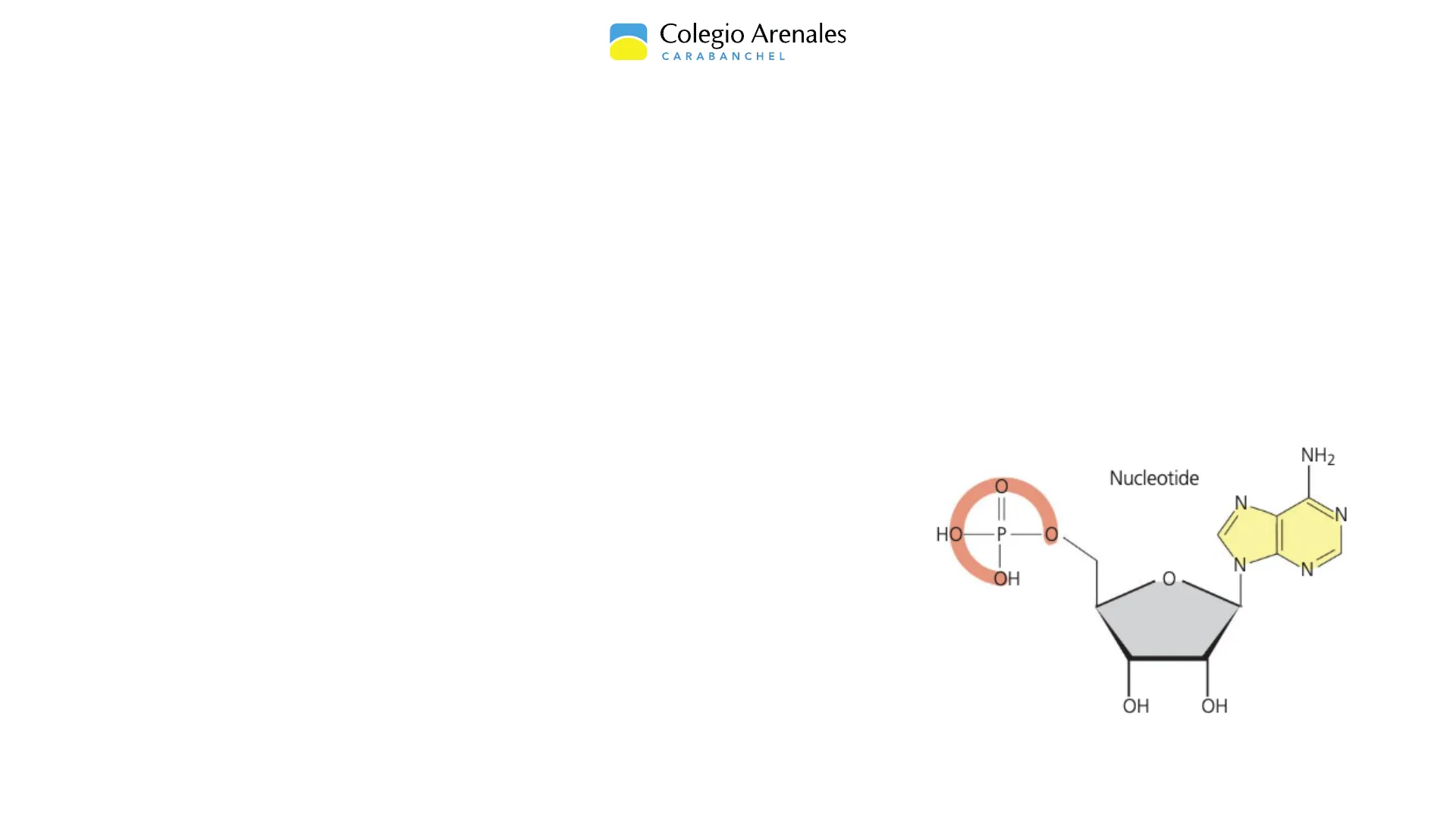
Nucleic acids are complex molecules that carry genetic information. They are composed by simpler molecules called nucleotides which are composed by:
NH2 Nucleotide O N -N HO-P-O N N OH O ÒH OHColegio Arenales CARABANCHEL
NUCLEIC ACIDS COMPOSITION
Nucleic acids are complex molecules that carry genetic information. They are composed by simpler molecules called nucleotides which are composed by: v A pentose (a monosacharide with 5 carbon atoms) which can be ribose o deoxyribose.
HOCH2 O OH HOCH2 0 OH 1 ¿ H 5-U-I C 1 OH OH Ribose Deoxyribose NH2 Nucleotide O II -N HO-P-O N OH . O OH ÒH -0-I C H C. I-Uto C OH I-UFI C H NColegio Arenales CARABANCHEL
Nucleotide Components: Nitrogenous Base
Nucleic acids are complex molecules that carry genetic information. They are composed by simpler molecules called nucleotides which are composed by: v A pentose (a monosacharide with 5 carbon atoms) which can be ribose o deoxyribose. v A nitrogenous base.
NH2 O NH N N N N° N N H H Cytosine (C) Guanine (G) H2N 0 H3C N NH .N N O N H Uracil (U) NH2 Nucleotide N EN N N OH 0 ÒH OH O II HO-P-O NH O N H H Adenine (A) Thymine (T) O ·N OColegio Arenales CARABANCHEL
Nucleotide Components: Phosphoric Acid
Nucleic acids are complex molecules that carry genetic information. They are composed by simpler molecules called nucleotides which are composed by: v A pentose (a monosacharide with 5 carbon atoms) which can be ribose o deoxyribose. v A nitrogenous base. v A phoporic acid (H3PO4).
NH2 Nucleotide O N -N HO-P-O N N OH O ÒH OHColegio Arenales CARABANCHEL
Nucleotide Joining to Form Nucleic Acids
Nucleotides join to form long chains called nucleic acids. The pentose of one nucleotide joins with the phosphate of the next nucleotide.
NH2 O Nucleotide N N HO-P-O 1 N N OH O ÒH OH P O P 0 P O P OColegio Arenales CARABANCHEL
TYPES OF NUCLEIC ACIDS
There are two types of nucleic acids:
- DNA: deoxyribonucleic acid
- RNA: ribonucleic acid
Nitrogenous bases Columns of glucose- phosphate - IColegio Arenales CARABANCHEL
DNA STRUCTURE
A DNA molecule is made up of two strands of deoxyribonucleotides joined by hydrogen bonds between nitrogenous bases. This structure es called a double helix. Adenine (A) always joins with thymine (T) and guanine (G) always joins with cytosine (C). For this reason the two chains are not the same, but complementary.
6 55 P T A P A T P P G c P C P GColegio Arenales CARABANCHEL
DNA Example
T G G C A A T A C G C T G A G A A G T CColegio Arenales CARABANCHEL
RNA STRUCTURE AND FUNCTION
A RNA molecule is made up of one strand of ribonucleotides. It has 4 types of nitrogenous bases: A, U, C, G. There are three types of RNA:
- Messenger (mRNA)
- Transfer (tRNA)
- Ribosomal (rRNA)
Its function is to bring the genetic information to the ribosome to produce proteins.
C Nitrogenous bases G Columns of glucose- phosphate A UColegio Arenales CARABANCHEL
GENE EXPRESSION
Genes are parts of the DNA which have information to be transformed into a protein. In a cell, not all the genes are going to be transformed because some will be activated and other inhibited, depending on the type of cell. Genes expression refers to the process through which organisms transform information in nuclei acids into proteins.Colegio Arenales CARABANCHEL
THE DOGMA OF MOLECULAR BIOLOGY
Although the mechanism of replication of the DNA and transcription to RNA would take some time to be clarified, there was still a greater difficulty: How is the sequence of proteins determined from the information contained in DNA? This was a great difficulty because proteins are made up of 20 different amino acids and DNA is made up of nucleotides. To go from the language of DNA to RNA, a transcription of the characters was enough, in which T is replaced by U. But going from a message expressed by a combination of 4 characters to another expressed by a combination of 20 requires a translation process. To solve the problem, Crick assumed that an RNA would act as an intermediate template, formulating what has been called the "central dogma of molecular biology", according to which he describes the flow of genetic information in the cell:
Replication Transcription Translation DNA RNA ProteinColegio Arenales CARABANCHEL
Genetic Information Flow
Genetic information is encoded in DNA and this information is passed on to messenger RNA in the process of transcription. The transcribed RNA is read in the process of translation to give rise to proteins. The process of transcription, which takes place in the nucleus (in eukaryotes), consists of the synthesis of an RNA chain from one of the chains of the DNA double helix that serves as a template. Translation consists of the synthesis of proteins from a messenger RNA chain that is read by the ribosomes.
Replication Transcription Translation DNA RNA ProteinColegio Arenales CARABANCHEL
Modifications to the Central Dogma
Years later, Crick himself would publicly regret having coined the term dogma. Not only because talking about dogmas in science is nonsense, but because as quickly as this universal and apparently immovable rule was established, nuances began to appear. Six decades later we know that:
- RNA can re-encode DNA (a process known as retrotranscription, and used by, among others, HIV, responsible for AIDS);
- RNA also has the ability to replicate, as occurs in some viruses.
- There are RNA molecules that will never give rise to a protein (rRNA, tRNA).
- There are huge regions along the DNA chain in our genome whose function is structural or regulatory, without containing information to build proteins.
- Interfering RNAs (RNAi) can bind to specific genetic regions, preventing their functioning and deactivating the genes found there.Colegio Arenales CARABANCHEL
Crick's Modified Proposal
After this modifications, Crikc's proposal became a hypothesis using this formula:
Replicación Replicación Transcripción Traducción ADN ARN Proteína - Transcripción inversaColegio Arenales CARABANCHEL
DNA REPLICATION PROCESS
When a cell divides, the two daughter cells must receive the same genetic material. For this to happen, the DNA must replicate or duplicate itself. This process is called replication and happens in S phase of interphase. Replication happens in the cell's nucleus and must be very accurate because, if not, the daughter cells will receive different genetic information y result in mutations.
CG CK G CG CG T A TA T A A A G G G C G A A A A G G G G G G GC T A TA 3. The nucleotides connect to each other. T A A TA G C G C G G T A A A A 4. Two molecules identical to the original DNA are produced. TA A G G C 1. The double helix of DNA opens and its chains separate. 2. Free nucleotides join the original strand according to their complementary bases. G T O SA GColegio Arenales CARABANCHEL
Semiconservative Replication
The new molecules are made of two strands. The first is a strand from the original DNA y and the secund is complementary new one, meaning it is identical to the original. This type of replication is called semiconservative replication.
888 X Original DNA Original and Copied and copied DNA original DNAColegio Arenales CARABANCHEL
TRANSCRIPTION PROCESS
Transcription is the process when part of the genetic information is copied from the original DNA to the mRNA. It takes place inside the nucleus. The mRNA leaves the nucleus and passes into the cytoplasm through the pores in the nuclear membrane. This mRNA has complementary sequences of vases to the DNA fragment that has been transcribed. Each one corresponds to a specific protein that cell needs in that moment and there should be no errors in the sequence of ribonucleotides.Colegio Arenales CARABANCHEL
Transcription Steps
C G A G C T Double helix of DNA A C G G 1. The double helix of DNA opens. 3. Only one of the DNA strands is copied. G U P C G Single strand of DNA mRNA G U G C 5 A A C 7 2. Complementary nucleotides are placed in front of one of the strands, the template strand. A C A C G RNA G D G 4. An mRNA strand complementary to the DNA one is created. Free nucleotides A D U n D 5. The newly formed mRNA molecule will exit the nucleus of the cell. A G CColegio Arenales CARABANCHEL
TRANSLATION PROCESS
In translation proteins are synthesised using the information. Contained in the mRNA molecule formed during transcription. This takes place inside the ribosomes. It is essential the amino acids are incorporated in the correct order for each kind of protein because this orden gives the protein its function.
Large subunit DNA Protein chain Small subunitColegio Arenales CARABANCHEL
Elements Involved in Translation
These are several elements involved in the process:
- mRNA: created from the transcription of a DNA fragment.
- Ribosomes: which read the mRNA and form proteins from it.
- tRNA,: which bring amino acids to the ribosomes to form the protein.
- Amino acids: to create the proteins.DNA Nucleus Nuclear membrane Ribosome UG Amino acids 0 G 1. mRNA exits the nucleus with the copied DNA information. 1 0 C C GUA mRNA Cytoplasm A U GACCGA IGCUACCGUA 2. mRNA joins the ribosomes. 3 CGA G G UGACCGAUGCU ACCGUA 3. tRNA carries amino acids to the ribosomes in order, according to the genetic message found in the mRNA. tRNA M CGA UGO A U GAC CG AUG CUA CCGUA 4 Protein (chain of amino acids) 5 4. Ribosomes go over the mRNA chain and join amino acids in the correct order, according to the sequence of nitrogenous bases: ribosomes read the mRNA and translate it into a protein. A UGACCGA CGA UGCUA CCGU A 5. The finished protein separates itself from the ribosome. U A 2 CÂU ČColegio Arenales CARABANCHEL
GENETIC CODE
Genetic code is the relationship between a particular sequence of nitrogenous base and the amino acids that form a protein. Three nitrogenous bases are needed to code for an amino acid. These are called triplets or codons. There are four different nitrogenous bases, so there are 64 different codons which results in 20 amino acids. Of all the codons, one controls the start of the translation (AUG) and three finish the process.
Amino acid Amino acids Amino acids 1 U C A A G C A A G C U U Nitrogenous bases mRNA U A U G
Can’t find what you’re looking for?
Explore more topics in the Algor library or create your own materials with AI.