The International System: Dynamics of International Relations
Slides about The International System. The Pdf explores the concept of the international system, defining it as a situation where actors' behavior mutually influences decisions. The document analyzes the relationship between agency and structure, using the First World War as a historical example for university-level Economics students.
See more43 Pages


Unlock the full PDF for free
Sign up to get full access to the document and start transforming it with AI.
Preview
The International System
ROBERT O. HARMSEN ROHARMSEN@TEC MXWhat is a[n international system?
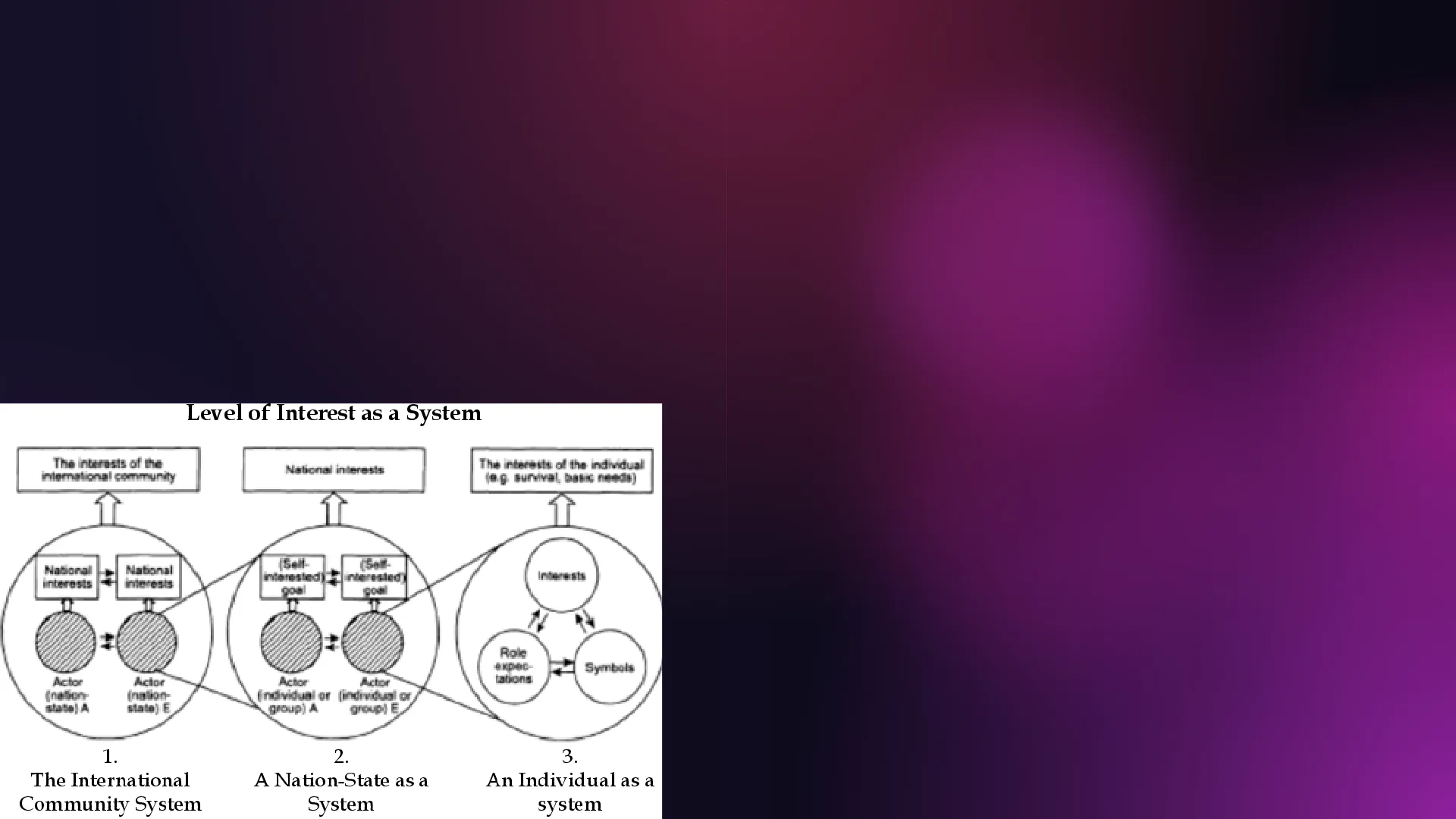
Level of Interest as a System
The interests of the international community National interests The interests of the individuall (eg survival, basic needs)
National Interests National interests Self- interested): interested Role Symbols Actor Lations! group! E
- The International Community System
- A Nation-State as a System
- An Individual as a system
'A situation in which the behaviour of each [actor] is a necessary factor in the calculations of the others' Or 'A relationship in which changes in one or more component parts initiates changes in other component parts, and these changes, in turn, produce changes in the parts in which the original changes occurred'
Actor (nation stata).A Actor Innlion stato) E Actor Individual or (individual or group) AThe Agent-Structure debateAgency-Structure
Thucydides and State Autonomy
Athens, Sparta, and the Melians ... the strong do what they can and the weak suffer what they must The sphere of power - independent of the sphere of justice - renders the State an autonomous actor, able to pursue its own interests, limited only by its capabilities ... But -> do Great Powers often have very little freedom of action amid the overwhelming pull of international events?
PENGUIN CLASSICS THUCYDIDES HISTORY OF THE PELOPONNESIAN WARman the State and Wal Kenneth N. WallL With a new preface a theoretical analysis
Kenneth Waltz's Three Images
Kenneth Waltz - 3 images: · First and second image: [the individual, the State [leaders] - sources of State action - explain State behaviour; · Third image: [the international system] - in which 'the requirements of State action are ( ... ) imposed by the circumstances in which all States exist';Agency-Structure
Conceptualizing States in a System
Conceptualising States - as one State embedded in a larger system of States [nested politics ] ... 'Nested': the three layers of political authority (individual sovereignty, domestic hierarchy, and international anarchy) are nested within one another, and their relationship to one another drives the most important outcomes in the international system' ...Agency-Structure
Defining and Function of Structure
How can we define structure ?: 'the pattern of constraints and opportunities for action and choice' · What do structures do? [constrain, provide opportunities] · What are structures? [patterns] International structure - the State's position in the world economy and its level of development, as well as international military balances - and internal structure - the organizational and coercive capacity of the State ...Agency-Structure
Focus on Power Distribution
Int. realm - major focus on the distribution of power -> 'the balance of power' [the distribution of realised military capabilities across the most powerful States in the system] -> security politics ...; But -> distribution of ideas or ideologies; distribution of economic and political capacity; climate; natural resources; state boundaries; ethnic/religious groups; culture ...; 11: 20 What about ... nutmeg ...Agency-Structure
SPAIN. FRANCE oyine's hourand ENGLAND
Structure's Focus on Systemic Distributions
In short, structure focuses on: Systemic distributions of quantities deemed most important by the States in the system in the realm of international security ...Agency-Structure
Agent Influence on Structure
How much influence/control do agents have over structure? Int. system > the 'result' of purposive action by agents -> they (attempt to) exercise control over it ... 'Important' to understand the ways in which that system, via the application of generative rules and resources, and in the context of unintended outcomes, is produced and reproduced in interaction'.Agency-Structure
Approaches to Understanding the System
Still ... there is no 'one-size fits all' approach to understanding the int. system, agency or even structure - and their interaction ... . Some focus on the role of the actions of States and Statesmen; . Some focus on the external environment [the distribution of 'power'] . Some focus on the distribution of 'authority' [international political institutions, economic processes and information flows, etc.] · What about the distribution of ideas' that comprise the identities of States ...French Revolution
Impact of the French Revolution
Popularized the ideas of liberty, equality, and fraternity ... Agency-Structure Result [after Napoleon] > European political interaction between nationalism and political liberty vs. traditional royal authority ... Most prominent int. events and institutions > The Treaty of Vienna; the Holy [Grand] Alliance, the Quadruple Alliance, the various Congresses and Concerts of Europe -> results of [various] actors attempting to resolve these results ... LOCRIAgency-Structure
Post-Revolution Alliances and Tensions
Triple Alliance Triple Entente RUSSIA GREAT BRITAIN GERMANY FRANCE AUSTRIA- HUNGARY ITALY In the aftermath > technology, arms races and international tensions -> led to the Triple Alliance and the Triple Entente diplomatic polarization assassination Archduke Ferdinand WWI ...In short
Key Considerations for International Security
In short, the following should be considered: 1. How citizens [individuals] understand the world determines what they do or do not want out of it in the realm of security politics. [Often > the less they have, the more they desire a change in the status quo]; 2. The political machinery of State determines how their desires are collected, aggregated, and conveyed to leaders > the latter attempting to carry out those mandates; 3. Leaders - in attempting to carry out those mandates - are limited by the capabilities of their States; andIn short
4. The interactions of many different States with different capabilities and diverse national interests determine the most important qualities of the system. . The distribution of the spoils that results from 4 influences citizens demands for action in 1 > the process begins anew ... . Dynamic -> the sequence of events results in frequent changes in levels of State activity and a constant revaluation of the distribution of spoils ...Levels of analysis
Levels of Analysis in International Relations
Methodological Individualist Perspective
Methodological individualist perspective -> individuals > central point of a series of expanding concentric circles > family > neighbourhood -> city > State -> human race > [also diminishing spiral]; · Each level can be conceived of in terms of abstracted units and systems; · Each level can be represented as a unit within a larger system - or as a system embracing the units of a lower level; City -> can be seen as a unit in the system of the State -> or as a system made up of neighbourhood units;Levels of analysis
Five Frequently Used Levels of Analysis
In IR, the five most frequently used levels of analysis: 1. International systems: The largest conglomerates of interacting or interdependent units - no system level above them -> currently, encompasses the whole planet > earlier times > several [disconnected] international systems existing simultaneously ... 2. International sub-systems: Groups of units within an IntSys that can be distinguished from the whole system by the nature or intensity of their interactions/interdependence with each other; Sub-system may be either territorially coherent - regional - or not - simply subsystems ...Levels of analysis
3. Units: Entities composed of various sub-groups, organizations, communities - and many individuals - sufficiently cohesive to have actor quality [decision-making capability], and sufficiently independent to be differentiated from others, and to have standing at the higher levels [States, nations, transnational firms, etc.] 4. Subunits: Organized groups of individuals within units that are able - or try - to affect the behaviour of the unit [bureaucracies, lobbies, etc.] 5. Individuals: The bottom line of most analysis in the social sciences ...Framework to describe phenomena that one observes - and theorise about causes and effects > important to note -> not a theory;
Theories and Causal Explanations
Theories -> may suggest causal explanations from one level to another: Top-down > system structure to unit behaviour; Bottom up -> human nature to behaviour of human collectivities; For ex .: war as a phenomenon -> human nature [individual level]; nature of State [unit level]; or even the 'anarchic structure' of the international system [system level]Levels of analysis
Locating Actors and Structures
· Enable us to locate [many] actors, forums, and other elements involved in 'international' relations; . Some organizations (the UN), structures (the 'global' market), and processes (international law) operate at the system level; · Others, the NATO, EU, NAFTA, ASEAN -> sub-systemic; . Not always clear to locate actor within a given level > lobby groups, NGOs, transnational firms, mafias, etc.Sectors of analysis
Sectors of Analysis
Approaching the International System
* * The practice of approaching the IntSys in terms of the types of activities, units, interactions, and structures within it. · The International Economic system · The International Political system · The International Legal system Indicates thinking in terms of sectoral divisions of the subject ...Sectors of analysis
Views of the Whole System
Views of the whole system > which selects one particular type of relationship and highlights the types of unit, interaction, and structure most closely associated with it; The metaphor of a lens > useful way of understanding and analysing the IntSys > the observed object remains the same -> different lenses highlight different aspects ...Sectors of analysis
Five Commonly Used Sectors
Five [commonly] used Sectors of analysis: 1. The Military Sector 2. The Political Sector 3. The Economic Sector 4. The Societal or Socio-Cultural Sector 5. The Environmental SectorSectors of analysis
The Military Sector
The Military Sector · Relationships of forceful coercion, and the ability of actors to fight wars with each other; · Focus -> often on two-level interplay of the armed offensive and defensive capabilities of actors in the IntSys - and their perceptions of each others' intentions; · The military strategist looks at human systems in terms that highlight the offensive and defensive capability of actors ...Sectors of analysis
The Political Sector
The Political Sector · Relationships of authority -> concerns the organizational stability of systems of government and the ideologies that give them legitimacy; . Do actors accept other units as equals, or are relations hierarchical, with superior/ inferior status acknowledged by both sides? Or do actors deny each other recognition, in effect treating each other as unoccupied territory available for seizure ? · Political sector > can be interpreted in a more realist, state-centric, sense as being about government, or in a looser, more liberal, sense as being about governance, including norms, rules, and institutions above the level of the state. INGRES, P ANNO.180
Can’t find what you’re looking for?
Explore more topics in the Algor library or create your own materials with AI.
