The Elizabethan Theatre: Origins, Structure, and London's Permanent Theatres
Slides about The Elizabethan Theatre. The Pdf, a high school Literature resource, explores the origins of theatre from religious celebrations to permanent structures, detailing London's playhouses like the Globe and their architecture.
See more15 Pages


Unlock the full PDF for free
Sign up to get full access to the document and start transforming it with AI.
Preview
The Elizabethan Theatre
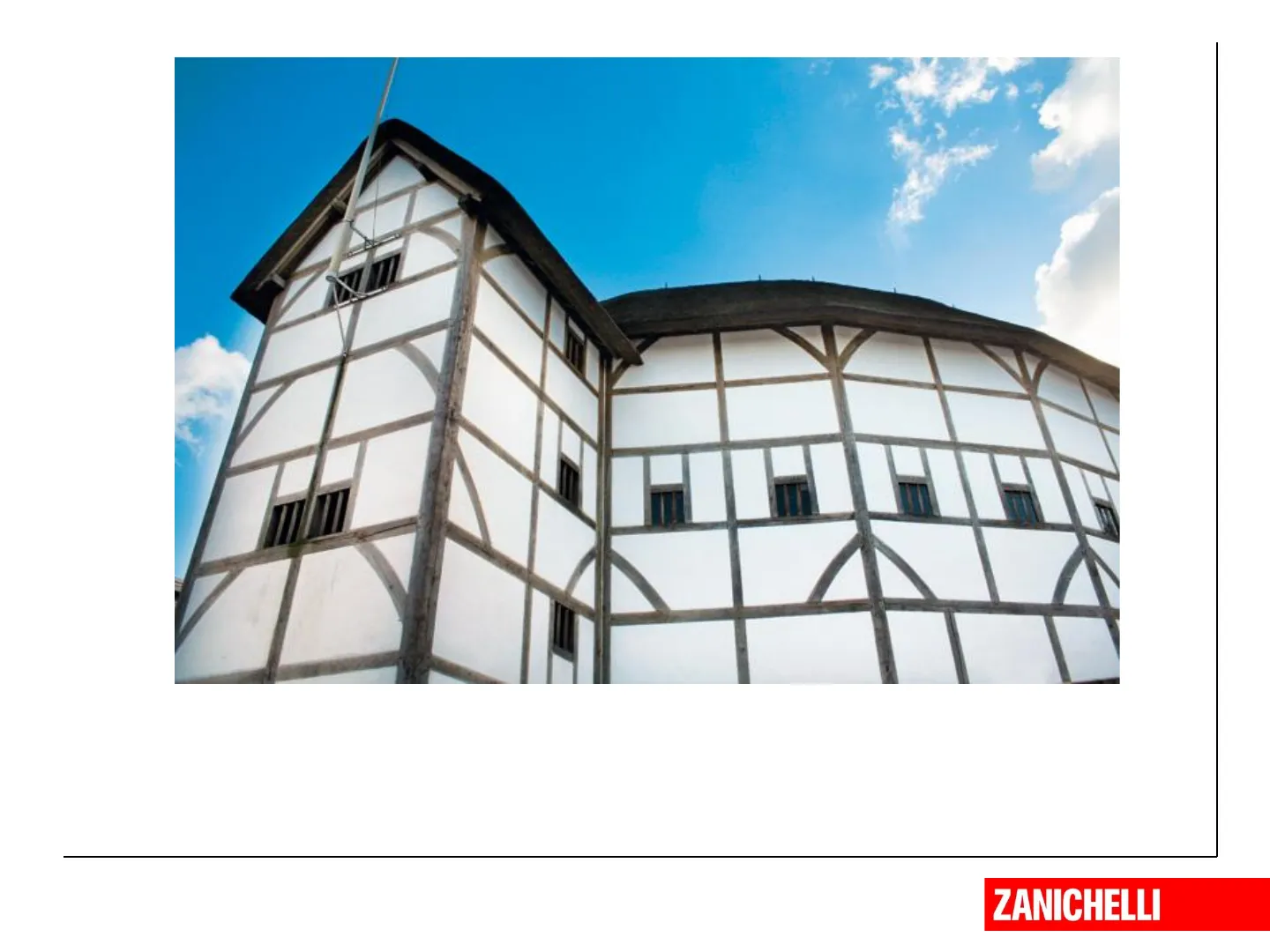
A modern reconstruction of the Globe, named 'Shakespeare's Globe', London.
Compact Performer Shaping Ideas Marina Spiazzi, Marina Tavella, Margaret Layton @ 2021 ZANICHELLIThe Elizabethan theatre
Origins of Theatre
- The origins of the theatre
- Linked to religious celebrations;
- took place in the nave of the church;
- later they moved outside:
- English replaced Latin;
- lay people took the place of monks and priests;
- these plays, called 'miracle plays', were staged on pageants.
Compact Performer Shaping Ideas ZANICHELLIThe Elizabethan theatre
Development in Drama
- The origins of the theatre
The next development in drama ‘morality plays':
- performed at lords' mansions;
- they dealt with human vices and virtues;
- their characters: personifications of vices and virtues.
Interludes:
- short plays which combined comic and serious elements;
- their aim: to arouse people's laughter.
Compact Performer Shaping Ideas ZANICHELLIThe Elizabethan theatre
Sources of Elizabethan Theatre
- The sources
- The Italian Commedia dell'Arte;
- the works of Niccolò Machiavelli with their display of horrors, unnatural crimes, vice and corruption;
- the Greek theatre with its celebration of national history;
- the Latin philosopher and tragedian Seneca in the division of the play into five acts, as well as a taste for revenge, the use of rhetoric about conflicting emotions and passions.
Compact Performer Shaping Ideas ZANICHELLIThe Elizabethan theatre
Reasons for Development
- Reasons for development
Why did drama become the main form of art? Because:
- entertainment was rooted in communal life;
- the public were more trained in listening than in reading;
- permanent theatres were built on the South Bank in London;
- the theatres prospered as economic enterprises.
Compact Performer Shaping Ideas ZANICHELLIThe Elizabethan theatre
London's Permanent Theatres
- London's permanent theatres
The building of permanent playhouses in London was a break with the past.
The Red Bull The Theatre City wall Guildhall administrative London Theatres c.1600 The Curtain area CLERKENWELL The Fortune COUNTY OF MIDDLESEX Other buildings FINSBURY FIELDS Gray's Inn BARBICAN ST. Cripplegate HOLBORN HOLBORN Trinity Hall Moorgate Lincoln's Inn Newgate Aldersgate All Hallows on the Wall Greyfriars Drapers Hall Y Warwick Inn The Boar's Head Stationers Hall Ludgate WEST CHEAP St. Pauls School Merchant Taylors Hall CORNHILL Aldgate The Red Lion Middle Temple Blackfriars The Bell Inn Northumberland Place House Pauls Wharf STREET 0 1/4 mi Tower of London 0 1/2 km RIVER THAMES Bankside Paris Garden Manor House Bull Ring The Swan Ist Bear Garden The London Bridge The Hope Clink COUNTY OF SURREY The Globe SOUTHWARK (1997, Encyclopedia Britannica, Inc. FLEET STREET Whitefriars Bel Savage Inn Porters Hall Leadenball Cross Keys Inn . Salisbury Court St. Pauls Cathedral The Wardrobe Mermaid Tavern EAST CHEAP GRACECHURCH ST. FENCHURCH THAMES Mercers Hall The Bull Inn St. Katherine Christ Church The Cockpit (Phoenix) in Drury Lane Fleet Ditch St. Olaves Church Carpenters Hall Bishopsgate - "Guildhall MOOR FIELDS (marsh) Halls and other buildings used as theatres
Compact Performer Shaping Ideas ZANICHELLI The Rose Saracen's HeadThe Elizabethan theatre
Theatres Built in the 16th Century
- London's permanent theatres
Towards the end of the 16th century, several theatres were built:
- the Theatre (by James Burbage, 1576);
- the Curtain (by James Burbage, 1577);
- the Swan (by Francis Langley, 1595);
- the Globe (by Cuthbert and Richard Burbage, 1599).
Compact Performer Shaping Ideas ZANICHELLIThe Elizabethan theatre
Structure of Theatres
- The structure of theatres
The open-air playhouses:
- were round or octagonal in shape;
- could hold up to three thousand people.
The Globe Theatre was built in 1599 by Shakespeare's playing company, and was destroyed by fire on 29 June 1613. A modern reconstruction of the Globe, named "Shakespeare's Globe", opened in 1997. It is on London South Bankside.
Compact Performer Shaping Ideas ZANICHELLIThe Elizabethan theatre
Playhouse Features
- The structure of theatres
The playhouses:
- had a rectangular stage, called ‘apron stage', 12 metres wide;
- had no curtain.
A reconstruction of the Globe Theatre. Folger Shakespeare Library.
Compact Performer Shaping Ideas ZANICHELLIThe Elizabethan theatre
Internal Layout
- Internal layout
The same basic structure consisted of:
- a stage partially covered by a thatched roof, or 'shadow', supported by two pillars and projected into a yard, or 'pit'.
Globe Theatre Stage, 1997.
Compact Performer Shaping Ideas ZANICHELLIThe Elizabethan theatre
Theatre Structure Details
- Internal layout
Aic planities faire metre.
The structure included:
- three tiers of roofed galleries around the stage with the actors' tiring house at the back;
- a trap door in the front of the stage used for apparitions or disappearances;
- an inner stage used for discoveries or concealments.
The interior drawing of 'The Swan' by Johannes de Witt, circa 1596. The Swan Theatre was built by Francis Langley about 1595, south of the Thames. The Swan was one of the largest and most distinguished of all the playhouses in London.
Compact Performer Shaping Ideas ZANICHELLIThe Elizabethan theatre
Theatre Performance Conditions
- The internal layout
- Theatre performances took place in the afternoon because there was limited artificial lighting;
- limited number of props: the theatre relied on the audience's imagination;
- the action was continuous and a scene ended when all the actors lefts the stage.
Compact Performer Shaping Ideas ZANICHELLIThe Elizabethan theatre
The Audience
- The audience
- Poor people stood in the pit (around the stage);
- wealthy people were granted access to seated places in the covered galleries;
- nobility sat around the stage.
Compact Performer Shaping Ideas ZANICHELLIThe Elizabethan theatre
The Actors
- The actors
The Elizabethan actor was:
- a busy man and had to vary his repertoire;
- he had no more than little time to prepare a new play;
- he belonged to an acting company and he worked on the basis of a share system made money from the profits of the plays.
Compact Performer Shaping Ideas ZANICHELLIThe Elizabethan theatre
Female Roles
- Female roles
- There were no actresses;
- the parts of young women were performed by boys;
- companies included 5-6 boys to play female roles until their voices broke.
Compact Performer Shaping Ideas ZANICHELLI
Can’t find what you’re looking for?
Explore more topics in the Algor library or create your own materials with AI.
