Cell respiration: ATP, chemiosmosis, and oxygen's role in energy production
Slides from University about Cell Respiration. The Pdf explores cell respiration, focusing on ATP as the energy molecule and chemiosmosis, analyzing anaerobic and aerobic differences, and oxygen's role as the final electron acceptor. This Biology Pdf also covers factors influencing cell respiration rate.
See more55 Pages

Unlock the full PDF for free
Sign up to get full access to the document and start transforming it with AI.
Preview
Cell Respiration: Interaction and Interdependence
C1.2 Cell respiration
Interaction andiinterdependece - Molecules
- What are the roles of hydrogen and oxygen in the release of
energy in cells? - How is energy distributed and used inside cells?Contents
ATP and Energy Distribution
SL
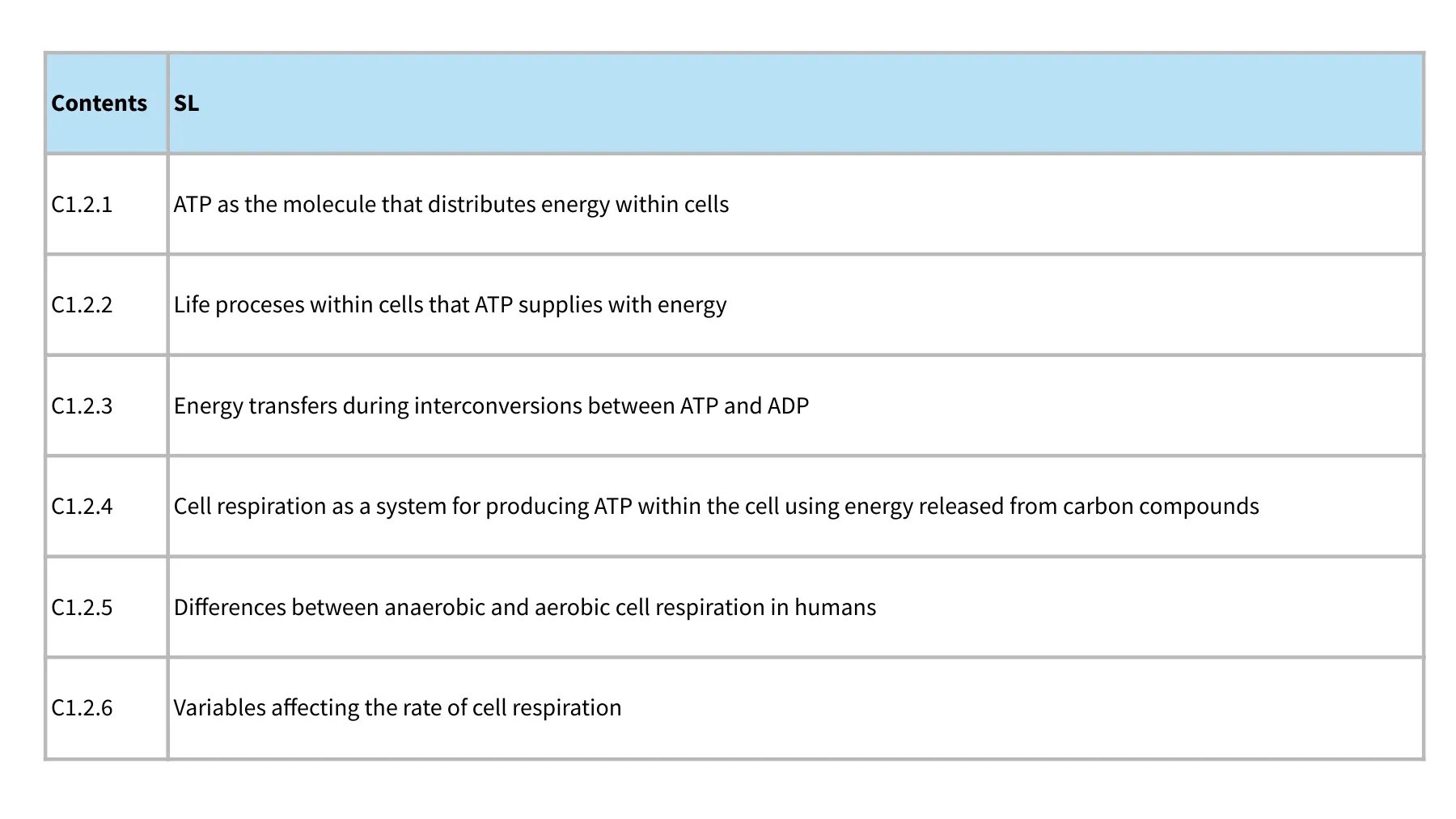
C1.2.1
ATP as the molecule that distributes energy within cells
C1.2.2
Life proceses within cells that ATP supplies with energy
C1.2.3
Energy transfers during interconversions between ATP and ADP
C1.2.4
Cell respiration as a system for producing ATP within the cell using energy released from carbon compounds
C1.2.5
Differences between anaerobic and aerobic cell respiration in humans
C1.2.6
Variables affecting the rate of cell respiration
ATP as the Molecule Distributing Energy
C1.2.1-ATP as the molecule that distributes energy within cells
ATP
H2N
N
N
N
O-P-O-P-O-P-O
N
I
1
C
O
1
OH OH
ATP is a nucleotide (A1.2.1):
Phosphate group
Nitrogenous base
Pentose sugar
Adenosin TriPhosphate
ATP is a high energy molecule that functions as an immediate power source for cells. It
transfers chemical energy between metabolic reactions.
High energy bond
0
O
OC1.2.1-ATP as the molecule that distributes energy within cells
ATP is an excellent energy storage molecule to use as "currency" due to the phosphate
groups that link through phosphodiester bonds.
Adenosine Triphosphate -
4
Adenine
High-energy
bond
P
P
P
Adenosine Diphosphate -
Adenine
Inorganic
phosphate
P
P
+
P
Ribose
Ribose
What do we need
the energy for?
Free energy
Life Processes Supplied by ATP
C1.2.2-Life processes within cells that ATP supplies with energy
Low concentration
of molecules, ions
Outside cell
I
Cell membrane
Inside cell
ADP
+
Pi
AT
High concentration
of molecules, ions
monomers
dimer
polymer
propeller like
motion
back and forth
beating
passiv e part
in motion
1)
2
4
basal body
Flagellum
Cilia
water out
water out
synthase
synthase
+
5
Energy Transfers Between ATP and ADP
C1.2.3-Energy transfers during interconversions between ATP and ADP
NH2
C.
N
C
HC
+
H20
C
CH
N
O=0-0
O=0-0
O
O
o=
0-P-
-0-P.
-- 0-P-O -- CH2
-
0
C
H
I-6
O-I
H C.
-
OH
H
ATP
Energy
Energy
NH2
G.
N
SN
HC
CH
N
O
O
O-P-O-
+
0-
0-P-O -- CH2
O
C
C
H
H
H
C
H
OH
H
Pi + ADP
d
o
Hydrolysis
Used in endergonic
reactions (anabolism)
Regeneration
Released from
exergonic
reactions
(catabolism
Exergonic
reaction
Endergonic
reaction
_
_
O
O
O=0-0
EN
Cell Respiration System for ATP Production
C1.2.4-Cell respiration as a system for producing ATP within the cell using
energy released from carbon compounds
What is respiration?
intermembrane
matrix
space
ribosome
DNA
o
inner membrane
outer membrane
cristae
ATP Production from Carbon Compounds
C1.2.4-Cell respiration as a system for producing ATP within the cell using
energy released from carbon compounds
Cell respiration is a series of
metabolic reactions that break
down
organic
molecules,
releasing energy
(used
to
produce the ATP) that power
all other processes in the cell
Main substrates of cell respiration:
CH2OH
O
OH
OH
OH
I-U-I
H
H-
H-C-H
I-O-I
I-O-I
I-O-I
I-O-I
H
C
H
0
1
`OH
OH
C6H1206 +602
respiration
6CO2 + 6H2O
ADP
Pi
ATP
I-O-I
O
I-O-I
H
I-U-I
I-O-I
I-U-IC1.2.4-Cell respiration as a system for producing ATP within the cell using
energy released from carbon compounds
CELL RESPIRATION
VS
GAS EXCHANGE
--
09-19
Krebs Cycle
-
=
-
-
1
-
VS
-
-
-
Rape tweet they
1
Ventilation
Gas Exchange
Cell Respiration
Anaerobic and Aerobic Respiration in Humans
C1.2.5-Differences between anaerobic and aerobic cell respiration in humans
Aerobic respiration
glucose + oxygen -> carbon dioxide + water (+ATP)
Anaerobic respiration
glucose -> lactate (+ATP)
o,
Cytoplasm
Mitochondrion
Ethyl alcohol + CO2
ADP
Glucose
Glycolysis
Pyruvate
Lactate
Lactic acid fermentation
Aerobic respiration
in humans
Anaerobic
respiration in
humans
Oxygen
With oxygen
Without oxygen
Location
Cytoplasm and
mitochondria
Cytoplasm only
Respiratory
substrates
All
Carbohydrates only
ATP yield
High
Low
Waste products
Carbon dioxide and
water
H.C
2 ATP
2 ATP
CO2
32 ATP
Cytoplasm
Alcoholic fermentation
ATP
Krebs
cycle
Oxidative
phosphorylation
Glycolysis
Glucose -+2 Pyruvate
Pyruvate
oxidation
Pyruvate +Acetyl
COA
Lactate/lactic acid
Glucose to Pyruvate Conversion
C1.2.5-Differences between anaerobic and aerobic cell respiration in humans AND C1.2.8-Conversion of
glucose to pyruvate by stepwise reactions in glycolysis with a net yield of ATP and reduced NAD.
Glucose
NAD+
ATP
(2)
Glycolysis
NADH
Pyruvate
NADH
Pyruvate
Acetyl COA
NADH
Fermentation
TCA
cycle
NAD+
ATP
(34)
NADH
I
CO2 + H2O
Lactate
Factors Affecting Cell Respiration Rate
C1.2.6-Variables affecting the rate of cell respiration
Rate of respiration
Respiration rate = Variable measured / time
Variables:
· 02 consumed
· CO2 produced
Factors that affect respiration rate:
· Temperature
· Concentration of substrates (02,
glucose)
· pH
.
...
Respirometer Setup
C1.2.6-Variables affecting the rate of cell respiration
Respirometer
Tap (closed
during
experiment)
Manometer (capillary
u-tube containing
coloured liquid)
Tap (closed
during
experiment)
Gauze basket
containing
the insect
Filter paper
Potassium
hydroxide
(to absorb CO2)
Tube A
Filter paper
Calibrated
scale
Potassium
hydroxide
(to absorb CO2)
Tube BC1.2.6-Variables affecting the rate of cell respiration
Virtual Lab for Respiration Rate
C1.2.6-Variables affecting the rate of cell respiration
Rate of respiration virtual lab
Rate of Respiration
Theory
Procedure
Simulator
?
Viva Voce
Resources
Feedback
Rate of Respiration
SAVE
Select the seeds:
Wheat
v
6
Number of seeds: 10
10
50
Temperature: 5℃
5
35
Start
Initial water level
Result
Rising level of water (ml):
2
Water
Submit
Dacat
Go to the virtual
lab and complete
the Teams Forms
Developed by Amrita University Under research grant from
Ministry of Electronics and Information Technology
Video
5
4
Advanced Topics in Cell Respiration
Contents
AHL
C1.2.7
Role of NAD as a carrier of hydrogen and oxidation by removal of hydrogen during cell respiration.
C1.2.8
Conversion of glucose to pyruvate by stepwise reactions in glycolysis with a net yield of ATP and reduced NAD.
C1.2.9
Conversion of pyruvate to lactate as a means of regenerating NAD in anaerobic cell respiration
C1.2.10
Anaerobic cell respiration in yeast and its use in brewing and baking.
C1.2.11
Oxidation and decarboxylation of pyruvate as a link reaction in aerobic cell respiration.
C1.2.12
Oxidation and decarboxylation of acetyl groups in the Krebs cycle with a yield of ATP and reduced NAD.
C1.2.13
Transfer of energy by reduced NAD to the electron transport chain in the mitochondrion.
C1.2.14
Generation of a proton gradient by flow of electrons along the electron transport chain.
C1.2.15
Chemiosmosis and the synthesis of ATP in the mitochondrion.
C1.2.16
Role of oxygen as terminal electron acceptor in aerobic cell respiration.
C1.2.17
Differences between lipids and carbohydrates as respiratory substrates.
Role of NAD in Hydrogen Carrying and Oxidation
C1.2.7-Role of NAD as a carrier of hydrogen and oxidation by removal of
hydrogen during cell respiration.
Redox reaction:
Loss of electron (Oxidation)
e-
0
0
+
-
A
+
B
A
B
A
+
B
Gain of electron (reduction)
Oxidation
Reduction
e
Electrons
Loss
Gain
H
x
Y
Hydrogen
Loss
Gain
O
Oxygen
Gain
Loss
Reducing agent
Oxidizing agent
OIL RIG - Oxidation Is Loss (of electrons) ; Reduction Is Gain (of electrons)
NAD as a Coenzyme and Electron Carrier
C1.2.7-Role of NAD as a carrier of hydrogen and oxidation by removal of
hydrogen during cell respiration.
Redox reaction:
Vital role in several steps of cell respiration
Nicotinamide adenine dinucleotide (NAD) is
a key molecule in cell respiration.
It functions as a coenzyme, a molecule that is
required for an enzyme to carry out its
function.
NAD's ability to be reduced and oxidised
allows it to perform the critical role of a
hydrogen/electron carrier.
Reduction
H
O
0
HH
·NH2
NH
O
0
0=P-0=
N+
0=P-O-
N
0.
O.
+2H+ + 2e"
OH OH
OH OH
0
+ H+
NH2
NH2
N
N
Z
2
O=P-0.
O=P-0.
N
N
0
0
0
OH OH
OH OH
NAD OX
NADred
NAD++ 2H+ + 2e" = NADH + H+
Oxidation
-0.
0
N
NC1.2.7-Role of NAD as a carrier of hydrogen and oxidation by removal of
hydrogen during cell respiration.
Redox reaction:
Reduction
H { H+ + e-
· H+
-
Organic
molecule
NAD+
Organic
molecule
NADH + H+
(gains energy)
Oxidation
NAD's ability to be reduced and oxidised
allows it to perform the critical role of a
hydrogen/electron carrier.
Glycolysis: Glucose to Pyruvate Conversion
C1.2.8-Conversion of glucose to pyruvate by stepwise reactions in glycolysis
with a net yield of ATP and reduced NAD.
Glycolysis
- Cytoplasm
- Shared with anaerobic
respiration
- Metabolic pathway (catalyzed by
enzymes)
- Includes the following processes:
1. Phosphorylation
2. Lysis
3. Oxidation
4. ATP formation
000000
Glucose
ATP
ADP
ADP
Unstable
Fructose- 1, 6-bisphosphate
POOO
DHAP
000-1
glyceraldehyde-
3-phosphate
1
All the DHAP
will be converted
into glyceraldehyde-
3- phosphate
NAD+ ®
Happens
2×
NADH
ADP
ATP
ADP
ATP
OOO
Pyruvate
Phosphorylation in Glycolysis
C1.2.8-Conversion of glucose to pyruvate by stepwise reactions in glycolysis
with a net yield of ATP and reduced NAD.
Glycolysis
1. Phosphorylation: a phosphate group (PO43-) is added to an organic molecule
H
0
HCH
o
H
H
H
0
C
c
0
H
H
c)
0
H
H
H
0
c
C
0
H
H
CC
H
H
ATP
0
0
ADP
Glucose 6-phosphate
The phosphate group is
usually transferred from ATP
2
PO3
0
HCH
The phosphorylated
molecule is less stable
and therefore reacts
1
more easily in the
metabolic pathway.
c
H
H
H
H
0
O
Glucose
Hexokinase
Lysis in Glycolysis
C1.2.8-Conversion of glucose to pyruvate by stepwise reactions in glycolysis
with a net yield of ATP and reduced NAD.
Glycolysis
2. Lysis: 1 glucose molecule (6 C) is
splitted into two molecules of
pyruvate (2 x 3 carbon)
H
H-
O
c
H
GLUCOSE
C
O
H
H
H
C
C
O
H
H
0
I
C
C
H
O
I
ATP
ADP -
®
ATP
AD
Energy
in
(2 ATP)
F
P
PGAL: P-000
®-
INTERMEDIATES DONATE
PHOSPHATE TO ADP, MAKING 4
ATP
Pyruvate
To second
set of
reactions
NET ENERGY YIELD: 2
ATP
2007 Thomson Higher Education
H
O
Oxidation in Glycolysis
C1.2.8-Conversion of glucose to pyruvate by stepwise reactions in glycolysis
with a net yield of ATP and reduced NAD.
Glycolysis
3. Oxidation:
- 1 H isremoved from each of the 3C sugars
(oxidation) to reduce NAD+ to NADH + H+
- Two molecules of NADH are produced in
total (one from each 3C sugar)
H
HO
c
H
GLUCOSE
C
O
H
H
H
C
C
O
H
H
0
I
C
C
H
O
I
ATP
ADP -
®
ATP
AD
Energy
in
(2 ATP)
F
P
PGAL: P-000
®-
0-1
Glyceraldehyde
3-phosphate (G3P)
H
0-P=O
Glyceraldehyde-
3-phosphate
dehyrogenase
1
C=0
C=0
2 X H-C-OH O
H-C-O-P=0
H
2 X H-C-OH O
1,3-Bisphospho- H-C-O-P=0
glycerate
L
H
-O
NET ENERGY YIELD: 2
ATP
2007 Thomson Higher Education
5
6
2x NAD + P 2x NADH + H
INTERMEDIATES DONATE
PHOSPHATE TO ADP, MAKING 4
ATP
Pyruvate
To second
set of
reactions
H- O
Can’t find what you’re looking for?
Explore more topics in the Algor library or create your own materials with AI.
