Introduction to Valuation: Time Value of Money, Lancaster University Presentation
Slides from Lancaster University Management School about Introduction to Valuation: Time value of money. The Pdf, a university-level Economics document, explores future and present value concepts, including capitalization and practical examples for one and two-period scenarios.
See more56 Pages


Unlock the full PDF for free
Sign up to get full access to the document and start transforming it with AI.
Preview
Time Value of Money Overview
Lancaster University
Management School
Introduction to Valuation:
Time value of money
Week 13
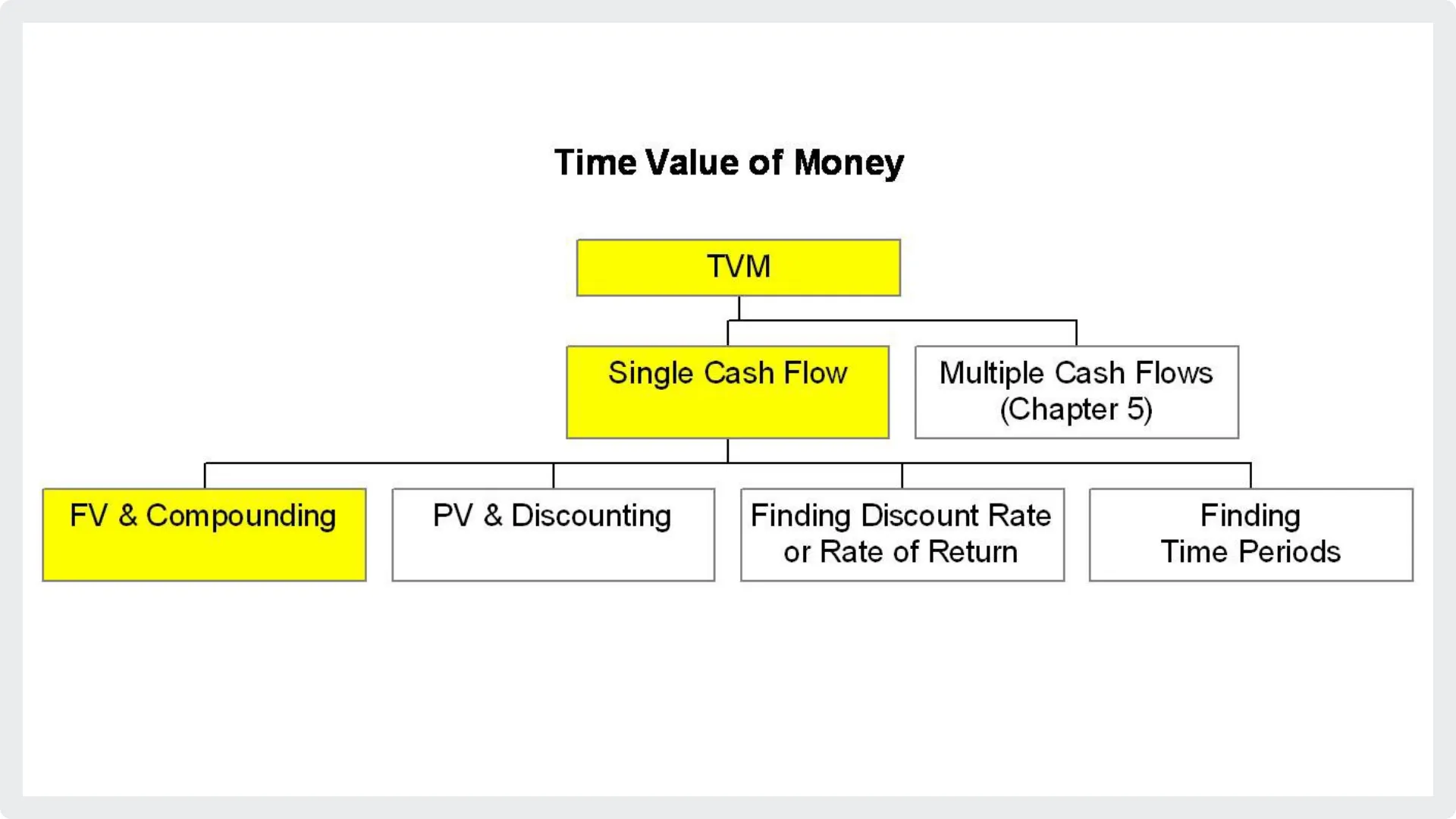
1Time Value of Money
TVM
Single Cash Flow
Multiple Cash Flows
(Chapter 5)
FV & Compounding
PV & Discounting
Finding Discount Rate
or Rate of Return
Finding
Time Periods
Investment Timeline and Value Concepts
Lancaster University
Management School
Timeline of investment
Future Value
t = 0
1
2
3
...
...
...
time = t
Present Value
Required rate of return on investment = r
3Lancaster University
Management School
Basic Definitions in Valuation
- present value (PV)
. the current value of future cash flows discounted at the appropriate discount rate
· value at t = 0 on a timeline - future value (FV)
. the amount an investment is worth after one or more periods
· "later" money on a timeline
. interest rate (r) is the "exchange rate" between earlier money and later money
· discount rate / cost of capital / opportunity cost of capital / required return
· terminology depends on usage
4Lancaster University
Management School
Future Value Calculation
. The amount of money an investment will grow to over some period of time
at a given interest rate:
FV = PV x (1 + r)t
where
· FV - future value
· PV - present value
· r - period interest rate, expressed as a decimal
· t - number of periods
5Future value - one period
example
Lancaster University
Management School
· suppose you invest £100 for one year at 10% per year
· what is the future value in one year?
· interest = 100 x 0.10
= 10
· value in one year
= principal + interest = 100 + 10 = 110
· future value (FV)
= 100 × (1 + 0.10) = 110
6Future value - investing for
two periods
Lancaster University
Management School
. at the end of the first period, you have £110. How much you can get at the end
of the second period depends on what you do with the £10 interest at the end of
the first period?
· withdraw £10 interest and leave £100 in the bank
· payoff: 10 + 100 x (1 + 0.10) = 120
. leave the entire £110 in the bank to earn interest in the second year
· payoff: 110 x (1 + 0.10) = 121
· where is the extra £1 from?
7Lancaster University
Management School
Compounding Interest
- simple interest
. interest earned only on the original principal - compound interest
· interest earned on principal and on interest received
· "interest on interest" - interest earned on reinvestment of previous interest
payments
. consider the previous example (t = 2, r = 10%)
. FV with simple interest = 100 + 10 + 10 = 120
. FV with compound interest = 100 x 1.102 = 121
. the extra £1 comes from the interest of 0.10 x 10 = 1 earned on the first interest
payment
8Future
value ($)
$161.05
160
150
$146.41
140
$133.10
130
$121
120
$110
110
100
Time
$0
(years)
1
2
3
4
5
· Growth of £100 original amount at 10% per year. Blue shaded area
represents the portion of the total that results from compounding of
interest
9Investing for t periods - the
general formula
Lancaster University
Management School
. FV with compound interest
FV = PV x (1 + r) x (1 +r)x ... x(1+r)
FV = PV x (1 + r)t
· Future value interest factor = (1 + r)t
· note: "yx" key on your calculator
· FV with simple interest
FV = PV + PV x r + PV x r + ... + PV x r
FV = PV x (1 + rxt)
10Lancaster University
Management School
Future Value Example with Compound and Simple Interest
· Deposit £5,000 today in an account paying 12%. How much will you have in 6 years
with compound interest?
FV = PV x (1 + r)t = 5,000 × (1 +0.12)6 = 5,000×1.974=9,869
. make sure you know how to raise a number to a power on your calculator
. How much will you have in 6 years with simple interest?
FV = PV x (1 + r xt) = 5,000 x (1 + 0.12 × 6) = 8,600
. How much is the compound interest?
= 9,869 - 5,000 = 4,869
· What is the interest on interest?
= 4,869 - (8,600 - 5,000) = 1,269
11Lancaster University
Management School
Future Value Over 200 Years
· Suppose you had a relative deposit £5 for you at 6% interest 200 years ago. How
much would the investment be worth today by compounding interest?
FV = PV x (1 + r)t = 5 x(1 +0.06)200 = 575,629.52 or £0.57 million
. How much can you get if the investment only earns simple interest?
FV = PV x (1 + r xt) = 5x(1 + 0.06 × 200) = 65
· The difference is amazing!
. The effect of compounding is small for a small number of periods but increases as
the number of periods increases. Simple interest is constant each year. The size of
the compound interest keeps increasing because more and more interest builds up
and there is thus more to compound.
12Lancaster University
Management School
Future Value Calculation Example
. What is the future value of £4,900 invested for 8 years at 7 percent
compounded annually?
13Lancaster University
Management School
Important Relationships for Future Value
FV = PV x (1 + r)t
Other things being equal:
. the longer the time period, the higher the future value
· what is the future value of £500 in 5 years and 10 years at an interest rate of 10%?
· £805.26 and £1,296.87
· the higher the interest rate, the larger the future value
· what is the future value of £500 in 5 years if the interest rate is 10% and 15%?
· £805.26 and £1,005.67
14Lancaster University
Management School
Impact of Different Interest Rates on Future Value
Future
value
of $1 ($)
7
20%
6
5
4
15%
3
10%
2
5%
1
0%
1 2 3 4 5 6 7 8 9
10
Time
(years)
15Lancaster University
Management School
Dividend Growth Calculation
. a dividend is a payment made by firms to stockholders. It is usually cash
but may also be stock. A dividend represents part of the investor's return
for buying the stock (the other part of the return is any capital gain made
when the stock is sold)
. suppose an investor buys 1 share in BT plc. The company pays a current
dividend of £1.10, which is expected to grow at 40% per year for the next
five years
· what will the dividend be in five years?
· FV = Do x (1 + r)t
· FV = 1.10 x (1 + 0.4)5 = 5.92
16Lancaster University
Management School
Path of Dividend Growth
£1.10 ×1.45
£1.10×1.44
£1.10×1.43
£1.10×1.42
£1.10×1.4
£1.54
£2.16
£3.02
£4.23
£5.92
.
.
.
.
0
1
2
3
4
5
17Time Value of Money
TVM
Single Cash Flow
Multiple Cash Flows
( Chapter 5)
FV & Compounding
PV & Discounting
Finding Discount Rate
or Rate of Return
Finding
Time Periods
18Lancaster University
Management School
Present Value Concepts
. present value refers the current value of an amount to be received in
the future
. why is it worth less than future value?
· opportunity cost
· risk & uncertainty: discount rate = f(time, risk)
· value at t = 0 on a timeline
. discounting means finding the present value of one or more future
amounts
19Lancaster University
Management School
Present Value Definition and Calculation
. The current value of future cash flows discounted at the appropriate
discount rate
· Answers the questions:
. how much do I have to invest today to have some amount in the future?
· what is the current value of an amount to be received in the future?
· Rearrange FV = PV x (1 + r)t to solve for PV:
PV = FV / (1 + r)t
. when we talk about the "value" of something, we are talking about the
present value unless we specifically indicate that we want the future value
20Lancaster University
Management School
Present Value Example
· suppose you need £1,000 in one year for the down payment (incl. VAT) on a
new car - if you can earn 7% annually, how much do you need to invest today?
PV = FV / (1 + r)t
PV = 1,000 / (1 + 0.07)1 = 934.58
21Lancaster University
Management School
Present Value Example for College Education
. You want to begin saving for you daughter's college education and you estimate
that she will need £150,000 in 17 years' time
. If you feel confident that you can earn 8% per year, how much do you need to
invest today?
22Lancaster University
Management School
Important Relationships for Present Value
PV = FV / (1 + r)t
· for a given interest rate, the longer the time period, the lower the present value
· for a given r, as t increases, PV decreases
. what is the present value of £500 to be received in 5 years and 10 years when
the discount rate is 10%?
· 5 years:
PV = 500 / (1 + 0.1)5 = 310.46
· 10 years:
PV = 500 / (1 + 0.1)10 = 192.77
23Lancaster University
Management School
Present Value and Interest Rate Relationship
PV = FV / (1 + r)t
· for a given time period, the higher the interest rate, the smaller the present
value
· for a given t, as r increases, PV decreases
· what is the present value of £500 received in 5 years if the interest rate is 10%
or 15% ??
· 10% and 5 years:
PV = 500 / (1 + 0.10)5 = 310.46
· 15% and 5 years:
PV = 500 / (1 + 0.15)5 = 248.58
24Lancaster University
Management School
Impact of Different Interest Rates on Present Value
Present
value
of $1 ($)
1.00
-
r = 0%
.90
.80
.70
.60
r = 5%
.50
.40
r = 10%
.30
r = 15%
.20
r = 20%
.10
Time
1 2 3 4 5 6 7 8 9 10
(years)
25Time Value of Money
TVM
Single Cash Flow
Multiple Cash Flows
( Chapter 5)
FV & Compounding
PV & Discounting
Finding Discount Rate
or Rate of Return
Finding
Time Periods
26Lancaster University
Management School
Finding the Discount Rate
. Often, we will want to know what the implied interest rate is in an
investment
. the basic equation: FV = PV x (1 + r)t involves: PV, FV, r and t
. if we know any three, we can solve for the fourth
· rearrange the basic FV equation and solve for r:
FV = PV x (1 + r)t
r = (FV / PV)1/t - 1
. you will want to make use of both the yx (or ^) and the 1/x keys on a calculator
27Lancaster University
Management School
Discount Rate Example
. Suppose you are offered an investment that will allow you to double your
money in 6 years. You have £10,000 to invest. What is the implied rate of
interest?
28Time Value of Money
TVM
Single Cash Flow
Multiple Cash Flows
( Chapter 5)
FV & Compounding
PV & Discounting
Finding Discount Rate
or Rate of Return
Finding
Time Periods
29Lancaster University
Management School
Finding the Number of Periods
· Start with basic FV equation and solve for t (remember your logs):
FV = PV x (1 + r)t
FV / PV = (1 + r)t
· Using the rule In(xa) = a x In(x) we get:
In (FV / PV) = t x In (1 + r)
t = ln (FV / PV) / ln (1 + r)
30Finding the number of periods
- example
Lancaster University
Management School
. You want to purchase a new car and you are willing to pay £20,000. If you can
invest at 10% per year and you currently have £15,000, how long will it be before
you have enough money to pay cash for the car?
t = ln (FV / PV) / ln (1 + r)
ln (FV / PV) = ln (20,000 / 15,000) = ln (1.3333) = 0.2877
ln (1 + r) = ln (1 + 0.1) = 0.0953
t = 0.2877 / 0.0953 = 3.02 years
Can’t find what you’re looking for?
Explore more topics in the Algor library or create your own materials with AI.
