Plasma Membrane II: Voltage-Gated Ion Channels and Nerve Impulse
Slides from Universidad Europea about UNIT 3.2 Plasma membrane II. The Pdf explores the transport across the plasma membrane, focusing on voltage-gated ion channels and their role in nerve impulse and muscle contraction. This University Biology material includes review sections with definitions and questions for effective learning.
See more57 Pages

Unlock the full PDF for free
Sign up to get full access to the document and start transforming it with AI.
Preview
UNIT 3.2 Plasma membrane II
1. Structure of the membrane
2. Composition of the membrane
3. Membrane transport
4. Cell communication
5. Specializations
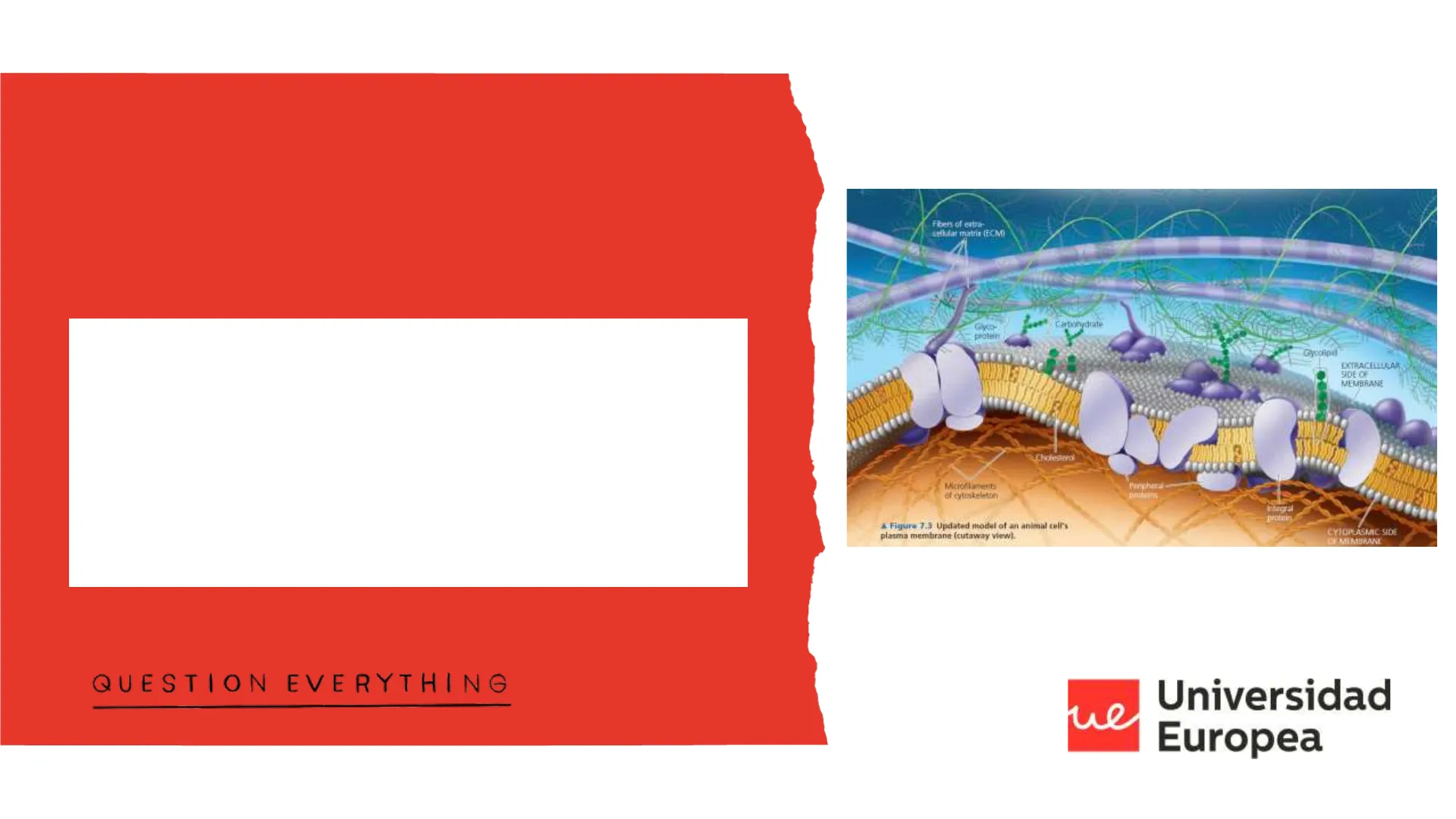
Fibers of extra-
cellat matris (ECM)
Carbohydrate
Glyco-
protein
EXTRACELLULAR
SIDE CE
MEMBRANE
Cholesterol
Microflament
of cytoskeleton
Peripheral
proteins
protok
A Figure 7.3 Updated model of an animal cell's
plasma membrane (cutaway view).
CYTOPLASMIC SIDE
OF MEMBRANE
QUESTION EVERYTHING
ue
Universidad
EuropeaPlasma membrane- transport
Transport and Semipermeable Membrane
@ Transport
@ Semipermeable membrane:
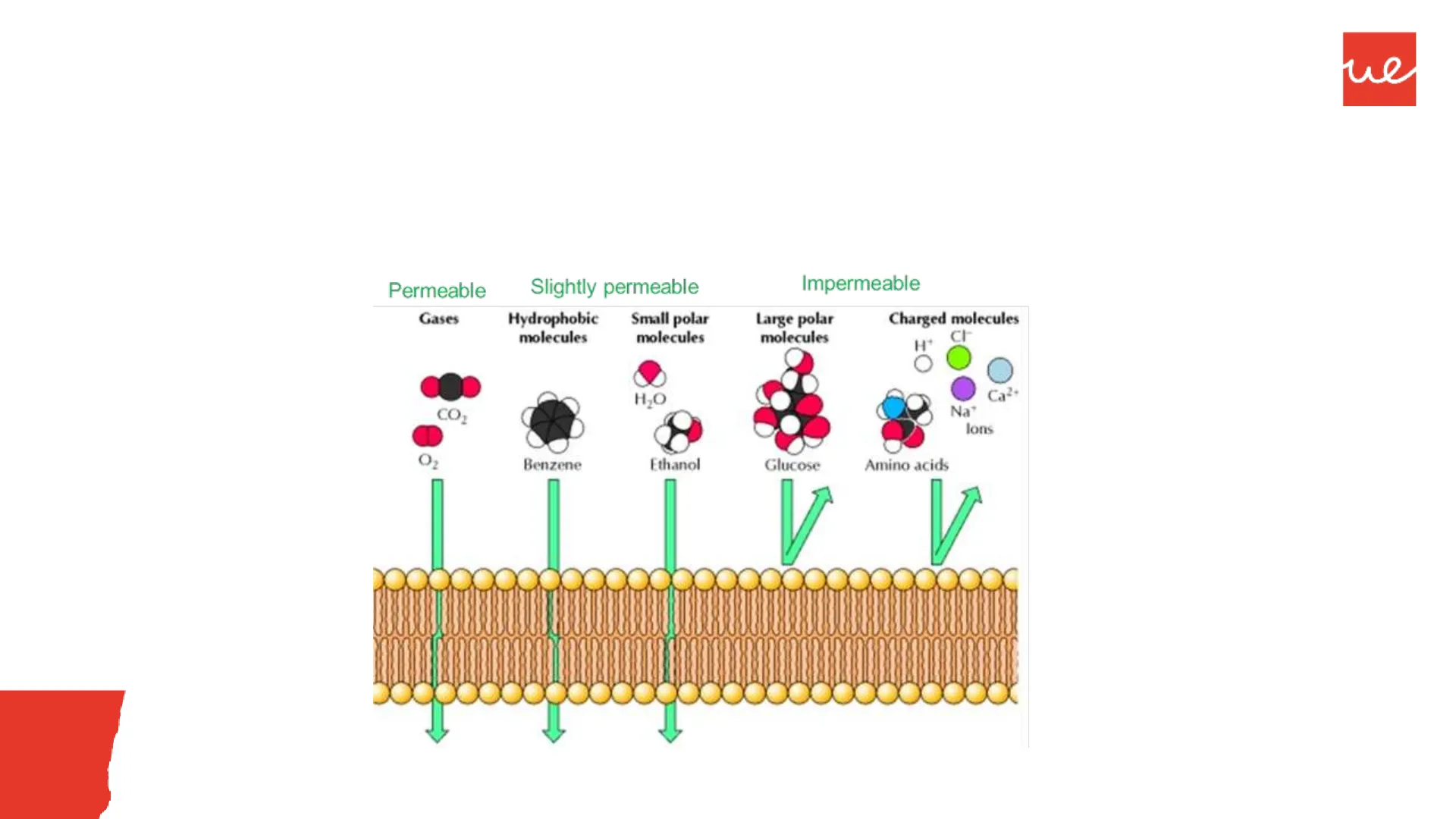
The cell membrane is a selective barrier. Only small, uncharged molecules can pass freely. All other molecules
require specific transport systems.
Permeable
Slightly permeable
Impermeable
Gases
Hydrophobic
molecules
Small polar
molecules
Large polar
molecules
Charged molecules
CF
Ca2+
H2O
CO
Na+
lons
O
Benzene
Ethanol
Glucose
Amino acids
. VPlasma membrane- transport
Concentration Gradients
PREVIOUS CONCEPTS
Concentration gradients
The idea of concentrations and the gradients within
them is important to understand the movement of
particles or molecules across cell membranes.
Concentration
When salt (NaCl) is dissolved in water, the solute is
NaCl and water is the solvent. Together they form a
solution.
The more salt particles there are in a given volume of
the solvent, the more concentrated the solution is.
High concentration
Low concentration
.Plasma membrane- transport
Gradients and Equilibrium
Previous concepts
Gradient: Difference in the concentration of a substance between the inside and the outside of the
membrane.
El Corte Inglés
- robojas
Tienda ~ Frio 50 8 Puta
Tienda _ Frio 50 rebajas
INICIO ILLA
From high to low concentration > Equilibrium
南
9
From low to high concentration (takes energy)O
Electrochemical Gradient
Previous concepts
Ue
Electrochemical gradient
· Chemical/concentration gradient: Responsible for the movement of particles from one side to other
of a semipermeable membrane. It depends on the final concentration of each particle on both sides.
· Electrical gradient: Responsible for the movement of charged particles from one side to the other of a
semipermeable membrane. It depends on the final balance of electrical charges in each compartment.
Electrochemical gradient: Responsible for the movement of
particles, from one side to the other of a semipermeable
membrane, which depends on the final balance of charges
and concentration, in each of the compartments.
Cell membrane)
CI
Na
K+
Protein
Na
+
-
CI
Na
K
+
-
Na
CI
Na
K+
Na
K+
Na
+
-
K+
K+
CI
+
-
Protein
Na
+
Extracellular
Intracellular
Physiology
Unit 2.
K+
K+
K+Ue
Substance Movement Through Membrane
How will substances move through the
membrane? Which forces are involved?
Electrochemical gradient: It is the combinatorial gradient generated by the final balance of both concentration and
electrical gradients. Responsible for the movement of particles from one side to the other of a semipermeable
membrane.
Concentration and Electrical Gradients Examples
Example 1: Concentration gradient
outside
inside
Example 2: Electrical and
concentration gradients are combined
+
+
+
+
+
+
+
-
-
+
-
-
Example 3: Electrical and concentration
gradients are opposed (but the
concentration gradient is a little stronger).
+
+
+
+
+
+
+
+
+
+
+
+Plasma membrane- transport
Forces Involved in Membrane Transport
Previous
concepts
How will substances move through the
membrane? Which forces are involved?
Chemical force
Electrical and chemical forces
+
+
+
+
+
+
+
+
+
+
OUTSIDE
+ + +
+ + +
+ + +
+ + +
I
INSIDE
+
+
+
+
+
+
+
+
+
NO charged molecules,
concentration gradient
Charged molecules
electrochemical gradient
+Down gradient:
No energy required (spontaneous)
Against gradient:
Energy (ATP)Plasma membrane- transport
Small Substances Transport
Small substances
Passive Transport
Passive transport
Molecules move down gradient
NO energy expenditure
O
Diffusion
Facilitated diffusion
Active Transport
Key Concepts
Active transport
Molecules move against gradient
Requires energy expenditure (ATP)
It happens only through specialized proteins
Primary
Active Transport
Secondary
Active Transport
Glucose
Na
ATP
K+
Antiport
SymportPlasma membrane- transport
Membrane Transport Mechanisms
O
Transport
Passive Transport Mechanisms
Simple diffusion
Passive transport
No energy required
Facilitated diffusion
Active Transport Mechanisms
Small
substances
Primary
Active transport
Requires energy
Secondary
Bulk Transport Mechanisms
Big molecules
Receptor-mediated endocytosis
Endocytosis
(Inwards)
Pinocytosis
Phagocytosis
Exocytosis
(Outwards)
Transcytosis
(Inwards & outwards)Plasma membrane- transport
Passive and Active Transport Overview
Small substances
Passive Transport Types
Passive transport
No energy required
Simple diffusion
Facilitated
diffusion
lipid
bilayer
concentration
gradient
simple
diffusion
channel-
mediated
transporter-
mediated
Active Transport Types
Active transport
Energy expenditure
Primary
Secondary
ENERGY
PASSIVE TRANSPORT
ACTIVE TRANSPORTPlasma membrane- transport
Transport Summary
ue
O
Transport
Simple Diffusion
Simple diffusion
Hạn went to post threwgh!
th cuốn, Go right ahead:
Passive transport
No energy required
Small
substances
Facilitated Diffusion
Facilitated diffusion
primary
09
Semipermeable membranes:
putting the "passive" in passive transport.
Active Transport
Active transport
requires energy
expenditure
Secondary
Bulk Transport
Receptor mediated endocytosis
Endocytosis
(Inwards)
pinocytosis
Bulk
Phagocytosis
Exocytosis
(Outwards)
Transcytosis
(Inwards & outwards)Plasma membrane- transport
Simple Diffusion Characteristics
Key Concepts
O
Simple diffusion
Movement of molecules from a region of higher concentration to lower concentration
(down gradient) until equilibrium is reached.
Characteristics of Simple Diffusion
- Passive transport
- No energy expenditure
- No carrier protein to assist
- Only substances that can go
through the membrane (small,
apolar)
Simple Diffusion
Extracellular fluid
Lipid bilayer
(plasma
membrane)
Cytoplasm
i.e: transport of
respiratory gases (O2
and CO2) and EtOH
TimePlasma membrane- transport
Osmosis: Water Movement Across Membranes
ue
Osmosis: When a semi-permeable membrane allows water but not solutes to pass,
there is a spontaneous net movement of water toward the side with the higher solute
concentration.
Amoeba sisters - Osmosis
This completely passive
process uses no energy
water molecule
differentially permeable
membrane
sucrose molecule
C
O
Another way to look at it: osmosis is really the simple diffusion of
water, water will move where there is a lower water concentrationPlasma membrane- transport
Osmosis and Osmotic Pressure
Osmosis: spontaneous net movement of
solvent molecules (water) through a semi-
permeable from an area of lower solute
concentration to an area of higher solute
concentration.
This is, in the direction that tends to equal the
solute concentrations on the two sides.
The force that drives this movement is called
osmotic pressure.
@ Higher solute concentration creates higher
osmotic pressure, drawing water toward it.
Lower solute
concentration
higher solute
concentration
Osmotic
pressure
Movement of
solvent
Solute
molecule
molecules
Solvent
(water)
Semi-permeable
membranePlasma membrane- transport
Osmosis and Cell Behavior
Osmosis spontaneous net movement of solvent molecules
(water) through a semi-permeable membrane.
Key Concepts
ul
AQUARIUS
What happens to a cell when it is in a medium with different osmolarity
(solute concentration)?Plasma membrane- transport
Cell Response to Osmolarity
Osmosis spontaneous net movement of solvent molecules
(water) through a semi-permeable membrane.
Key Concepts
ul
AQUARIUS
What happens to a cell when it is in a medium with different osmolarity
(solute concentration)?
H2O
H2O
Hypertonic solution
Cells lose water
and shrivel
Hypotonic solution
Cells take up
water, swell and
burst.
H20
H20
Isotonic solution
The rates of water
movement in and
out are equal
?
H2O
RBC
H20Plasma membrane- transport
Tonicity and Cell Volume
Tonicity: The ability of an extracellular solution to make water
Key Concepts
move into or out of a cell by ósmosis:
Hypotonic Solutions
Hypotonic solutions: An external solution that has a lower
concentration of a given solute than the cell. E.g. distilled water.
. Causes cells to swell.
Isotonic Solutions
Isotonic solution
An external solution that has the same concentration
of a given solute than the cell.
· No net movement of water
Hypertonic Solutions
Hypertonic
An external solution that has a higher concentration of a
given solute than the cell.
•
Causes cells to shrink
Osmosis in the Kitchen
Osmosis in the kitchen
Raisins to grapes
EggsPlasma membrane- transport
Osmosis and Tonicity Summary
Key Concepts
ul
Osmosis spontaneous net movement of solvent
molecules (water) through a semi-permeable membrane
Hypotonic Solutions Effects
Hypotonic solutions: An external solution that has
lower concentration of a given solute than the cell.
. Causes cells to swell.
Isotonic Solutions Effects
Isotonic solution
An external solution that has the same concentration
of a given solute than the cell.
· No net movement of water
Hypertonic Solutions Effects
Hypertonic
An external solution that has a higher concentration of a
given solute than the cell.
Causes cells to shrink (dehydrates)
•
NT
WHAT HAPPENS
WHEN YOU DRINK
SEAWATER?Plasma membrane- transport
Transport Mechanisms Revisited
O
Transport
Simple Diffusion
Simple diffusion
Passive transport
No energy required
Facilitated Diffusion
Facilitated diffusion
Small
substances
Active Transport
Primary
Active transport
Requires energy
expenditure
Secondary
Bulk Transport
Receptor-mediated endocytosis
Endocytosis
(Inwards)
Pinocytosis
Bulk
Phagocytosis
Exocytosis
(Outwards)
Transcytosis
(Inwards & outwards)Plasma membrane- transport
Facilitated Diffusion
Difusión facilitada
Facilitated diffusion:
· Down gradient
· No energy cost
. It depends on a protein that "facilitates" the transport:
Channel protein
Transporter or carrier protein
solute
lipid
bilayer
solute-binding site
(A) TRANSPORTER
(B) CHANNEL PROTEINPlasma membrane- transport
Facilitated Diffusion by Carrier Proteins
Facilitated diffusion by carrier proteins (transporters)
. The molecule to transport binds specifically to the transporter.
. The transporter has to shift to an alternative conformation to release the molecule to the other
part of the bilayer.
· Responsable for sugars and amino acids transport through the membrane.
(A)
1 The carrier protein has
a glucose binding site.
2 Glucose binds to
the protein ...
3 ... which then changes
the protein's shape ...
Outside of cell
High glucose
concentration
Glucose
Example: Glucose
transporter (GLUT4
and GLUT1)
Concentration
Gradient
2
5
Glucose
carrier protein
5 The carrier protein returns
to its original shape, ready
to bind another glucose.
4 ... releasing
the glucose
Inside of cell
Low glucose concentrationPlasma membrane- transport
Carrier Protein Saturation Kinetics
Facilitated diffusion by carrier proteins
· Saturation kinetics
As the molecule concentration
outside the cell increases, the
rate of diffusion increases until
a point at which all the
available transporters are being
used (the system is saturated).
2
3
Rate of
molecule
transport
1
Extracellular
fluid
Concentration of
molecules
outside the cell
Molecule to be
transported
Carrier protein
Can’t find what you’re looking for?
Explore more topics in the Algor library or create your own materials with AI.
